


Introduction
Digital printing has fundamentally transformed the way manufacturers, brands, packaging companies, textile producers, and commercial printers operate. As businesses increasingly demand shorter production runs, faster turnaround times, personalization capabilities, and sustainable printing solutions, digital inks have become one of the most critical components enabling this transition.
Unlike conventional printing methods, digital printing relies on highly specialized inks designed to deliver superior color accuracy, durability, substrate compatibility, and production efficiency. Continuous innovation in UV-curable inks, water-based inks, eco-solvent inks, latex inks, and pigment technologies is expanding the range of applications across packaging, textiles, labels, décor printing, industrial printing, and product customization.
As the global digital printing ecosystem evolves, several companies are emerging as industry leaders through investments in research and development, sustainability initiatives, advanced ink formulations, and next-generation printing technologies.
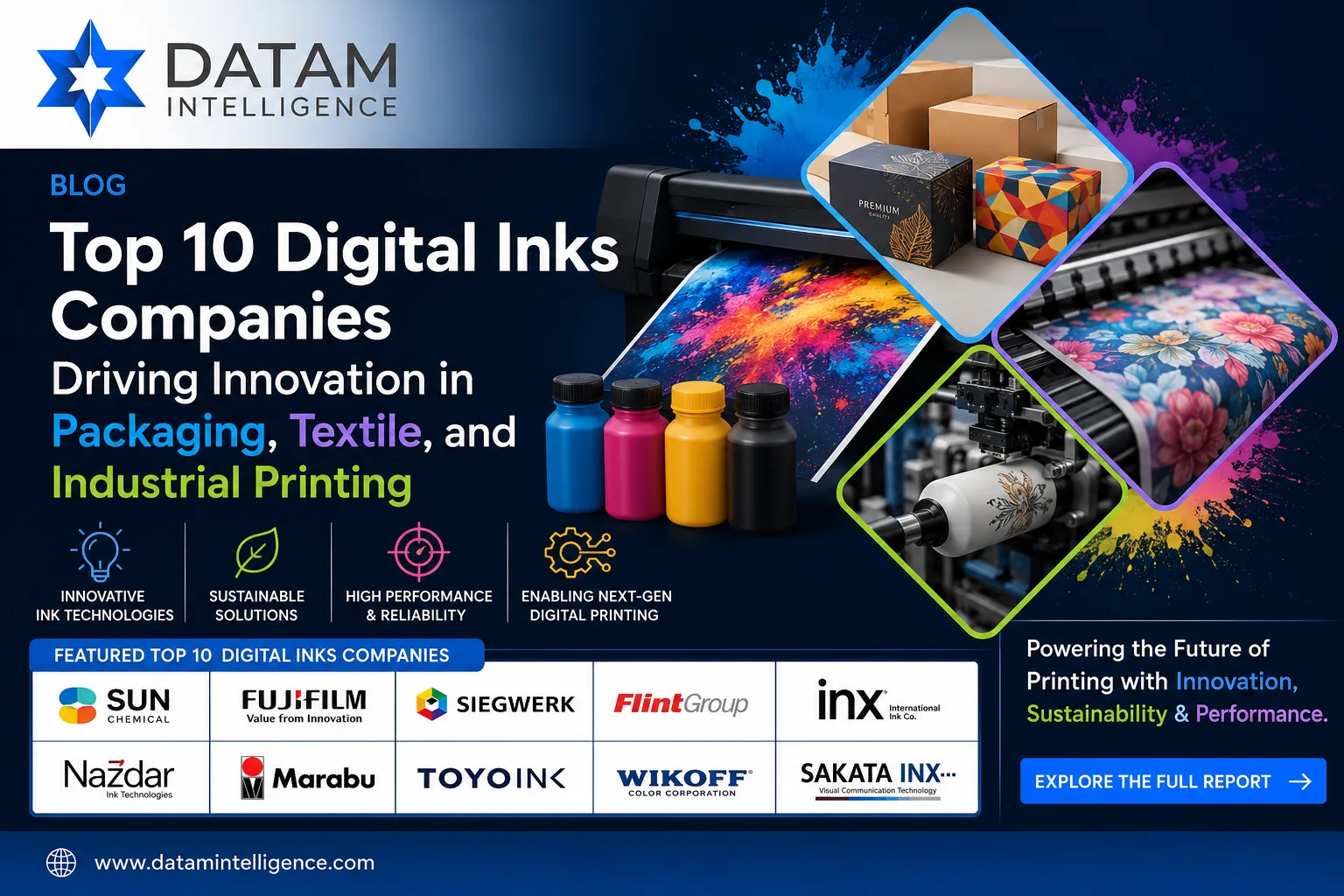
This article highlights ten of the most influential digital ink companies helping shape the future of packaging, textile, and industrial printing.
Get the Full Digital Inks Market Analysis
Looking for detailed market forecasts, competitive intelligence, technology trends, and growth opportunities?
Download DataM Intelligence's Digital Inks Market Report to access:
- Market Size & Forecasts
- Competitive Landscape Analysis
- Technology & Innovation Trends
- Regional Growth Opportunities
- Strategic Investment Insights
Download the Report: https://www.datamintelligence.com/download-sample/digital-inks-market
Buy Report: https://www.datamintelligence.com/buy-now-page?report=digital-inks-market
Why Digital Inks Are Becoming Increasingly Important
Digital inks play a central role in enabling modern printing technologies.
Key factors driving demand include:
- Growth of e-commerce packaging
- Personalized product packaging
- Sustainable printing solutions
- Textile digitalization
- Industrial printing automation
- Short-run production requirements
- On-demand manufacturing
- Smart labeling technologies
As these trends continue to accelerate, digital ink manufacturers are focusing on improving performance while reducing environmental impact.
1. Sun Chemical (DIC Corporation)
Sun Chemical remains one of the most recognized names in the global printing inks industry.
The company offers a broad portfolio of:
- UV-curable digital inks
- Water-based digital inks
- Industrial printing solutions
- Packaging inks
- Textile printing inks
Its extensive research capabilities and global manufacturing footprint position it among the leading innovators within the digital inks sector.
Key Focus Areas
- Sustainable ink technologies
- Packaging applications
- Industrial digital printing
- High-speed production systems
2. Fujifilm Specialty Ink Systems
Fujifilm has established itself as a major supplier of advanced digital ink technologies.
The company's ink portfolio supports:
- Wide-format graphics
- Industrial printing
- Packaging applications
- Commercial printing
Fujifilm continues investing heavily in high-performance UV and aqueous ink systems designed to meet evolving customer requirements.
Key Focus Areas
- UV ink innovation
- Industrial applications
- Packaging printing
- Sustainable printing solutions
3. Siegwerk Druckfarben AG & Co. KGaA
Siegwerk is recognized globally for its expertise in packaging and specialty printing inks.
The company is increasingly focused on:
- Circular economy initiatives
- Sustainable packaging
- Food-safe ink technologies
- Advanced digital printing solutions
Its innovation strategy aligns closely with growing regulatory and sustainability requirements across the packaging industry.
4. Flint Group
Flint Group serves customers across packaging, labels, publication printing, and industrial markets.
The company has expanded its digital ink portfolio through ongoing investments in:
- UV ink systems
- Label printing technologies
- Flexible packaging solutions
- Sustainable ink development
Flint Group's diversified market presence makes it an important player within the digital inks landscape.
5. INX International Ink Co.
INX International is known for delivering innovative digital printing solutions across commercial and industrial markets.
The company focuses on:
- Digital packaging inks
- Industrial printing applications
- Sustainable formulations
- Specialty ink technologies
Its ongoing investments in environmentally responsible products support growing customer demand for greener printing solutions.
6. Nazdar
Nazdar has built a strong reputation in digital printing through its extensive portfolio of inkjet inks and specialty formulations.
Its products support:
- Textile printing
- Industrial graphics
- Signage applications
- Wide-format printing
The company continues to innovate in response to changing customer needs and printing platform developments.
7. Marabu GmbH & Co. KG
Marabu specializes in high-performance inks for industrial, graphic, and digital printing applications.
Its portfolio includes:
- UV-curable inks
- Solvent-based inks
- Water-based inks
- Specialty industrial inks
The company is particularly recognized for its expertise in challenging industrial printing environments.
8. Toyo Ink SC Holdings
Toyo Ink is a global leader in printing technologies and specialty chemicals.
The company continues expanding its digital ink offerings across:
- Packaging printing
- Commercial graphics
- Industrial applications
- Sustainable printing solutions
Its strong presence in Asia-Pacific provides significant competitive advantages in fast-growing regional markets.
9. Wikoff Color Corporation
Wikoff Color serves commercial, packaging, and digital printing customers through a broad range of innovative ink technologies.
The company emphasizes:
- Color management
- Print quality optimization
- Sustainability initiatives
- Customized customer solutions
Its expertise supports growing demand for high-performance digital printing applications.
10. Sakata INX Corporation
Sakata INX continues expanding its presence within digital printing through investments in advanced ink technologies and sustainable solutions.
Its portfolio supports:
- Packaging printing
- Commercial printing
- Industrial graphics
- Specialty applications
The company remains focused on innovation, quality, and environmental responsibility.
Key Technology Trends Driving Digital Ink Innovation
UV-Curable Inks
UV-curable inks are gaining popularity due to:
- Fast curing times
- High durability
- Improved productivity
- Broad substrate compatibility
Water-Based Inks
Growing sustainability requirements are increasing adoption of water-based formulations.
Benefits include:
- Reduced VOC emissions
- Lower environmental impact
- Improved workplace safety
Textile Digital Printing
Fashion brands and textile manufacturers are increasingly adopting digital printing technologies to support:
- Customization
- On-demand production
- Reduced waste
- Faster product development
Smart Packaging
Digital inks are enabling:
- Variable data printing
- Track-and-trace capabilities
- Product authentication
- Consumer engagement technologies
What Investors Should Watch
The digital inks industry is undergoing a significant transformation as printing technologies evolve to meet changing customer expectations, sustainability requirements, and manufacturing demands. For investors, the market presents compelling opportunities driven by several long-term structural trends that are reshaping packaging, textiles, industrial manufacturing, and commercial printing.
Companies that can develop innovative, sustainable, and application-specific ink technologies are well-positioned to capture growth as digital printing adoption continues to expand across industries.
Growth of E-Commerce Packaging
The rapid expansion of e-commerce is creating substantial demand for digitally printed packaging solutions.
Unlike traditional retail packaging, e-commerce brands often require:
- Short production runs
- Customized packaging designs
- Seasonal promotional campaigns
- Variable data printing
- Faster time-to-market
Digital printing enables brands to quickly adapt packaging designs without the high setup costs associated with conventional printing methods. As online retail continues to grow globally, packaging manufacturers are increasingly investing in digital printing technologies and specialized inks that can deliver high-quality, durable, and visually appealing packaging solutions.
For investors, this trend represents a significant growth opportunity for digital ink manufacturers serving the packaging sector.
Sustainability Regulations and Eco-Friendly Inks
Environmental sustainability has become a major priority across the printing industry.
Governments, brand owners, and consumers are demanding solutions that reduce environmental impact while maintaining print quality and performance.
As a result, manufacturers are accelerating investments in:
- Water-based inks
- Low-VOC formulations
- Bio-based ink technologies
- Recyclable packaging-compatible inks
- Energy-efficient curing systems
Large multinational brands are increasingly incorporating sustainability requirements into supplier selection processes, creating competitive advantages for ink manufacturers that can deliver environmentally responsible solutions.
Investors should closely monitor companies with strong sustainability-focused product portfolios, as regulatory pressures and consumer preferences continue to drive market demand.
Industrial Printing Expansion
Digital printing is no longer limited to commercial graphics and packaging applications.
Manufacturers across various industries are adopting digital printing technologies for:
- Product decoration
- Electronics printing
- Automotive components
- Building materials
- Ceramics and tiles
- Industrial labeling
- Direct-to-object printing
Industrial printing offers significant benefits including reduced production waste, improved flexibility, mass customization, and faster production cycles.
As manufacturing facilities embrace automation and digital production methods, demand for specialized industrial inks is expected to grow steadily.
Companies developing application-specific industrial ink solutions are likely to benefit from this expanding market segment.
Textile Industry Transformation
The textile industry is experiencing one of the fastest shifts toward digital printing technologies.
Traditional textile printing methods often involve:
- High water consumption
- Chemical-intensive processes
- Large inventory requirements
- Lengthy production cycles
Digital textile printing offers several advantages:
- Reduced waste
- Lower water usage
- On-demand production
- Faster design changes
- Improved customization capabilities
Fashion brands increasingly rely on digital printing to support fast-fashion models, personalized apparel, and sustainable manufacturing initiatives.
As global apparel companies continue to modernize production processes, digital textile inks are becoming a critical component of the industry's transformation.
Investors should pay particular attention to companies with strong positions in textile printing inks, as this segment continues to demonstrate robust growth potential.
Smart Manufacturing and Industry 4.0
The adoption of Industry 4.0 technologies is creating new opportunities throughout the digital printing ecosystem.
Manufacturers are integrating:
- Automation systems
- Artificial intelligence
- IoT-enabled production equipment
- Digital workflow management
- Real-time production monitoring
Digital printing technologies align naturally with smart manufacturing initiatives because they enable highly flexible, data-driven production environments.
Advanced digital inks play an important role in supporting:
- Variable data printing
- Product traceability
- Smart labeling
- Anti-counterfeiting solutions
- Connected packaging technologies
As smart factories become more common, demand for high-performance digital inks capable of supporting advanced manufacturing processes is expected to increase significantly.
Emerging Opportunities in Smart Packaging
Smart packaging represents another high-growth area attracting investor attention.
Brands are increasingly incorporating:
- QR codes
- RFID-enabled packaging
- Interactive consumer experiences
- Product authentication features
- Track-and-trace capabilities
Digital printing enables these features by supporting highly customized and variable print applications.
As supply chains become more connected and consumers demand greater transparency, smart packaging solutions are expected to become a major driver of digital ink consumption.
Regional Growth Dynamics
While North America and Europe remain important markets, Asia-Pacific continues to lead growth due to:
- Expanding manufacturing activity
- Growing packaging demand
- Rising textile production
- Increasing adoption of digital printing technologies
Countries such as China, India, Vietnam, Indonesia, and Thailand are becoming major centers for digital printing investment and innovation.
Investors evaluating growth opportunities should closely monitor regional expansion strategies pursued by leading digital ink manufacturers.
Long-Term Investment Outlook
The digital inks industry sits at the intersection of several powerful global trends, including e-commerce expansion, sustainability initiatives, industrial automation, textile digitalization, and smart manufacturing adoption.
Companies that can successfully combine:
- Technological innovation
- Sustainable product development
- Strong customer relationships
- Global manufacturing capabilities
- Application-specific expertise
are likely to emerge as long-term beneficiaries of the industry's transformation.
As digital printing continues to replace traditional printing methods across multiple industries, demand for advanced digital ink solutions is expected to remain strong, creating attractive opportunities for investors seeking exposure to next-generation manufacturing and printing technologies.
Frequently Asked Questions
Which industries use digital inks the most?
Packaging, textiles, labels, commercial printing, industrial manufacturing, signage, and décor printing represent the largest application areas.
What are the major types of digital inks?
The most common categories include:
- UV-curable inks
- Water-based inks
- Solvent-based inks
- Eco-solvent inks
- Latex inks
- Pigment inks
Why is sustainability important in digital inks?
Manufacturers are increasingly developing low-VOC, recyclable, and environmentally friendly formulations to comply with regulations and meet customer sustainability goals.
Which region dominates the digital inks market?
Asia-Pacific remains a major manufacturing and consumption hub due to strong packaging, textile, and industrial production activities.
Analyst Perspective
Digital inks are becoming increasingly important as industries embrace customization, sustainability, automation, and digital manufacturing. The companies highlighted in this article continue to drive innovation through investments in advanced formulations, industrial printing capabilities, and environmentally responsible technologies.
As packaging, textile, and industrial printing applications continue to evolve, digital ink manufacturers will play a crucial role in enabling next-generation production capabilities and supporting the broader transition toward digital printing technologies.
Explore the Full Market Analysis
To evaluate market size forecasts, competitive intelligence, technology trends, regional opportunities, and strategic developments shaping the global digital inks industry, explore DataM Intelligence's comprehensive Digital Inks Market report.
Related Reports
The digital inks industry is closely connected to broader developments in packaging, printing, specialty chemicals, textile manufacturing, and industrial automation. As businesses increasingly adopt digital printing technologies to improve customization, sustainability, and production efficiency, understanding adjacent markets becomes essential for identifying growth opportunities and emerging industry trends. Explore the following related reports for deeper insights into the technologies, materials, and end-use industries driving demand for digital inks worldwide.
Packaging Inks Market
The growing demand for flexible packaging, e-commerce packaging, and sustainable labeling solutions is driving innovation in packaging inks. As brands increasingly adopt digital printing technologies, advanced packaging inks are becoming essential for high-quality, customized, and environmentally responsible packaging applications.
Printing Inks Market
Printing inks remain a fundamental component of commercial, packaging, publication, and industrial printing. Advances in digital printing technologies are creating new opportunities for specialty ink formulations designed to improve print quality, productivity, and sustainability.
Textile Printing Market
Digital textile printing is transforming the apparel and fashion industries by enabling on-demand production, reduced waste, and greater customization. Growing adoption of digital textile printing technologies continues to support demand for specialized textile inks.
Industrial Printing Market
Industrial printing applications are expanding across automotive, electronics, construction materials, ceramics, and product decoration. Advanced digital inks play a critical role in enabling high-performance industrial printing processes and customized manufacturing solutions.
Specialty Chemicals Market
Digital inks rely on advanced pigments, additives, resins, and specialty chemicals to achieve superior performance characteristics. Innovations in specialty chemicals continue to drive improvements in ink durability, sustainability, color accuracy, and substrate compatibility.
Labels Market
Variable data printing, product traceability, and smart packaging initiatives are increasing demand for digitally printed labels. The evolution of the labels market is creating new opportunities for digital ink manufacturers focused on high-resolution and customized printing applications.
Flexible Packaging Market
Flexible packaging continues to gain popularity due to its lightweight design, cost efficiency, and sustainability benefits. Digital printing technologies are increasingly being used within flexible packaging production, creating strong demand for advanced digital ink solutions.