


Market Overview
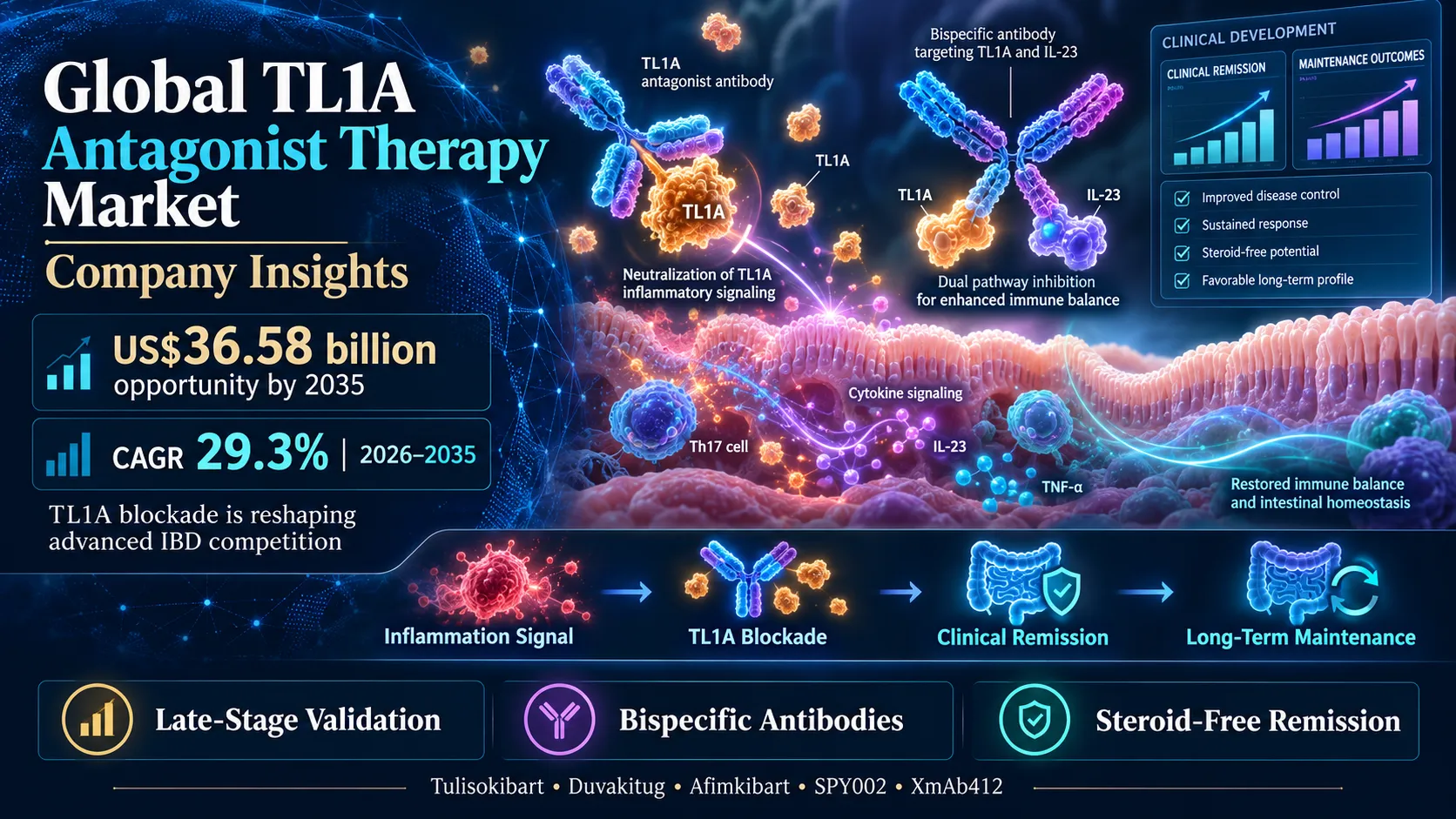
TL1A (tumor necrosis factor-like ligand 1A) is an immune-signaling protein implicated in intestinal inflammation and fibrotic remodeling. TL1A antagonists seek to neutralize this pathway in ulcerative colitis, Crohn’s disease and potentially other immune-mediated conditions. Unlike established anti-TNF or IL-23 biologics, the TL1A class remained pre-commercial in 2025. DataM Intelligence forecasts a US$36.58 billion global opportunity by 2035, with 29.3% growth indicated for 2026-2035. The prospective value depends on successful approvals, long-term efficacy, uptake and reimbursement.
Competition intensified in June 2026 when Merck disclosed that its Phase III ATLAS-UC induction study of tulisokibart met the primary endpoint of clinical remission at week 12. The result provides late-stage validation for TL1A blockade, while Sanofi-Teva’s duvakitug and Roche’s afimkibart remain central comparators. Biomarker selection, maintenance durability, steroid-free remission and the ability to limit intestinal fibrosis are likely to determine commercial differentiation.
In announcing the June result, Merck said tulisokibart was “the first anti-TL1A monoclonal antibody to demonstrate clinical remission at 12 weeks” in a Phase III trial. Meanwhile, Roche CEO Thomas Schinecker described 2025 as “a strong year for Roche,” highlighting the depth of its development pipeline. These viewpoints underline why large pharmaceutical groups are committing substantial clinical resources to next-generation immunology.
Request Sample: https://www.datamintelligence.com/download-sample/tl1a-antagonist-therapy-market
Leading Companies and Competitive Positioning
The ten leading companies below follow the key-player order in the supplied DataM report. The comparison covers commercialization scale, TL1A asset ownership, and development strategy rather than suggesting market shares in an unlaunched medicine class.
Merck & Co. - Tulisokibart (MK-7240); Phase III ulcerative colitis and Crohn’s disease; late-stage leader.
Roche - Afimkibart (RVT-3101); late-stage IBD development; acquired rights through Telavant.
Sanofi - Joint development of duvakitug; global immunology commercialization infrastructure.
Teva Pharmaceutical Industries - Duvakitug co-development with Sanofi; immunology portfolio diversification.
AbbVie - Strong incumbent IBD franchise; potential competitive and pipeline exposure.
Pfizer - Broad immunology portfolio and access capabilities; potential TL1A strategic participation.
Boehringer Ingelheim - Inflammation and fibrosis expertise; differentiated discovery and immunology interest.
Xencor - XmAb942 anti-TL1A and XmAb412 TL1A × IL-23p19 bispecific platforms.
Spyre Therapeutics - SPY002 / SPY072 long-acting anti-TL1A; combination and extra-IBD strategies.
Absci - ABS-101 antibody program; molecular engineering and potential partnering.
2025 Revenue Comparison - Top 10 Companies
| Company | 2025 Revenue (US$) |
| Merck & Co. | US$65.01 billion |
| Roche | US$73.8 billion |
| Sanofi | US$49.30 billion |
| Teva | US$17.26 billion |
| AbbVie | US$61.16 billion |
| Pfizer | US$62.60 billion |
| Boehringer Ingelheim | US$31.40 billion |
| Xencor | US$125.60 million |
| Spyre Therapeutics | Not Commercialized |
| Absci | US$2.80 million |
Rising Companies and Strategic Focus Areas
- Xencor - TL1A/IL-23p19 dual targeting designed to combine inflammatory pathway suppression within one antibody.
- Spyre Therapeutics - long-acting TL1A inhibition and co-formulated combinations for inflammatory diseases beyond IBD.
- Absci - molecular design and external partnering strategy for ABS-101 and differentiated antibody assets.
- Qyuns Therapeutics - regional clinical development and potential China-centered commercialization of inflammatory biologics.
- FutureGen Biopharmaceutical - next-generation TL1A antibody engineering and licensing-led pipeline expansion.
- Earendil Labs - differentiated immune biologics and clinical development partnerships.
Major Mergers, Acquisitions and Portfolio Restructuring - 2026
The primary 2026 competitive developments were clinical-stage investments and changes in portfolio priorities. The following are dated strategic actions; they are not represented as completed TL1A acquisitions.
- 15 June 2026 - Spyre disclosed positive SPY002 Phase II induction results in ulcerative colitis, strengthening the commercial rationale for its long-acting anti-TL1A portfolio.
- 29 July 2026 - Xencor announced a US$105 million agreement with Alexion resolving a royalty matter; this provided additional corporate funding flexibility but was not a TL1A asset acquisition.
- 10 August 2026 - Spyre launched the SPY772 co-formulation program and initiated the Phase II SKYLIGHT trial, extending its portfolio into hidradenitis suppurativa.
- 25 August 2026 - Spyre reported Phase II rheumatoid-arthritis data and deprioritized SPY072 monotherapy in that indication, redirecting focus toward combinations and selected diseases.
Recent Innovations and Their Potential Impact - June-October 2026
| Date | Innovation milestone | Potential industry impact |
| 15 Jun 2026 | Spyre SPY002 Phase II ulcerative-colitis induction results | Independent clinical signal could strengthen competition on efficacy and long-duration dosing. |
| 22 Jun 2026 | Merck positive Phase III ATLAS-UC tulisokibart topline | First Phase III validation increases confidence in the TL1A mechanism and future approval prospects. |
| 16 Jul 2026 | Peer-reviewed duvakitug Crohn’s disease Phase IIb publication | Broadens clinical evidence and supports comparisons across TL1A programs. |
| 5 Aug 2026 | Xencor XmAb412 TL1A × IL-23p19 first-in-human study open | Tests whether a single bispecific agent can address two inflammatory pathways. |
| 10 Aug 2026 | Spyre SPY772 dual TL1A / IL-17A/F combination launched | Opens an extra-IBD positioning route in hidradenitis suppurativa. |
| 25 Aug 2026 | Spyre SPY072 rheumatology proof-of-mechanism data | Provides a cautionary signal on indication selection and the limits of monotherapy. |
Request Sample: https://www.datamintelligence.com/download-sample/tl1a-antagonist-therapy-market
Competitive Outlook
By 2035, TL1A therapeutics may become an important part of advanced IBD care, particularly for patients who have failed established biologics. The competitive test will be sustained remission during induction and maintenance, endoscopic improvement, safety, convenient subcutaneous administration and access through specialist networks. Antifibrotic claims will need clinical validation before being treated as proven therapeutic benefits.
Merck has the clearest publicly disclosed Phase III milestone to date. Roche and the Sanofi-Teva alliance bring large-scale trial and commercialization capacity, while Xencor, Spyre and Absci are pursuing product differentiation through bispecificity, prolonged dosing and antibody design. The strongest future commercial positions are likely to combine convincing efficacy with reimbursement evidence and well-developed global launch capabilities.