


Ready-to-Drink Coffee Company Research Insight
The ready-to-drink coffee market is not simply an extension of the packaged coffee business. It sits between coffee, dairy and plant-based beverages, energy drinks, convenience beverages and café brands. That makes the competitive landscape unusually mixed. Some companies own globally recognized coffee brands, some provide large-scale beverage manufacturing and distribution, while others dominate mature canned-coffee markets in Japan and South Korea.
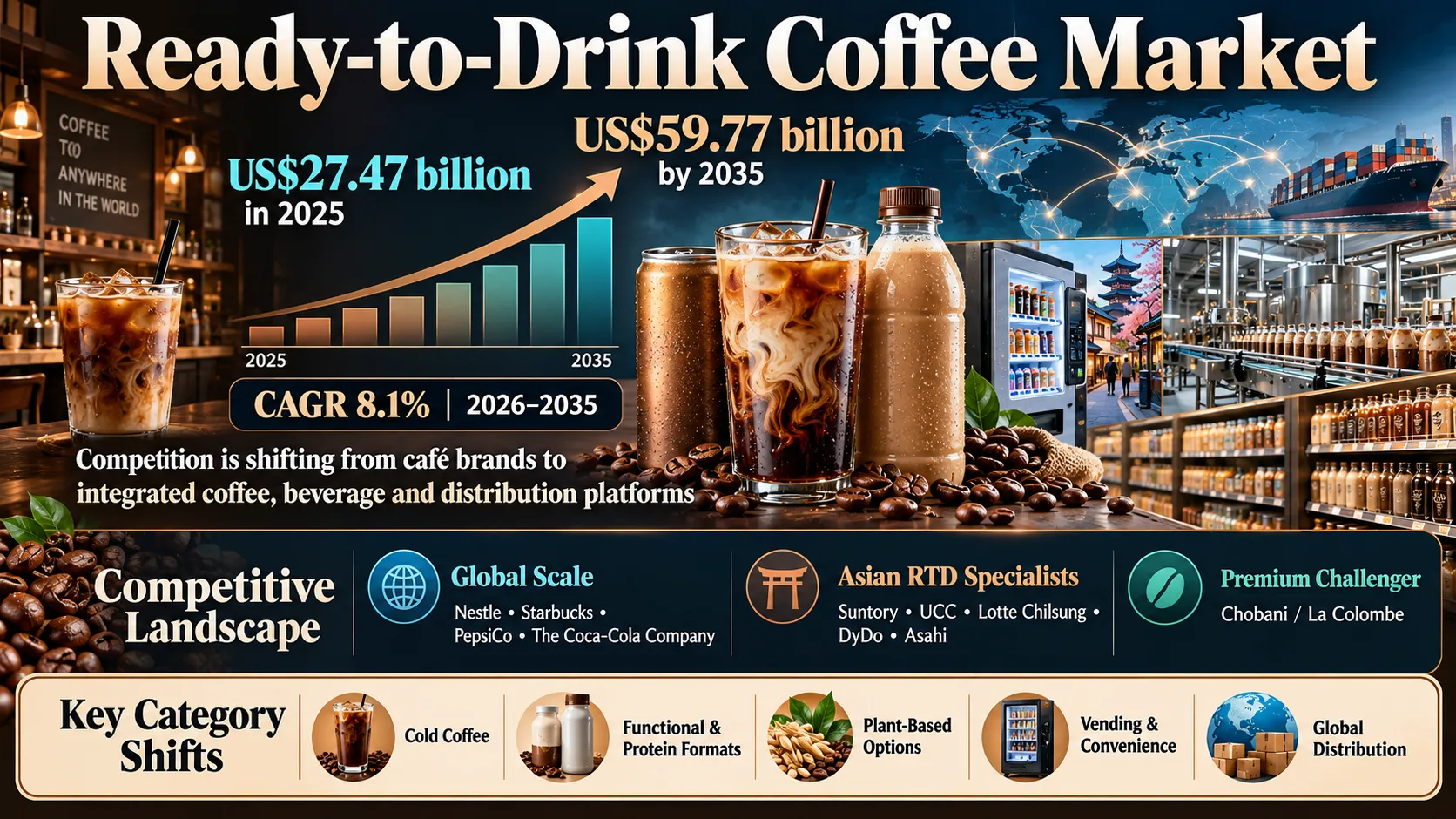
According to DataM Intelligence, the global Ready-to-Drink Coffee Market reached US$ 23.5 billion in 2023 and is expected to reach US$ 43.8 billion by 2031, growing at a CAGR of 8.1%. Using the same CAGR to align the study to a 2025 base year and 2035 forecast horizon, the market is approximately US$ 27.47 billion in 2025 and would reach approximately US$ 59.77 billion by 2035. The market is segmented by packaging into cans, PET bottles, Tetra packs and other formats, with distribution split between online and offline channels. Asia-Pacific remains especially important because Japan and South Korea have long-established RTD and canned coffee consumption cultures.
DataM currently lists Nestle, Starbucks, The Coca-Cola Company, The J.M. Smucker Company, Suntory Beverage & Food, Lotte Chilsung Beverage, Tres Coracoes Alimentos, Dr Pepper Snapple Group, Dunkin' Brands and WhiteWave Foods among the key players. That list needs updating for a 2025 base year. Dr Pepper Snapple Group no longer exists as a standalone company after the formation of Keurig Dr Pepper. Dunkin' Brands is now part of Inspire Brands. WhiteWave was acquired by Danone. The current list also understates PepsiCo, which is central to Starbucks RTD coffee in North America, as well as UCC, DyDo, Asahi and La Colombe under Chobani.
The updated market is therefore shaped by three competitive models. Nestle, PepsiCo and Coca-Cola bring global beverage scale and distribution. Starbucks contributes one of the strongest consumer coffee brands but relies on strategic partners for packaged RTD execution. Suntory, UCC, Lotte, DyDo and Asahi remain important because Asia has the deepest history of canned and bottled coffee consumption. Chobani has become a more serious U.S. participant through La Colombe, while Califia Farms and other premium brands are pushing plant-based, cold brew and functional formats.
Request Exclusive Sample: https://www.datamintelligence.com/download-sample/rtd-coffee-market
Top 10 Companies Analysis
Nestle S.A.
Nestle is one of the strongest RTD coffee competitors because it combines Nescafe, Nespresso and Starbucks packaged-coffee partnerships with an unmatched global coffee distribution platform. Its role is broader than a single RTD brand. It can use existing coffee manufacturing, retail relationships and consumer recognition to expand cold coffee formats across both developed and emerging markets.
The company accelerated this strategy in 2025 by expanding Nescafe Ready-to-Drink into India, the Middle East and North Africa, and Brazil. Nestle has said RTD is the fastest-growing coffee segment globally, supported by younger consumers and the shift toward cold coffee. China, Southeast Asia and Turkey have already provided a base for this expansion.
Nestle also has international RTD exposure through its collaboration with Starbucks outside North America. The competitive advantage is therefore portfolio breadth and geographic reach. The challenge is maintaining clear brand positioning across Nescafe, Starbucks and other coffee formats while responding to local taste, sugar and dairy preferences.
Starbucks Corporation
Starbucks remains one of the most influential brands in global RTD coffee because it helped define the premium bottled coffee category. The company can translate café beverages into grocery and convenience formats, allowing consumers to buy familiar Frappuccino, cold brew, espresso and seasonal products without visiting a coffeehouse.
Its competitive model is partnership-driven. In the United States, Starbucks and PepsiCo operate the North American Coffee Partnership, which has been active since 1994. In international markets, Nestle supports Starbucks RTD expansion. This gives Starbucks access to beverage manufacturing and distribution systems that would be expensive to build independently.
The portfolio is also moving toward functional positioning. Newer launches include lower-calorie Frappuccino variants, energy products and, in 2026, bottled Coffee & Protein products with high protein and prebiotic fiber. The main strength is brand pull. The risk is that much of the execution sits with partners, so economics and route-to-market control differ by region.
PepsiCo, Inc.
PepsiCo should be added to the Top 10 because its role in North American RTD coffee is much larger than the current DataM company list suggests. The North American Coffee Partnership with Starbucks is one of the longest-running and most important RTD coffee collaborations in the market.
PepsiCo contributes beverage development, bottling, retail execution and distribution across grocery and convenience channels. That matters because RTD coffee competes for refrigerated and ambient shelf space alongside energy drinks, soft drinks, dairy beverages and other high-velocity products. Distribution quality can be as important as coffee brand strength.
The Starbucks partnership gives PepsiCo exposure to premium coffee without requiring it to build an independent global coffeehouse brand. The competitive strength is route-to-market scale. The limitation is that much of PepsiCo's RTD coffee identity is tied to a partner-owned brand rather than a wholly owned flagship coffee brand.
Suntory Beverage & Food Limited
Suntory is one of the most important Asian RTD coffee companies through BOSS Coffee. Japan has one of the world's most mature canned coffee markets, and BOSS has been a major brand there since 1992. That heritage gives Suntory product-development expertise in black coffee, milk coffee, canned formats and vending-led consumption occasions.
The company has also taken BOSS beyond Japan. Suntory Beverage & Food positions the brand across Oceania, where Japanese-style flash-brewed coffee has become part of its broader beverage portfolio. International expansion matters because it takes a format developed in Japan into markets where cold coffee adoption is still increasing.
Suntory's strength is category experience. It understands how to manage taste, packaging and frequent product renewal in a mature RTD coffee environment. The challenge is building the same level of brand scale outside Asia where Starbucks, Nestle and local cold-brew brands are stronger.
The Coca-Cola Company
The Coca-Cola Company belongs in the Top 10 because RTD coffee fits naturally inside its global beverage distribution system. Its acquisition of Costa Coffee gave it a major coffee platform covering cafés, machines and packaged formats, providing a route into coffee occasions beyond traditional carbonated beverages.
Coca-Cola's advantage is commercial execution. It already serves convenience stores, supermarkets, restaurants and vending channels in almost every major market. Those relationships are valuable for RTD coffee because cold-chain placement, single-serve availability and impulse purchasing are central to the category.
The strategic challenge is building a coffee brand with the same level of global packaged-beverage recognition that Coca-Cola has in soft drinks. Costa gives the company credibility in coffee, but RTD competition remains intense and highly regional. The company's distribution system keeps it important even where its coffee brand share is still developing.
UCC Ueshima Coffee Co., Ltd.
UCC is one of the companies that should be added because its importance is easy to underestimate from a Western view of the category. Japan is a foundational RTD coffee market, and UCC has deep expertise across canned coffee, bottled black coffee, liquid coffee and other packaged formats.
The company competes through coffee specialization rather than a broad soft-drink portfolio. Its current range includes PET, canned and paper-pack beverages, along with black, milk and decaffeinated options. That product breadth makes UCC relevant across convenience, retail and foodservice consumption occasions.
UCC's strength is authenticity and technical coffee expertise. The challenge is international scale compared with Nestle, Starbucks or Coca-Cola. Even so, its position in Japan and experience with packaged liquid coffee make it a more direct RTD coffee competitor than several names on the current DataM list.
Lotte Chilsung Beverage Co., Ltd.
Lotte Chilsung should remain because South Korea is another important Asian RTD coffee market. The company participates through brands such as Cantata and Let's Be, with products spanning premium canned coffee, larger-format coffee and milk-based variants.
Cantata is particularly important because Lotte has built the brand around premium bean selection and differentiated extraction, while Let's Be has a long history in Korean canned coffee. Lotte also benefits from a nationwide beverage distribution network and manufacturing infrastructure in South Korea.
The advantage is domestic scale and the ability to compete across multiple beverage categories. Lotte is also expanding internationally, although its coffee position remains much stronger in Korea than globally. It should therefore stay in the Top 10, but below the global leaders.
DyDo DRINCO, Inc.
DyDo should be added because canned coffee remains central to its beverage identity. The company is closely associated with Japan's vending-machine culture, where coffee is consumed both hot and cold in single-serve cans and bottles throughout the year.
DyDo Blend gives the company a long-standing coffee platform supported by a route-to-market model that differs from supermarket-led Western markets. Vending provides direct access to commuting, workplace and on-the-go occasions, which are core RTD coffee consumption moments.
The company's strength is its understanding of high-frequency Japanese convenience consumption. The limitation is geography. DyDo has less global reach than the largest multinational beverage companies, but its depth in one of the world's most developed RTD coffee markets makes it strategically important.
Asahi Group Holdings / Asahi Soft Drinks
Asahi should be added through its WONDA coffee franchise. Like Suntory, UCC and DyDo, Asahi competes in a Japanese market where canned coffee is an established everyday beverage rather than a newer convenience trend.
WONDA gives Asahi exposure to black coffee, milk coffee and other canned or bottled variants, supported by the company's broader beverage manufacturing and distribution platform. This allows Asahi to compete for vending-machine, convenience-store and supermarket consumption occasions.
The company's importance is primarily regional, but that region matters disproportionately to global RTD coffee. The risk is that Japanese RTD coffee volumes face demographic and category-maturity pressures, making innovation, premiumization and new formats increasingly important.
Chobani / La Colombe
Chobani should be added through La Colombe, which it acquired for US$ 900 million in 2023. La Colombe is one of the stronger premium U.S. RTD coffee brands, particularly in draft latte and cold-brew formats, giving Chobani a direct entry into coffee alongside its dairy and yogurt businesses.
The strategic fit is important. RTD coffee increasingly overlaps with dairy, protein, plant-based and breakfast occasions. Chobani can combine refrigerated distribution, dairy formulation expertise and retail relationships with La Colombe's coffee brand and café heritage.
The company remains smaller globally than Nestle, Starbucks or Suntory, but it represents the premium challenger model that is reshaping North American RTD coffee. Its challenge is international scale. Its advantage is the ability to innovate at the intersection of coffee, dairy and better-for-you beverages.
Competitor Analysis: Top Ready-to-Drink Coffee Market Players
| Sponsor | Intervention | Clinical Stage | MoA | RoA | Modality | |||
| Kodiak Sciences | Zenkuda (Tarcocimab Tedromer / KSI-301) | Phase 3 - Completed | VEGF-A inhibition using an antibody-biopolymer conjugate designed for prolonged VEGF suppression | Intravitreal | Antibody-Biopolymer Conjugate | |||
| Ocular Therapeutix | AXPAXLI (OTX-TKI / Axitinib Implant) | Phase 3 | Sustained VEGFR-1, VEGFR-2 and VEGFR-3 tyrosine kinase inhibition, suppressing VEGF-mediated retinal vascular pathology | Intravitreal | Small Molecule Sustained-Release Implant | |||
| AbbVie / REGENXBIO | Surabgene Lomparvovec (Sura-vec / ABBV-RGX-314) | Phase 2/3 | AAV8-mediated delivery of a gene encoding an anti-VEGF Fab for sustained intraocular VEGF inhibition | Suprachoroidal | AAV Gene Therapy | |||
Beletalent (Zhuhai) Pharmaceutical | Tangning Tongluo Tablets (TNTL) | Phase 3 | Multicomponent modulation of retinal microvascular dysfunction and inflammatory pathways | Oral | Multicomponent Botanical Therapy | |||
Jaeb Center for Health Research / DRCR Retina Network | Fenofibrate | Phase 3 | PPAR-伪 activation modulates lipid metabolism, inflammation and endothelial signaling associated with retinal microvascular injury | Oral | Small Molecule | |||
| Boehringer Ingelheim | BI 764524 | Phase 2 | Sema3A inhibition designed to reduce ischemia-associated retinal vascular dysfunction and support physiological revascularization | Intravitreal | Monoclonal Antibody | |||
| Vantage Biosciences | Oruvestat (VX-01) | Phase 2 | Selective AOC3/VAP-1 inhibition reduces leukocyte trafficking and vascular inflammatory signaling | Oral | Small Molecule | |||
Bayer / Perfuse Therapeutics | PER-001 | Phase 2 - Completed | Endothelin receptor antagonism designed to improve retinal perfusion and reduce ischemia-associated retinal injury | Intravitreal | Small Molecule Sustained-Release Implant | |||
Opus Genetics / Ocuphire Pharma | APX3330 | Phase 2 - Completed; Phase 3-Ready | APE1/Ref-1 redox inhibition suppresses inflammatory and angiogenic transcriptional signaling including HIF-1伪, NF-魏B and AP-1 | Oral | Small Molecule | |||
| Bayer | Runcaciguat (BAY 1101042) | Phase 2 - Completed | Soluble guanylate cyclase activation increases cGMP signaling and supports retinal microvascular function | Oral | Small Molecule | |||
EyePoint Pharmaceuticals | DURAVYU (EYP-1901 / Vorolanib) | Phase 2 - Completed | Sustained pan-VEGFR tyrosine kinase inhibition suppresses VEGF-driven angiogenesis and vascular leakage | Intravitreal | Small Molecule Sustained-Release Insert | |||
| OcuTerra Therapeutics | Nesvategrast (OTT166) | Phase 2 -Completed | Inhibition of RGD-binding integrins involved in angiogenesis, vascular permeability, inflammation and fibrosis | Ophthalmic | Small Molecule | |||
| Boehringer Ingelheim | BI 765128 | Phase 1/2 | NRP1 inhibition designed to modulate pathological retinal vascular signaling | Intravitreal | Monoclonal Antibody | |||
| Hoffmann-La Roche | RO7663498 | Phase 1 | Molecular target and detailed mechanism have not yet been publicly disclosed sufficiently for confident assignment | Intravitreal | Investigational Biologic | |||
Request Exclusive Sample: https://www.datamintelligence.com/download-sample/rtd-coffee-market
The table shows why RTD coffee competition is difficult to simplify. Starbucks has the consumer brand but relies heavily on PepsiCo in North America and Nestle internationally. Nestle is building its own Nescafe RTD business at the same time. Suntory, UCC, DyDo, Asahi and Lotte reflect the continued importance of Asian canned-coffee markets. Coca-Cola brings beverage-distribution scale through Costa, while Chobani and La Colombe represent the premium refrigerated challenger model.
Who Are Other Companies Influencing the Market?
Several companies outside the top group still influence RTD coffee. Califia Farms is important in plant-based cold brew and dairy-free coffee, particularly in North America. Danone remains relevant because coffee increasingly overlaps with dairy and plant-based beverages, although WhiteWave should no longer be shown as an independent company because Danone acquired it in 2017. Emmi is another important dairy-led participant through Caffe Latte products in Europe.
Keurig Dr Pepper also belongs in the wider competitive landscape. The DataM page still uses the former Dr Pepper Snapple Group name, which became outdated when Keurig Green Mountain and Dr Pepper Snapple combined in 2018. KDP is one of the world's largest coffee and beverage companies, although its strongest coffee positions remain in brewing systems and at-home coffee rather than a globally dominant RTD coffee franchise.
J.M. Smucker remains a major packaged-coffee company through Folgers and Cafe Bustelo, but it is more important to the at-home roast-and-ground and instant coffee market than to global RTD. Tres Coracoes remains influential in Brazil and Latin America but has less global RTD reach than UCC, DyDo or Asahi. These companies should remain in the broader company universe rather than the core Top 10.
Dunkin remains a highly influential coffee brand, but Dunkin' Brands should not be treated as an independent company because Inspire Brands acquired it in 2020. The brand can still influence packaged and RTD coffee through licensing and beverage partnerships. Regional specialists such as Georgia coffee in Coca-Cola's Japanese portfolio, Pokka Sapporo, Maeil, Binggrae and other Asian beverage companies also influence individual country markets.
Premium and functional challengers are becoming harder to ignore. Califia Farms, Super Coffee, High Brew, RISE Brewing, Chamberlain Coffee and similar brands have helped push cold brew, plant-based, lower-sugar, protein and functional positioning. These companies may be smaller than the global leaders, but they can shape category innovation faster than traditional beverage groups.
What Is Driving Competition in the Market?
Competition is being driven first by the shift from hot coffee toward cold and on-the-go consumption. Nestle describes RTD as the fastest-growing coffee segment globally, with younger consumers particularly important. This is expanding the category beyond mature Japanese canned coffee into India, the Middle East, Latin America, Southeast Asia, North America and other markets where cold coffee is still gaining penetration.
The second driver is the battle for distribution. RTD coffee is purchased in supermarkets, convenience stores, vending machines, petrol stations and increasingly online. That gives PepsiCo, Coca-Cola, Nestle and large Asian beverage groups an advantage because they can secure shelf space and replenish products at scale. Premium coffee brands without strong beverage distribution usually need partnerships or acquisition to expand nationally.
Health and functionality are becoming a major competitive line. Traditional sweet milk coffee is being joined by lower-sugar, plant-based, protein, energy and functional products. Starbucks has already moved into lower-calorie and protein RTD formats, while Nescafe is expanding cold coffee to younger consumers. The category is therefore moving closer to energy drinks and functional nutrition as well as traditional coffee.
Packaging and consumption occasions also matter. Cans remain deeply established in Japan, while PET bottles and multi-serve formats work well for cold brew and at-home consumption. Refrigerated bottles can support premium dairy and plant-based positioning. Companies therefore need different manufacturing and distribution capabilities depending on whether they are targeting vending, ambient grocery shelves, chilled cabinets or e-commerce.
Coffee input costs and supply volatility are another competitive pressure. Green coffee inflation can raise costs while consumers remain price sensitive. Large players have procurement scale, hedging capability and pricing power, but premium brands can sometimes pass through higher costs because consumers are buying differentiated flavors, functionality or brand experiences rather than commodity coffee alone.
The next phase of competition will probably favor companies that can combine a trusted coffee brand with cold-beverage formulation, large-scale manufacturing, retail distribution and rapid product innovation. For the 2025 base-year competitive landscape, the strongest Top 10 list is Nestle, Starbucks, PepsiCo, Suntory Beverage & Food, The Coca-Cola Company, UCC Ueshima Coffee, Lotte Chilsung Beverage, DyDo DRINCO, Asahi Group through Asahi Soft Drinks, and Chobani through La Colombe. The most important changes to the current DataM list are adding PepsiCo, UCC, DyDo, Asahi and Chobani/La Colombe while removing outdated standalone entries for Dr Pepper Snapple Group, Dunkin' Brands and WhiteWave Foods and moving J.M. Smucker and Tres Coracoes into the wider competitive landscape.