


Introduction
The global Platinum Group Metals (PGMs) market is undergoing a strategic transformation driven by electrification, hydrogen economy expansion, tightening emissions regulations, and supply chain diversification. Platinum, palladium, rhodium, ruthenium, iridium, and osmium continue to play a critical role in automotive catalytic converters, fuel cells, electronics, and industrial applications.
According to industry research insights from the Platinum Group Metals market, demand dynamics are increasingly shaped by ESG compliance, recycling innovation, and geopolitical mining concentration risks. In this landscape, a select group of global mining, refining, and materials technology companies dominate supply and innovation leadership.
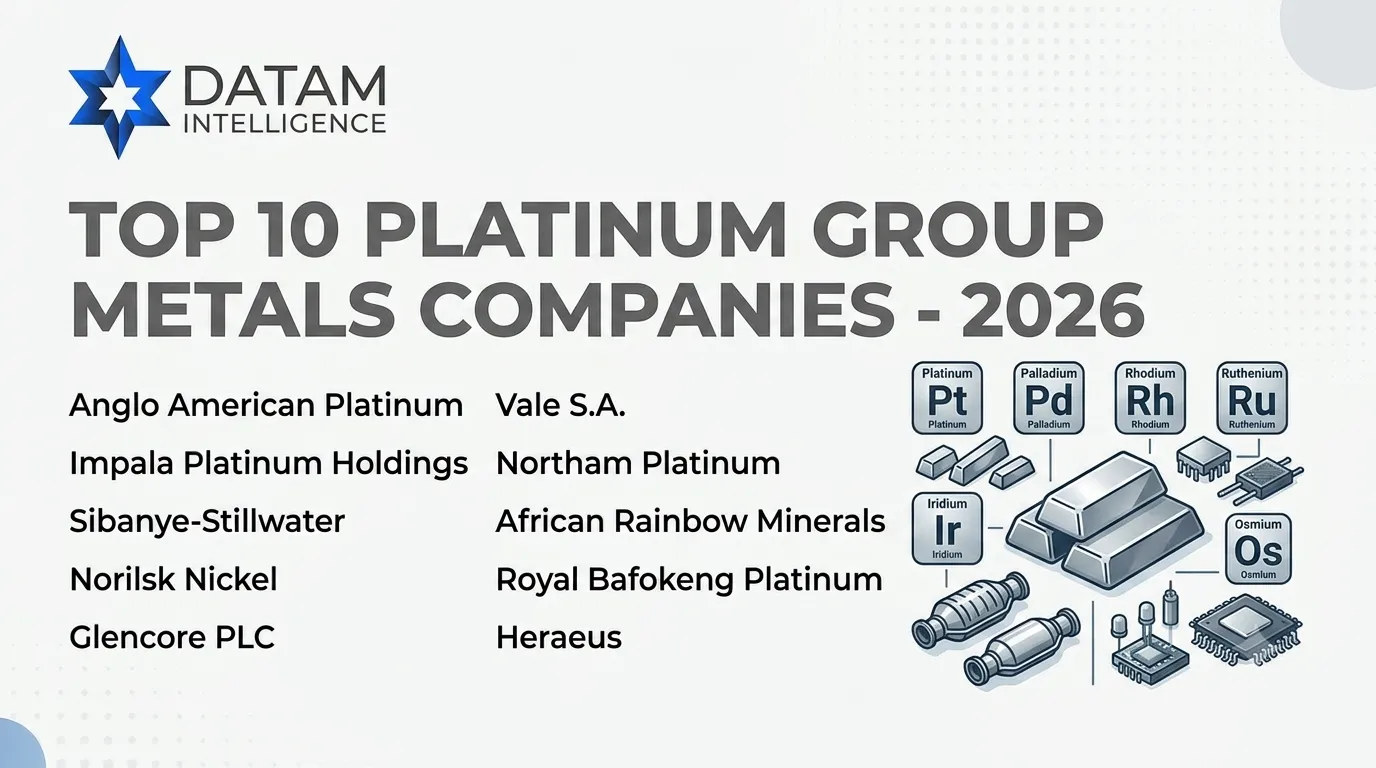
This article highlights the Top 10 Platinum Group Metals companies leading the global market in 2026, based on production scale, strategic reserves, refining capabilities, and downstream integration across automotive, chemical, and clean energy industries.
Access the Comprehensive 2026-2035 Platinum Group Metals Market Intelligence
Get instant access to deep market insights, a projected USD 46.86 Billion valuation roadmap, and comprehensive analyst viewpoints on Euro 7 emission impacts and emerging clean energy shifts.
Download Sample Analysis Report PDF
The leading Platinum Group Metals companies in 2026 include Anglo American Platinum, Impala Platinum, Sibanye-Stillwater, Norilsk Nickel, Northam Platinum, Glencore, Johnson Matthey, Umicore, Heraeus, and Vale. These companies dominate global PGMs supply through large-scale mining operations in South Africa and Russia, advanced refining technologies, and strong recycling networks serving automotive, hydrogen fuel cells, and industrial catalyst markets.
Top 10 Platinum Group Metals (PGM) Companies: Leading the Clean-Tech Transition
The global Platinum Group Metals (PGM) market is undergoing a massive structural shift. The global Platinum Group Metals market is projected to grow from $35.29 billion to $46.86 billion, demonstrating a steady 3.2% CAGR over the forecast period. This expansion underscores the critical role PGMs play in powering the clean-energy transition and advanced manufacturing, the demand for the six key PGMs platinum, palladium, rhodium, iridium, ruthenium, and osmium is expanding rapidly beyond traditional automotive catalysts. Driven by strict global emission standards (like Euro-7 and China-VI-b) and the explosive growth of green hydrogen technologies, primary producers and recycling specialists are securing critical positions in the modern energy transition.
This comprehensive guide profiles the top 10 companies dominating the PGM ecosystem, evaluating their primary assets, operational innovations, and sustainability initiatives.
The Top 10 PGM Producers and Innovators
1. Valterra Platinum (Formerly Anglo American Platinum)
Following its transition into a fully independent standalone entity, Valterra Platinum retains its crown as the world's largest primary producer of PGMs. Operating predominantly in South Africa’s lucrative Bushveld Complex (including the premier Mogalakwena asset) alongside operations in Zimbabwe, the company is a cornerstone supplier of platinum, palladium, and rhodium.
- Strategic Outlook: Valterra is heavily advancing its ESG-driven mining practices and is currently undergoing a major feasibility study for the Sandsloot underground project to sustain its 3.0M+ ounce annual production targets.
2. Impala Platinum Holdings (Implats)
Impala Platinum is a highly integrated major producer with a massive footprint across South Africa and Zimbabwe. Following its strategic acquisition of Royal Bafokeng Platinum, Implats has consolidated its market share to maximize synergy and supply chain efficiencies.
- Strategic Outlook: Implats is leveraging its robust net cash position to invest heavily in processing infrastructure, capitalizing on the persistent physical market deficits driving PGM values upward.
3. Sibanye-Stillwater
As a highly diversified transnational mining group, Sibanye-Stillwater boasts premier PGM assets in South Africa and remains the only major primary producer of platinum and palladium in the United States through its Montana-based Stillwater operations.
- Strategic Outlook: Sibanye-Stillwater has aggressively built out its circular-economy portfolio, acquiring key recycling assets like the Reldan Group and Metallix to secure secondary, low-carbon PGM streams from industrial and electronic waste.
4. Norilsk Nickel (Nornickel)
While primarily a base metals titan, Russia’s Nornickel is the single largest producer of palladium in the world. The company extracts massive quantities of PGMs as high-value byproducts from its low-cost nickel and copper operations in the Taimyr Peninsula.
- Strategic Outlook: Despite shifting geopolitical dynamics and supply chain regionalization, Nornickel remains vital to global electronics and automotive supply networks.
5. Northam Platinum Holdings
Northam Platinum stands out as a highly efficient, independent PGM producer operating deep-level mines within both the Western and Eastern limbs of the Bushveld Complex.
- Strategic Outlook: Known for its aggressive mechanized expansion and optimization programs (notably at Booysendal and Zondereinde), Northam continues to outpace many peers in cost-efficiency and volume growth.
6. Glencore
Glencore approaches the PGM market with a unique dual strategy, operating both asset investments (such as its stake in the Mototolo joint venture) and a world-class, multi-commodity global marketing network.
- Strategic Outlook: By integrating primary extraction with massive commercial trading arms, Glencore smoothly bridges the gap between raw mine outputs and industrial end-users across Europe and Asia.
7. Johnson Matthey
A tier-one downstream player, Johnson Matthey is a global authority on catalytic technologies, sustainable chemistry, and PGM refining. The company specializes in manufacturing advanced emissions-control autocatalysts.
- Strategic Outlook: Johnson Matthey is positioning itself at the forefront of the hydrogen economy, scaling up production of membrane electrode assemblies (MEAs) for proton exchange membrane (PEM) electrolyzers.
8. Umicore
Umicore is a pioneer in the circular economy, operating one of the world's most sophisticated precious metals recycling facilities in Hoboken, Belgium.
- Strategic Outlook: Rather than traditional mining, Umicore utilizes "urban mining" to recover exceptionally pure platinum, palladium, and rhodium from spent automotive converters and electronic scrap, minimizing the environmental footprint of PGM sourcing.
9. Heraeus Group
Germany's Heraeus Group is an elite global family-owned technology company and precious metals refiner. They specialize in chemical processing, precision refining, and customizing PGM-based compounds for high-performance industrial applications.
- Strategic Outlook: Heraeus provides the essential materials required for semiconductor manufacturing, advanced medical devices, and custom chemical catalysts, supporting high-growth industries globally.
10. Vale S.A.
Brazilian mining giant Vale S.A. is world-renowned for its iron ore and nickel operations, yet it yields significant PGM volumes as an institutional byproduct from its Canadian nickel-sulfide operations in Sudbury.
- Strategic Outlook: Vale's established infrastructure ensures that as the world demands more battery-grade nickel for electric vehicles, its concurrent supply of critical critical-byproduct PGMs remains highly competitive.
Key Industry Dynamics Driving the PGM Market
| Market Driver | Strategic Impact |
|---|---|
| The Hydrogen Economy | Platinum and iridium act as irreplaceable catalysts in PEM fuel cells and green hydrogen electrolyzers. |
| Persistent Supply Deficits | Structural mining challenges and rising energy costs in South Africa keep primary global supply tightly constrained. |
| High-Tech Electronics | Ruthenium demand is surging due to its adoption in next-generation microchips and high-capacity AI data storage hard drives. |
Market Trends Driving PGM Companies in 2026
1. Automotive Catalytic Converter Demand
Despite the rapid acceleration of electric vehicle (EV) adoption, internal combustion engine (ICE) vehicles continue to dominate the global automotive fleet, particularly in emerging economies. This structural reality sustains strong demand for Platinum Group Metals, especially palladium and rhodium, which are essential components in catalytic converters used for emissions control. As global emission regulations become increasingly stringent particularly Euro 7 standards and equivalent frameworks in Asia-Pacific and North America automotive OEMs are required to maintain or even increase PGM loadings per vehicle in certain segments. This ensures that automotive catalysts remain one of the most stable and high-impact demand drivers for the PGM industry in 2026.
2. Hydrogen Economy Expansion
Platinum is emerging as a critical enabler of the global hydrogen economy, particularly in proton exchange membrane (PEM) fuel cell technologies. These fuel cells rely on platinum as a catalyst to facilitate efficient hydrogen-to-electricity conversion, making it indispensable for fuel cell electric vehicles (FCEVs), stationary power systems, and industrial hydrogen applications. As governments and corporations scale investments in green hydrogen infrastructure, platinum demand is expected to gain structural support beyond traditional automotive use cases. This transition positions PGMs as strategic materials in global decarbonization pathways and long-term energy transition frameworks.
3. Supply Chain Concentration Risk
The global platinum supply chain remains highly concentrated, with more than 70% of primary platinum production originating from South Africa’s Bushveld Complex. This geographic concentration introduces significant supply-side vulnerabilities, including labor disruptions, energy instability, regulatory changes, and logistical constraints. Additionally, geopolitical dynamics in other producing regions, such as Russia, further amplify market uncertainty for palladium and related PGMs. For investors and industrial buyers, this concentration risk is a critical pricing and supply security factor, often leading to heightened volatility and strategic stockpiling behavior across downstream industries.
4. Recycling & Urban Mining Growth
Recycling has become a structurally important pillar of the PGM supply ecosystem. Secondary recovery from spent automotive catalytic converters, electronic waste, and industrial residues is expanding rapidly as companies such as Umicore and Johnson Matthey scale advanced metallurgical and chemical recovery technologies. Urban mining not only helps reduce dependence on primary mining but also enhances supply chain resilience and supports ESG objectives. As recovery efficiencies improve, recycled PGMs are expected to account for an increasingly significant share of total global supply in the coming years.
5. ESG & Decarbonization Pressure
Environmental, Social, and Governance (ESG) considerations are reshaping operational priorities across the PGM mining industry. Leading producers are investing heavily in low-carbon extraction methods, renewable-powered mining operations, and water-efficient processing technologies to reduce environmental footprints. Carbon intensity per ounce of metal produced has become a key performance indicator for institutional investors and downstream buyers. In addition, stricter disclosure requirements and sustainability-linked financing are encouraging mining companies to integrate decarbonization strategies directly into core operational models. This shift is not only improving environmental outcomes but also redefining competitive advantage in the global PGMs market.
Expert Insight
The PGM industry remains structurally constrained by limited geological supply and high entry barriers. Companies with vertically integrated operations from mining to refining and recycling are expected to outperform peers as demand shifts toward clean energy and emission-reduction technologies. Strategic investors are increasingly focusing on diversified exposure across primary producers and circular economy leaders.
Conclusion
The Platinum Group Metals sector in 2026 is defined by a balance between traditional mining giants and emerging circular economy leaders. While South African and Russian producers continue to dominate supply, recycling innovators and catalyst technology companies are reshaping long-term market structure.
For B2B stakeholders, investors, and industrial buyers, monitoring these top 10 PGMs companies provides critical insight into pricing trends, supply risks, and future demand growth across automotive, energy, and industrial applications.