


The global natural caffeine market is growing as food, beverage and supplement companies look for ingredients that support plant-based and clean-label product positioning. But for procurement and strategy teams, the key question is not simply whether demand is rising. It is whether a supplier can deliver the right caffeine source, product form, quality documentation and supply reliability for a specific application.
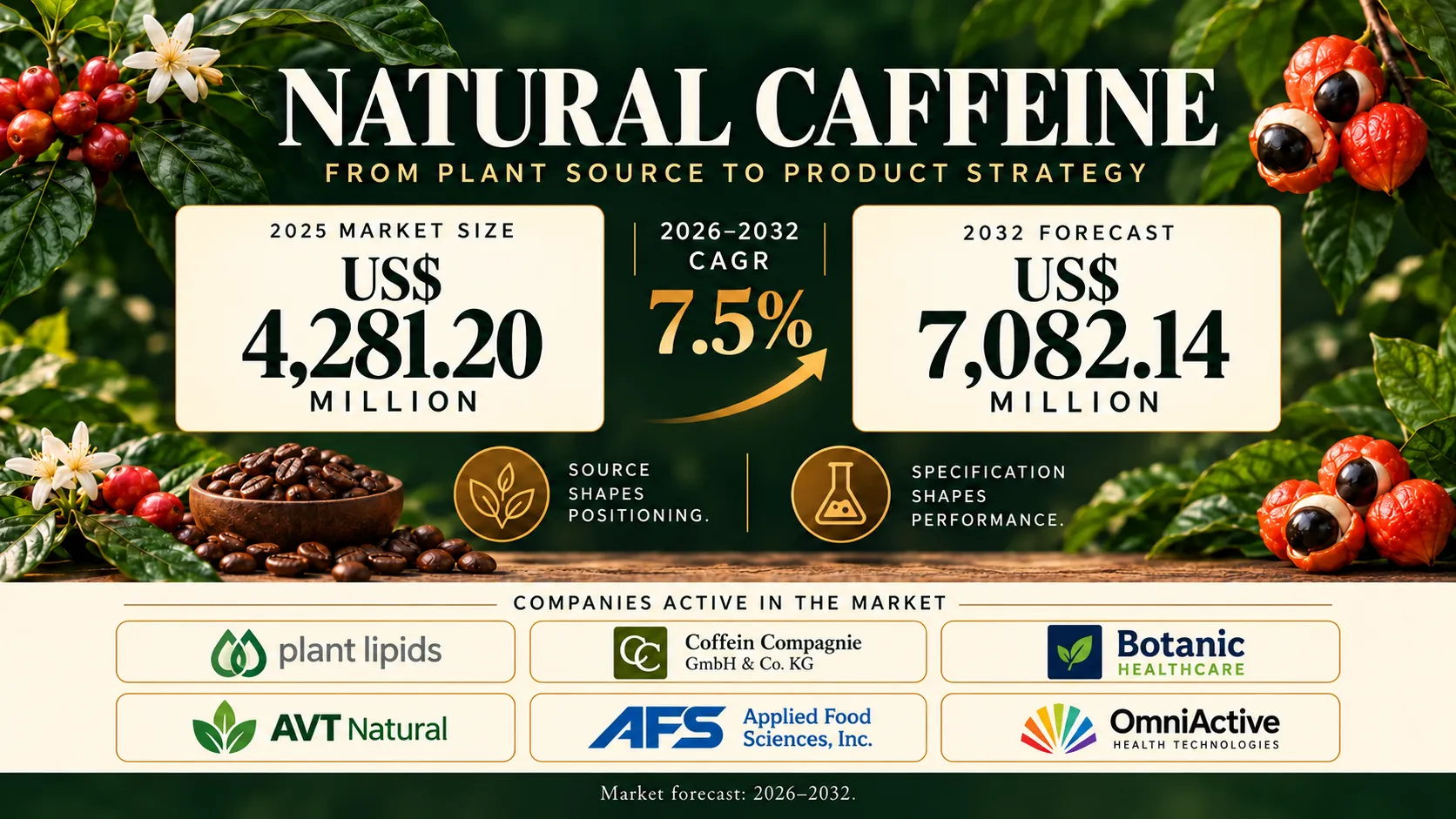
The Natural Caffeine Market Report estimates the market at US$4,281.20 million in 2025, with a forecast of US$7,082.14 million by 2032, representing a 7.5% CAGR from 2026 to 2032. The report covers sources including coffee, tea, guarana, cocoa, kola nut and yerba mate, alongside powder, liquid, granule and encapsulated forms. Applications include food and beverages, dietary supplements, pharmaceuticals, cosmetics and personal care.
That growth estimate is useful for market planning, but it is not a supplier ranking. Publicly comparable natural-caffeine-specific revenue and market-share figures are limited. The companies below are drawn from the report’s competitive landscape and should be evaluated by verified product fit and supply capability, not assumed market position.
Request Exclusive Sample: https://www.datamintelligence.com/customize/natural-caffeine-market
What buyers should assess before selecting a supplier
A natural-origin claim is only one part of the purchasing decision. Companies developing products should compare suppliers on:
- Source and origin: Confirm whether caffeine comes from coffee, tea, guarana or another botanical source, and whether the source fits the product’s positioning.
- Specification and consistency: Request current technical data, assay ranges, impurity limits and batch-to-batch controls.
- Application fit: Check solubility, taste, color, heat stability and compatibility with the finished formulation.
- Documentation: Verify traceability, quality systems, allergen statements and any certifications required for the target market.
- Supply resilience: Assess production capacity, lead times, regional availability and the supplier’s ability to manage raw-material variability.
- Commercial terms: Compare total delivered cost, minimum order quantities, packaging, logistics and technical support-not only price per kilogram.
These checks matter because botanical sourcing and extraction can create cost and supply differences. The report identifies higher production costs and competition from synthetic caffeine as restraints on market growth.
Natural Caffeine Companies
Coffein Compagnie GmbH & Co. KG
The report places Coffein Compagnie among established companies associated with coffee decaffeination and caffeine recovery. For buyers, that makes it a potential candidate to assess when recovered caffeine, process capabilities and documentation are central to the specification. Verify source-material traceability, recovery process details, available grades and whether the product meets the intended “natural” claim and market requirements.
CR3-Kaffeeveredelung GmbH
CR3 is also identified in the report with coffee decaffeination and caffeine recovery. This points to a supplier profile that may be relevant to companies seeking caffeine connected to coffee processing. Compare the supplier’s caffeine specifications, production capacity, origin documentation and continuity of supply for the planned contract period.
Derivados Industrializados del Café S.A.
The report includes Derivados Industrializados del Café in the coffee-processing and caffeine-recovery group. Its relevance to a buyer will depend on the specific product grade, sourcing model and ability to serve the buyer’s geography.
Plant Lipids
The report groups Plant Lipids with companies contributing through botanical extracts and natural-ingredient portfolios. It may be a relevant company to assess for product development that prioritizes botanical ingredients and formulation support. The caffeine-bearing ingredient, standardization approach, source traceability and formulation support available for the target application.
Botanic Healthcare Pvt. Ltd.
Botanic Healthcare is identified in the report among the botanical-extract and natural-ingredient suppliers. For product teams, the key question is whether its relevant offerings match the required caffeine source, concentration and finished-product performance.
Shri Ahimsa Naturals Ltd.
The report includes Shri Ahimsa Naturals among the botanical ingredient suppliers and lists the company in its competitive landscape. Buyers should evaluate its fit against the intended application and sourcing standards.
AVT Natural
AVT Natural is included among the report’s botanical and natural-ingredient companies. Its potential fit should be assessed product by product, especially where origin, extraction and clean-label positioning matter.
Applied Food Sciences, Inc.
The report places Applied Food Sciences in the broader specialty-ingredient market, including botanical and functional ingredients. That positioning may be relevant when a buyer needs ingredient selection and application input as well as supply.
OmniActive Health Technologies Limited
OmniActive is also identified in the report as a broader specialty-ingredient company, including botanical and functional ingredients. Its relevance should be confirmed against the buyer’s intended caffeine product and requirements.
Other companies named in the report
The report’s competitive landscape also lists Cymbio Pharma Private Limited, Natura Vitalis Industries Pvt. Ltd., Sivaroma Naturals Pvt. Ltd., NutriScience Innovations, LLC, Cepham, Vita Forte Inc., Anderson Global Group, LLC, UNICORN NATURAL PRODUCT LIMITED, Descafeinadores Mexicanos S.A., EPC Natural Products Co., Ltd., Herbo Nutra Extract Private Limited, Hangzhou Muhua Bio-Tech Co., Ltd., Umang Global, Elementaet A Foods, Foreverland, and others. Their inclusion in the report is a starting point for supplier screening; it should not be interpreted as a verified ranking by natural-caffeine sales or market share.
Competitive Comparison
| Company or group | Position described in the report | Decision question for buyers |
Coffein Compagnie, CR3, Derivados Industrializados del Café | Associated with coffee decaffeination and caffeine recovery | Can the supplier provide the required grade, source records and contracted capacity? |
Plant Lipids, Botanic Healthcare, Shri Ahimsa Naturals, AVT Natural | Contribute through botanical extracts and natural-ingredient portfolios | Is the caffeine-specific ingredient standardized, traceable and suitable for the formulation? |
Applied Food Sciences, OmniActive, NutriScience Innovations | Participate in the broader specialty-ingredient market | Can the supplier support the required product specification, application and scale? |
The report describes these company groupings as qualitative because comparable market-share and growth data are limited. That makes supplier-level validation essential.
What could shape competition next?
1. Functional beverages remain a major demand channel
The report identifies food and beverages as the leading application segment, including energy drinks, ready-to-drink teas, sports beverages and functional products. That creates an opportunity for suppliers able to meet beverage-specific needs such as solubility, taste neutrality, stability and reliable scale-up.
2. Clean-label positioning needs evidence behind it
“Natural” can help a product communicate its ingredient story, but it does not replace substantiation. Brands and ingredient buyers should ensure that sourcing, processing and labeling claims are supported by supplier documentation and comply with the rules in each sales market.
3. Product launches signal demand, not supplier share
The Natural Caffeine report cites 2026 launches involving matcha and guarana-based energy drinks. These examples indicate ongoing product experimentation in natural-energy formats, but they do not establish market share for any caffeine supplier. Buyers should treat launches as a signal to assess application demand-not as proof of a specific supplier’s commercial performance.
4. Cost and supply reliability will influence adoption
Natural caffeine competes with synthetic caffeine on cost and availability. A buyer’s decision should therefore account for the value of source positioning alongside total formulation economics, supplier continuity and the finished product’s target price point. A premium ingredient is commercially viable only when the product proposition and customer willingness to pay support it.
5. The most useful market advantage may be a qualified supply base
For manufacturers, the strategic goal is not necessarily to choose one supplier immediately. Qualifying alternatives across source, geography and production approach can reduce exposure to raw-material disruption and help preserve negotiating flexibility.
Strategic Outlook
The natural caffeine market’s forecast growth creates room for ingredient suppliers, manufacturers and brands to pursue new applications. Yet the commercial winners will need more than a natural-origin story. They will need dependable specifications, credible sourcing, application performance and a supply model that fits the economics of the final product.
Frequently Asked Questions
How large is the Natural Caffeine Market?
The DataM Intelligence report states a 2025 market size of US$4,281.20 million and forecasts US$7,082.14 million by 2032, at a 7.5% CAGR for 2026-2032. The report page contains a conflicting forecast in one FAQ, so confirm the final figure with the report publisher before external publication.
Which companies should buyers evaluate?
The report lists companies including Plant Lipids, Coffein Compagnie, Botanic Healthcare, Shri Ahimsa Naturals, AVT Natural, Applied Food Sciences, OmniActive, CR3-Kaffeeveredelung and Derivados Industrializados del Café. This list is not a market-share ranking.
What should a company verify before choosing a natural caffeine supplier?
Confirm the source, product specification, batch consistency, traceability, quality documentation, application performance, production capacity, lead times and commercial terms.
Which application offers a major opportunity?
The report identifies food and beverages as the leading application segment, supported by demand for energy drinks, ready-to-drink teas, sports beverages and functional products.
How can companies identify suitable partners?
A structured partner-identification process can compare suppliers by product fit, sourcing, capacity, geography, documentation and commercial readiness.
Expanding your business in the Natural Caffeine Market? Identify suitable partners, assess supply and demand challenges, and request pricing intelligence through DataM Intelligence’s Natural Caffeine Market partner-identification service.