


Top 10 Companies in the Methanol Fuel Cell Market
Methanol fuel cell companies are developing solutions for applications where reliable power, liquid-fuel logistics and reduced dependence on conventional generators matter. Their products and technologies serve markets such as portable and off-grid power, defense, telecommunications, marine energy and distributed electricity.
The competitive landscape includes two distinct system types. Direct methanol fuel cells (DMFCs) convert methanol into electricity inside the fuel cell. Reformed methanol fuel cells (RMFCs) first convert methanol into a hydrogen-rich gas, which then feeds a fuel cell stack. These approaches have different system designs, power ranges and applications. Companies developing generic hydrogen fuel cells, methanol reformers or fuel cell components should not automatically be treated as commercial methanol fuel cell system suppliers.
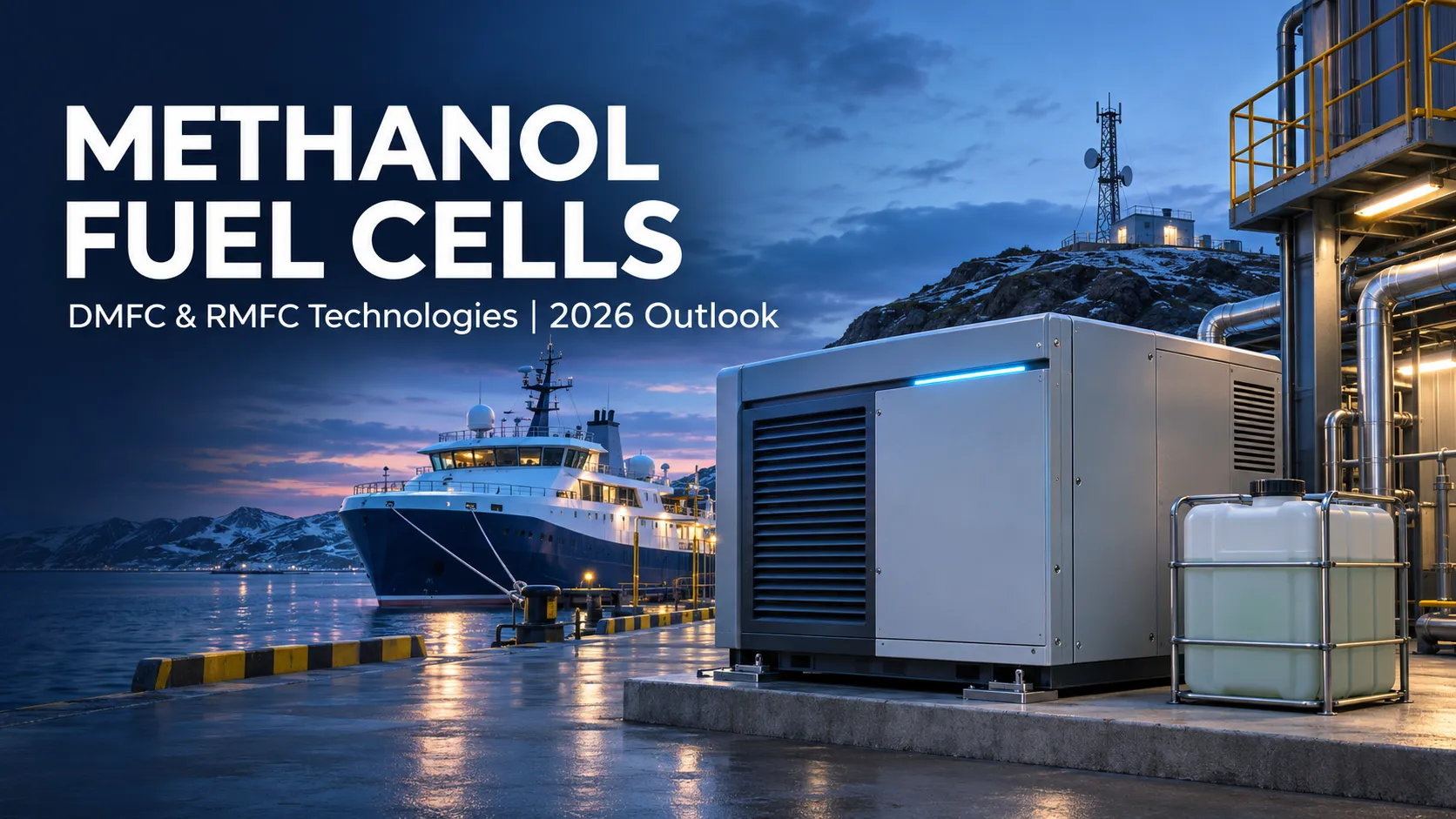
Request for Direct Methanol Fuel Cell Market Sample: https://www.datamintelligence.com/download-sample/direct-methanol-fuel-cell-market
Request for Reformed Methanol Fuel Cells Sample: https://www.datamintelligence.com/download-sample/reformed-methanol-fuel-cell-market
DMFC and RMFC: What is the difference?
A DMFC uses methanol directly at the anode of the fuel cell. It can simplify fuel storage and handling compared with systems that rely on compressed hydrogen, which is useful for portable or remote applications. A direct methanol reaction also produces carbon dioxide, so a system’s lifecycle emissions depend partly on how its methanol is made. The U.S. Department of Energy describes DMFCs as a type of fuel cell using a proton-conducting polymer membrane.
An RMFC system uses a reformer to extract hydrogen from methanol, then feeds that hydrogen-rich gas into a fuel cell stack. This adds components and control requirements, but can support different power ranges and applications. The overall system needs to manage reformer heat, fuel processing and gas quality.
Both pathways face engineering and commercial challenges. For DMFCs, research continues on catalyst performance, methanol crossover, durability and fuel management. RMFC developers must optimize reformer efficiency and system integration. Renewable methanol can improve the lifecycle profile of either pathway, but it does not make a system automatically emissions-free.
10 companies to know
1. SFC Energy AG
SFC Energy is one of the clearest examples of an established commercial provider in the methanol fuel cell ecosystem. Its EFOY and defense-oriented fuel cell products are based on direct methanol fuel cell technology and target mobile, remote and off-grid power needs. Applications include industrial monitoring, security and defense equipment, telecommunications and other critical infrastructure.
In July 2026, SFC agreed to acquire key Siqens assets, including patented methanol reformer fuel cell technology, intellectual property, customer relationships and selected personnel. SFC said the acquisition would extend its offering from DMFC systems below 1 kW toward methanol-reformer applications in the 1-5 kW range. This is a portfolio expansion; the acquired technology should not be confused with an already established SFC RMFC product line.
In October, SFC announced a cooperation agreement with EDGE in the United Arab Emirates covering power solutions for defense, public security and critical infrastructure. The announcement describes demonstrators in development and does not specify that the cooperation is a methanol-specific commercial deployment.
2. Blue World Technologies
Denmark-based Blue World Technologies develops and manufactures methanol fuel cell systems using high-temperature proton exchange membrane technology. Its focus is primarily marine power, where methanol can be stored and supplied using established maritime fuel logistics.
The company has reported successful testing of a 200 kW system designed to run on green methanol and has described a modular approach that can be combined into larger systems. Its announced marine work includes a 1 MW pilot system intended for onboard power generation. Blue World has said commercial readiness for its maritime system was targeted for 2027, so the pilot and target date should not be presented as an already completed commercial deployment.
The company’s approach may suit shipboard auxiliary power and, over time, larger marine applications. Commercial adoption will depend on system performance under operating conditions, fuel availability, certification, maintenance requirements and the cost and carbon intensity of the methanol used.
Competitive position: Blue World is one of the more specialized companies in the methanol fuel cell landscape, with a clear marine focus and system development beyond small portable power.
3. Oorja Protonics / DMFC Corporation
Oorja Protonics is associated with DMFC Corporation, which describes itself as a developer and manufacturer of direct methanol fuel cell power systems. Its model combines fuel cell output with a battery to support applications that require a higher-power response than the stack alone may deliver. The company lists systems across a range of power levels and markets including backup power.
Oorja has historically been linked to material-handling uses, where a methanol fuel cell can recharge an onboard battery during operation. A U.S. Department of Energy presentation documents earlier deployments of Oorja DMFC systems in material-handling applications, but that historical evidence does not establish current deployment volumes or product availability.
For prospective buyers, the key questions are whether the requested product is currently offered, what service support is available and whether the system is qualified for the intended operating environment. Publicly available information on current commercial activity is more limited than for some larger fuel cell suppliers.
Competitive position: A DMFC-focused product history and hybrid battery architecture are relevant differentiators; current market activity and product status merit direct confirmation.
4. Advent Technologies
Advent Technologies develops fuel cell materials, stacks and systems, including high-temperature PEM technologies. Its methanol-related pathway is primarily reformed methanol: methanol is processed onboard to provide hydrogen-rich fuel for the stack. Advent’s published product information describes reformed methanol systems and its Serene line as fuel-flexible platforms.
Advent’s history is connected to SerEnergy, a Danish fuel cell company associated with methanol reforming and high-temperature PEM systems. The relationship means the two names should not be counted as separate independent market leaders without explaining the corporate context. Advent has described applications including marine, stationary and portable power, but product availability and current deployment status should be confirmed by model and region.
Competitive position: Advent’s strength is its focus on high-temperature PEM materials and fuel flexibility. Its commercial opportunity depends on converting that technical platform into reliable, repeatable system deployments and maintaining support for customers across the system lifecycle.
5. FC TecNrgy
FC TecNrgy (FCT) is an Indian fuel cell system provider that lists both direct and reformed methanol fuel cell solutions. Its product pages include methanol-powered JENNY systems for military applications and describe DMFC products for portable and stationary remote or backup power. FCT also lists reformed methanol systems in modular 5 kW and 10 kW configurations.
The company’s portfolio spans several power levels and applications, including defense, industrial and off-grid uses. Its product pages identify specific equipment, but the presence of a product listing does not, by itself, confirm the scale of active deployments, production capacity or availability in every market.
Competitive position: FCT’s breadth across DMFC and RMFC categories makes it relevant for buyers comparing portable, military and multi-kilowatt remote power systems. Procurement teams should request current technical datasheets, certification details, supply timelines and local service terms.
6. PowerCell Group
PowerCell Group is a fuel cell system provider whose August 2026 announcement provides a concrete recent RMFC-related development. The company secured an order worth approximately SEK 21 million from the German Aerospace Center (DLR) for a fuel-to-power system at DLR’s maritime test facility in Kiel.
The planned system combines two fuel cell units with methanol reformers, hydrogen buffer storage, gas mixing and integrated controls. Delivery was planned for Q4 2026, with commissioning targeted for the first half of 2027. The project is intended for research and maritime testing; it should not be described as a commercial ship deployment.
Competitive position: The DLR order demonstrates application-specific system integration around methanol reforming and fuel cells. It also provides a visible test pathway for maritime operating profiles, although the project’s purpose is validation and research rather than a mass-market product launch.
7. Fuji Electric and Mitsubishi Gas Chemical
Fuji Electric and Mitsubishi Gas Chemical (MGC) are collaborating to study a fuel cell system that uses hydrogen produced through methanol reforming. Their August 2025 announcement set out a feasibility study and targeted a demonstration by March 2027. MGC brings methanol reforming experience, while Fuji Electric contributes fuel cell and power system capabilities.
This is an RMFC development effort, not evidence of a commercially available joint system. It is relevant to the competitive landscape because it connects methanol conversion with a fuel cell platform and demonstrates how partnerships can combine capabilities that a single company may not hold across the entire chain.
Competitive position: The collaboration gives both companies a route to explore methanol-derived hydrogen power, particularly for stationary or distributed applications. Its future position will depend on demonstration results, economics and a clear commercialization plan.
8. Palcan Energy
Palcan Energy has been associated with methanol reforming systems that convert methanol into hydrogen for use in a fuel cell stack. Historical company and industry materials describe applications such as transportation, communications, mobile charging and backup power. A 2019 announcement described a partnership to explore methanol-to-hydrogen technology for charging infrastructure; an industry case study later reported Palcan began producing methanol-reforming fuel cells at a facility in China in 2021.
These sources establish technical and manufacturing activity in the past, but they do not establish Palcan’s current product availability or deployment scale in 2026. It is therefore important to distinguish its historical RMFC work from verified current commercial supply.
Competitive position: Palcan belongs in a broader view of methanol reforming technology and its potential use in transport and distributed power. Buyers and investors should verify the company’s present operating status, product lineup and customer references before treating it as an active supplier.
9. Johnson Matthey
Johnson Matthey is a component and materials technology supplier rather than a complete methanol fuel cell system manufacturer. The company has supplied catalysts for SFC Energy’s DMFC systems. In 2023, Johnson Matthey and SFC announced an expanded partnership, including a plan for Johnson Matthey to supply DMFC catalysts for at least five years and transfer certain component technology and assets to SFC.
Catalysts and membrane electrode assemblies affect performance, durability and cost. Suppliers in this part of the value chain can influence system competitiveness without selling a finished generator or stack under their own brand.
Competitive position: Johnson Matthey is relevant as an enabling supplier whose catalyst expertise has supported a commercial DMFC manufacturer. This profile should not imply that it currently sells complete methanol fuel cell systems directly to end users.
10. Fujikura
Fujikura has a history of direct methanol fuel cell research and technical development. Its published technical papers describe work on DMFC systems, including a 1 kW system, and its patent portfolio includes methanol fuel supply and cell design innovations. These documents establish technical activity, but they are not evidence of a currently marketed commercial DMFC product.
Fujikura is therefore best understood as a historical and technology-development participant in the DMFC ecosystem. A credible company profile should focus on documented research and intellectual property, while clearly stating that the public evidence reviewed does not confirm active market-scale sales of a methanol fuel cell system.
Competitive position: Fujikura’s technical history can help readers understand the evolution of DMFC design. Its present commercial position should not be equated with that of companies advertising currently available methanol fuel cell products.
Competitive Comparison
| Company | Technology or role | Main application focus | Evidence status |
| SFC Energy | Commercial DMFC; acquired RMFC assets | Defense, industrial, remote power | Commercial products; RMFC portfolio expansion |
Blue World Technologies | Methanol HT-PEM systems | Marine and stationary power | System development and pilot activity |
Oorja / DMFC Corporation | DMFC systems | Material handling, backup power | Product portfolio described; confirm current availability |
| Advent Technologies | HT-PEM and methanol reforming | Portable, stationary, marine | Product and technology descriptions; deployment status varies |
| FC TecNrgy | DMFC and RMFC systems | Defense, remote, industrial | Product listings include methanol systems |
| PowerCell Group | Methanol reformer plus fuel cell system | Maritime testing | DLR order and planned demonstration |
| Fuji Electric / MGC | Methanol-derived hydrogen fuel cell | Stationary/distributed power under study | Feasibility and demonstration plan |
| Palcan Energy | Methanol reforming technology | Transport, communications, backup | Historical production and partnership evidence |
| Johnson Matthey | Catalyst and component supplier | DMFC stack components | Documented supplier relationship |
| Fujikura | DMFC R&D and patents | Historical technical development | Public evidence is largely historical |
The companies differ in product maturity, business model and role in the value chain, so it should not be interpreted as a head-to-head performance ranking.
Recent Developments
The most directly relevant recent development in the defined August 17-November 17, 2026 window is PowerCell Group’s August order from DLR. The project combines methanol reformers with fuel cell systems for maritime testing, with commissioning planned for 2027. It is an important validation project, but not a commercial vessel installation.
SFC Energy’s October agreement with EDGE is another notable company development, focused on advanced power solutions for defense, public security and critical infrastructure in the UAE. Demonstrators are in development. The announcement includes tactical fuel cells and hybrid systems but does not identify the agreement as a methanol-specific deployment.
SFC’s acquisition of Siqens assets in July falls just outside the article’s three-month research window, but it is strategically relevant to the 2026 competitive landscape. The acquired methanol reformer technology may extend SFC’s portfolio into a higher power range and shows how intellectual property, customer relationships and specialist teams can shift the competitive position of an established supplier.
These examples point to a market moving through a mix of commercial sales, product development, demonstration projects and acquisitions. Those stages should be described separately. A partnership or planned demonstration can signal intent, but it does not prove that a product has reached broad commercial deployment.
Five trends shaping methanol fuel cell competition
1. DMFC and RMFC systems are addressing different power needs
The two architectures can complement one another. DMFCs are associated with portable and lower-power applications, while methanol reforming can support systems that first produce hydrogen for a fuel cell stack. SFC’s acquisition of Siqens assets reflects the strategic value of expanding across power ranges and technology pathways. System complexity, efficiency and maintenance will remain key purchase considerations.
2. Marine applications are creating a test ground for higher-power systems
Marine developers are exploring methanol fuel cells for onboard electricity and auxiliary power, with potential applications in larger power systems. Blue World Technologies’ 200 kW testing and planned 1 MW pilot illustrate this direction, while PowerCell’s DLR order supports maritime testing of a separate methanol-reformer approach. Commercial use will depend on certification, fuel availability, operational reliability and total cost.
3. Portable and off-grid power remains a practical use case
Methanol’s liquid form can simplify fuel storage and transport compared with compressed hydrogen in some contexts. This can matter for remote monitoring, temporary installations, defense applications and industrial sites with limited grid access. The value depends on the specific system’s runtime, fuel supply arrangements, safety procedures and maintenance needs.
4. Green methanol affects lifecycle performance
A methanol fuel cell’s exhaust and lifecycle emissions are not determined by the fuel cell alone. Conventional methanol is generally fossil-derived, while renewable methanol can be produced through alternative pathways. Buyers evaluating emissions should ask about fuel origin, production pathway, transport and the full operating boundary. “Methanol-powered” does not by itself mean carbon-neutral.
5. Components and system integration can be decisive
Catalysts, membranes, reformers, fuel management, controls and balance-of-plant equipment all influence performance. Johnson Matthey’s catalyst relationship with SFC illustrates the role of component suppliers; TreadStone Technologies, for example, markets fuel cell bipolar plate coatings, but public product information does not establish a methanol-specific application. Component providers should be classified separately from complete DMFC or RMFC system manufacturers.
Regional Opportunities: USA, Japan and Europe
In the United States, procurement interest may come from defense, industrial users, telecom infrastructure and remote power applications. Buyers should check product certification, domestic service capability, fuel logistics and whether a company has a current U.S. product offering.
In Japan, the technology landscape includes historical DMFC research as well as current interest in methanol-derived hydrogen systems. Fuji Electric and MGC’s feasibility work is an example of a partnership exploring the latter pathway, but the announced target is a demonstration rather than commercial deployment.
In Europe, companies such as SFC Energy and Blue World Technologies demonstrate different routes: commercial off-grid DMFC systems and marine-focused methanol fuel cell development. Regional opportunities will depend on local emissions rules, renewable methanol supply and the maturity of each company’s service and manufacturing network.
Future outlook: what buyers should evaluate
The methanol fuel cell market is not a single competition between equivalent manufacturers. It is an ecosystem of stack producers, reformer developers, component suppliers, system integrators and end-use specialists. A company’s relevance depends on whether its product fits the buyer’s power requirement and operating conditions.
Before selecting a supplier, buyers should confirm whether the product is DMFC or RMFC, its rated and continuous output, efficiency, expected runtime, fuel consumption, emissions profile, safety certifications, warranty, maintenance requirements and service availability. They should also distinguish between products in commercial use, pilot systems, demonstrations and research-stage technology.
For investors and strategic partners, the strongest signals are repeat deployments, stable manufacturing capability, transparent performance data, qualified applications and an established service network. Partnerships and acquisitions can broaden technology portfolios, but their commercial effect depends on successful integration and follow-through.
Frequently Asked Questions
Who are the leading methanol fuel cell companies?
A research shortlist includes SFC Energy, Blue World Technologies, Oorja/DMFC Corporation, Advent Technologies, FC TecNrgy, PowerCell Group, Fuji Electric and Mitsubishi Gas Chemical, Palcan Energy, Johnson Matthey and Fujikura. They vary significantly in commercial maturity and role in the value chain, and the list is not a market-share ranking.
Which companies manufacture direct methanol fuel cells?
SFC Energy, Blue World Technologies, Oorja/DMFC Corporation and FC TecNrgy describe methanol fuel cell products or systems. Confirm current model availability and target applications directly with suppliers before procurement.
What is the difference between DMFC and RMFC technology?
A DMFC uses methanol directly in the fuel cell. An RMFC reforms methanol into a hydrogen-rich gas first, then uses that gas in a fuel cell stack.
Which companies are developing reformed methanol fuel cells?
SFC Energy acquired Siqens methanol reformer technology assets in 2026. Advent Technologies describes methanol-reformed fuel cell systems, while PowerCell Group’s DLR project and the Fuji Electric-MGC feasibility study are examples of related development activity. Commercial status differs by project.
What industries use methanol fuel cells?
Potential applications include portable and remote power, defense, telecommunications, industrial backup and marine power. The right technology depends on power output, runtime, fuel availability, emissions requirements and operating conditions.
Is methanol fuel cell power carbon-neutral?
Not automatically. The lifecycle emissions depend on how the methanol is produced and delivered. Renewable methanol can improve the lifecycle emissions profile, but buyers should evaluate the full fuel pathway.
Explore the methanol fuel cell market
For deeper analysis of technologies, applications, competitive strategies and regional opportunities, explore DataM Intelligence’s dedicated research: