


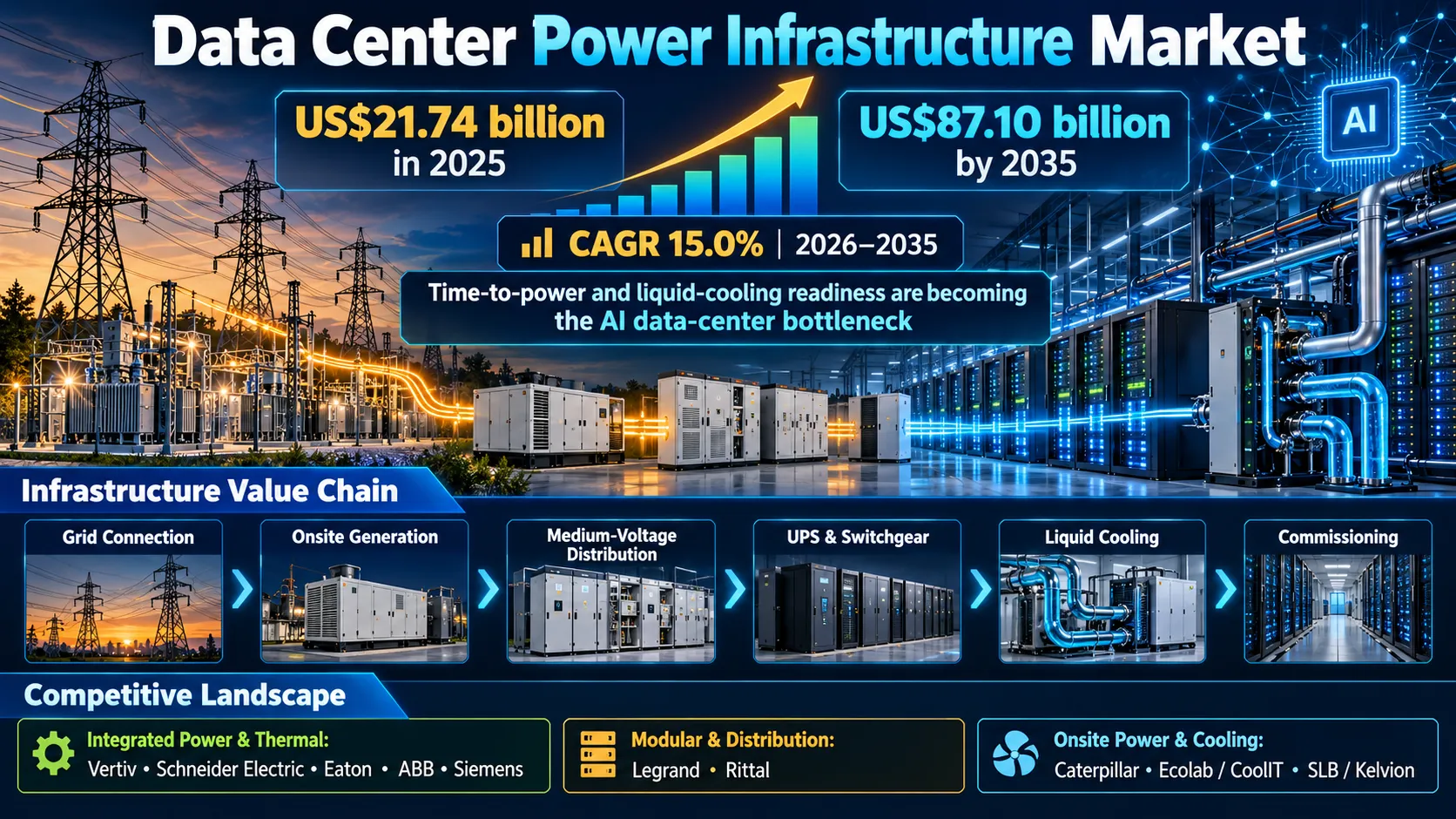
Data Center Power Infrastructure has become a strategic bottleneck in the global AI buildout. Procurement decisions now extend beyond uninterrupted power and cooling capacity to grid interconnection, onsite generation, liquid-cooling readiness, modular deployment and guaranteed commissioning performance. Suppliers that integrate these layers can capture more value per megawatt while helping operators shorten time to energization.
DataM Intelligence estimates the global data center power infrastructure market at $21.74 billion in 2025, rising to $87.1 billion by 2035. This power-specific measure is one component of the broader Data Center Power Infrastructure industry, which also includes thermal management, racks, monitoring, connectivity and mechanical systems. North America held an estimated 38% share of the power infrastructure segment in 2025. AI rack densities and constrained utility connections are accelerating demand for integrated power and thermal architecture.
Industry executives are describing a structural shift. Announcing its Kelvion agreement on August 31, 2026, SLB CEO Olivier Le Peuch said, “AI is driving the most significant infrastructure investment cycle in our lifetime.” In September, Vertiv Chief Product and Technology Officer Scott Armul observed that “The scale of AI deployment is forcing a more integrated approach to Data Center Power Infrastructure.” The remarks capture why power availability, thermal performance and standardized deployment now shape competition.
Request Exclusive Sample: https://www.datamintelligence.com/download-sample/data-center-power-infrastructure-market
Top 10 Companies Analysis
Vertiv Holdings
Vertiv supplies critical power systems, thermal equipment, racks, controls and lifecycle services. Its 2025 revenue was $10.23 billion. A $15 billion year-end order backlog demonstrated exceptional demand visibility. OneCore integration and its liquid-cooling portfolio differentiate it in hyperscale AI deployment, while delivery execution and supply-chain scaling are key risks.
Schneider Electric
Schneider Electric combines electrical distribution, UPS, building controls, software and modular infrastructure through its EcoStruxure ecosystem. Its 2025 group revenue was approximately $47 billion when converted from more than €40 billion reported revenue. Its advantage is electrical-to-facility integration, especially where operators require digital monitoring and energy optimization.
Eaton
Eaton recorded $27.4 billion in 2025 group sales. Medium-voltage equipment, UPS, switchgear, busway and power-management systems make it a core beneficiary of data center electrification. Its strategic opportunity is to capture a larger share of substation-to-rack electrical architecture, including resilient onsite-power interfaces.
ABB
ABB generated $33.2 billion in 2025 group revenue. Switchgear, electrical automation, power-quality technology and monitoring position the company in high-capacity data center buildouts. ABB competes on reliability and grid-to-facility engineering, although these activities account for only part of its diversified group revenue.
Siemens
Siemens reported fiscal 2025 group revenue of €78.9 billion, approximately $89 billion at a rounded 2025 average conversion rate. Electrical infrastructure, building automation and industrial digital twins offer a compelling approach to energy-intensive facilities. Its differentiation lies in combining design, power distribution and intelligent operations.
Legrand
Legrand reported 2025 sales of €9.48 billion, approximately $10.7 billion in USD. Data centers accounted for 26% of its sales. Racks, busway, PDUs and structured infrastructure make it particularly relevant close to the IT load. Its acquisition strategy is expanding the offer into modular power and critical distribution.
Caterpillar
Caterpillar generated $67.6 billion of consolidated 2025 sales and revenue. Large generators, engines and distributed power systems serve data centers confronting utility-connection delays and resilience requirements. Its position strengthens where onsite generation shifts from standby coverage toward a bridge to grid capacity.
Ecolab / CoolIT Systems
Ecolab posted $16.08 billion of group sales in 2025. Following its July 2026 acquisition of CoolIT, the company combines water-treatment capabilities with chip-level liquid-cooling technologies. Its strategic advantage is coolant quality and liquid-loop optimization across the full thermal chain; CoolIT standalone 2025 sales are not represented by the parent figure.
SLB / Kelvion
SLB is moving into Data Center Power Infrastructure through its Data Center Solutions business and its August 2026 agreement to acquire Kelvion. Heat exchangers and heat-rejection systems would strengthen its thermal-management position. The deal remains pending; a comparable Kelvion 2025 standalone revenue figure was not established.
Rittal (Friedhelm Loh Group)
Rittal is a specialist in enclosures, racks, modular data center systems and IT cooling. Its installed engineering ecosystem is valuable in scalable, prefabricated facility projects. A verified comparable 2025 Rittal standalone revenue figure is not publicly presented here, so group-level figures are not substituted.
Competitor Analysis: Leading Data Center Power Infrastructure Market Players
| Company | 2025 Revenue (USD) | Infrastructure Position |
| Vertiv | $10.23bn | Critical power, thermal, integrated systems |
| Schneider Electric | ~$47bn | Grid-to-rack power and software |
| Eaton | $27.4bn | Switchgear, UPS, electrical infrastructure |
| ABB | $33.2bn | Electrification and control |
| Siemens | ~$89bn | Building and electrical digitalization |
| Legrand | ~$10.7bn | PDUs, racks, modular power |
| Caterpillar | $67.6bn | Onsite generation and backup |
| Ecolab / CoolIT | $16.08bn | Liquid cooling and water management |
| SLB / Kelvion | Not comparable | Heat exchange and thermal integration |
| Rittal | Not disclosed | Racks, enclosures, cooling |
Request Exclusive Sample: https://www.datamintelligence.com/download-sample/data-center-power-infrastructure-market
Revenue figures represent consolidated company sales unless otherwise indicated, not data-center-only revenue. Figures converted from euros to USD are rounded approximations using a 2025 average exchange-rate convention and should not be interpreted as segment market share.
Who Are the Rising Companies Influencing the Market?
- LiquidStack - Strategic focus: expand direct-to-chip liquid cooling, especially for very high-density accelerated computing.
- Submer - Strategic focus: commercialize immersion and modular liquid-cooling infrastructure for high-density deployments.
- Gates Corporation - Strategic focus: coolant-compatible flexible hoses and connection systems close to the rack.
- GRC - Strategic focus: immersion-cooling platforms that can reduce reliance on traditional air cooling.
- UtilityInnovation Group - Strategic focus: microgrid control and behind-the-meter architecture to accelerate energization of power-constrained data centers.
Major Mergers, Acquisitions and Portfolio Restructuring | 2026
- June 10, 2026 - Legrand announced the acquisition of Girtz Industries, expanding modular Power Pod and distributed generation integration capabilities.
- June 12, 2026 - Vertiv completed its ThermoKey acquisition, strengthening heat rejection and heat exchange.
- July 2, 2026 - Ecolab completed its approximately $4.75 billion acquisition of CoolIT Systems, expanding into direct liquid cooling.
- August 31, 2026 - SLB agreed to acquire Kelvion; the transaction is subject to approvals and expected to close in 2027.
- September 2, 2026 - Vertiv announced its proposed acquisition of UtilityInnovation Group for approximately $1.45 billion upfront, with contingent consideration.
- September 24, 2026 - Vertiv announced an agreement to acquire King Environmental Services, expanding thermal fluid management and commissioning services.
Recent Innovations and Their Potential Impact | June–October 2026
- June 1, 2026 - Vertiv introduced progress on its SmartRun digital-twin capability within the NVIDIA Omniverse DSX blueprint. Potential impact: more repeatable AI facility design and earlier system-level validation.
- June 3, 2026 - Vertiv introduced PurgeRite NearZero for fluid-system commissioning. Potential impact: less water use, hauling and wastewater during liquid-cooling deployment.
- July 21, 2026 - Vertiv announced expanded chiller manufacturing and test capacity in Italy. Potential impact: accelerated supply and validation of high-density cooling systems.
- September 21, 2026 - Vertiv announced that its 2.3 MW CoolChip coolant distribution unit qualified as NVIDIA DSX Ready. Potential impact: increased buyer confidence in standardized high-density cooling integration.
What Is Driving Competition in the Market?
The first determinant is time to power. Large AI campuses increasingly face multiyear grid-connection timelines, elevating onsite generation, medium-voltage distribution, switchgear capacity and microgrid management. The second is thermal density: direct-to-chip cooling is pulling value toward coolant distribution units, heat exchangers, liquid connections, commissioning and maintenance. The third is repeatability. Factory-tested power modules, digital twins and integrated thermal architecture can reduce construction risk, making suppliers with end-to-end deployment responsibility more attractive.
Capital allocation is also reshaping supplier competition. Legrand is extending its hardware portfolio through targeted acquisitions, Ecolab is moving from water treatment into liquid cooling, SLB is seeking a place in thermal infrastructure, while Vertiv is expanding toward onsite power orchestration. By 2035, buyers will increasingly compare integrated infrastructure partners on delivered megawatts, deployment speed, thermal efficiency, uptime risk and operating cost rather than hardware prices alone.