


The expansion of artificial intelligence (AI) and hyperscale computing is changing how data centers plan for power. Securing a grid connection is only one part of the challenge. Operators also need reliable backup, power quality, flexible energy management and options for integrating renewable electricity.
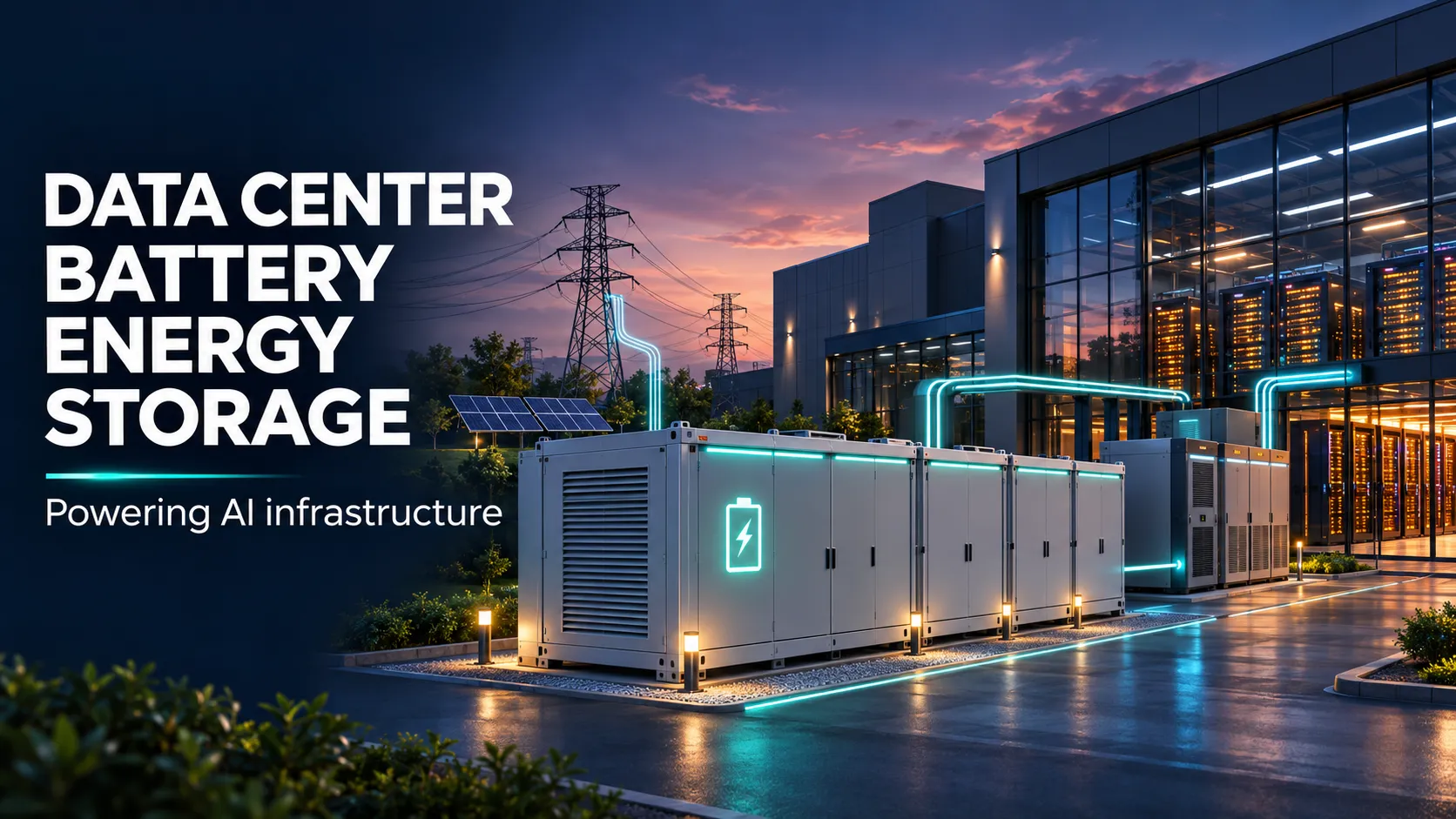
That shift is broadening the role of battery energy storage systems (BESS). Batteries can provide short-duration backup and help manage demand peaks, store renewable energy for later use, and support facilities facing grid constraints. The market now involves several kinds of suppliers: battery manufacturers, BESS integrators and providers of data center power infrastructure.
This article profiles 10 companies active across those layers. It is an analytical shortlist, not a verified ranking by market share. The companies are not direct equivalents: a battery cell supplier, a system integrator and a UPS provider may compete for different parts of a data center project.
Request Sample: https://www.datamintelligence.com/download-sample/battery-energy-storage-systems-market
How BESS fits into data center power infrastructure
A data center UPS and a campus-level BESS may both use batteries, but they serve different roles. A UPS protects critical IT equipment from power interruptions and disturbances, responding rapidly to maintain continuity. A larger BESS can support facility or campus power needs, including peak management, renewable integration and, depending on its design, backup.
The two systems may work together, but they are not interchangeable. Their configuration depends on the facility’s power architecture, runtime requirements, grid connection and operating goals. For AI campuses, these decisions can include how to handle rapid changes in demand while preserving power quality.
Lithium-ion batteries, particularly lithium iron phosphate (LFP), are widely used in stationary storage. The U.S. Energy Storage Market Outlook Q4 2026 estimates that LFP will account for 92% of lithium-ion BESS deployments in 2026. Alternative chemistries, including sodium-ion, are also being developed, but their suitability depends on application, availability and commercial deployment.
10 companies shaping the competitive landscape
1. Tesla Energy
Tesla Energy supplies integrated battery storage through Megapack, which combines battery modules, inverters, thermal systems and controls. The company identifies data centers among Megapack’s potential applications. That makes Tesla relevant to developers considering larger-scale storage for campus power, grid support or renewable integration.
Tesla’s competitive position comes from offering a packaged system rather than battery cells alone. For buyers, the central questions are whether the solution fits the site’s power design, required duration, interconnection plan and operating model. Project-level performance, service arrangements and delivery schedules matter as much as product specifications.
2. CATL
CATL is a major battery manufacturer with a growing stationary-storage portfolio. Its TENER products span lithium-ion and sodium-ion energy storage. In June 2026, CATL announced its TENER Sodium system, designed for modular configurations and multiple storage durations. In October, it signed a memorandum of understanding with European storage provider INTILION to plan 3 GWh of deployments across several markets over five years. These developments concern broader storage applications; they should not be described as data-center contracts without evidence of a direct connection.
CATL’s scale and chemistry development make it a significant participant in the battery supply layer. For data center buyers, however, a manufacturer’s total battery capacity does not establish how much is available for a specific project. Procurement teams need to assess system integration, regional sourcing, warranty terms and the project’s operational requirements.
3. BYD
BYD participates in energy storage through battery manufacturing and integrated solutions. Its energy storage business lists utility-scale and commercial and industrial BESS, microgrid controls, and power solutions for data centers among its areas of activity.
That combination can be relevant to facilities exploring both backup power and broader energy management. BYD’s product fit should be assessed by application: a data center UPS, a campus BESS and a grid-scale storage installation have different specifications. Buyers should confirm the exact product configuration, regional availability and whether the proposed equipment is designed for the intended use.
4. Sungrow
Sungrow supplies energy storage systems and power conversion equipment. Its PowerTitan portfolio is designed for utility-scale storage, with capabilities for integrating batteries, power conversion and system controls. This positions Sungrow primarily as a BESS provider rather than a data center UPS specialist.
For a data center project, Sungrow may be relevant when the requirement involves a larger storage installation supporting grid interaction, renewable power or facility-level energy management. Site design, controls integration and coordination with the data center’s critical-power systems remain important parts of project evaluation.
5. Fluence Energy
Fluence combines storage-system integration with energy management software and services. Its Smartstack platform is designed for grid-scale storage, and the company has described data center developers as a potential use case for high-density systems. This gives Fluence a role in projects where software and system orchestration are central to the storage plan.
The commercial distinction is that Fluence is not simply selling cells. Its offer focuses on integrating storage assets and managing their operation. Buyers should examine system performance, software capabilities, service coverage and how the solution will coordinate with onsite generation, utility power and facility controls.
6. LG Energy Solution
LG Energy Solution manufactures battery cells and supplies energy storage systems. The company has been expanding North American LFP production and integrating cells into complete storage systems. In November 2026, it reported securing a direct-supply behind-the-meter BESS project for a large technology customer, which it said could open opportunities for further AI data center projects.
That announcement is especially relevant because it identifies a direct data-center-related customer project, while many storage contracts serve the wider grid. LG’s competitive position combines localized manufacturing ambitions, LFP technology and system integration. Customers should still verify the project scope and distinguish announced capacity from equipment already commissioned.
7. Samsung SDI
Samsung SDI supplies batteries for energy storage, UPS and battery backup unit (BBU) applications. In August 2026, the company announced its expansion into AI data center BBUs using cylindrical batteries. In October, it reported more than 60 GWh of ESS orders during the year and said LFP production had begun at its StarPlus Energy facility in Indiana. On November 16, it announced a 16 GWh LFP supply agreement with Jupiter Power for U.S. storage projects beginning in 2029; that agreement is not identified as a data center contract.
Samsung SDI stands out for its presence across stationary storage and high-power battery applications for data centers. Its BBU and UPS products address rapid-response needs, while larger ESS products serve different applications. Buyers should compare these solutions separately rather than treating them as one interchangeable battery system.
8. Panasonic Energy
Panasonic Energy is developing battery technologies for both data center backup and larger storage applications. The company has discussed high-output BBUs, including solutions for power-dedicated racks, and outlined a ¥350 billion investment plan over three years that includes support for battery production and related manufacturing. In September 2026, Panasonic also announced a new battery research and development facility in Osaka to support automotive and data center applications.
Its position is particularly relevant where buyers are evaluating battery units close to server racks as well as broader power infrastructure. Manufacturing plans and product announcements indicate strategic intent; buyers should separately confirm availability, qualification status and delivery timelines for their region and application.
9. Schneider Electric
Schneider Electric is a data center power and energy management provider, not a battery cell manufacturer. Its portfolio includes UPS, power distribution, microgrid controls and energy management. Its EcoStruxure Microgrid Flex offer integrates control, electrical distribution, battery storage and services, making the company relevant to facilities considering coordinated onsite power systems.
Schneider’s value lies in connecting storage with the wider electrical architecture. For buyers, this can simplify coordination across power systems, but solution design still needs to account for the data center’s uptime requirements, existing infrastructure and chosen battery supplier.
10. Vertiv
Vertiv supplies data center critical-power infrastructure, including UPS and battery systems. Its portfolio has expanded toward facility-level storage: Vertiv lists EnergyCore Grid for applications including data centers, with support for behind-the-meter use cases such as microgrid operation and peak management.
In September 2026, Vertiv announced an agreement to acquire UtilityInnovation Group, a microgrid and behind-the-meter power architecture provider. The deal was intended to extend Vertiv’s capabilities toward grid interconnection, onsite generation and storage orchestration. The announcement described an agreement subject to approvals and closing conditions, so it should not be presented as a completed acquisition.
Request a Customized Report According to Your Business Strategy: https://www.datamintelligence.com/customize/battery-energy-storage-systems-market
Recent developments shaping competition
The latest U.S. market figures underscore the growing importance of commercial and industrial storage. The Energy Storage Market Outlook Q4 2026 reports that C&I and UPS BESS deployments reached 1.3 GWh in Q3, up 29% year over year. Year-to-date installations reached 5.4 GWh, exceeding the 4.8 GWh installed during all of 2025. The report points to data center growth and grid capacity constraints as demand drivers. These figures cover the broader C&I and UPS market, not data centers alone.
Three other developments illustrate how the market is evolving:
- Battery supply is localizing: Samsung SDI began LFP production at its Indiana facility, while LG Energy Solution has expanded its North American ESS production plans. Local manufacturing may influence sourcing decisions, but buyers should assess specific product eligibility and delivery capacity.
- Storage is being linked to clean-energy procurement: A Google-sponsored pilot announced in September by Quintrace, esVolta and LevelTen Energy tested shifting renewable energy through batteries to better match hourly electricity use. It illustrates a possible role for BESS beyond emergency backup: supporting energy management and carbon-free power strategies.
- Power infrastructure is converging: Vertiv’s proposed acquisition of UtilityInnovation points to growing interest in integrating UPS, storage, onsite generation and microgrid controls. The transaction was announced, not yet completed at the time of publication.
What buyers should compare
Comparisons across these suppliers should start with their role in the project. Battery manufacturers supply cells or storage products; integrators combine batteries, power conversion and controls; critical-power providers focus on UPS, distribution and facility infrastructure. Some companies operate across more than one layer.
Procurement teams should compare application fit, battery chemistry, usable capacity, duration, system efficiency, warranty, safety provisions, service support, manufacturing location and integration requirements. They should also check whether published performance relates to a specific product and whether a cited project is proposed, contracted or operating.
For U.S. projects, manufacturing location and grid constraints may shape supplier selection. In Japan and the wider Asia-Pacific region, buyers may prioritize energy security, local project requirements and access to regional service networks. Company presence alone does not confirm deployment in either market; project-level evidence is needed.
Outlook: which companies may benefit from AI data center demand?
Companies with relevant capabilities span all three competitive layers. Tesla, CATL, BYD, LG Energy Solution and Samsung SDI bring battery products and manufacturing; Fluence and Sungrow focus on storage systems and integration; Schneider Electric and Vertiv address critical power and facility infrastructure. Panasonic is investing in battery research and products aimed at data center applications.
The market’s competitive advantage may increasingly come from how well suppliers connect these capabilities to a specific site: reliable power, safe operations, integration with UPS and controls, available supply and support across the system lifecycle. AI demand is raising the stakes, but it does not make every BESS product a data center solution. Buyers should assess the complete power architecture before selecting a supplier.
Frequently Asked Questions
Who are the top companies in the data center battery energy storage market?
An analytical shortlist includes Tesla Energy, CATL, BYD, Sungrow, Fluence Energy, LG Energy Solution, Samsung SDI, Panasonic Energy, Schneider Electric and Vertiv. They operate in different parts of the supply chain, and this list is not a market-share ranking.
How is BESS different from a data center UPS?
A UPS protects critical equipment from power interruptions and disturbances. A larger BESS can support facility-level needs such as peak management, renewable integration and, when designed for it, backup. The systems may work together, but serve different functions.
Which companies are expanding U.S. battery production?
Recent company announcements describe U.S. ESS manufacturing activity or expansion by Samsung SDI, LG Energy Solution and Panasonic Energy. Buyers should confirm product availability, local qualification and delivery schedules for each project.