


The global battery energy storage system (BESS) industry is moving from an equipment procurement market toward an integrated grid-flexibility business. Utility-scale projects increasingly compete on delivered energy, availability guarantees, thermal safety, operating software and grid-forming performance. Cell cost remains important, but bankability and execution can determine which supplier wins a multi-year storage portfolio.
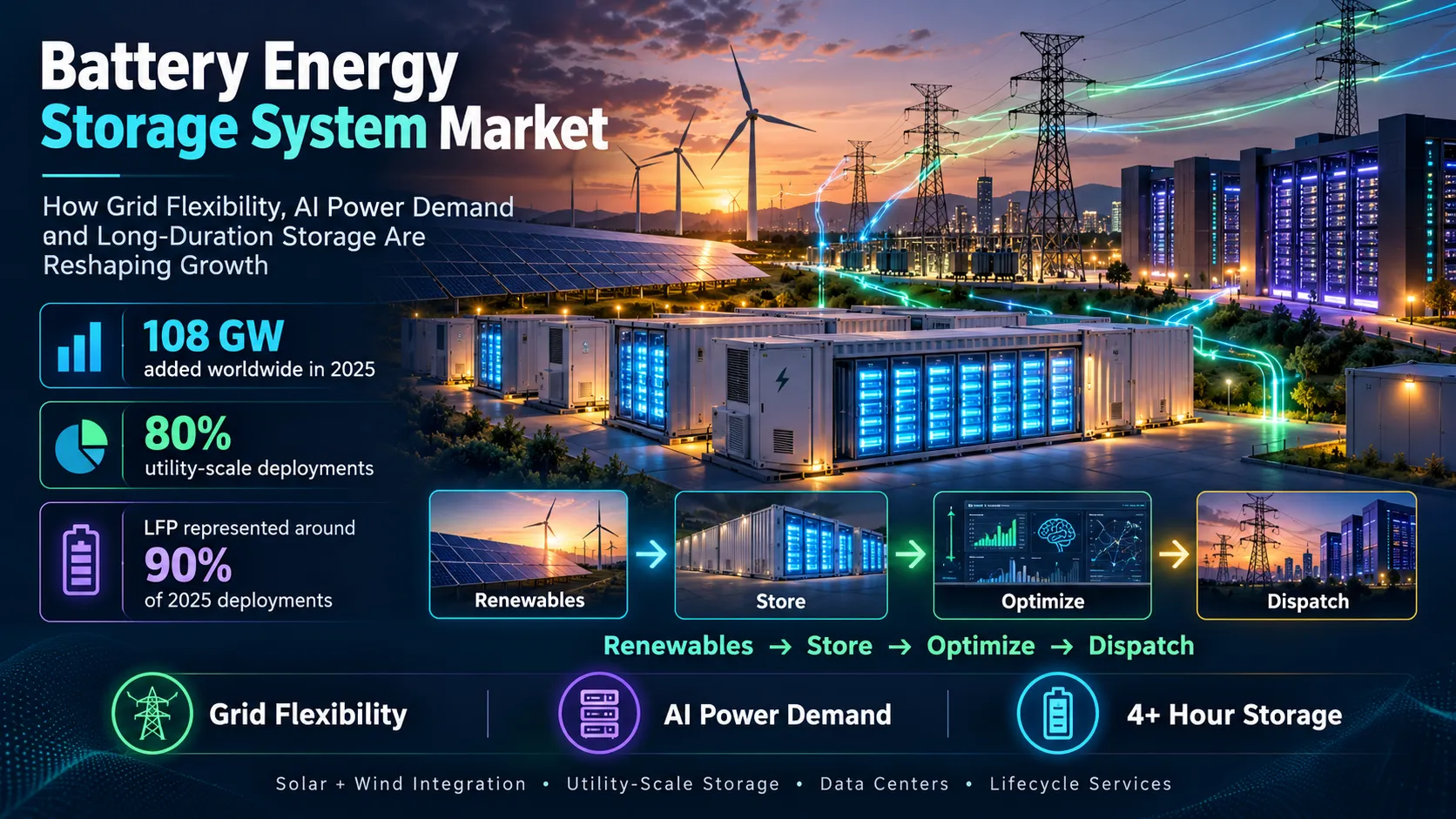
DataM Intelligence values the global BESS market at US$52.40 billion in 2025 and forecasts US$187.90 billion by 2035. Asia-Pacific is the largest regional market, supported by Chinese manufacturing and installations across China, Australia, India and Japan. Energy shifting, frequency response, capacity support, renewable integration and data center resilience are key uses.
The strategic direction is visible in industry leaders’ statements. At CATL’s 22 June 2026 sodium-ion storage launch, William Wu, Director of its Energy Storage Technology Center, described the ambition as developing chemistry based on “abundant resources available across all continents.” When Wärtsilä announced its planned energy-storage joint venture on 15 June 2026, CEO Håkan Agnevall emphasized strengthening competitiveness through an experienced integrated-storage partner. Both perspectives reinforce the importance of supply diversification and system economics.
Request Sample: https://www.datamintelligence.com/download-sample/battery-energy-storage-systems-market
Top 10 Companies Analysis
CATL
Global scale leader in storage cells and increasingly complete BESS solutions. Its TENER platform, LFP manufacturing scale and June 2026 sodium-ion commercial unveiling position the company across mainstream and emerging chemistries. Its main competitive issue is translating cell leadership into enduring project-level service and warranties.
BYD
A highly integrated battery and energy storage manufacturer supplying utility and commercial applications. Blade-battery-related manufacturing competencies and vertically integrated electronics support cost competitiveness. Investors should separate BYD’s much larger automotive business from stationary storage revenue.
Tesla Energy
Megapack and Powerwall combine battery hardware with integration, deployment services and software. Tesla recorded US$12.77 billion in 2025 energy generation and storage segment revenue, including non-storage generation activities. Its advantage is standardized large-project delivery; execution capacity and price compression shape margins.
Sungrow
A major power-conversion and system-integration supplier whose PowerTitan platform combines batteries, liquid cooling, inverters and grid-support functions. Strong utility relationships and integrated PCS expertise underpin global growth; deployment and long-term performance remain key differentiators.
Fluence Energy
A grid-scale system integrator offering Gridstack hardware, controls, lifecycle services and optimization software. Its equipment-agnostic procurement and localization approach helps address large utility tenders. Competitive pressure centers on delivered cost, warranties and project timing.
LG Energy Solution
An established cell manufacturer supplying stationary projects alongside EV customers. Its geographic manufacturing presence supports supply diversification. Storage customers increasingly evaluate LFP costs and long-duration warranties against incumbent nickel-based manufacturing strengths.
Samsung SDI
An established advanced-battery supplier pursuing stationary installations through battery design, modules and safety systems. Differentiation lies in cell quality and industrial engineering; broad LFP cost competition remains a challenge.
EVE Energy
A rapidly scaling Chinese cell producer with large-format stationary-storage offerings. Its strength is competitive cell supply and growing BESS partnerships, though overseas system warranties and local-service reach matter for major tender awards.
Wärtsilä / Valo
Wärtsilä supplied grid-scale storage systems, lifecycle services and GEMS energy-management software. On 1 October 2026 it completed a 50:50 joint venture with RCT Solutions, named Valo, designed to strengthen manufacturing integration and commercial execution.
Hitachi Energy
A grid-engineering provider with a strong position in power conversion, grid interfaces and project integration. Its storage relevance is greatest where controls, transformers, grid-forming performance and utility engineering are integral to the contract.
Competitor Analysis: Leading BESS Market Players
| Company | 2025 Revenue (USD) | Revenue scope | Strategic position |
| CATL | US$58.9bn | Group; storage + EV batteries | Cells, TENER, sodium-ion |
| BYD | US$111.0bn | Group; mostly automotive | Integrated cells and systems |
| Tesla Energy | US$12.77bn | Energy generation + storage segment | Megapack and controls |
| Sungrow | US$12.4bn | Group; solar + energy storage | PowerTitan and PCS |
| Fluence Energy | $2.26 bn | Pure-play systems and software | Gridstack and optimization |
| LG Energy Solution | $17.3 bn | Storage + EV cells | Supply localization |
| Samsung SDI | $9.7 bn | Storage + EV cells | Safety and cell systems |
| EVE Energy | $8.5 bn | Cells across applications | Large-format stationary cells |
| Wärtsilä / Valo | $7.24 bn | 2025 energy storage segment | Grid integration / GEMS |
| Hitachi Energy | $15.4 bn | Business within Hitachi group | Grid interfaces and controls |
Request Sample: https://www.datamintelligence.com/download-sample/battery-energy-storage-systems-market
Who Are the Rising Companies Influencing the Market?
- Eos Energy Enterprises - Strategic focus: commercialize zinc-based long-duration storage for grid capacity and power-hungry industrial or data-center customers.
- Invinity Energy Systems - Strategic focus: develop vanadium flow storage for frequent cycling and longer-duration applications.
- Form Energy - Strategic focus: commercialize multi-day iron-air storage for resource adequacy in renewable-heavy electricity markets.
- Hithium - Strategic focus: scale dedicated stationary LFP cells and containerized storage systems in international markets.
- Alfen - Strategic focus: integrate battery storage with European grid connections and diversify toward sodium-ion through its 2026 CATL collaboration.
Major Mergers, Acquisitions and Portfolio Restructuring - 2026
- 15 June 2026 - Wärtsilä announced an agreement to establish a 50:50 energy-storage joint venture with RCT Solutions. The strategic purpose was stronger vertical integration, project delivery and competitiveness.
- 1 October 2026 - Wärtsilä confirmed completion of the joint venture, named Valo. This is a completed restructuring, rather than a proposed acquisition.
- 16 July 2026 - CATL and Alfen announced a 5 GWh European sodium-ion storage collaboration. This is a strategic commercial partnership, not an acquisition.
- 21 July 2026 - CATL and Solarpro announced a 2 GWh sodium-ion cooperation agreement for Eastern Europe, extending their future deployment pipeline.
Recent Innovations and Their Potential Impact - June to October 2026
- 22 June 2026 - CATL unveiled its TENER Sodium energy storage system, describing it as commercially validated. Impact: sodium-ion offers supply-chain diversification beyond lithium and could open new procurement options where cycle life, cost and temperature tolerance matter.
- 1 July 2026 - Sungrow announced its PowerTitan 3.0 received The smarter E AWARD for energy storage. Impact: recognition strengthens the commercial case for integrated high-density liquid-cooled storage with advanced thermal and power-conversion capabilities; the underlying product was launched earlier.
- 5 August 2026 - Eos reported commercial production on a second zinc battery line and improvements in production cycle time. Impact: higher manufacturing throughput may reduce delivery bottlenecks for non-lithium long-duration projects.
- 2 September 2026 - Eos, MN8 Energy and Google announced a project combining 10 MW/100 MWh of zinc-based storage with 70 MW/280 MWh of lithium-ion storage and solar generation. Impact: hybrid storage can align short-duration balancing with longer-duration clean-power needs.
What Is Driving Competition in the Market?
BESS purchasing decisions increasingly turn on contracted availability, system safety, fire mitigation, construction timelines, warranty economics, augmentation costs and grid interconnection. LFP remains the mainstream chemistry, but sodium-ion, zinc-based and flow-battery systems are becoming credible alternatives for selected durations and operating conditions.
Vertical integration is becoming a competitive dividing line. CATL and BYD derive leverage from cell scale, while Tesla, Sungrow and Fluence emphasize integrated systems, power electronics and operational software. Local sourcing requirements, import tariffs and safety permitting create openings for regional suppliers that can document project reliability and offer responsive maintenance.
The next phase of competition will increasingly favor suppliers able to deliver reliable megawatt-hours at a predictable lifetime cost, rather than the lowest initial battery price. DataM Intelligence identifies renewable integration, energy arbitrage, grid services and data center power support as key growth categories through 2035.