


Autonomous & Self-Driving Cars Commercial Intelligence
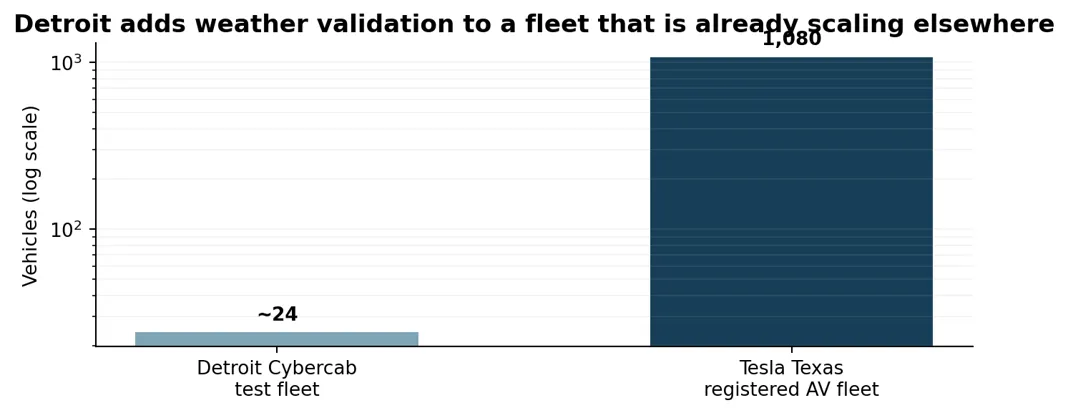
| DETROIT TEST | About two dozen Cybercabs are now running on Metro Detroit roads with test drivers and temporary steering wheels, moving Tesla's validation program into snow, ice and multi-season conditions. |
| AUSTIN PROOF | Cybercab entered Tesla's commercial Robotaxi service in Austin on September 3. Tesla reported nearly 2 million cumulative unsupervised Robotaxi miles by the end of Q3. |
| COMMERCIAL CLOCK | Tesla says it is trying to deliver Cybercabs to customers by the end of 2026, while NHTSA is simultaneously auditing the vehicle's self-certification without conventional driver controls. |
The Robotaxi Debate Has Shifted From Software Demos to Fleet Operations
Tesla's Cybercab story is becoming commercially important because three previously separate questions are converging at once: Can the vehicle operate without conventional controls? Can the software handle a wider range of environments? And can Tesla manufacture and deploy enough vehicles for autonomy to become a network business rather than a technology demonstration?
The Detroit deployment matters because it attacks the environmental question. About two dozen gold Cybercabs have been observed around Metro Detroit, including I-696, M-10, Telegraph Road and Eight Mile. These vehicles still use human test drivers and temporary steering wheels, so this is not a driverless commercial launch. It is a validation program in a region where snow, ice, low winter sun and rapidly changing road conditions create a very different operating domain from Austin.
At the same time, Austin has become the commercialization proof point. Cybercab entered paid Robotaxi service on September 3, while Tesla's broader Robotaxi network is now operating across multiple Texas and Florida cities. That combination is changing the competitive benchmark from “who has the best demo?” to “who can accumulate autonomous miles, expand geographies, manufacture purpose-built vehicles and clear regulation at the same time?”
Request Executive Sample: https://www.datamintelligence.com/download-sample/autonomous-self-driving-cars-market
Texas Shows Tesla Is No Longer Operating at Pilot-Fleet Scale
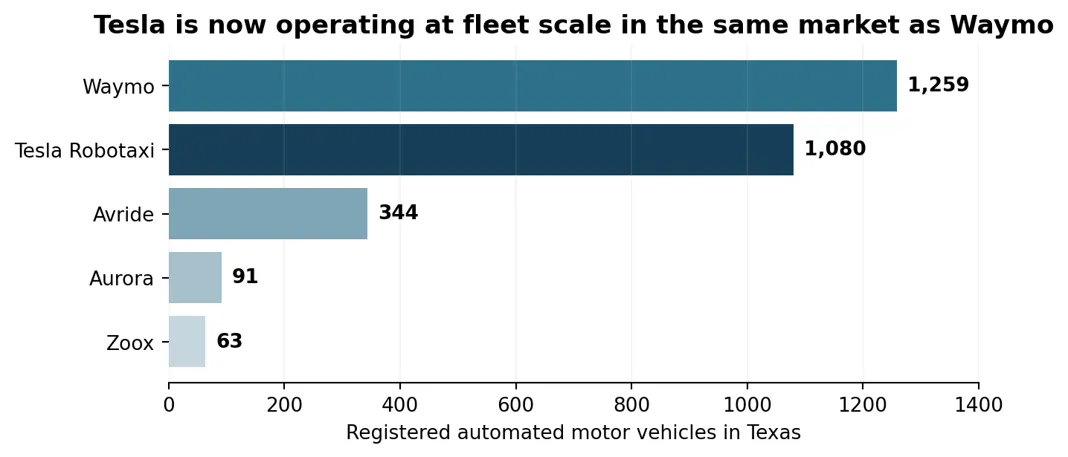
Texas DMV records listed 1,080 automated vehicles under Tesla Robotaxi as of October 29, compared with 1,259 for Waymo. The gap between the two largest operators was only 179 vehicles. Registration counts are not identical to vehicles simultaneously carrying passengers, but they are still a useful measure of how quickly autonomous fleets are moving into operational scale.
This is strategically important because the economics of robotaxis are fleet economics. A purpose-built autonomous vehicle only becomes disruptive when manufacturing, charging, cleaning, maintenance, insurance, teleoperations and dispatch can work across hundreds or thousands of vehicles. Fleet size therefore becomes as important as the driving stack itself.
Austin Is Still the Center of Gravity - But the Network Is Spreading
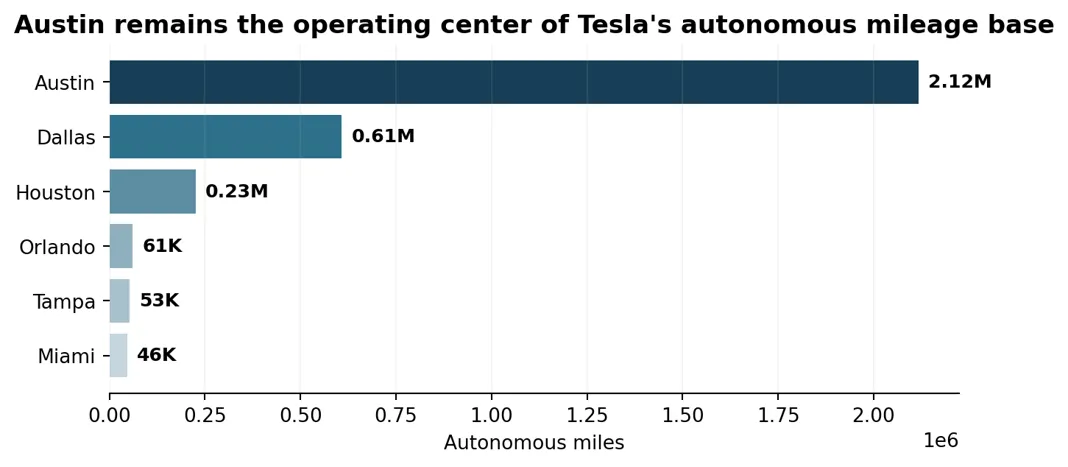
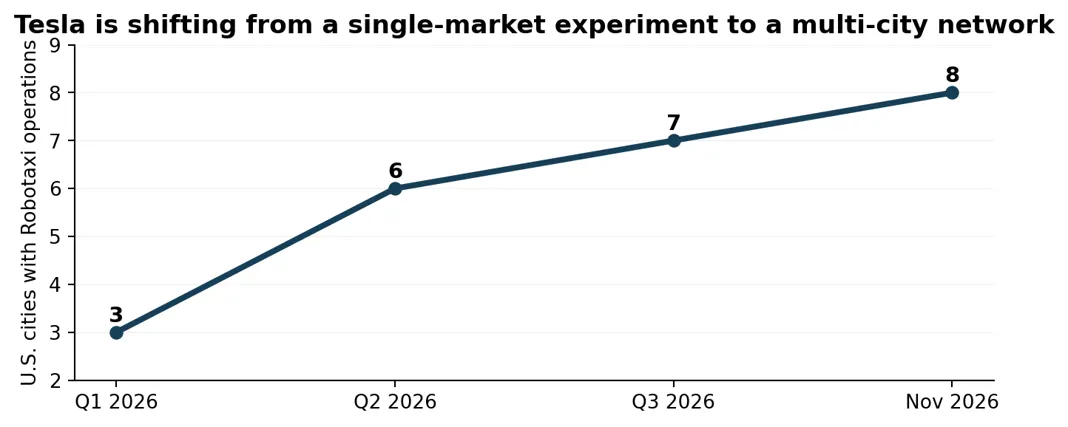
Tesla reported 3.1 million autonomous Robotaxi miles as of October 18, with Austin accounting for more than 2.1 million. Dallas had passed 608,000 miles and Houston 225,000, while Miami, Orlando and Tampa were building smaller operating bases. Tesla's current Robotaxi site now lists eight operating cities across Texas and Florida, showing how quickly the company is attempting to replicate the operating model beyond its original launch market.
Detroit Adds a Different Kind of Data: Multi-Season Validation
Scale in Texas does not answer every autonomy question. Detroit introduces conditions that matter disproportionately for a camera-led system: winter precipitation, salt spray, dirty road surfaces, glare, low contrast lane markings and fast transitions between dry, wet and frozen pavement. Tesla's Detroit fleet therefore has strategic value even if it is small.
The important distinction is that the roughly two dozen Detroit Cybercabs are test vehicles with human drivers and temporary steering wheels. Waymo, by contrast, began fully driverless testing in Metro Detroit in October 2026. The two companies are therefore collecting similar environmental evidence through different deployment models.
The Bigger Constraint May Be Regulation, Not Vehicle Manufacturing
Tesla's strategy depends on Cybercab being treated as a vehicle designed around autonomy rather than a conventional car with the driver removed. That puts federal safety standards directly into the commercialization path. Cybercab lacks permanently attached steering, accelerator and brake controls, along with conventional mirrors.
On September 4, NHTSA opened an Audit Query into Tesla's self-certification that Cybercab complies with applicable Federal Motor Vehicle Safety Standards. The agency said it would examine the technical data and processes Tesla used, including whether Tesla correctly determined that some requirements are inapplicable to a vehicle without traditional human controls. That makes regulation a potential fleet-ramp variable, not merely a legal footnote.
| MANUFACTURE Cybercab production | VALIDATE Austin + Detroit | CERTIFY FMVSS pathway | DEPLOY City fleet growth | MONETIZE Rides + ownership |
The 2026 End of year Customer Target Changes the Business Model
Tesla told investors in its Q3 2026 earnings call that it is trying to get Cybercabs to customers by the end of the year. The company also said all current production is going into its internal Robotaxi fleet and that the vast majority of Cybercabs are expected to remain Tesla-owned and operated as transport-as-a-service assets.
That distinction matters for the autonomous-car market. A customer-owned Cybercab introduces new questions around vehicle financing, insurance, fleet management, remote support, maintenance responsibility and whether privately owned autonomous vehicles can participate in Tesla's ride-hailing network. Tesla has said first customer vehicles may begin joining the Robotaxi fleet around Q2 2027. The market is therefore starting to blur the line between vehicle sale, fleet asset and mobility service.
Five Commercial Signals Autonomous-Vehicle Companies Should Track
| Signal | What it reveals | Likely market impact | Commercial action |
| Cold-weather test fleet | Operating domain is widening | Higher validation burden for perception and controls | Track climate-specific testing by city |
| Purpose-built AV deployment | Autonomy is moving into dedicated hardware | New vehicle architecture, service and insurance models | Benchmark cost per mile and fleet uptime |
| State fleet registrations jump | Operator is preparing for scale | Charging, depots, cleaning and maintenance capacity | Map infrastructure partners and local permits |
| Federal certification inquiry | Regulation can gate fleet ramp | Deployment timing and design changes | Track NHTSA and FMVSS rulemaking |
| Customer ownership begins | Robotaxi model extends beyond operator-owned fleets | Financing, insurance and fleet-management demand | Identify new ecosystem and channel partners |
Request a Customized Report According to Your Business Strategy: https://www.datamintelligence.com/customize/autonomous-self-driving-cars-market
Why This Matters for the Autonomous & Self-Driving Cars Report
Autonomy is no longer adequately measured by software capability alone. The commercial market now depends on a connected set of variables: fleet size, autonomous miles, city-by-city operating domains, weather exposure, vehicle architecture, regulatory approvals, depot infrastructure, insurance, partnerships and the economics of owned versus customer-operated fleets.
Tesla's Cybercab illustrates why those variables must be tracked together. Detroit is a weather-validation story. Austin is a commercialization story. Texas registration data is a fleet-scale story. NHTSA is a regulatory story. The end-2026 customer target is a business-model story. Looking at only one of those signals can produce the wrong conclusion about who is actually closest to scalable autonomous mobility.
| WHAT THE DATAM AUTONOMOUS & SELF-DRIVING CARS REPORT HELPS ANSWER • Which companies are moving from testing into paid autonomous operations? • How do Tesla, Waymo, Zoox and other operators compare by fleet size, operating geography and autonomous mileage? • Which cities and regulatory jurisdictions are opening fastest to driverless deployment? • How are camera-only, lidar-radar-camera and other sensor strategies translating into commercial operating domains? • Where are purpose-built robotaxis changing vehicle cost, maintenance, insurance and fleet infrastructure requirements? • Which 2026-2027 milestones could materially change competitive position and commercialization timing? |
Use the report to move from autonomy headlines to company-by-company, city-by-city decisions on deployment readiness, regulatory risk and commercial scale: Explore DataM Intelligence Autonomous & Self-Driving Cars Research