


Sustainable packaging is no longer only a packaging-design conversation. It is now reshaping the chemistry, compliance, technology, and competitive structure of the global printing ink industry.
Brands want recyclable packaging. Regulators want safer materials. Converters want faster production with fewer emissions. Food and beverage companies want low-migration inks. E-commerce companies want durable graphics on corrugated packaging. Packaging buyers want inks that support sustainability claims without affecting shelf appeal, print quality, color strength, or production speed.
This is why the global ink industry is entering a new phase in 2026. The strongest growth is not coming from traditional commercial printing. It is coming from packaging, labels, flexible films, paperboard, corrugated boxes, food-safe packaging, water-based formulations, UV-curable inks, and flexographic technologies.
For companies tracking the Printing Inks Market, the real market signal is clear: ink suppliers are no longer competing only on color, price, and press compatibility. They are competing on sustainability, compliance, recyclability, low migration, energy efficiency, and packaging performance.
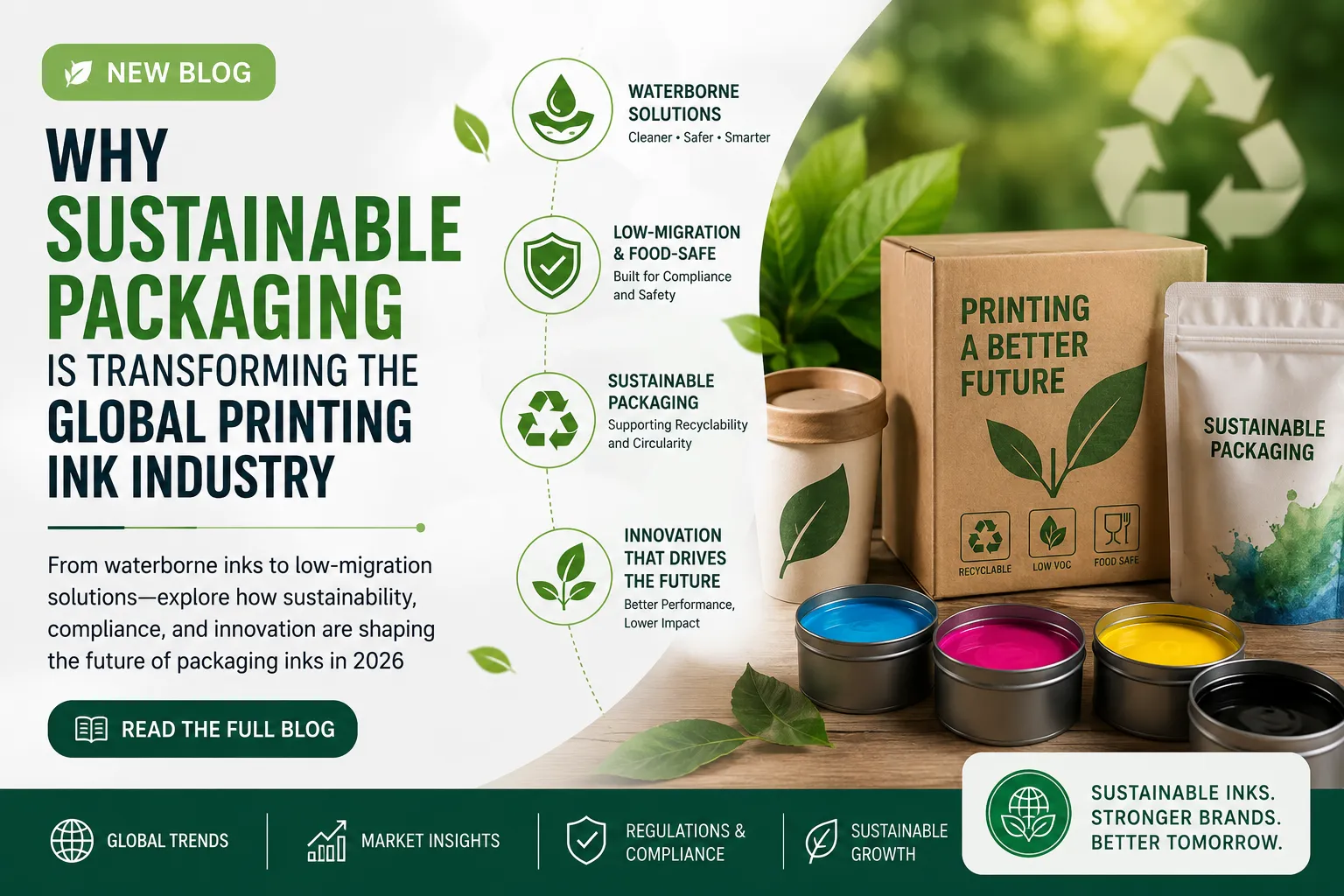
Packaging Sustainability Is Becoming the Main Growth Engine
The packaging industry is one of the largest demand centers for printing inks because almost every packaged product requires branding, labeling, product information, traceability, safety instructions, regulatory details, or anti-counterfeit features.
In 2026, packaging sustainability is pushing ink manufacturers to rethink formulations. The question is no longer simply whether an ink prints well. Buyers now want to know whether the ink supports recyclable packaging, whether it is suitable for food packaging, whether it has low VOC emissions, whether it works on paper-based alternatives, and whether it can support mono-material packaging structures.
This is especially important for flexible packaging, folding cartons, labels, corrugated packaging, pouches, wrappers, sachets, and food containers. These applications require inks that can perform under heat, friction, moisture, handling, sealing, and distribution stress.
The Packaging Inks Market is becoming more strategic because packaging inks now influence sustainability outcomes. Poor ink selection can affect recyclability, migration risk, color consistency, and packaging compliance. Better ink systems can support safer food packaging, cleaner recycling streams, sharper branding, and lower environmental impact.
Why Waterborne Inks Are Replacing Solvent-Based Inks
Waterborne inks are gaining strong attention because they reduce dependence on solvent-heavy formulations. For packaging converters and brand owners, this matters because solvent-based inks can create concerns around VOC emissions, odor, worker safety, regulatory compliance, and environmental footprint.
The Waterborne Ink Market is benefiting from this shift. Water-based inks are increasingly used in paper, paperboard, corrugated packaging, labels, flexible packaging, and food-related applications where lower emissions and improved sustainability are important.
Why buyers are moving toward water-based inks
Waterborne inks are attractive because they support cleaner production environments and help converters align with sustainability goals. They are also becoming more technically capable. Earlier, some converters viewed water-based inks as weaker in drying speed, adhesion, and color strength compared with solvent-based systems. Today, improved resin technologies, additives, pigment dispersion, and drying systems are making waterborne inks more competitive.
Where waterborne inks create the strongest value
Waterborne inks are especially relevant in corrugated packaging, paper bags, food packaging, cartons, labels, and sustainable paper-based packaging formats. As brands shift from plastic-heavy packaging to fiber-based alternatives, waterborne ink systems are likely to gain more commercial importance.
For decision-makers, the message is direct: waterborne inks are not only an environmental alternative. They are becoming a mainstream packaging ink platform.
Regulatory Pressure is Changing Ink Formulation Decisions
Regulation is one of the strongest forces reshaping the printing ink industry in 2026.
Packaging inks used in food, beverages, pharmaceuticals, cosmetics, and personal care products must address chemical safety, migration risk, raw material selection, and documentation. In food packaging, the biggest concern is migration, where chemical substances from inks, coatings, adhesives, or packaging layers may transfer into the product.
This is why low-migration inks, food-contact compliant inks, and documentation-backed formulations are gaining importance. Regulatory pressure is also pushing companies toward better raw material screening, stronger supplier documentation, and improved testing protocols.
Compliance is becoming a commercial differentiator
In the past, compliance was often treated as a technical requirement. In 2026, it is becoming a sales advantage.
Packaging buyers increasingly prefer ink suppliers that can provide documentation, migration testing support, regulatory guidance, and application-specific recommendations. This is especially important for food packaging, pharmaceutical packaging, and premium consumer goods packaging.
Ink companies that can support compliance across Europe, North America, and Asia-Pacific will have a stronger position with multinational packaging converters and brand owners.
Growth of Food-Safe and Low-Migration Packaging Inks
Food-safe packaging inks are one of the hottest topics in the ink industry because food packaging carries high regulatory and reputational risk.
Brands cannot afford packaging failures linked to odor, contamination, migration, or non-compliance. As a result, demand is increasing for low-migration inks, migration-optimized UV inks, water-based food packaging inks, compliant coatings, and packaging systems designed for indirect food contact.
Why food-safe inks matter in 2026
Food packaging is becoming more complex. Brands want attractive graphics, faster production, sustainable materials, recyclable structures, and compliance assurance at the same time. This creates a need for inks that can support both performance and safety.
Low-migration inks are especially important in folding cartons, flexible packaging, labels, wraps, paperboard packaging, and pharmaceutical cartons. These inks are formulated to reduce the risk of chemical transfer and support safer packaging structures.
For companies evaluating packaging ink suppliers, food-safe capability should be part of supplier qualification, not an afterthought.
Flexographic Printing Inks Are Winning in Packaging
Flexographic printing continues to gain importance because it is widely used in flexible packaging, labels, corrugated boxes, paper bags, cartons, and films. It offers speed, versatility, and compatibility with multiple substrates.
The Flexographic Printing Inks Market is closely linked to packaging growth. As e-commerce, food delivery, personal care, pharmaceuticals, and FMCG packaging expand, flexographic inks are becoming more important for high-volume packaging production.
Why flexographic inks are strategically important
Flexographic printing works well for both short-run and large-volume packaging. It can support water-based, solvent-based, and UV-curable ink systems. This flexibility makes it important for converters balancing cost, performance, sustainability, and compliance.
In 2026, water-based flexographic inks and low-migration UV flexo inks are likely to attract more attention as packaging converters look for safer, lower-emission, and regulation-ready solutions.
Future of UV-Curable and LED-UV Ink Technologies
UV-curable printing inks are becoming more important because they offer fast curing, strong adhesion, high print quality, durability, and lower VOC emissions compared with many conventional solvent-based systems.
The UV Cured Printing Inks Market is benefiting from demand across packaging, labels, commercial printing, industrial printing, cosmetics packaging, electronics, and specialty applications.
Why UV and LED-UV inks are trending in 2026
LED-UV curing is one of the most important technology trends in the ink industry. It can reduce energy use, improve curing control, support faster production, and work on heat-sensitive substrates. This makes it valuable for flexible packaging, labels, plastics, films, folding cartons, and specialty packaging.
UV-curable inks are also gaining attention in food packaging, but only when low-migration and compliance requirements are properly addressed. As a result, the market is moving toward safer photoinitiator systems, migration-optimized UV formulations, and better curing controls.
The strategic opportunity
UV and LED-UV technologies are not replacing all conventional inks. Instead, they are becoming premium solutions for applications that require speed, durability, high graphics quality, low emissions, and efficient production.
Ink Industry Trends to Watch in 2026
1. Low-migration inks for food and pharma packaging
Food-safe and pharmaceutical packaging will continue to drive demand for compliant ink systems with strong documentation.
2. Water-based inks for paper and corrugated packaging
As brands shift toward paper-based packaging and fiber-based alternatives, waterborne inks will gain more traction.
3. LED-UV curing for energy-efficient printing
LED-UV curing will become more important for converters seeking faster output, lower energy use, and better substrate flexibility.
4. Deinkable and recycling-friendly inks
Recyclability is becoming a packaging design priority. Inks that improve deinking and recycling outcomes will gain strategic value.
5. Digital and hybrid printing inks
Short-run packaging, personalization, variable data, and e-commerce packaging will support demand for digital inkjet and hybrid printing systems.
6. Bio-based and low-carbon ink formulations
Brands are looking beyond recyclability and asking for lower-carbon materials. This will support innovation in bio-based resins, renewable content, and carbon-footprint reporting.
Regional Opportunities in Sustainable Printing Inks
Asia-Pacific
Asia-Pacific remains one of the most important growth regions due to packaging demand, manufacturing expansion, consumer goods production, e-commerce growth, and rising food and beverage consumption. China, India, Japan, South Korea, and Southeast Asia are expected to remain important demand centers for packaging inks, flexographic inks, waterborne inks, and UV-curable technologies.
North America
North America is a high-value market for sustainable packaging inks due to strong brand-owner commitments, food packaging standards, e-commerce packaging demand, and investment in advanced printing technologies. Demand is particularly strong for low-migration inks, UV-curable inks, corrugated packaging inks, and water-based flexographic systems.
Europe
Europe is one of the most regulation-driven markets. Sustainability, circular packaging, chemical safety, and food-contact compliance are central to purchasing decisions. This makes Europe a strong market for waterborne inks, low-migration inks, recycling-friendly inks, and documentation-backed packaging ink solutions.
Top 5 Global Ink Players and Strategic Importance in 2026
Market-share figures below are approximate strategic estimates based on global ink and graphic arts sales visibility and total printing ink market baselines. They should be treated as directional, not as audited company-declared shares.
| Rank | Company | Approx. Global Printing Ink Market Share | Strategic Importance in 2026 |
| 1 | DIC Corporation / Sun Chemical | 25% | Strong global leadership in packaging inks, pigments, coatings, UV inks, water-based inks, and sustainability-focused ink systems. Its scale makes it highly important for food packaging, labels, flexible packaging, and compliance-led innovation. |
| 2 | Flint Group | 13% | Strategically important in flexographic, narrow web, packaging, and low-migration UV ink technologies. Its role is significant as converters demand safer food packaging inks and energy-curable solutions. |
| 3 | Toyo Ink / artience Group | 6% | Important in Asia-Pacific packaging, gravure, offset, functional inks, and specialty materials. The company is strategically positioned as demand rises for sustainable and high-performance ink systems in Asia. |
| 4 | Sakata INX | 5% | Strong in packaging, digital, UV, water-based, and specialty inks. Its global and Asia-focused presence makes it important for converters seeking sustainable packaging and circularity-ready ink solutions. |
| 5 | Siegwerk | 5% | A key packaging ink specialist with strong positioning in food-safe inks, circular packaging coatings, flexible packaging, and low-migration systems. Its strategic value is rising as brands demand recyclable and compliant packaging. |