


Introduction
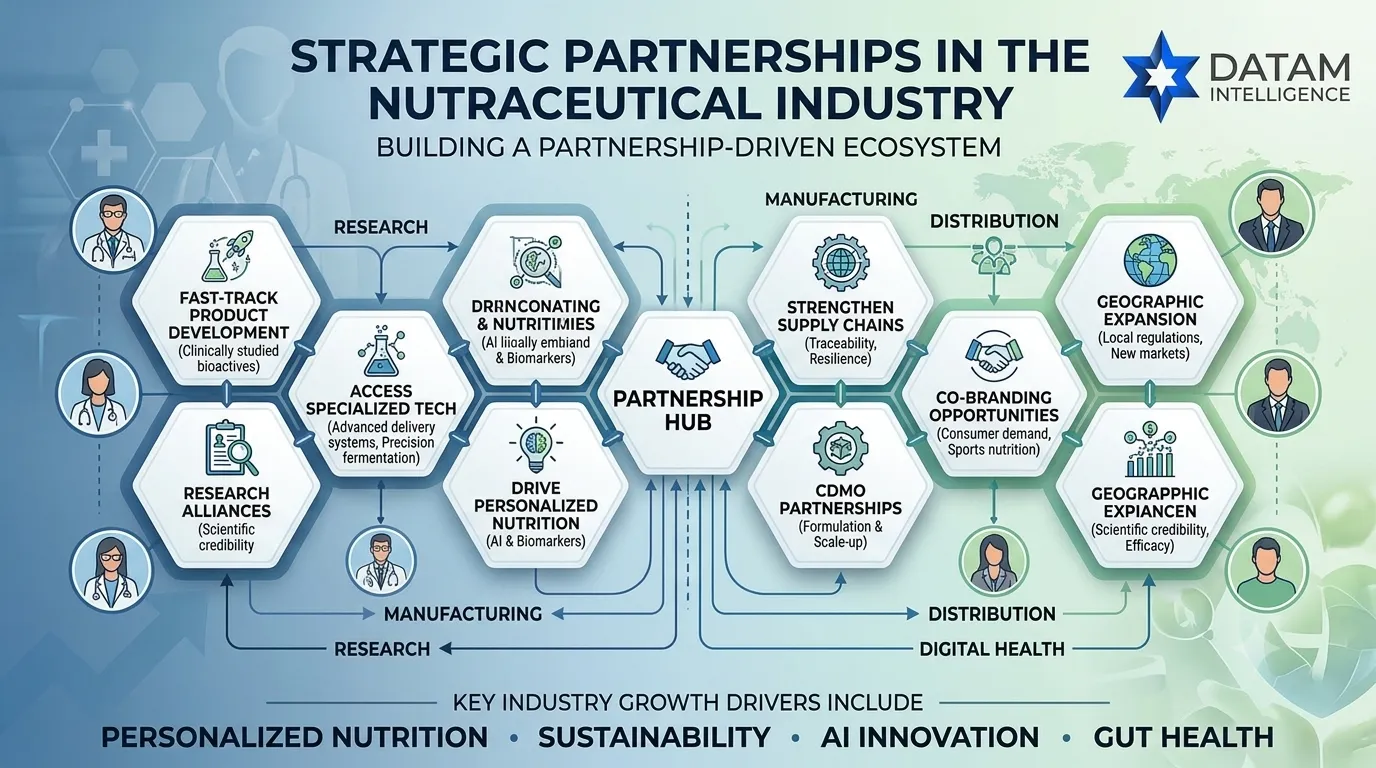
The global nutraceutical industry is entering a partnership driven phase in which companies are increasingly collaborating across ingredients, biotechnology, research, formulation, manufacturing, distribution and digital health. Rather than relying entirely on internal capabilities, nutraceutical companies are forming strategic alliances to shorten product-development timelines, access specialized technologies, strengthen supply chains and enter new geographic markets.
This shift is becoming particularly important as consumers demand scientifically supported ingredients, personalized nutrition, convenient delivery formats, clean-label formulations and products targeting specific health outcomes.
According to DataM Intelligence, the global nutraceuticals market was valued at US$505.45 billion in 2024 and is projected to reach US$874.97 billion by 2032, expanding at a 7.1% CAGR from 2025 to 2032. The market is also being influenced by personalized nutrition, sustainability and continued product innovation.
At the ingredient level, DataM Intelligence estimates that the global nutraceutical ingredients market reached US$157.98 billion in 2025, with growth increasingly linked to preventive healthcare, functional nutrition and demand for scientifically supported ingredients.
Partner With DataM Intelligence to Unlock New Growth Opportunities
Join forces with DataM Intelligence to expand your reach, connect with high-value business opportunities, and leverage actionable market intelligence. Whether you are looking to strengthen your market presence, build strategic relationships, or access new growth opportunities, our partnership program is designed to create lasting value.
Become a DataM Intelligence Partner today and explore new opportunities for collaboration.
The result is a competitive environment where the ability to build the right ecosystem of partners can become as important as owning a strong product portfolio.
What Are Strategic Partnerships in the Nutraceutical Industry?
Strategic partnerships in the nutraceutical industry are structured collaborations between two or more organizations that combine complementary capabilities to create, manufacture, commercialize or distribute nutrition and wellness products.
Partners can include:
- Nutraceutical ingredient manufacturers
- Biotechnology companies
- Pharmaceutical companies
- Food and beverage manufacturers
- Contract development and manufacturing organizations (CDMOs)
- Clinical research organizations
- Universities and research institutions
- Digital health and AI companies
- Retailers and e-commerce platforms
- Distribution companies
- Healthcare and wellness organizations
These partnerships can take several forms, including co-development agreements, licensing arrangements, joint ventures, contract manufacturing agreements, technology collaborations, distribution partnerships, research alliances and acquisitions.
The strategic objective is increasingly moving beyond simple supplier relationships toward long-term capability sharing and commercialization ecosystems.
Why Strategic Partnerships Are Becoming Critical for Nutraceutical Companies
1. Faster Product Development
Developing a nutraceutical product internally can require expertise across ingredient science, formulation, clinical validation, regulatory compliance, manufacturing and commercialization.
Strategic partnerships allow companies to combine these capabilities.
An ingredient manufacturer may provide a clinically studied bioactive, while a formulation company develops the dosage format and a CDMO scales production. This can significantly reduce the time required to move an innovation from concept to market.
The growing importance of this model is reflected in recent industry activity. In 2026, Martin Bauer, Finzelberg and MB-Med formed a unified Nutraceutical Unit designed to connect botanical raw-material expertise, extraction, clinical substantiation and market-ready ingredient development.
2. Access to Specialized Ingredients and Technologies
The next generation of nutraceutical products increasingly depends on differentiated technologies rather than commodity ingredients.
Companies are pursuing partnerships involving:
- Probiotics and postbiotics
- Prebiotics
- Plant extracts
- Omega-3 fatty acids
- Protein and amino acids
- HMOs
- Precision-fermented ingredients
- Microencapsulation
- Controlled-release systems
- Advanced delivery technologies
- Bioavailability-enhancing technologies
These partnerships enable brands to access scientific and manufacturing capabilities that may be expensive or time-consuming to build internally.
3. Personalized Nutrition Is Encouraging Cross-Industry Collaboration
Personalized nutrition is one of the clearest areas where partnerships are reshaping the nutraceutical ecosystem.
Personalized products require a combination of:
Consumer data + biomarkers + nutrition science + AI + formulation + manufacturing + distribution
No single company necessarily controls all of these capabilities.
Consequently, nutraceutical brands are collaborating with digital health platforms, AI companies, diagnostic providers, ingredient suppliers and personalized supplement manufacturers.
For example, Q1 2026 industry activity highlighted Bioniq's integration with Herbalife as a way to expand personalized nutritional supplements through Herbalife's global manufacturing and distribution capabilities.
DataM Intelligence also identifies AI as an important force in nutraceutical product formulation, personalized nutrition, quality control, supply-chain optimization and consumer engagement.
4. Partnerships Are Strengthening Nutraceutical Supply Chains
Supply-chain resilience has become a strategic priority for nutraceutical companies.
Ingredient shortages, geopolitical uncertainty, transportation disruptions, changing regulations and fluctuations in raw-material prices can affect product availability and margins.
As a result, companies are increasingly considering partnerships that provide:
- Multi-region sourcing
- Localized manufacturing
- Alternative ingredient suppliers
- Long-term capacity agreements
- Integrated logistics
- Greater traceability
- Quality-control support
- Contract manufacturing capacity
The shift toward supply-chain control is also visible in 2026 investment activity, where buyers have increasingly targeted manufacturing capacity, cross-border distribution and vertically integrated capabilities.
5. Contract Manufacturing Partnerships Are Moving Up the Value Chain
Contract manufacturers are no longer viewed simply as production vendors.
Modern nutraceutical CDMOs increasingly participate in:
- Product formulation
- Ingredient selection
- Prototype development
- Dosage-form development
- Stability testing
- Regulatory support
- Packaging
- Scale-up
- Global manufacturing
- Fulfillment
This creates deeper partnerships between brands and manufacturers.
In June 2026, Cosmos Health reported a contract manufacturing orderbook exceeding 25 million units, with agreements extending for as long as ten years across multiple international partners.
The development demonstrates how long-term manufacturing relationships can become strategic growth platforms rather than transactional outsourcing arrangements.
6. Strategic Partnerships Are Accelerating Geographic Expansion
Entering a new market requires knowledge of local regulations, consumer preferences, distribution networks, manufacturing requirements and retail structures.
Partnerships can reduce these barriers.
A company entering Asia-Pacific, for example, may partner with a regional ingredient supplier, manufacturer or distributor that already understands local regulatory and commercial conditions.
Recent industry activity demonstrates this direction. In July 2026, the U.S.-based Organic and Natural Health Association and India's SHEFEXIL announced a partnership aimed at strengthening natural-ingredient supply chains, scientific collaboration and market access between the two countries.
7. Co-Branding Is Creating New Consumer Demand
Partnerships are also moving closer to the consumer.
Nutraceutical companies are collaborating with:
- Sports organizations
- Food and beverage brands
- Retailers
- Healthcare platforms
- Fitness companies
- Lifestyle brands
- Celebrity-led businesses
These collaborations can provide instant brand recognition while allowing nutraceutical companies to enter new consumer communities.
A notable 2026 example is Applied Nutrition's collaboration with Mondelēz International to develop sports nutrition products associated with SOUR PATCH KIDS® and SWEDISH FISH®. The products are expected to enter Walmart and GNC stores in the U.S. from August 2026.
This illustrates how nutraceutical partnerships are increasingly connecting nutrition science with mainstream consumer brands.
8. Research Partnerships Are Increasing Scientific Credibility
Scientific substantiation is becoming increasingly important as consumers, retailers and regulators demand greater transparency around product claims.
Research partnerships can help nutraceutical companies generate evidence through:
- Clinical trials
- Human studies
- Bioavailability testing
- Ingredient characterization
- Microbiome research
- Biomarker analysis
- Safety studies
- Long-term efficacy research
The industry is therefore moving toward a model in which the commercial value of an ingredient increasingly depends not only on its availability but also on the strength of its scientific evidence.
The Most Important Nutraceutical Partnership Models
Ingredient Manufacturer + Nutraceutical Brand
This model allows brands to access differentiated ingredients and develop products around proprietary or clinically supported technologies.
Primary benefit: Product differentiation.
Ingredient Manufacturer + Research Organization
This partnership focuses on clinical validation, efficacy and scientific substantiation.
Primary benefit: Stronger evidence base.
Nutraceutical Brand + CDMO
The brand provides market knowledge while the CDMO contributes formulation, manufacturing and scale-up capabilities.
Primary benefit: Faster commercialization.
Pharmaceutical Company + Nutraceutical Company
These collaborations combine pharmaceutical expertise, healthcare channels and scientific capabilities with consumer nutrition portfolios.
Primary benefit: Expansion into condition-specific and preventive-health categories.
Food & Beverage Company + Nutraceutical Company
This model integrates functional ingredients into everyday foods and beverages.
Primary benefit: Wider consumer adoption.
Nutraceutical Company + AI/Digital Health Platform
These partnerships enable personalized recommendations, data-driven formulation and digital consumer engagement.
Primary benefit: Personalized nutrition at scale.
Cross-Border Distribution Partnership
A local partner provides market access while the international company supplies products, technology or ingredients.
Primary benefit: Faster geographic expansion.
Key Areas Attracting Nutraceutical Partnerships in 2026
Personalized Nutrition
Personalization is moving from a niche proposition toward a broader commercial opportunity as companies combine consumer data, nutrition science and AI.
Gut Health and Microbiome
Probiotics, prebiotics, postbiotics and microbiome-focused solutions remain important partnership areas.
DataM Intelligence identifies probiotics as a major segment within the nutraceutical ingredients market, reflecting continued demand for gut-health-focused products.
Healthy Aging and Longevity
Companies are increasingly exploring products focused on:
- Cognitive health
- Bone health
- Muscle health
- Cardiovascular wellness
- Metabolic health
- Cellular health
- Healthy aging
Women's Health
Women's lifecycle nutrition is emerging as an important investment and M&A theme. Recent 2026 market activity has highlighted women's health and preventive solutions as high-growth areas.
Sports Nutrition
Partnerships between supplement companies, sports organizations and mainstream consumer brands are creating new routes to market.
Advanced Delivery Formats
Gummies, soft chews, powders, softgels and other convenient formats are creating opportunities for partnerships between brands, excipient companies and manufacturers.
Sustainable Ingredients
Partnerships are increasingly focused on responsible sourcing, plant-based materials, traceability and more sustainable production systems.
How Partnerships Are Changing the Competitive Landscape
The competitive advantage in nutraceuticals is increasingly shifting from individual products to integrated capabilities.
A company with a strong partnership network can potentially gain access to:
Better ingredients → faster formulation → stronger evidence → scalable manufacturing → wider distribution → faster commercialization
This creates a more interconnected industry structure.
DataM Intelligence's broader nutraceutical market analysis identifies major global participants including Danone, Glanbia, Nestlé, Bayer, Abbott Nutrition, GNC, Garden of Life, NOW Foods, Kellanova and Parry Nutraceuticals, while continued partnerships and product innovation are reshaping competitive positioning.
At the same time, M&A activity is increasingly being used to build platforms around manufacturing, ingredients and specialized capabilities rather than simply acquiring consumer brands.
What Nutraceutical Companies Should Look for in a Strategic Partner
Choosing the right partner is critical. Companies should evaluate potential partners across several dimensions.
Scientific Capability: Does the partner have meaningful R&D expertise and evidence-generation capabilities?
Regulatory Expertise: Can the partner support compliance across the target markets?
Manufacturing Scale: Can production scale from pilot batches to commercial volumes?
Quality Systems: Does the partner maintain appropriate quality standards, testing capabilities and traceability?
Geographic Reach: Does the partner already have access to the target market?
Technology: Can the partner contribute differentiated formulation, delivery, AI or biotechnology capabilities?
Financial and Operational Stability: Can the partner support a long-term commercial relationship?
Strategic Alignment: Do both organizations have compatible goals, timelines and investment priorities?
Strategic Partnerships Will Become a Core Growth Strategy
The future of the nutraceutical industry is likely to be defined less by isolated companies and more by interconnected ecosystems.
Ingredient suppliers, biotech companies, manufacturers, pharmaceutical organizations, food companies, digital platforms and retailers are increasingly working together to solve different parts of the product-development and commercialization chain.
The most successful partnerships will likely be those that combine scientific credibility, differentiated ingredients, manufacturing scalability, regulatory expertise, consumer insight and global market access.
As the global nutraceutical market continues to expand, strategic partnerships can help companies reduce development barriers, strengthen supply chains, accelerate innovation and capture emerging opportunities in personalized nutrition, healthy aging, women's health, gut health and sports nutrition.
In other words, the next competitive advantage in nutraceuticals may not simply be what a company develops but who it develops it with.
Frequently Asked Questions
1. What are strategic partnerships in the nutraceutical industry?
Strategic partnerships are collaborations between nutraceutical companies and organizations such as ingredient suppliers, CDMOs, biotechnology companies, research institutions, pharmaceutical companies, retailers or digital health platforms. They combine complementary capabilities to accelerate innovation, manufacturing, commercialization or market expansion.
2. Why are nutraceutical companies forming strategic partnerships?
Companies are forming partnerships to access specialized ingredients and technologies, accelerate product development, strengthen supply chains, enter new markets, improve scientific validation and scale manufacturing more efficiently.
3. What types of companies partner with nutraceutical manufacturers?
Nutraceutical manufacturers commonly partner with ingredient companies, biotechnology firms, pharmaceutical companies, food and beverage companies, CDMOs, research institutions, digital health platforms, retailers and distributors.
4. How are strategic partnerships supporting personalized nutrition?
Personalized nutrition requires capabilities in data analytics, AI, biomarkers, nutrition science, formulation and manufacturing. Partnerships allow companies to combine these capabilities and deliver personalized products at greater scale.
5. Are contract manufacturers becoming strategic partners for nutraceutical brands?
Yes. Modern CDMOs increasingly contribute to formulation, product development, ingredient sourcing, scale-up, packaging, quality management and regulatory support rather than simply manufacturing finished products.
6. Which nutraceutical categories are attracting the most partnership activity?
Key areas include personalized nutrition, probiotics and microbiome health, healthy aging, women's health, sports nutrition, metabolic health, plant-based nutrition and advanced delivery formats.
7. How do partnerships help nutraceutical companies enter international markets?
Local partners can provide regulatory knowledge, manufacturing infrastructure, distribution networks, market intelligence and established commercial relationships, reducing the barriers associated with entering unfamiliar markets.
8. What should nutraceutical companies consider before forming a strategic partnership?
Companies should assess scientific capabilities, quality systems, regulatory expertise, manufacturing capacity, technology, geographic reach, financial stability, intellectual-property considerations and strategic alignment.
9. What is the future of strategic partnerships in the nutraceutical industry?
Partnerships are expected to become increasingly important as companies pursue personalized nutrition, AI-enabled product development, advanced ingredients, clinical substantiation, sustainable sourcing and global manufacturing networks.
10. How large is the global nutraceutical market?
DataM Intelligence estimates that the global nutraceuticals market reached US$505.45 billion in 2024 and is projected to reach US$874.97 billion by 2032, representing a CAGR of 7.1% during 2025 - 2032.