


Sodium-Ion vs Lithium-Ion Batteries: Technology, Cost, Applications and Market Outlook & Top 5 Sodium-Ion Battery Manufacturers
The global battery industry is entering a more diversified phase. For more than a decade, lithium-ion batteries have dominated electric vehicles, consumer electronics, grid storage and portable power systems. Their high energy density, improving cost structure and mature manufacturing base made them the default technology for electrification. However, rising demand for energy storage, lithium supply chain exposure, price volatility, cold-weather performance challenges and the need for safer stationary systems are creating room for alternative battery chemistries.
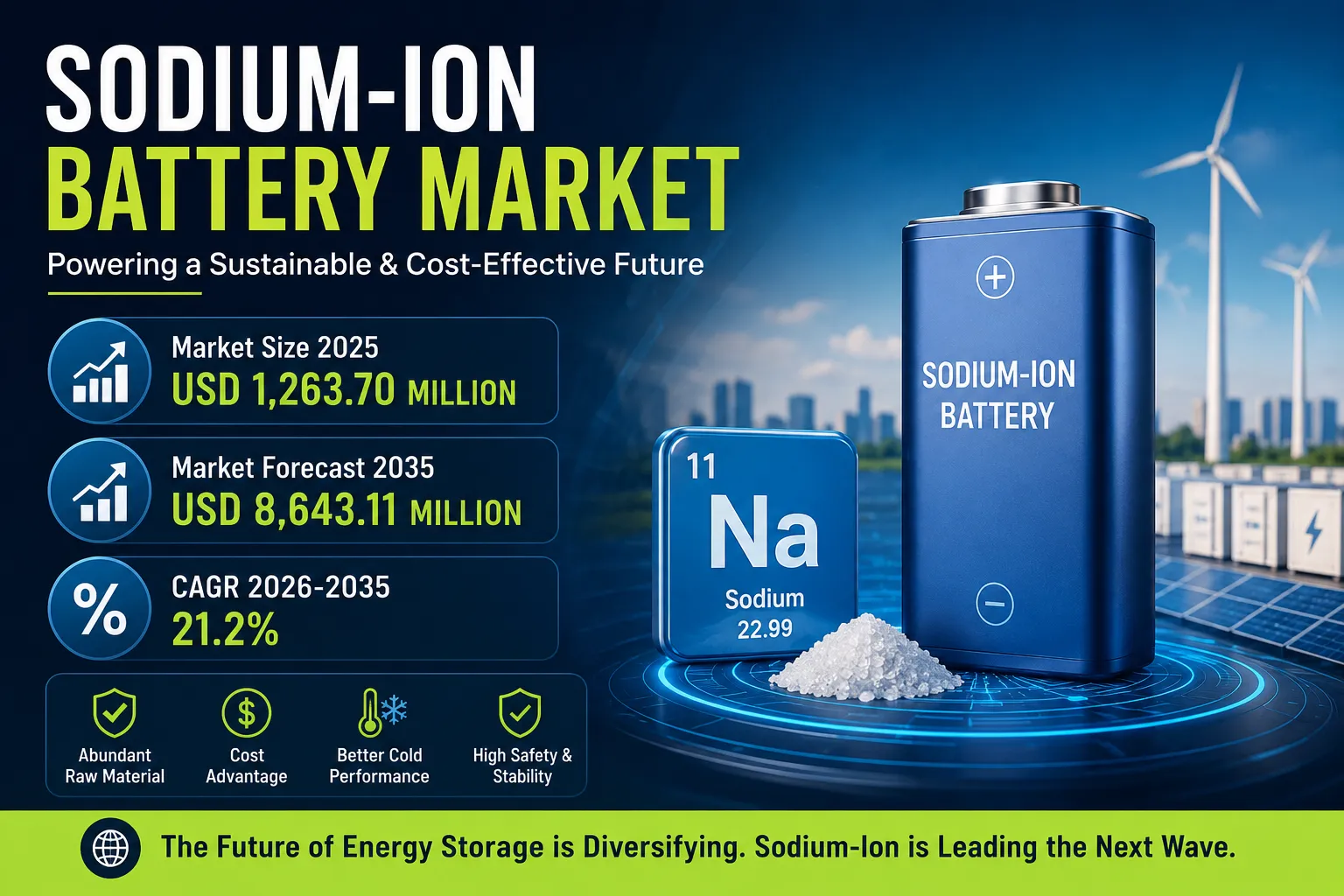
Sodium-ion batteries are now one of the most closely watched alternatives. They do not aim to replace lithium-ion batteries across every application. Instead, they are emerging as a complementary chemistry for use cases where cost, safety, material availability, temperature tolerance and supply chain resilience matter more than maximum energy density. This shift is important because the next phase of battery demand will not be driven by one application alone. It will come from grid-scale energy storage, renewable power integration, data centers, electric mobility, industrial equipment, backup power and emerging-market transport systems.
The International Energy Agency notes that sodium-ion batteries are gaining momentum as a way to diversify battery chemistries and supply chains at a time when global demand for electric vehicles and energy storage is rising quickly. The same analysis highlights that sodium-ion batteries still face challenges, particularly lower energy density compared with lithium-ion batteries, but their commercial relevance is increasing as technology and manufacturing scale improve.
Request for Exclusive Sample on Sodium-Ion Battery Market
What Are Sodium-Ion Batteries?
A sodium-ion battery works in a way that is broadly similar to a lithium-ion battery. During charging and discharging, ions move between the cathode and anode through an electrolyte. The major difference is the charge carrier: sodium-ion batteries use sodium ions, while lithium-ion batteries use lithium ions.
This difference may sound small, but it changes the economics and supply chain profile of the battery. Sodium is widely available and does not carry the same resource concentration risks as lithium. Sodium-ion chemistries can also reduce or avoid dependence on materials such as cobalt, nickel and copper, depending on the cell design. For applications where material security and cost stability are critical, this is a meaningful advantage.
Lithium-ion batteries still lead on energy density and manufacturing maturity. That is why they remain the preferred choice for long-range electric vehicles, premium electronics and high-performance applications. Sodium-ion batteries, however, are gaining attention in markets where the battery does not need to deliver the highest possible range or compactness. In grid storage, industrial backup power, two-wheelers, three-wheelers, low-speed vehicles and cold-region mobility, sodium-ion can offer a more balanced performance-cost equation.
Sodium-Ion vs Lithium-Ion Batteries: Key Technology Differences
The sodium-ion versus lithium-ion comparison should not be reduced to a simple “better or worse” argument. The real question is where each chemistry delivers the best value.
| Parameter | Sodium-Ion Batteries | Lithium-Ion Batteries |
| Main charge carrier | Sodium ions | Lithium ions |
| Energy density | Lower than lithium-ion, but improving | Higher, especially NMC and advanced lithium chemistries |
| Material availability | Strong advantage due to abundant sodium | More exposed to lithium, nickel and cobalt supply chains |
| Cost potential | Attractive at scale because of cheaper raw material base | Mature but exposed to lithium price cycles |
| Cold-weather performance | Strong potential in low-temperature environments | Performance can decline in extreme cold |
| Safety profile | Strong thermal stability potential | Depends on chemistry, pack design and thermal management |
| Best-fit applications | Grid storage, backup power, short-range EVs, two-wheelers, industrial systems | Long-range EVs, electronics, high-energy applications |
| Commercial maturity | Emerging, moving toward scale | Highly mature global supply chain |
Request for Exclusive Sample on Sodium-Ion Battery Market
The IEA’s 2026 Global EV Outlook notes that sodium-ion batteries have lower energy density than lithium-ion batteries, which can limit driving range in electric vehicles. However, it also identifies potential fit in small-range electric cars, urban light commercial vehicles, two- and three-wheelers, forklifts and stationary storage.
This distinction is important. Lithium-ion batteries are designed to maximize energy in compact formats. Sodium-ion batteries are better positioned where battery weight and volume are less critical, or where cost, safety and operating temperature are more important. That is why grid storage and industrial backup power may become stronger early markets than premium passenger vehicles.
Why Sodium-Ion Batteries Are Gaining Market Momentum
Sodium-ion batteries are gaining attention because the battery market is no longer defined by electric vehicles alone. Stationary storage demand is increasing as renewable energy penetration rises, electricity grids become more complex and large power users require reliable backup systems. In these applications, maximum driving range is irrelevant. What matters is dependable energy delivery, long service life, safety, cost control and lower maintenance.
General Motors has described sodium-ion as compelling for grid-scale storage because stationary customers prioritize reliable and affordable power over range or weight. GM is developing sodium-ion cells for grid-scale storage in partnership with Peak Energy, with a focus on matching the right chemistry to the right application.
The second driver is supply chain diversification. Lithium-ion batteries are deeply established, but they depend on supply chains that can be exposed to resource concentration, permitting delays, geopolitical risk and commodity volatility. Sodium-ion batteries offer a pathway to reduce lithium dependence and create a more distributed battery materials base.
The third driver is temperature performance. Several sodium-ion developers are emphasizing low-temperature capability as a core advantage. CATL’s Naxtra sodium-ion battery, for example, is positioned for operation across a wide temperature range from -40°C to +70°C, and the company states that its passenger EV battery retains 90% usable power at -40°C.
The fourth driver is manufacturing compatibility. Sodium-ion batteries can use parts of the existing lithium-ion manufacturing ecosystem, which may help accelerate commercialization. This does not remove all scale-up challenges, but it means sodium-ion does not require a completely separate industrial base from scratch.
Cost Comparison: Why Sodium-Ion Batteries Could Become Economically Attractive
Cost is one of the strongest reasons sodium-ion batteries are being taken seriously. Sodium is more abundant than lithium, and many sodium-ion chemistries can avoid expensive or constrained materials. This creates long-term potential for lower raw material costs and reduced exposure to lithium price volatility.
However, sodium-ion batteries are not automatically cheaper today in every product category. Lithium-ion batteries have decades of manufacturing scale, optimized supply chains and high production yields. LFP batteries, in particular, are already highly cost-competitive. Sodium-ion batteries must therefore compete not only on raw material logic but also on manufacturing efficiency, cycle life, safety, reliability and total system cost.
The strongest near-term cost case is likely to emerge in stationary energy storage. In grid systems, battery packs are part of a larger cost structure that includes cooling, power electronics, installation, safety systems, land, maintenance and operations. If sodium-ion batteries reduce thermal management complexity, improve operating temperature range or simplify system design, the total installed and operating cost can become attractive even if cell-level comparisons remain application-specific.
CATL’s sodium-ion energy storage strategy points in this direction. In 2026, CATL and HyperStrong announced a three-year sodium-ion battery supply partnership covering 60 GWh for energy storage, which CATL described as a major milestone for sodium-ion industrialization.
Request for Customized Sample as per Your Business Requirements on Sodium-Ion Battery Market
Applications: Where Sodium-Ion Batteries Can Win First
Grid-Scale Energy Storage
Grid-scale storage is the most important early opportunity for sodium-ion batteries. Stationary storage systems do not need to be lightweight. They need to be safe, durable, economical and reliable across varying temperatures. Sodium-ion batteries can be attractive for renewable energy storage, peak shaving, microgrids, utility-scale backup and power systems serving large electricity users.
GM’s sodium-ion work with Peak Energy is focused specifically on grid-scale energy storage, not passenger EVs. GM highlights that wider temperature operation and lower system complexity can matter significantly in large stationary systems where active cooling adds hardware, maintenance, parasitic energy losses and failure points.
Short-Range Electric Vehicles
Sodium-ion batteries are less suited for premium long-range EVs where energy density is critical. However, they can be relevant for short-range vehicles, urban mobility and models designed around affordability rather than maximum range.
CATL and CHANGAN unveiled a mass-production passenger vehicle equipped with sodium-ion batteries, with the vehicle set to reach the market by mid-2026. CATL described this as part of a dual-chemistry ecosystem where sodium-ion and lithium-ion batteries complement each other across different customer needs.
Two-Wheelers and Three-Wheelers
Two-wheelers and three-wheelers are strong potential markets because they often require moderate range, lower cost, safety and high cycle reliability. In emerging mobility markets, sodium-ion batteries could help reduce dependence on lithium-based battery packs while supporting affordable electrification.
Industrial Equipment and Forklifts
Forklifts, warehouse vehicles, low-speed industrial vehicles and material-handling equipment are practical use cases because they operate on predictable routes and can benefit from reliable cycle performance. The IEA also identifies forklifts as one of the suitable application areas for sodium-ion batteries.
Backup Power, Telecom and Data Centers
Backup power is another promising segment. Data centers, telecom towers and critical facilities need safe and dependable energy storage. Energy density is less important than uptime, safety, ease of maintenance and lifecycle economics. Sodium-ion batteries may gain traction here if field performance validates their reliability and cost advantage.
Market Outlook: Sodium-Ion Will Support a Multi-Chemistry Battery Future
The future battery market is unlikely to be dominated by one chemistry. Lithium-ion batteries will remain essential in high-energy applications. LFP will continue to expand in cost-sensitive EVs and stationary storage. Sodium-ion will grow where supply chain security, safety, low-temperature performance and system-level cost advantages matter.
CATL’s 2026 technology positioning reflects this shift toward multi-chemistry battery systems. The company stated that sodium-ion batteries offer broad potential for extreme temperatures and energy storage applications, while also emphasizing the need for coordinated development across multiple chemical systems.
For the market, this means sodium-ion batteries should be viewed as a strategic addition rather than a direct replacement. Their strongest role will be in expanding the battery industry’s ability to serve different applications with the most suitable chemistry.
Top 5 Sodium-Ion Battery Manufacturers
1. CATL – China
CATL is one of the most influential companies in the sodium-ion battery market because it combines battery technology, manufacturing scale and customer access. The company unveiled its Naxtra sodium-ion battery platform as part of its broader multi-power strategy. CATL states that the Naxtra passenger EV battery reaches 175 Wh/kg energy density, supports operation from -40°C to +70°C and can deliver over 10,000 cycles.
CATL’s sodium-ion strategy is not limited to passenger vehicles. The company is also targeting heavy-duty trucks, battery swapping, commercial vehicles and stationary energy storage. Its agreement with HyperStrong for 60 GWh of sodium-ion battery supply over three years shows that CATL is positioning sodium-ion as a serious storage technology, not just a mobility experiment.
Why CATL matters: CATL gives sodium-ion batteries industrial credibility. Its manufacturing capacity, customer relationships and ability to validate battery systems at scale could accelerate market adoption faster than smaller technology developers.
2. HiNa Battery Technology – China
HiNa Battery is one of the most specialized sodium-ion battery companies in China. The company focuses on research, development and manufacturing of sodium-ion batteries and states that it holds core patents across materials, components, manufacturing and applications. HiNa’s product focus includes low-cost, long-life, high-safety and high-energy-density sodium-ion batteries.
The company’s potential application areas include low-speed electric vehicles, large-scale energy storage, electric vehicles and strategic energy uses. HiNa also supplies cathode materials, anode materials and electrolytes for sodium-ion batteries, which gives it relevance beyond finished cells.
Why HiNa matters: HiNa is important because sodium-ion commercialization depends on more than cell assembly. It also requires material innovation, electrolyte development, supply chain control and application-specific engineering. HiNa’s focus across cells and materials makes it a key company to watch.
3. Faradion / Reliance New Energy – UK / India
Faradion is one of the best-known sodium-ion battery technology companies outside China. The company describes itself as a leader in non-aqueous sodium-ion cell technology and positions its chemistry for transportation, storage, backup power and remote energy applications.
Faradion became strategically important after Reliance New Energy moved to acquire the company as part of its new energy and battery ecosystem. Reliance stated that Faradion’s sodium-ion technology is safe, sustainable, high energy density and cost competitive, and that the acquisition supports India’s ambition to build advanced energy storage capability.
Why Faradion/Reliance matters: This combination connects sodium-ion technology with India’s large-scale energy and manufacturing ambitions. It also gives the sodium-ion market a major non-China commercialization pathway, especially for stationary storage, backup power and mobility applications.
4. Tiamat Energy – France
Tiamat Energy is a French sodium-ion battery company focused on power and high-power applications. The company designs, develops, industrializes and sells sodium-ion batteries, with products including cylindrical cells for power tools and small electromechanical systems, as well as prismatic cells for automotive and stationary applications.
Tiamat’s positioning is different from companies focused primarily on low-cost storage. Its sodium-ion platform is built around high power, fast charging and durable performance for demanding applications. This makes it relevant for power tools, hybrid mobility, industrial systems, automotive support applications and stationary power systems.
Why Tiamat matters: Tiamat gives Europe a sodium-ion technology platform focused on high-power use cases. Its relevance will increase if European battery policy continues to prioritize local supply chains, sustainable materials and reduced dependence on critical minerals.
5. Altris – Sweden
Altris is a Swedish sodium-ion battery company with a strong position in Prussian White cathode technology and sodium-ion cell development. Its product portfolio includes P-Series high-rate cells, E-Series endurance cells and Prussian White cathode active material. Altris states that its cells are built on iron and salt, with zero critical minerals.
The company lists P-Series energy density at 110–130 Wh/kg and E-Series endurance cells above 160 Wh/kg, with more than 8,000 cycles and a 20-year calendar-life claim in its product information. Its Prussian White cathode active material is in production in Kolin, Czechia, strengthening its position in the European sodium-ion supply chain.
Why Altris matters: Altris is important because it is not only a cell developer; it is also building cathode material capability. That gives it strategic value in a market where supply chain localization and critical-mineral-free chemistry are becoming increasingly important.
Top Sodium-Ion Battery Manufacturers: Quick Comparison
| Company | Country / Region | Core Focus | Key Applications |
| CATL | China | Naxtra sodium-ion batteries, EVs and energy storage | Passenger EVs, commercial vehicles, storage, battery swapping |
| HiNa Battery | China | Sodium-ion cells, cathode/anode materials and electrolytes | Large-scale storage, low-speed EVs, industrial energy |
| Faradion / Reliance New Energy | UK / India | Non-aqueous sodium-ion technology | Storage, transport, backup power, remote energy |
| Tiamat Energy | France | High-power sodium-ion cells | Power tools, automotive, stationary systems |
| Altris | Sweden | Sodium-ion cells and Prussian White cathode material | Grid storage, data centers, automotive support, defense |
Request for Exclusive Sample on Sodium-Ion Battery Market
Key Challenges Holding Back Sodium-Ion Batteries
Sodium-ion batteries still face important barriers. The biggest limitation is energy density. Although performance is improving, lithium-ion batteries remain superior for compact, high-energy applications. This makes sodium-ion less attractive for premium long-range EVs and high-end consumer electronics.
The second challenge is manufacturing maturity. Lithium-ion batteries have a global supply chain with proven quality systems, established suppliers and large-scale manufacturing assets. Sodium-ion batteries need to prove consistency, safety, long-term cycle life and bankability across real-world deployments.
The third challenge is competition from LFP batteries. LFP is already lower cost, safer and more durable than many older lithium-ion chemistries. Sodium-ion must therefore offer a clear reason to switch, such as better low-temperature performance, lower system cost, simpler thermal management or stronger material security.
The fourth challenge is customer validation. Large energy storage buyers, vehicle manufacturers and infrastructure operators do not adopt new chemistries only because the chemistry is promising. They need certification, warranty confidence, service networks, financing support and long-term performance data.
Will Sodium-Ion Batteries Replace Lithium-Ion Batteries?
Sodium-ion batteries will not replace lithium-ion batteries completely. The more realistic outlook is a multi-chemistry battery market. Lithium-ion will continue to dominate high-energy applications. LFP will remain highly competitive in mainstream EVs and storage. Sodium-ion will expand in applications where cost stability, safety, cold-weather performance and supply chain diversification create a stronger business case.
This is why sodium-ion should be viewed as a strategic chemistry rather than a universal substitute. Its role will grow as manufacturers improve energy density, scale production, validate field performance and build dedicated supply chains. The strongest early growth is likely to come from stationary energy storage, short-range mobility, industrial systems and backup power.
Final Takeaway
Sodium-ion batteries are moving from early promise to commercial relevance. Their value lies not in outperforming lithium-ion batteries on every metric, but in solving different problems. They can reduce lithium dependence, improve material availability, support safer stationary storage and open new cost structures for applications where energy density is not the only priority.
For the battery industry, sodium-ion represents a shift from a single-chemistry mindset to an application-specific approach. The companies that succeed will be those that align chemistry, manufacturing, system design and customer needs. CATL, HiNa Battery, Faradion/Reliance, Tiamat and Altris are among the most important manufacturers shaping this transition.
The next phase of battery growth will not be about one chemistry replacing another. It will be about using the right chemistry in the right application. Sodium-ion batteries are now becoming one of the most important chemistries in that future.
Read Complete Research Report: https://www.datamintelligence.com/research-report/sodium-ion-battery-market