


On August 14, 2026, Reliance Industries and Rolls-Royce announced something more significant than another defence manufacturing agreement.
The two companies declared their strategic intent to work together on the design, development, manufacturing and delivery of a sovereign indigenous combat engine for India's Advanced Medium Combat Aircraft, or AMCA, programme. They also plan to explore the creation of an Aerospace Gas Turbine Complex in India focused on advanced power and propulsion technology.
The proposal still tells us something important about where India's aerospace strategy is heading.
For decades, India's aviation story was dominated by aircraft purchases, licensed manufacturing, and imported propulsion. The next phase is increasingly about designing systems in India, building complete aircraft locally, maintaining them domestically, and acquiring control over difficult technologies such as jet engines.
DataM Intelligence views the Rolls-Royce-Reliance announcement as part of a wider structural shift that could make India one of the world's most important emerging aerospace and aviation players over the next decade.
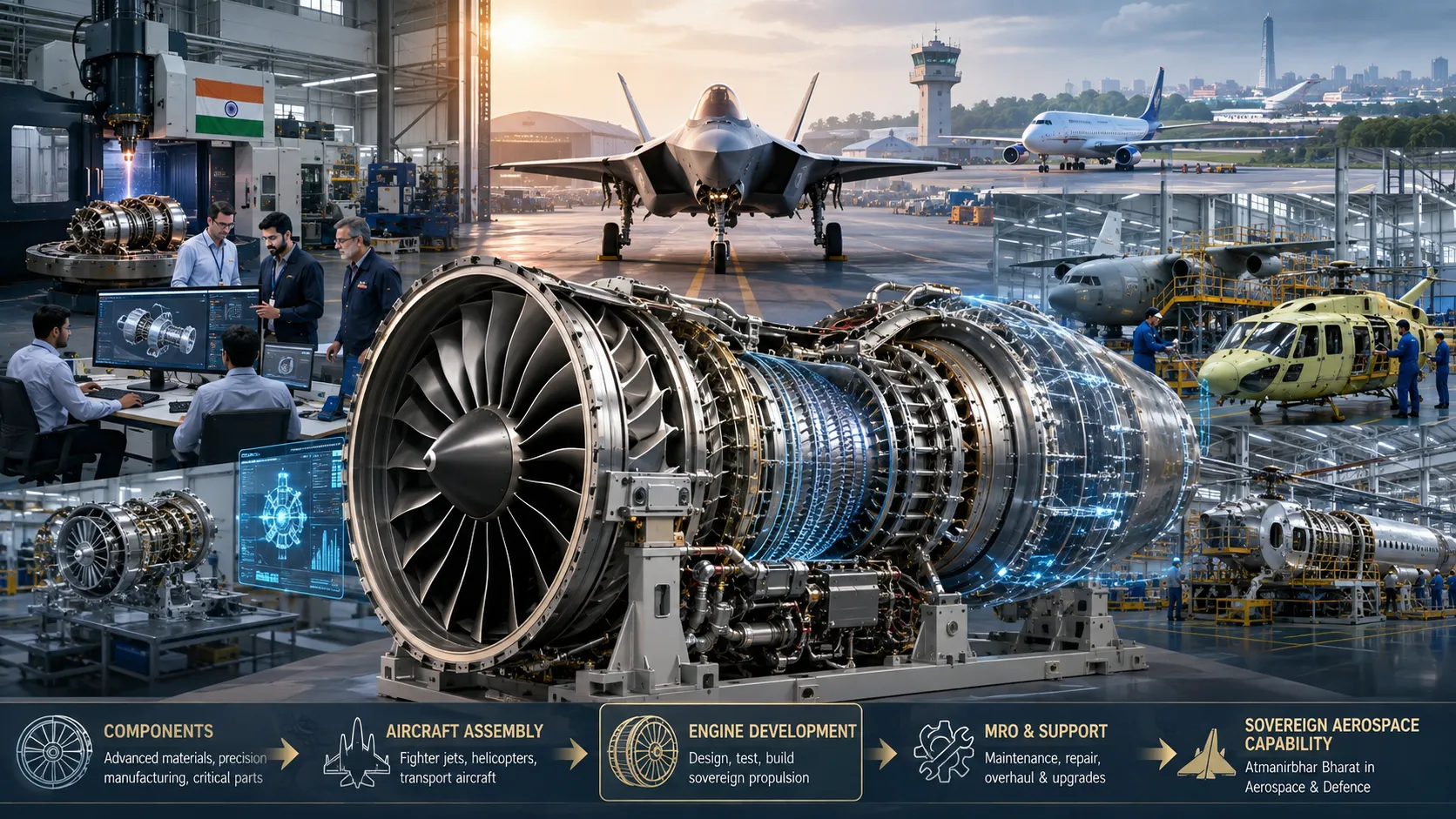
Why the AMCA Engine Matters More Than Another Aircraft Assembly Line
Modern combat-aircraft propulsion is difficult to master because an engine must operate at extreme temperatures and pressures while remaining reliable, lightweight, and maintainable.
India already has substantial aerospace expertise in airframes, avionics, missiles, radar, materials, and aircraft integration. Propulsion remains a harder strategic dependency.
That is why the wording of the Rolls-Royce-Reliance proposal is important.
The companies are not describing a plan merely to assemble imported engines.
Their announcement covers design, development, manufacturing, testing, production and through-life support in India. The proposed Aerospace Gas Turbine Complex would be intended to create end-to-end capability around propulsion.
If that model is eventually selected and executed as described, India could capture much more of the engine value chain.
The crucial questions will be how much design authority resides in India, who owns jointly developed intellectual property, how upgrades are handled, how deeply components are localized, and what export rights India receives.
Those details have not yet been announced.
And the official release does not specify a technology-transfer percentage, so claims that India has already secured complete engine technology would be premature.
Reliance Changes the Industrial Equation
Reliance's involvement is interesting because India's AMCA strategy is deliberately opening more room for private industry.
In May 2025, the Ministry of Defence approved a new AMCA execution model under which the Aeronautical Development Agency would work through industry partnerships. Public- and private-sector Indian companies can compete independently, through joint ventures or through consortia.
This is different from an aerospace ecosystem built primarily around one state-owned prime contractor.
It creates room for companies with strengths in advanced manufacturing, materials, digital technology, engineering and large-project execution to become more deeply involved.
For Reliance, the proposed partnership would also represent a move into one of the most technically demanding parts of advanced manufacturing.
Reliance reported consolidated FY2025-26 revenue of ₹11.76 lakh crore and operates businesses spanning energy, materials, digital services, retail, media, green technologies and advanced technology. Its scale gives it capital and industrial execution capability, although building a world-class combat aero-engine ecosystem would require highly specialised capabilities that go far beyond industrial scale alone.
That is where Rolls-Royce enters the equation.
Rolls-Royce Is Not Starting From Zero in India
Rolls-Royce already has a deep Indian engineering and supply-chain footprint.
In 2025, the company said it intended to at least double its sourcing from India by 2030, including more complex components for advanced aerospace engines, naval propulsion systems, diesel engines and gas turbines. It already works with Indian companies including HAL, Tata, Bharat Forge and Godrej & Boyce.
Its Indian ecosystem has continued expanding. In July 2026, Rolls-Royce said more than 4,000 people worked across its Indian ecosystem, including about 2,800 highly skilled engineers contributing to global development programmes.
That engineering base is important.
India's future aerospace opportunity is unlikely to come from low-cost manufacturing alone.
To capture more value, the country needs engineers working on design, digital twins, materials, controls, testing, certification, manufacturing engineering and lifecycle support.
The Rolls-Royce-Reliance proposal moves directly into that higher-value part of the chain.
The Aerospace Gas Turbine Complex Could Be More Important Than One AMCA Engine
The proposed Aerospace Gas Turbine Complex deserves particular attention.
Reliance and Rolls-Royce say the facility could become a centre of excellence for power and propulsion technology, covering the full engine lifecycle and potentially enabling wider collaboration across defence, civil aerospace and new power and propulsion systems.
This is where the long-term opportunity becomes larger than AMCA.
A country does not build an advanced propulsion industry around one engine alone.
It needs high-temperature materials, precision castings, turbine components, compressors, controls, bearings, sensors, testing facilities, software, specialist suppliers and maintenance capability.
Once those competencies exist at scale, some can support other aviation and power applications.
That does not mean military engine technology can automatically be transferred into commercial jet engines. The certification, economics and engineering requirements are different.
But the industrial skills can strengthen the broader aerospace ecosystem.
India's biggest opportunity may therefore come from building a propulsion cluster, rather than simply producing one indigenous fighter engine.
Request sample on Aerospace and Defense Materials Market: https://www.datamintelligence.com/download-sample/aerospace-and-defense-materials-market
AMCA Is Already Becoming an Industrial Ecosystem
India is building physical infrastructure around AMCA as well.
In May 2026, the government laid the foundation stone for the AMCA Core Integration & Flight Testing Centre at Puttaparthi in Andhra Pradesh. The broader AMCA programme has an outlay of around ₹15,000 crore, while the new integration and flight-testing facility is being established at a cost of about ₹2,000 crore.
The significance is not just the aircraft.
A fifth-generation fighter programme forces an industrial ecosystem to develop capabilities in advanced composites, stealth structures, flight-control systems, sensors, software, weapons integration, propulsion, testing and specialised manufacturing.
India is also deliberately increasing private-sector participation across its wider defence base.
Defence production reached a record ₹1.78 lakh crore in FY2025-26, up 15.6% year on year, while the private sector contributed around ₹42,000 crore, or 24% of the total. Defence exports reached ₹38,424 crore during the same financial year.
Those are defence-wide figures, not aerospace figures, but they show the industrial environment in which programmes such as AMCA are developing.
The DataM report covers the aircraft avionics ecosystem and identifies commercial aviation as the largest revenue segment, with military aviation and business jets offering significant opportunities because of advanced technology requirements and modernization.
Request Exclusive Sample on Aircraft Avionics Market: https://www.datamintelligence.com/download-sample/aircraft-avionics-market
India Is Moving From Aircraft Buyer to Aircraft Builder
The AMCA engine announcement is also arriving at the same time as a major change in India's civil and transport-aircraft manufacturing landscape.
The Tata Advanced Systems-Airbus C295 final assembly line in Vadodara is scheduled to produce its first Made-in-India C295 in September 2026.
Under the programme, 40 of the 56 C295 aircraft ordered for the Indian Air Force are to be manufactured and assembled in India. Airbus says the programme will perform more than 85% of structural and final assembly work domestically and manufacture 13,000 detail parts in India, with 37 Indian suppliers onboarded.
This matters because final assembly creates supplier demand far beyond the main factory.
Fasteners, structures, wiring, tooling, machining, electronics, test equipment and engineering services all have to meet aerospace certification and quality requirements.
Once suppliers qualify for one aircraft programme, they have a better chance of competing for other global aerospace work.
Helicopters Are Joining the Manufacturing Shift
India's aircraft-building ambitions are no longer limited to military transports.
In February 2026, Tata Advanced Systems inaugurated the country's first private-sector helicopter final assembly line for the Airbus H125 at Vemagal, Karnataka.
The first Made-in-India H125 is expected in early 2027 and Airbus says aircraft produced there will also be available for export into the wider South Asian region.
Airbus also says it already sources more than $1.5 billion of components and services annually from India, including complex aerostructures and systems.
This is the deeper trend investors should watch.
India is moving through several stages of the aerospace value chain at the same time:
from supplying components,
to assembling aircraft,
to providing engineering,
to maintaining fleets,
and now attempting to co-develop critical propulsion technology.
That progression is more important than any single factory announcement.
DataM's report covers the global aircraft parts market and specifically highlights airframe components, propulsion systems, avionics and interiors, while identifying Asia-Pacific as the fastest-growing region.
Request Exclusive Sample on Aircraft Parts Market: https://www.datamintelligence.com/download-sample/aircraft-parts-market
India's Huge Aircraft Order Book Creates a Domestic Industrial Base
The strongest reason India could become a major aviation player is that manufacturing capability is developing alongside enormous domestic demand.
In March 2026, India's Civil Aviation Minister said Indian carriers had about 1,700 aircraft on order, close to twice the existing fleet, and suggested India could have as many as 3,000 aircraft operating by around 2036 as the ecosystem develops.
That creates something countries trying to establish an aerospace sector often lack: a large home market.
Manufacturers investing in India are not relying only on exports.
They can see growing domestic demand for commercial aircraft, helicopters, maintenance, training, spare parts, engines and airport infrastructure.
India had 165 operational airports as of July 15, 2026, compared with 74 in 2014. The government's Modified UDAN programme is targeting another 100 airports and 200 modern helipads over FY2026-27 to FY2035-36.
The opportunity therefore extends well beyond airline ticket sales.
Every additional aircraft creates decades of demand for maintenance, components, trained technicians, engines, digital systems and airport services.
MRO Could Become India's Quiet Aviation Advantage
Maintenance, repair and overhaul is becoming another important piece of the strategy.
India's Civil Aviation Ministry says the number of MRO organisations has increased from around 160 to more than 240 during the past five years.
The government is now trying to connect workforce policy directly to this expansion.
DGCA and Gati Shakti Vishwavidyalaya have created an aviation-maintenance engineering programme designed around MRO training, simulation, OEM partnerships and industry-linked skills. The Civil Aviation Ministry says India may require 10,000 to 12,000 additional pilots over the next decade, alongside the technical workforce needed to support the expanding fleet.
This is important because aircraft manufacturing without lifecycle support leaves much of the economic value outside the country.
An aircraft can operate for decades.
During that period, maintenance and replacement parts can generate enormous cumulative activity.
The same logic applies to engines.
That is why the Rolls-Royce-Reliance announcement specifically includes through-life support, not only manufacturing.
Why India Could Become One of Aviation's Most Important Emerging Players
DataM Intelligence sees six developments coming together.
Domestic demand is reaching global scale. Indian airlines have roughly 1,700 aircraft on order.
Airport infrastructure is spreading beyond major metros. India now has 165 operational airports, with Modified UDAN targeting further expansion.
Aircraft assembly is moving onshore. C295 aircraft will be assembled in Vadodara and H125 helicopters in Karnataka.
Global supply chains are already sourcing more from India. Airbus sources more than $1.5 billion annually from the country, while Rolls-Royce plans to at least double its Indian sourcing by 2030.
Private companies are taking larger roles in strategic programmes. The AMCA execution model explicitly allows public and private Indian companies to compete.
And now propulsion sovereignty is entering the industrial conversation.
Those factors create a credible path for India to become more than one of the world's largest aviation markets.
It could become one of the major places where aircraft and aviation technologies are designed, engineered, manufactured, maintained and eventually exported.
The Biggest Test Will Be Intellectual Property, Not Factory Size
There is still a major difference between making aerospace equipment in India and controlling the technology.
For the proposed AMCA engine partnership, investors and policymakers should watch five issues particularly closely:
- Indian ownership or access to jointly developed intellectual property
- Design authority and freedom to modify future engine versions
- Domestic manufacturing of critical high-temperature components
- Testing, certification and lifecycle-support capability inside India
- Export and third-country integration rights
The August 14 announcement does not disclose those details.
That means the real significance of any future agreement should be judged by capability transferred and created, not simply the percentage of components manufactured locally.
India has already shown it can assemble increasingly complex aerospace platforms.
The next test is whether it can own enough of the knowledge behind them.
DataM Intelligence View: The Engine Could Become a Turning Point
The Reliance-Rolls-Royce announcement is still the beginning of a process, not its conclusion.
But its strategic direction is important.
India's aviation expansion used to be discussed mainly through passenger growth, airline orders and new airports.
The next decade will increasingly be about industrial depth.
Who designs the aircraft?
Who develops the engine?
Who manufactures critical components?
Who owns the IP?
Who maintains the fleet?
And which Indian suppliers become part of global aerospace programmes?
The C295 factory, H125 production line, growing MRO network, expanding airport system, large aircraft order book and increasing defence-manufacturing output show that these pieces are starting to connect.
A successful indigenous combat-engine programme would move India into a much smaller group of countries with deep propulsion capability.
That outcome is not guaranteed, and the Rolls-Royce-Reliance proposal has not yet been selected.
But the direction is clear.
India is trying to move from buying aviation technology to building it—and from building it to eventually owning it.
If that transition succeeds, India will not simply be one of the world's fastest-expanding aviation markets.
It could become one of the industry's most important new engineering and manufacturing centres.
Frequently Asked Questions
What did Reliance and Rolls-Royce announce?
On August 14, 2026, Reliance Industries and Rolls-Royce announced their strategic intent to partner on the design, development, manufacturing and delivery of a sovereign indigenous combat engine for India's AMCA programme.
Have Reliance and Rolls-Royce won the AMCA engine contract?
No government contract award was announced. The companies have announced their intent to partner and offer their capabilities for the programme.
What is the proposed Aerospace Gas Turbine Complex?
Reliance and Rolls-Royce plan to explore creating an Indian centre of excellence for power and propulsion covering design, development, manufacturing, testing, production and through-life support.
Does the agreement include full technology transfer?
The announcement does not state a technology-transfer percentage or disclose detailed intellectual-property arrangements. Those issues would need to be evaluated if a final programme agreement is reached.
What is AMCA?
AMCA is India's Advanced Medium Combat Aircraft programme. The Ministry of Defence describes it as a fifth-generation aircraft programme being executed by the Aeronautical Development Agency through industry partnership.
Why is an indigenous jet engine important for India?
Domestic engine capability can reduce dependence on overseas suppliers while creating expertise in propulsion design, advanced materials, manufacturing, testing and lifecycle support. The strategic value depends on how much design authority and IP India ultimately controls.
Is India already manufacturing complete aircraft?
Yes. Tata Advanced Systems and Airbus have established a C295 final assembly line in Vadodara, while an H125 helicopter final assembly line opened in Karnataka in February 2026.
How big could India's commercial aviation fleet become?
India's Civil Aviation Minister said in March 2026 that airlines had around 1,700 aircraft on order and that the country's operating fleet could reach around 3,000 aircraft by 2036 as the supporting ecosystem expands.
Is India becoming an aerospace manufacturing hub?
Evidence is building in that direction. India now hosts aircraft and helicopter final assembly, a growing MRO industry, a large engineering workforce, and expanding global aerospace sourcing. Airbus sources more than $1.5 billion annually from India, while Rolls-Royce intends to at least double its sourcing from India by 2030.
What should investors watch next?
The main milestones are a formal AMCA engine partner selection, details on IP and design authority, creation of the proposed gas-turbine complex, localization of critical components, AMCA prototype progress, the September 2026 Made-in-India C295 rollout and continued expansion of India's MRO and aerospace supplier base.