


Obesity Drug Commercialization Perspective
| KEY TREND | Retatrutide is still investigational, yet Lilly is already fighting a global illegal market for products sold under its name. |
| COMMERCIAL RISK | The challenge at launch may extend beyond competitors and reimbursement: patient expectations, illegal price anchors, counterfeit awareness and channel trust may already be established. |
| RECOMMENDED FOR | Pharma commercial teams, market access leaders, brand protection teams, digital health executives, obesity-care strategists and investors |
The Drug Has Not Launched. The Market Already Has.
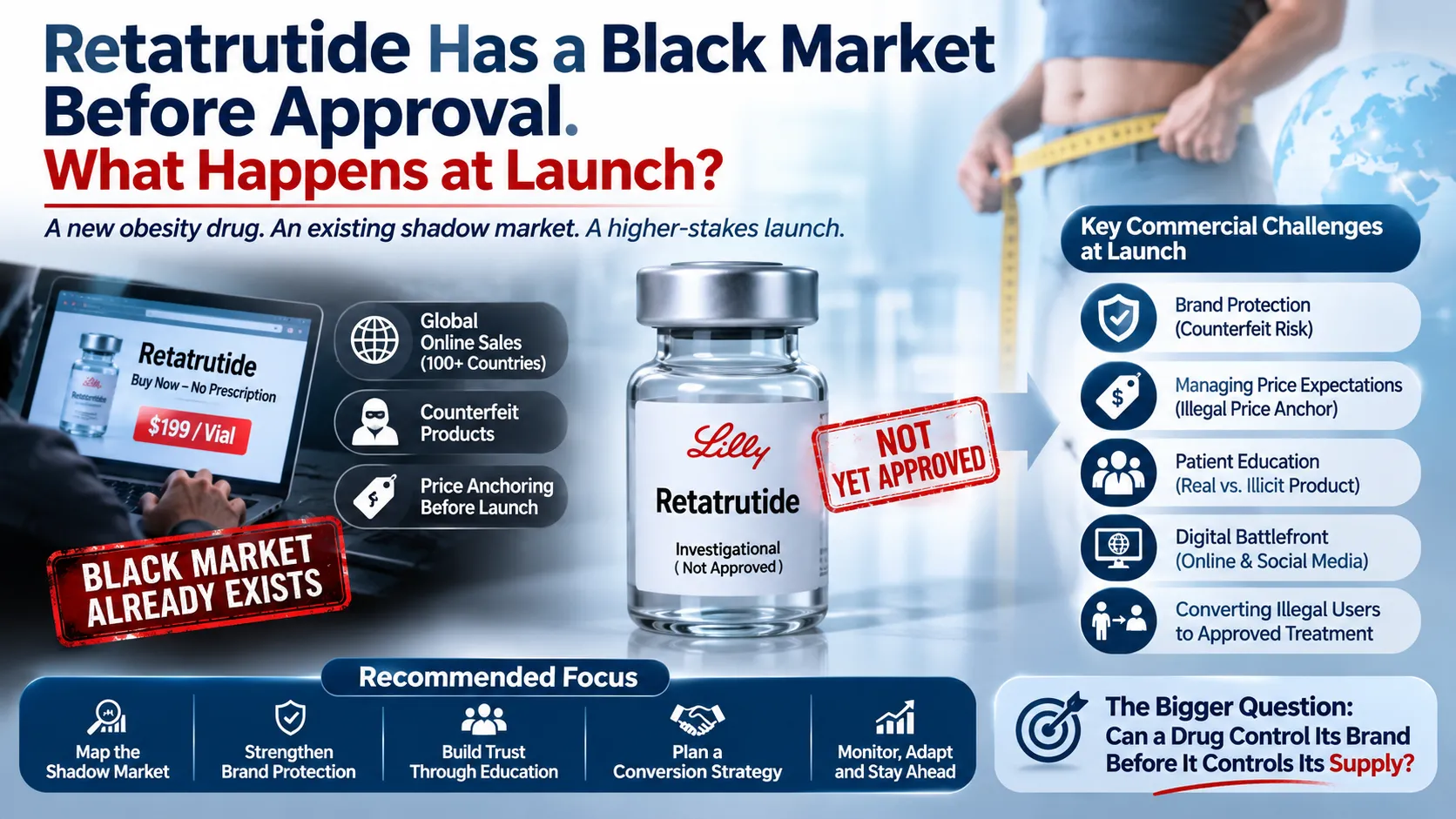
Retatrutide has not been approved by the FDA or any other regulator. No legitimate retatrutide medicine is available for sale. Yet Lilly is already dealing with a global network of websites, medical spas, online sellers and other operators marketing products under the retatrutide name.
That makes retatrutide an unusual commercialization case. The company may eventually launch a medicine into a market where some consumers already believe they know the product, have seen a price for it, or may even have used an illegal version before the approved brand exists.
In August 2026, Eli Lilly said it had reported more than 14,000 websites, advertisements, social posts and product listings across more than 100 countries, while referring more than 200 individuals and entities to regulators and law enforcement. The company also filed six new U.S. lawsuits targeting alleged sellers of illegal retatrutide products.
The FDA has separately stated that retatrutide cannot be used in compounding under federal law and is not a component of any FDA-approved drug.
Request Sample: https://www.datamintelligence.com/download-sample/next-generation-obesity-drugs-market
Why the Pre-Launch Demand Is So Intense
The illegal market is emerging against unusually strong clinical expectations. Lilly has now reported six positive Phase 3 studies across obesity and type 2 diabetes programs, with efficacy that is likely to reinforce consumer and prescriber interest if regulators ultimately approve the drug.
| Signal | 2026 evidence | Why it matters | Source |
| TRIUMPH-1 | 28.3% average weight loss at 80 weeks; 30.3% at 104 weeks in BMI >=35 extension | Sets a very high efficacy expectation before approval | Lilly |
| TRIUMPH-2 | 20.8% average weight loss at 80 weeks in people with type 2 diabetes | Broadens the potential treatment population | Lilly |
| TRANSCEND-T2D-2 | 20%-21% weight loss vs. 9% with Ozempic 2 mg at 80 weeks | Strengthens the competitive launch narrative | Lilly |
| Regulatory timing | U.S. submission planned for Q1 2027 | Shadow-market risk exists before formal launch | Lilly |
The Black Market Changes the Launch Playbook
1. Brand protection becomes a pre-launch commercial function
Counterfeit and illegal product monitoring can no longer sit only with legal or compliance teams. When consumers are seeing the brand name before approval, digital surveillance becomes part of demand forecasting, reputation management, and launch preparation.
2. Access strategy may have to fight an illegal price anchor
Consumers exposed to low-priced black-market products may form expectations about what retatrutide “should” cost long before approved pricing, insurance coverage or patient-support programs are established. Even when the illegal product is unsafe or fraudulent, the price reference can influence launch perceptions.
3. Patient education has to start before the branded medicine exists
The FDA says retatrutide cannot legally be compounded, while Lilly warns that illegal products may contain contaminants, the wrong ingredient or incorrect amounts of active ingredient. For launch teams, distinguishing the eventual approved product from what patients have already seen online will be a core trust challenge.
4. Digital channels are part of the competitive environment
Lilly is explicitly calling on social-media platforms, e-commerce companies, payment processors, credit-card networks and logistics providers to disrupt illegal sales. That shows the competitive battlefield for obesity drugs now extends far beyond pharmacy shelves and prescriber offices.
5. The company may need to convert users, not just acquire them
A conventional launch assumes most patients are entering a new therapy category or switching from an approved competitor. Retatrutide may face a third segment: people who believe they have already used “retatrutide.” Commercial teams will need to understand how large that population is, what they believe they experienced and what would make them move to the approved product.
The New Retatrutide Launch Risk Stack
| Risk layer | What is happening now | Launch implication | What to monitor |
| Clinical expectation | Phase 3 efficacy is already highly visible | High awareness before approval | Search volume, physician interest, social discussion |
| Illegal supply | Products are marketed globally under the retatrutide name | Potential safety events may be attributed to the brand | Seller networks, product claims, adverse-event mentions |
| Price anchoring | Illegal sellers can advertise prices before a branded list price exists | Future price may be compared with an illegitimate benchmark | Online pricing, cash-pay behavior, affordability sentiment |
| Channel trust | Medical spas, telehealth sites and social media are part of the discovery journey | Approved-channel education becomes more important | Patient source-of-information and channel preference |
| Conversion | Some consumers may have already tried an illegal product | Launch includes a re-conversion problem | Switch intent, adherence, perceived efficacy and safety |
This Is Already Moving Beyond Civil Litigation
The issue is also drawing criminal and regulatory attention. In April 2026, the U.S. Department of Justice announced an indictment involving a physician accused of receiving and selling non-FDA-approved peptides from China, including retatrutide.
Eli Lilly also says poison-control calls related to illicit retatrutide increased 265% in the first four months of 2026 versus the last four months of 2025. Because these products are unapproved and may not contain what sellers claim, safety incidents can create confusion around the molecule before regulators have completed their own review.
Five Commercial Priorities Before Approval
| Priority | Commercial objective | Decision question |
| Map the shadow market | Understand illicit demand before launch | Where is illegal retatrutide demand most visible? |
| Measure trust damage early | Protect the future approved brand | Are adverse events or poor-quality products shaping perception? |
| Prepare a conversion strategy | Move users toward regulated treatment | What would convince existing illegal-product users to switch? |
| Link access and education | Reduce the appeal of unregulated substitutes | Which price, access and support barriers matter most? |
Build digital enforcement into launch | Reduce illegal availability and misinformation | Which platforms, sellers and payment routes are sustaining the market? |
Request a Customized Report According to Your Business Strategy: https://www.datamintelligence.com/customize/next-generation-obesity-drugs-market
The Bigger Question: Can a Drug Control Its Brand Before It Controls Its Supply?
Retatrutide may become one of the most closely watched obesity-drug launches of the next cycle. Its clinical profile is generating attention, Lilly is preparing for regulatory submission and demand is clearly strong enough to support an illegal market before approval.
That creates an unusual commercialization problem. By the time the first approved dose reaches a pharmacy, the brand may already have counterfeit experiences, online price references, safety narratives and patient expectations attached to it. For obesity-drug manufacturers, the lesson is clear: launch planning now has to begin well before launch.
The question for commercial leaders is: if patients can encounter your next therapy before regulators approve it, are your brand-protection, access and patient-education strategies starting early enough?