


Recycled Polypropylene Market: Why rPP Is Becoming the Next Circular Materials Opportunity
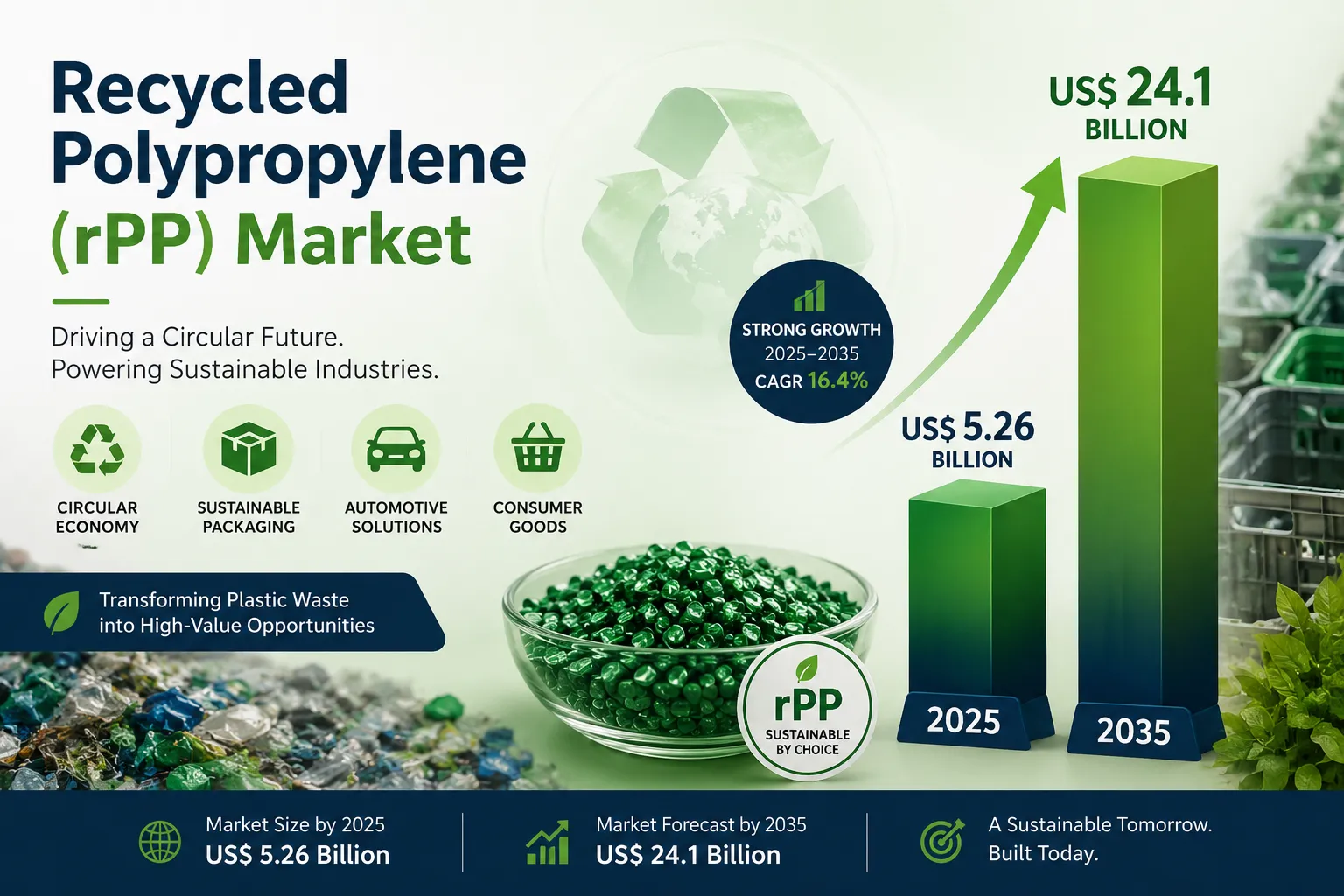
Recycled polypropylene is moving from a cost-saving resin alternative to a strategic circular materials opportunity. The global recycled polypropylene market size is projected to grow from US$ 5.26 billion in 2025 to US$ 24.1 billion by 2035, reflecting how quickly brands, converters, recyclers, automotive manufacturers, and packaging companies are rethinking recycled PP as a scalable commercial material.
This growth is being shaped by multiple forces working at the same time. Circular plastics policies are pushing companies to reduce dependence on virgin polymers. Recycled-content targets are changing procurement decisions across packaging and consumer goods. Automotive manufacturers are under pressure to lower vehicle lifecycle emissions. At the same time, material innovation is improving the quality, consistency, and performance of recycled polypropylene, also known as rPP.
For companies evaluating the Recycled Polypropylene Market Report, the real opportunity is not only market growth. The larger question is where rPP can create defensible business value, which applications can absorb higher-quality recycled resin, and which regions are becoming the strongest demand centers.
From Recycled Resin to Circular Material Platform
Historically, recycled polypropylene was often viewed as a lower-cost substitute for virgin PP, mainly suitable for non-critical applications. That perception is changing. Today, rPP is increasingly being developed as a certified, engineered, and application-ready material for packaging, automotive, consumer goods, industrial products, and construction-related uses.
The shift is important because buyers no longer want recycled material that creates processing uncertainty. They want reliable melt flow, stable color, lower odor, consistent mechanical properties, and documentation that proves recycled content. This is where the recycled polypropylene market is becoming more sophisticated.
Advanced sorting, washing, deodorization, compounding, and quality-control technologies are helping suppliers create rPP grades that can meet specific application needs. For example, packaging converters may need color-consistent material for tubs, crates, or closures, while automotive suppliers may require reinforced compounds with impact resistance, thermal stability, and low volatile organic compound performance.
This transition from basic recycled resin to circular material platform is creating a new competitive landscape. Companies that can combine feedstock access, certification, performance engineering, and supply reliability are likely to be better positioned than suppliers focused only on low-cost recycled plastic.
For decision-makers tracking the recycled polypropylene market size, this evolution matters because higher-value applications can support stronger margins and longer-term customer relationships.
Why Packaging Is the Strongest Demand Engine
Packaging remains one of the most important demand engines for recycled polypropylene. The report identifies rigid packaging as a leading demand area, supported by applications such as caps, closures, tubs, crates, pallets, trays, and industrial packaging.
This makes commercial sense. Rigid packaging often requires durability, stiffness, chemical resistance, and good processability, all properties that polypropylene can deliver. When recycled PP is properly sorted and compounded, it can serve a wide range of secondary and durable packaging applications.
Brand owners are also under increasing pressure to show measurable sustainability progress. Many have already made commitments around recycled content, plastic waste reduction, circular packaging, or lower carbon packaging materials. rPP can help address these goals, especially in packaging formats where mechanical performance matters and where recycled content can be integrated without compromising product protection.
Another reason packaging is attractive is volume. Packaging applications consume large amounts of plastic, which gives rPP suppliers a broad addressable market. From reusable transport packaging to industrial containers and non-food rigid packaging, the opportunity extends beyond consumer-facing formats.
However, packaging buyers are becoming more demanding. They are not only asking for recycled material. They are asking whether it is traceable, whether supply can be scaled, whether quality is consistent, and whether the material supports regulatory and brand requirements. This creates a clear opportunity for rPP suppliers that can offer certified recycled content, stable grades, and technical support.
Businesses reviewing the rPP market forecast 2026 to 2035 should pay close attention to packaging because it is likely to remain one of the most visible and commercially active segments in the market.
Automotive and Consumer Goods as Premium Growth Pockets
While packaging provides scale, automotive and consumer goods represent premium growth pockets for recycled polypropylene. These sectors are not simply looking for recycled resin. They are looking for engineered materials that can perform under real-world use conditions.
Automotive OEMs and Tier suppliers are exploring rPP for interior trims, under-the-hood components, wheel arch liners, battery-related plastic parts, luggage compartments, and other non-structural applications where recycled content can reduce environmental impact. The opportunity is especially strong where rPP can meet requirements for impact strength, dimensional stability, low odor, UV resistance, and long-term durability.
For automotive companies, the value proposition is broader than material cost. Recycled polypropylene can help support sustainability targets, supplier decarbonization programs, and circular vehicle design strategies. As automakers increase focus on lifecycle emissions, recycled polymers are becoming part of the materials conversation.
Consumer goods and appliance companies are also moving toward recycled PP for durable products, storage items, household components, small appliances, furniture parts, and electronics-related casings. In these categories, buyers often require better aesthetics, color consistency, surface finish, and odor control.
This is where premium rPP grades can stand out. High-impact, odor-controlled, UV-stabilized, and reinforced rPP compounds offer a stronger value proposition than commodity recycled resin. Companies that can develop these grades may be able to serve customers that need both sustainability and product performance.
For investors, producers, and procurement teams using circular plastics market analysis, the key takeaway is simple: the most attractive opportunities may emerge where recycled content moves into performance-sensitive applications.
Why Asia-Pacific Matters Most
Asia-Pacific is listed in the report as both the largest and fastest-growing region for recycled polypropylene. This position is supported by the region’s large manufacturing base, packaging consumption, automotive production, plastic processing capacity, and rising focus on circular economy development.
China remains a major factor because of its scale in plastics processing, packaging production, consumer goods manufacturing, and automotive supply chains. India is also becoming increasingly important as demand for sustainable packaging, recycled materials, and domestic recycling infrastructure continues to expand. Japan and South Korea bring strong capabilities in advanced materials, automotive manufacturing, electronics, and quality-driven industrial applications.
The report coverage also includes Australia, Indonesia, and Malaysia, which highlights how rPP opportunities are spreading across mature and emerging Asia-Pacific markets. In Southeast Asia, packaging demand, urbanization, consumer goods growth, and industrial activity are creating room for recycled plastic adoption. In more developed markets, regulatory pressure and corporate sustainability commitments are encouraging higher-quality recycled-content solutions.
For companies planning regional expansion, Asia-Pacific should not be treated as one uniform market. Feedstock quality, recycling infrastructure, regulations, customer requirements, and end-use demand vary widely by country. A strategy that works in Japan may not automatically work in India or Indonesia. Local partnerships, certification systems, sorting capacity, and customer education will all play an important role.
Still, the region’s scale makes it difficult to ignore. Any company assessing the Recycled Polypropylene Market Report should evaluate Asia-Pacific not only as a demand center, but also as a manufacturing, sourcing, and innovation base for circular plastics.
Competitive White Spaces in the rPP Market
The recycled polypropylene market is growing, but not all opportunities are equally attractive. The most promising white spaces are emerging where quality, compliance, and application performance are difficult to achieve.
Food-contact rPP is one of the most important opportunities, although it requires strong regulatory alignment, clean feedstock streams, and advanced processing. As packaging companies search for more circular solutions, food-contact applications could become a high-value growth area for qualified suppliers.
Odor-free rPP is another important white space. Odor remains a common barrier in recycled plastic adoption, particularly in consumer-facing products, automotive interiors, and household goods. Suppliers that can consistently reduce odor and volatile compounds may gain a competitive advantage.
Color-consistent rPP also matters. Many buyers want recycled content without sacrificing product appearance. This is especially relevant in branded packaging, consumer goods, appliances, and automotive interiors.
Automotive-grade compounds represent another premium opportunity. These materials may require reinforcement, impact modification, UV stabilization, heat resistance, and strict performance testing. Suppliers able to meet these technical requirements can move beyond commodity pricing.
Certified recycled content and traceable recycled PP are also becoming more valuable. Buyers increasingly need documentation for sustainability reporting, regulatory compliance, and customer claims. In the future, traceability may become as important as material performance.
What Businesses Should Watch Next
The recycled polypropylene market is entering a phase where growth will depend on more than recycling capacity. The winners will likely be companies that can connect feedstock security, technical upgrading, certification, customer-specific grades, and regional supply reliability.
Packaging companies should assess where rPP can be integrated without affecting product performance. Automotive suppliers should evaluate which components can use engineered recycled PP grades. Consumer goods brands should identify applications where recycled content supports sustainability positioning without reducing quality. Recyclers and compounders should focus on higher-value grades rather than competing only on price.
The commercial opportunity is clear, but execution will matter. Buyers will increasingly compare suppliers based on consistency, certification, application support, and ability to scale.
Top 10 Recycled Polypropylene (rPP) Market Players and Their Strategic Importance
1. Veolia
Veolia plays a critical role in the recycled polypropylene market because of its extensive waste collection, sorting, and recycling infrastructure. Unlike many recyclers that rely on third-party feedstock suppliers, Veolia has direct access to large volumes of post-consumer plastic waste through its global waste management network. This vertical integration allows the company to secure a consistent supply of recyclable polypropylene, making it a key enabler of circular economy initiatives. As demand for certified recycled plastics increases, Veolia's ability to provide traceable and sustainable feedstock positions it as one of the industry's most influential players.
2. PureCycle Technologies
PureCycle Technologies has emerged as a technology leader in the rPP industry through its proprietary purification process. The company's technology removes contaminants, odor, and color impurities from recycled polypropylene, producing near-virgin-quality resin. This capability is strategically important because it addresses one of the biggest barriers to recycled plastic adoption-quality inconsistency. PureCycle's technology is opening new opportunities in food packaging, consumer goods, and premium applications where traditional recycled polypropylene often struggles to meet performance requirements.
3. LyondellBasell Industries
LyondellBasell is strategically important because it bridges the gap between virgin and recycled polymer production. The company has invested heavily in advanced recycling technologies and circular polymer solutions, enabling customers to transition toward sustainable materials without compromising product performance. Its extensive global customer base, technical expertise, and manufacturing footprint make it one of the most influential companies driving commercial adoption of recycled polypropylene across packaging, automotive, and industrial sectors.
4. KW Plastics
KW Plastics is recognized as one of the largest recyclers of polypropylene in North America. The company's strength lies in its large-scale mechanical recycling operations and ability to deliver consistent recycled resin volumes to major packaging and automotive manufacturers. As global brands seek reliable suppliers capable of meeting recycled-content commitments, KW Plastics has become a preferred partner due to its production scale, operational efficiency, and established relationships with major industrial customers.
5. Reliance Industries
Reliance Industries is becoming increasingly important in the recycled polypropylene ecosystem due to its dominant position in the Asian polymer market. As sustainability regulations gain momentum across India and Asia-Pacific, Reliance is leveraging its extensive petrochemical infrastructure to develop circular polymer solutions. The company has the financial resources, manufacturing scale, and regional influence necessary to accelerate recycled plastic adoption throughout one of the world's fastest-growing markets.
6. Repsol
Repsol has positioned itself as a leader in circular polymers through investments in advanced recycling technologies and sustainable materials development. The company is actively expanding its portfolio of recycled polypropylene grades for packaging and automotive applications. Its strategic importance lies in its ability to combine traditional petrochemical expertise with innovative recycling solutions, helping major brands meet sustainability targets while maintaining product quality standards.
7. MBA Polymers
MBA Polymers is known for its advanced plastic sorting and separation technologies, which enable the recovery of high-purity recycled materials from complex waste streams. The company plays an important role in improving the quality of recycled polypropylene available to manufacturers. As industries increasingly demand higher-performance recycled materials, MBA Polymers' technological capabilities make it a valuable contributor to the evolution of premium-grade rPP products.
8. GCR
GCR specializes in sustainable polyolefin compounds and recycled plastics tailored for specific industrial applications. The company has established a strong presence in Europe by supplying customized recycled polypropylene solutions for packaging, construction, and consumer goods markets. Its focus on value-added compounds rather than commodity-grade recycled resin allows GCR to compete in higher-margin segments where performance and sustainability are equally important.
9. SUEZ
SUEZ is a major player in resource recovery and waste management, making it strategically important to the recycled polypropylene value chain. Through its extensive recycling infrastructure and expertise in material recovery, the company helps convert post-consumer plastic waste into valuable secondary raw materials. SUEZ's integrated approach to waste collection, sorting, and recycling strengthens the supply chain for recycled polypropylene and supports the transition toward a circular plastics economy.
10. Indorama Ventures
Indorama Ventures has expanded its focus on circular plastics through investments in recycling facilities and sustainable polymer production. While traditionally known for its leadership in PET recycling, the company is increasingly exploring opportunities in broader recycled polymer markets, including polypropylene. Its global manufacturing footprint, strong customer relationships, and commitment to sustainability position it as an emerging force in the recycled polypropylene industry.
Read full report Description: https://www.datamintelligence.com/research-report/recycled-polypropylene-rpp-market