


The quantum computing in financial services market is expected to grow to USD 409.98 million in 2035 from USD 12,554.21 million in 2025, at a CAGR of 40.8%. The market is shifting from theory to practice. Banks and capital-markets firms are increasing multi-year engagements and investments to discover early wins in optimization, portfolio construction, and cryptography using today’s quantum computers instead of waiting for fault-tolerant computers. The major financial institutions have changed from single proofs of concept into multi-phase projects together with hardware and software companies to test workflows in pilots and hybrid classical-quantum workflows.
Initial pilots show that financial institutions begin to experiment with quantum computing in their business processes. In December 2025, HSBC and IBM implemented a hybrid quantum-classical algorithm for bond trading optimization, where quantum computing was used in a pricing and trading optimization scenario in the fixed income markets. JPMorgan has experimented with quantum algorithms for portfolio optimization and option pricing.
Request Executive Sample: https://www.datamintelligence.com/download-sample/quantum-computing-in-financial-services-market
North America’s Leadership in Quantum Computing Adoption Across Financial Services
North America is the leading market for adopting quantum computers within the financial services industry, with a market share of 43.58% in 2025, which can be attributed to its technology ecosystem, R&D investment, and the availability of some of the world's largest financial companies. Some of the banks within the North American region are investing in quantum computing solutions to solve difficult computational problems, such as portfolio optimization, derivatives pricing, risk analysis, and cybersecurity.
Companies within the financial services industry, such as JPMorgan Chase, Goldman Sachs, and BMO Financial Group, are partnering with quantum technology firms, such as IBM, Quantinuum, and Quantum Motion, to develop quantum financial solutions. In March 2025, BMO Financial Group became a member of IBM Quantum Network to use IBM's quantum computing platform for applications such as portfolio optimization and risk analysis.
Quantum-Enabled Trading, Fraud Detection, and Portfolio Optimization Drive Financial Services Adoption
The U.S. is strengthening its position in quantum computing in finance via quantum algorithm research, quantum and classical computing hybrid solutions, and financial modelling. In September 2025, HSBC and IBM developed a quantum-classical solution for European corporate bond trading that achieved a 34% increase in predicting bonds' trading at their quoted price, proving the potential of the technology to enhance trading decision-making and execution. In June 2026, the companies JPMorganChase (US), Oxford Quantum Circuits (OQC; UK), and AMD (US) made an announcement about their collaborative work on developing a Quantum-AI Data Centre in London.
It will provide an opportunity to test quantum and hybrid computing for financial purposes securely, including portfolio optimization. The research agenda is also supported by results obtained in the study reported in the document: the portfolio-optimisation decomposition pipeline cut down problem size by 80% and provided a 3× speedup on large optimization problems (up to 1,500 variables) without losing solution accuracy.
Quantum Research Partnerships and Financial Risk Applications Drive Quantum Computing Adoption Across Europe
Europe's development in quantum computing in financial services has been driven by collaboration between banks and quantum computing software vendors in areas such as portfolio optimization, derivatives pricing, risk analysis, and next-generation financial modelling. The trend has been fueled by efforts from financial institutions that are working on hybrid quantum and classical computing solutions to solve computationally hard investment and trading problems. In July 2026, for example, Crédit Agricole CIB (France) and Pasqal (France) collaborated on applications of quantum computing for finance, demonstrating increasing interest in the use of quantum algorithms in complex financial computations.
At the same time, Europe is developing more financial security programs based on quantum computing in light of the threats to conventional encryption that may be caused by quantum computers. For instance, in July 2026, FINMA (Switzerland) reported that its survey carried out among 60 financial institutions in Switzerland between November 2025 and January 2026 showed high levels of awareness of quantum cybersecurity issues, yet poor migration plans for quantum-safe encryption.
Japan Advances Quantum Computing Research for Financial Optimization and Risk Analysis
Japan is strengthening its quantum technology development is being achieved by way of collaboration in research and exploring the use of advanced computations in the finance sector. Some of the areas of application include optimisation of portfolios, pricing of derivatives, risk modelling, and quantum-safe cybersecurity, which involves complex computations and protection of sensitive financial data.
A recent move is by Fujitsu Limited (Japan) and Daiichi Life Group (Japan) in the month of June 2026, which involved launching a collaboration in research to utilise quantum technology in managing assets. Daiichi Life Insurance has about ¥30 trillion (USD 200 billion) worth of assets under its management, and the research is geared towards using quantum algorithms to optimize the allocation of stocks, bonds, and other types of assets, taking into consideration the risk and return trade-off and liabilities. It is estimated that a mere improvement of 1 basis point in portfolio returns will yield about ¥3 billion (USD 20 million) in profits.
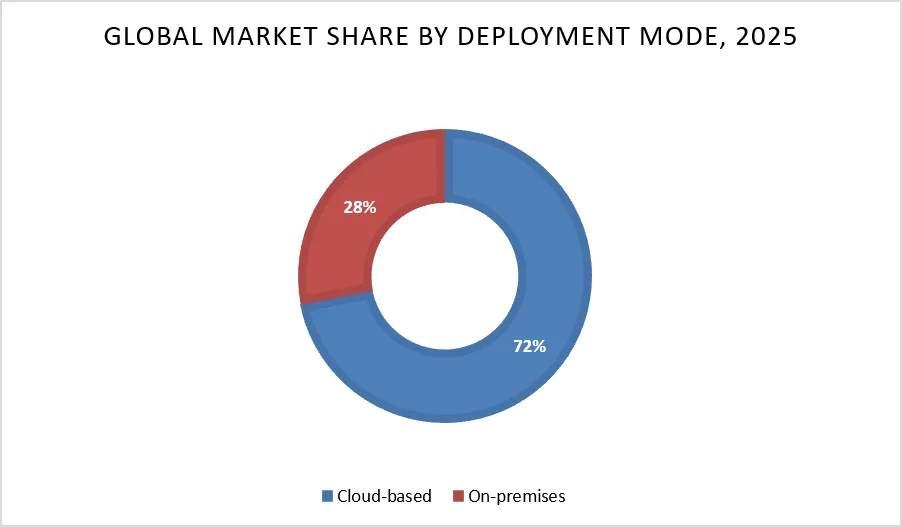
Cloud-Based Deployment Dominates the Quantum Computing in Financial Services Market
The cloud-based deployment is the leading segment in quantum computing in finance since it allows financial service providers to leverage the power of quantum processors without having to develop their own quantum hardware. Cloud solutions will help banks and other financial service providers experiment with the use of hybrid quantum-classical algorithms for portfolio optimisation, bond trading, risk modelling, pricing derivatives, and detecting fraud. This will become possible thanks to lower infrastructure requirements for such testing.
The development of collaborations between quantum technology companies and financial institutions will also contribute to the growing cloud deployment trend. Major cloud vendors like IBM, Microsoft, and Amazon Web Services offer access to quantum computing environments in which developers and financial organisations can experiment with algorithms based on currently available quantum hardware and simulators. For instance, Amazon Braket lets researchers conduct quantum optimization experiments using systems offered by several different hardware vendors.
Request a Customized Report According to Your Business Strategy: https://www.datamintelligence.com/customize/quantum-computing-in-financial-services-market
Hybrid Quantum Computing and Advanced Financial Modelling Create New Growth Opportunities in the Quantum Computing in Financial Services Market
The opportunity is becoming more tangible as financial companies continue to invest in quantum technologies. In October 2026, according to Gartner estimates, BFSI investment in quantum computing will hit USD 289 million by 2028, beating the projected spending in the public sector by USD 280 million.
Also, Gartner predicted global revenues from quantum computing to be USD 869.9 million in 2026, showing the growth of the commercial network around financial uses of quantum computers. It opens up possibilities for quantum software creators, quantum computing clouds, financial companies, and cybersecurity providers engaged in portfolio management, risk assessment, fraud detection, and quantum cryptography.