


For years, PET foam was presented to composite manufacturers through two familiar advantages: it is lightweight, and it can convert discarded beverage bottles into a structural core. Both claims remain relevant. Neither is sufficient for the buying decisions now being made by wind-blade manufacturers, transportation OEMs, marine yards, panel producers and composite processors.
Today’s decision is more demanding. Buyers need to know how much resin a core absorbs, whether it can survive the selected molding cycle, how consistently it can be formed and bonded, whether a supplier can deliver finished kits near the factory, and whether “recyclable” describes a technically possible property or a commercially workable end-of-life route.
This is changing competition in the PET foam market. Armacell is linking recycled content to finer cell structure, shear performance and lower resin uptake. Gurit is positioning Kerdyn PET in wind while engineering research exposes the structural compromises designers must solve when moving away from balsa. DIAB is developing application-specific PET grades and demonstrating PET in recyclable thermoplastic sandwich structures. 3A Composites is competing through a multi-region manufacturing and conversion network. CoreLite offers a challenger proposition based on cost-effective PET, processing flexibility and customization. Asian producers are adding capacity, conversion, and application-specific products, changing both the price and supply equation.
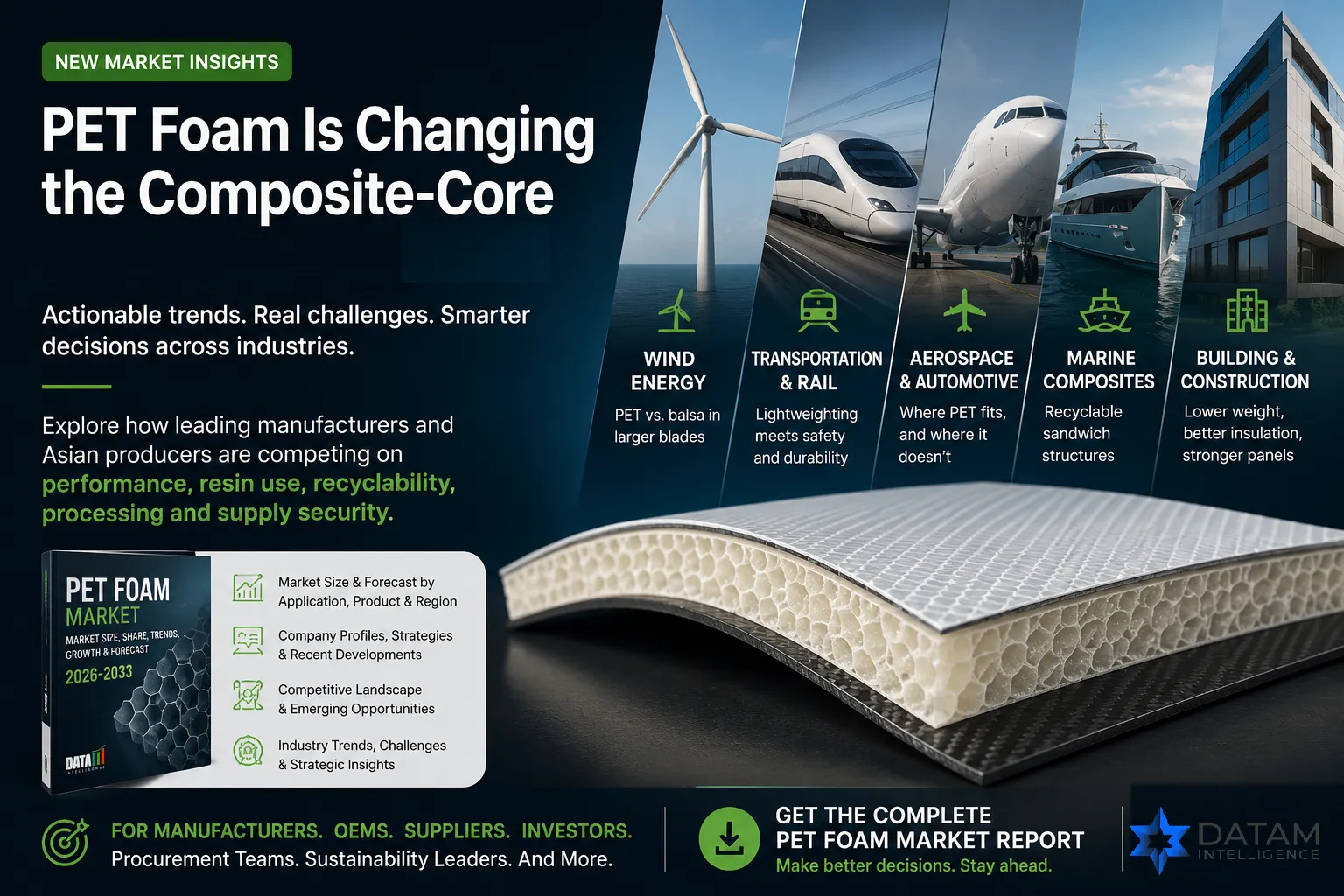
Request Exclusive Sample https://www.datamintelligence.com/research-report/pet-foam-market
Executive Takeaway: What Changed in the PET Foam Buying Decision?
Five shifts are redefining how buyers should assess PET structural foam.
First, foam density is no longer an adequate proxy for value. Two products at the same nominal density can behave differently because of cell structure, anisotropy, weld lines, surface treatment, and dimensional consistency.
Second, resin uptake is becoming a purchasing variable. The core may be inexpensive relative to the skins and resin, but absorbed resin adds both mass and cost. A more expensive foam can produce a cheaper finished panel if it reduces resin use, labor, or scrap.
Third, process compatibility is separating general-purpose PET from application-engineered PET. Thermoforming, compression molding, vacuum infusion, prepreg processing and press bonding impose different demands on ductility, thermal stability, surface quality and flow paths.
Fourth, regional supply and conversion capacity are becoming part of qualification. A globally available foam is not necessarily a locally available finished kit. Buyers increasingly care about cutting accuracy, grooving, perforation, scrim application, sealing, traceability, and the ability to reproduce a kit at more than one location.
Fifth, recycled content and end-of-life recyclability are being separated. A core made from post-consumer PET can reduce reliance on virgin feedstock, but a thermoset sandwich containing that core may still be difficult to recover. The stronger circularity question concerns the architecture of the entire sandwich-not the foam alone.
Five Questions Buyers Should Ask Before Selecting a PET Core
1. What is the cost of the finished part?
Price per cubic meter is easy to compare and often misleading. Buyers should model the cost of core, resin uptake, surface treatment, conversion, kitting, labor, scrap, cycle time, transport, and quality variation. Weight penalties also matter in wind, rail, marine and electric mobility.
2. Which properties govern the real failure mode?
Compression, shear, tensile behavior, fatigue and water resistance all matter, but not equally in every design. Directional properties may be especially important in welded or anisotropic foams. The material should be assessed against local loads, face-sheet wrinkling, shear crimping, core failure, buckling, and impact-not selected from density alone.
3. Is the foam optimized for the intended process?
A grade that performs well in infusion may not be the best choice for thermoforming or compression molding. Buyers should examine processing temperature, ductility, spring-back, dimensional stability, resin compatibility, cell behavior, weld-line visibility, and surface finish.
4. What exactly does the sustainability claim measure?
Questions should cover recycled content, feedstock traceability, manufacturing emissions, waste recovery, availability of environmental declarations, and end-of-life pathways. “Recycled,” “recyclable,” and “recycled in practice” are not interchangeable.
5. Can the supplier support the program at scale?
Qualification should include raw material and foam production locations, regional finishing capacity, tooling and kit replication, capacity allocation, quality systems, technical support and change-control procedures. A strong datasheet cannot compensate for an unreliable production system.
Armacell: Is Lower Resin Uptake Becoming as Important as Density?
Armacell’s ArmaPET strategy illustrates how recycled PET competition is moving beyond bottle-count claims. In 2026, the company said it had converted more than five billion PET bottles into foam products and manufactured ArmaPET across three continents. Those are manufacturer-reported figures, but they establish the scale and geographic reach behind its circularity positioning.
The more consequential development for buyers is ArmaPET Struct GRX. Armacell describes the product as having a finer, more homogeneous cell structure, improved shear performance and optimized resin uptake. Its technical material reports potential resin-uptake savings of up to 60% against the stated comparison, depending on density, surface treatment, and test conditions. It also describes the product as based on 100% recycled PET.
The commercial significance lies in the chain of effects:
cell structure → resin uptake → laminate weight → material cost → process repeatability
In a large infused component, a small reduction in resin absorbed per unit area can become a significant saving across the structure. The buyer therefore needs to test more than the dry foam. A representative panel made with the actual resin, surface treatment, grooves and process conditions is the better economic benchmark.
Armacell is also presenting recycled PET as a platform for thermoplastic sandwich structures. At JEC Forum Southeast Asia 2026, its technical program focused on recyclable foam-cored thermoplastic sandwiches using r-PET. This points toward faster-forming transport and construction applications in which the core and skins may be designed with greater material compatibility.
For procurement teams, Armacell’s proposition should be tested around four questions: Does GRX reduce resin under the buyer’s exact process? Does improved shear performance allow a density or thickness optimization? Can equivalent product and conversion support be obtained regionally? And does the thermoplastic concept lead to an actual recovery route for the final component?
Gurit: Can Recycled PET Replace Balsa in Larger Wind Blades?
Gurit positions Kerdyn PET Wind as a structural core made with up to 100% recycled post-consumer PET. The company reports up to 65% lower carbon dioxide emissions compared with conventional foam cores and says it recycles nearly one billion bottles annually through its PET activity. Kerdyn is offered for structural areas such as shear webs and blade shells, with emphasis on shear and compressive strength, fatigue, and closed-cell behavior.
The decision facing blade engineers is more complex than sustainability messaging suggests. Balsa and PET do not have identical directional properties. A 2025 Aalborg University study using the full-scale Gurit98m blade model noted that PET’s transverse stiffness and strength can be much lower than balsa’s and evaluated how core thickness and directional shear moduli influence buckling and sandwich failure. It found the spanwise shear modulus had the greatest influence among the investigated core variables, while core thickness had a moderate effect.
This does not prove that PET is unsuitable. It proves that substitution requires design work. Designers may need to optimize density, thickness, orientation, local reinforcements, and the distribution of materials across the blade. PET may be compelling in selected zones while balsa or another core remains preferable elsewhere.
The Gurit98m open-source blade model is relevant because it provides a modern structural framework for testing those decisions against buckling, static, and fatigue constraints.
For wind OEMs, the useful question is not “Can PET replace balsa?” It is “In which blade zones, under which load directions and processing conditions, does PET reduce cost, environmental impact or supply risk without reducing structural margin?”
DIAB: Is PET Becoming a Bridge to Thermoplastic Composites?
DIAB’s PET portfolio illustrates the move toward process-specific core design. Divinycell PA60 is positioned for automotive, mobility, industrial and construction applications. DIAB highlights its ductility, thermoformability, high-temperature processing resistance, and suitability for compression molding and press bonding. Soft weld lines are intended to support the surface appearance of automotive and interior sandwich parts.
This matters because higher-volume transport applications need more than structural efficiency. They need repeatable forming, short cycles, acceptable appearance, and integration with automated production. A core that requires extensive secondary finishing or creates visible surface defects may fail commercially even if its mechanical properties are adequate.
DIAB’s JEC World 2026 showcase raises the larger circularity question. The company presented thermoplastic hydrofoils developed with MiniLab using Divinycell PET foam and Victrex LMPAEK thermoplastic composite skins. DIAB described them as recyclable thermoplastic hydrofoils.
The concept is important because conventional thermoset sandwiches bind different materials into a structure that is difficult to separate. Thermoplastic skins paired with a thermoplastic core could allow different joining, forming, and recovery strategies. But material compatibility does not create a recycling economy by itself. Collection, dismantling, contamination, size reduction, polymer degradation and markets for recovered material still determine whether recycling occurs.
For buyers, DIAB’s development should be evaluated as a design pathway rather than proof of closed-loop commercial recycling. The right questions concern joint design, repairability, recovery yield, retained material properties, and the economics of processing the end-of-life structure.
3A Composites: Does Manufacturing Footprint Matter as Much as Foam Performance?
3A Composites competes through portfolio breadth and regional production. The company says its core-materials business focuses principally on PET foam and balsa. AIREX foam production is located in Switzerland, the United States, and China; its U.S. PET foam is manufactured in Glasgow, Kentucky, while its Changzhou site produces PET foam for the Asia-Pacific strategy. It also operates conversion capability in North America and China.
That footprint can influence procurement in ways a datasheet cannot show.
A core supplier may need to deliver precisely machined kits in production sequence, support design revisions, maintain material and process traceability, and reproduce output across regions. Shipping unconverted foam across continents can add time and logistical exposure. Regional conversion can shorten the feedback loop between an OEM’s engineering change and a production-ready kit.
3A Composites also has a material-selection advantage: it supplies AIREX foams and BALTEK balsa. A supplier with both options can support hybrid or zoned designs instead of forcing every location toward one core material. The risk is that portfolio breadth must still translate into current application expertise and consistent execution.
Procurement teams should therefore ask whether “global supply” means three interchangeable qualified sources or simply several sites producing different ranges. They should also examine whether drawings, toolpaths, inspection data, and material equivalency can be transferred between conversion locations without restarting the qualification process.
CoreLite and Other Challengers: Where Can Specialists Compete?
CoreLite markets its closed-cell PET foam as a cost-effective material made from recycled plastic bottles, with densities from 65 to 320 kilograms per cubic meter. It highlights thermoformability, processing temperatures up to 150°C, and applications in marine, wind, automotive, rail, aerospace and industrial structures. It also offers kits, sandwich panels and engineering services.
The challenger opportunity lies in usable performance rather than headline scale. Smaller or specialist suppliers can compete through responsive engineering, customized dimensions, low minimum quantities, conversion flexibility, regional service and aggressive total-cost proposals.
They may be especially competitive in marine, industrial panels, recreational vehicles, transportation interiors, and construction markets where buyers require dependable technical performance but may not need a wind-scale global supply agreement.
Buyers should avoid equating challenger status with either low quality or automatic savings. The evaluation should include property variation, weld-line behavior, fire data, surface finish, kit accuracy, quality certifications, long-term availability, and references from comparable applications. Where recent public development evidence is limited, qualification data should carry more weight than marketing recency.
Asian PET-Core Producers: Is Regional Manufacturing Changing Price and Supply?
Asian competition is moving beyond generic foam blocks. Global suppliers already manufacture PET foam in China, and domestic producers increasingly market sealed surfaces, fire-retardant grades, CNC machining, infusion patterns, and wind-specific kits.
Anhui Dongyuan New Materials states that its PET structural cores serve wind, rail, marine, automotive and construction applications. In April 2026, the company reported that a project for 33,000 cubic meters of annual wind-energy PET structural-kit capacity was advancing.
Other suppliers advertise broad density ranges, short delivery windows, and application-specific certification. These are commercial claims that require buyer verification, but they show the direction of competition: price is being combined with conversion and regional proximity.
For an Asian blade or transportation plant, local production can reduce freight, inventory, and lead time. It can also improve responsiveness during design revisions. For export customers, the calculation is different. Qualification cost, logistics, currency exposure, intellectual-property controls, audit access and consistency across shipments can outweigh a lower quoted material price.
The durable competitive divide will not be “European quality versus Asian cost.” It will be between suppliers that can deliver repeatable, qualified, application-ready cores and suppliers that cannot.
Automotive and EVs: Can PET Move Into Higher-Volume Components?
Automotive adoption depends on cycle time and integration. A lightweight material that works in slow, labor-intensive production may not fit a high-volume vehicle program.
PET foam has opportunities in battery covers, underbody shields, parcel shelves, luggage structures, seat components, roofs, load floors, and interior panels. Its value proposition can include stiffness at low weight, energy absorption, thermal insulation, recycled content, and compatibility with thermoforming or compression molding.
The practical hurdles are equally important:
- Forming complex shapes without cracking or excessive spring-back
- Achieving an acceptable Class A or visible interior surface
- Meeting flammability and odor requirements
- Bonding reliably to thermoplastic or thermoset skins
- Controlling cycle time and automated handling
- Maintaining crash and durability performance over temperature
- Securing automotive-scale supply and change control
DIAB’s PA60 positioning is relevant precisely because it addresses ductility, thermoforming, compression molding, and appearance. The adoption question is whether these properties translate into a stable, automated component process at target takt time.
Rail: Fire, Smoke and Toxicity Decide Adoption
Rail manufacturers value weight reduction because it can reduce energy use, axle loads and operating cost. They also operate in a strict fire-safety environment. A core cannot be selected independently of the skins, adhesives, coatings, joints and complete panel construction used in the fire test.
PET-based sandwich structures can be considered for floors, doors, walls, driver cabins, tables and other interior or structural elements. Armacell identifies such rail uses for its PET solutions.
The buyer should investigate flame spread, smoke density, toxicity, heat release, moisture behavior, durability, and repair-not accept a general “flame-retardant” description. Certification of a foam grade does not always qualify the final sandwich assembly.
The total-value case may include lower vehicle mass, easier installation, fewer support members, thermal and acoustic benefits, and reduced maintenance. PET wins only if those advantages survive the complete rail qualification process.
Aerospace: Where PET Fits-and Where It Does Not
Aerospace rewards lightweight structures but imposes demanding fire, smoke, and toxicity requirements, temperature limits, fatigue performance, damage tolerance, outgassing controls, and long qualification cycles. This makes broad claims about PET “disrupting aerospace” unreliable.
PET may be relevant in selected ground equipment, noncritical panels, general aviation, drones, urban-air-mobility concepts or other applications where its processing and performance envelope is suitable. It does not automatically replace honeycomb, PMI, PES, PEI, or other high-temperature and aerospace-qualified cores.
DIAB, for example, positions Divinycell F-a PES as foam for commercial-aircraft interiors because it is designed for demanding FST performance and high-temperature processing.
That distinction is commercially important. In aerospace, qualification history, lot consistency, machining, bonding, repair data, and supply continuity can matter more than foam price or recycled content. Suppliers should target realistic niches and build the supporting evidence rather than treating aerospace as another generic lightweighting market.
Marine: From Recycled Foam to a Recyclable Sandwich
Marine applications value low water absorption, fatigue, chemical resistance, bond durability, and ease of shaping. PET can serve hulls, decks, bulkheads, interiors, hydrofoils and other structures, but selection depends on impact, slamming loads, local reinforcement and the manufacturing method.
The sustainability debate is becoming more sophisticated. A recycled PET core inside glass-fiber thermoset skins makes productive use of plastic waste, but the complete boat or component remains difficult to recycle. The DIAB-MiniLab hydrofoil points to a different concept: combine a thermoplastic PET core with thermoplastic composite skins and consider circularity at the structure level.
Marine buyers should ask whether the proposed sandwich can be repaired, separated or mechanically recycled, how saltwater and fatigue affect it, and whether a recovery partner exists. End-of-life design must be validated alongside hydrodynamic performance-not added as a marketing claim after the structure is complete.
Construction Panels: Can PET Win on Total Installed Cost?
Building and construction decisions are shaped by more than material strength. Panel weight affects transport, crane requirements, and installation labor. Closed-cell behavior influences moisture exposure. Thermal performance, dimensional stability, screw retention, fire behavior and long-term creep can determine suitability.
PET foam may compete in façades, roofs, modular buildings, doors, partitions and structural insulated panels. Higher-density grades can be considered where inserts or fasteners need local support, although connection design and pull-out testing remain essential.
The correct comparison is the installed system:
- Core and skin cost
- Panel manufacturing time
- Transport and lifting expense
- Substructure requirements
- Fastening and sealing labor
- Thermal performance
- Maintenance and moisture risk
- Fire compliance
- End-of-life route
A foam that costs more than a conventional panel core may still reduce overall project cost if it enables lighter panels, faster installation, or fewer structural supports. Conversely, sustainability alone will not justify PET if fire or connection requirements force expensive secondary measures.
Wind: PET vs. Balsa Is an Engineering Trade-Off, Not a Slogan
Wind remains one of the most consequential PET foam applications because blades consume large volumes of core material and operate under repeated, multidirectional loading for decades.
Balsa offers excellent mechanical properties, particularly in compression, but presents natural variability, moisture-management concerns, and a geographically concentrated supply chain. PET provides industrially controlled density, recycled feedstock, thermoformability and closed-cell behavior. Yet the lower transverse performance identified in engineering studies can require different design choices.
A credible blade-core decision should consider:
- Directional shear stiffness and strength
- Compression and tensile properties
- Fatigue under representative load spectra
- Buckling and face-sheet wrinkling margins
- Core thickness and local density zoning
- Resin uptake and surface sealing
- Infusion speed and flow pattern
- Moisture and freeze-thaw exposure
- Kit tolerances and blade-factory handling
- Material availability across a multi-year platform
The likely future is not a single-material victory. Larger blades may use PET, balsa, and other cores in different zones, with optimization software determining the best balance of weight, performance, cost, and supply risk.
The Hidden Economics: Resin Uptake, Processing Time and Conversion
The core purchase price is visible. Many of the larger economic effects are hidden inside manufacturing.
Resin uptake is the clearest example. The correct comparison uses test panels produced with the intended core finish, geometry, and resin. Buyers should record resin mass per unit area, cured panel weight, infusion time, void content, and mechanical performance. Vendor laboratory values are a starting point, not the final business case.
Conversion adds another layer. Grooves and perforations can improve resin flow but may increase resin consumption. Surface sealing can reduce uptake but adds a processing step and may influence bonding. Scrimmed contour sheets improve drapability while introducing gaps that fill with resin. CNC kits reduce factory cutting and scrap but make dimensional control and nesting efficiency part of supplier performance.
The most useful sourcing metric is therefore not price per kilogram or cubic meter. It is:
cost, weight, and cycle time per accepted finished component
That metric aligns procurement, engineering and operations around the same outcome.
The New Supplier Model: Foam Plus Manufacturing Solution
Core suppliers increasingly compete through finishing, kitting, engineering, process trials, certification support and application development. DIAB offers finishing, kitting and engineering services alongside its materials. 3A Composites combines regional PET manufacturing with conversion. Gurit supplies structural cores within a wider composites portfolio that includes engineering and other materials.
This changes the buying unit. OEMs are not always purchasing a sheet of foam; they are purchasing a repeatable geometry, documented process window and qualified supply chain.
The model creates higher switching costs. Changing suppliers may require new material testing, infusion trials, toolpath verification, kit inspection, panel testing and customer approval. It also creates value: a capable supplier can reduce scrap, simplify assembly and accelerate industrialization.
For investors, this distinction separates commodity capacity from defensible capability. Extrusion volume can be replicated more easily than application data, qualified conversion networks, customer-specific kits and embedded engineering relationships.
PET Foam Core Buyer Checklist
Before approving a PET core, buyers should document:
- Exact grade, density range and directional properties
- Compression, tensile, shear and fatigue requirements
- Governing failure modes in the component
- Resin uptake under the production process
- Surface treatment, grooves, perforations and scrim configuration
- Forming temperature, pressure, cycle time and dimensional recovery
- Bond compatibility with skins, adhesives and resin
- Fire, smoke, toxicity and other required certifications
- Water absorption, temperature and chemical exposure
- Recycled content and supporting traceability
- Practical end-of-life route for the complete sandwich
- Foam production and conversion locations
- Kit tolerances, nesting yield and inspection plan
- Capacity, lead time, business-continuity and change-control plans
- Prototype, validation and requalification cost
- Total cost and weight per accepted finished part
What This Article Cannot Answer-and Where Underlying Market Data Matters
This investigation explains why the PET foam buying decision is changing and which technical and competitive variables deserve attention. It cannot determine the size, timing, or geographic attractiveness of every opportunity.
Decision-grade market research is still needed to answer questions such as:
- How large is PET foam demand by application and region?
- Which countries are adding wind, transportation and panel capacity fastest?
- How are demand and pricing distributed by product, density, and grade?
- Which suppliers hold strong positions in each regional and application segment?
- Where is capacity expanding, and where could oversupply emerge?
- Which end markets can support premium engineered grades?
- How quickly is PET displacing balsa, PVC, or other cores?
- Which regulatory, qualification and recycling constraints could slow adoption?
- Where are partnerships, acquisitions or market-entry opportunities most attractive?
The strategic role of a PET Foam Market report is therefore not to repeat that PET is lightweight or sustainable. It is to quantify where the opportunity exists, identify who is positioned to capture it, and expose the risks that a product announcement or technical datasheet cannot show.
The article tells the reader what has changed and why it matters. The underlying market data should tell them how large the opportunity is, where it is developing, who is competing, and what action is justified.
Frequently Asked Questions
What should buyers compare beyond PET foam density?
They should compare directional shear and compression properties, fatigue, cell and weld-line consistency, resin uptake, surface treatment, processing window, fire performance, conversion quality, recycled content, regional capacity and total finished-part cost.
Why does resin uptake matter when choosing PET foam?
Resin absorbed by the core increases panel weight and material cost. Surface condition, cell structure, grooves, perforations, and contour cuts influence the result, so buyers should test the actual production configuration.
Can PET foam replace balsa in wind turbine blades?
It can replace balsa in selected locations and designs, but not necessarily as a direct substitution. Differences in directional stiffness and strength may require changes to density, thickness, orientation, reinforcement, or blade zoning.
Is recycled PET foam automatically recyclable after use?
No. The foam may be recyclable as a material, but skins, adhesives, contamination, and component architecture can make the complete sandwich difficult or uneconomic to recover.
Is PET foam suitable for automotive mass production?
Potentially, especially in thermoformed or compression-molded sandwich parts. Adoption depends on cycle time, ductility, surface quality, bonding, fire performance, automated handling, and reliable automotive-scale supply.
Can PET foam meet rail fire-safety requirements?
Certain grades and sandwich constructions may meet relevant requirements, but compliance generally depends on the complete assembly, including skins, adhesives and coatings. Buyers must validate the intended construction.
Why is PET foam not automatically the best aerospace core?
Aerospace applications may require more demanding FST performance, higher processing temperatures, outgassing control, and extensive qualification. Honeycomb, PMI, PES, PEI, or other materials may remain better suited to many applications.
How does regional conversion affect supplier selection?
Local kitting and conversion can reduce freight, inventory, response time, and factory labor. Buyers should confirm whether specifications, toolpaths and quality controls can be reproduced across locations.
Are Asian PET foam producers competing only on price?
Increasingly, no. Some offer fire-retardant grades, surface sealing, CNC conversion and wind-specific kits. Buyers should independently verify capacity, consistency, certification, and application references.
What is the best commercial metric for comparing core materials?
The most useful metric is cost, weight, and cycle time per accepted finished component. It captures resin consumption, conversion, labor, scrap, and quality-not merely the foam quotation.