


Oncology Commercialization & Manufacturing Perspective
| KEY TREND | Merck and Moderna reported the first positive Phase 3 readout for an individualized mRNA cancer therapy in August 2026. |
| COMMERCIALIZATION TEST | Personalized vaccines require thousands of patient-specific batches, strict chain-of-identity controls and turnaround measured in weeks. |
| WHY IT MATTERS | The winners may be defined as much by manufacturing orchestration, logistics and cost discipline as by clinical efficacy. |
The Science Has Crossed a Threshold. The Operating Model Has Not.
Personalized mRNA cancer vaccines moved from a compelling idea to a potential commercial category in August 2026, when Merck and Moderna said the Phase 3 INTerpath-001 study of intismeran autogene plus KEYTRUDA met its recurrence-free survival and distant metastasis-free survival endpoints in resected melanoma.
That is a major clinical milestone. It is also the beginning of a very different commercialization problem. Unlike a conventional vaccine or biologic, an individualized neoantigen therapy is designed from the mutations in one patient's tumor. The commercial system therefore has to manufacture thousands of distinct medicines in parallel rather than making one large standardized batch.
The question is no longer only whether personalized mRNA cancer vaccines can work. It is whether the industry can build a reliable, fast and economically viable operating model around them.
Request Exclusive Sample: https://www.datamintelligence.com/download-sample/oncology-biosimilars-market
Why Personalized Manufacturing Changes Everything
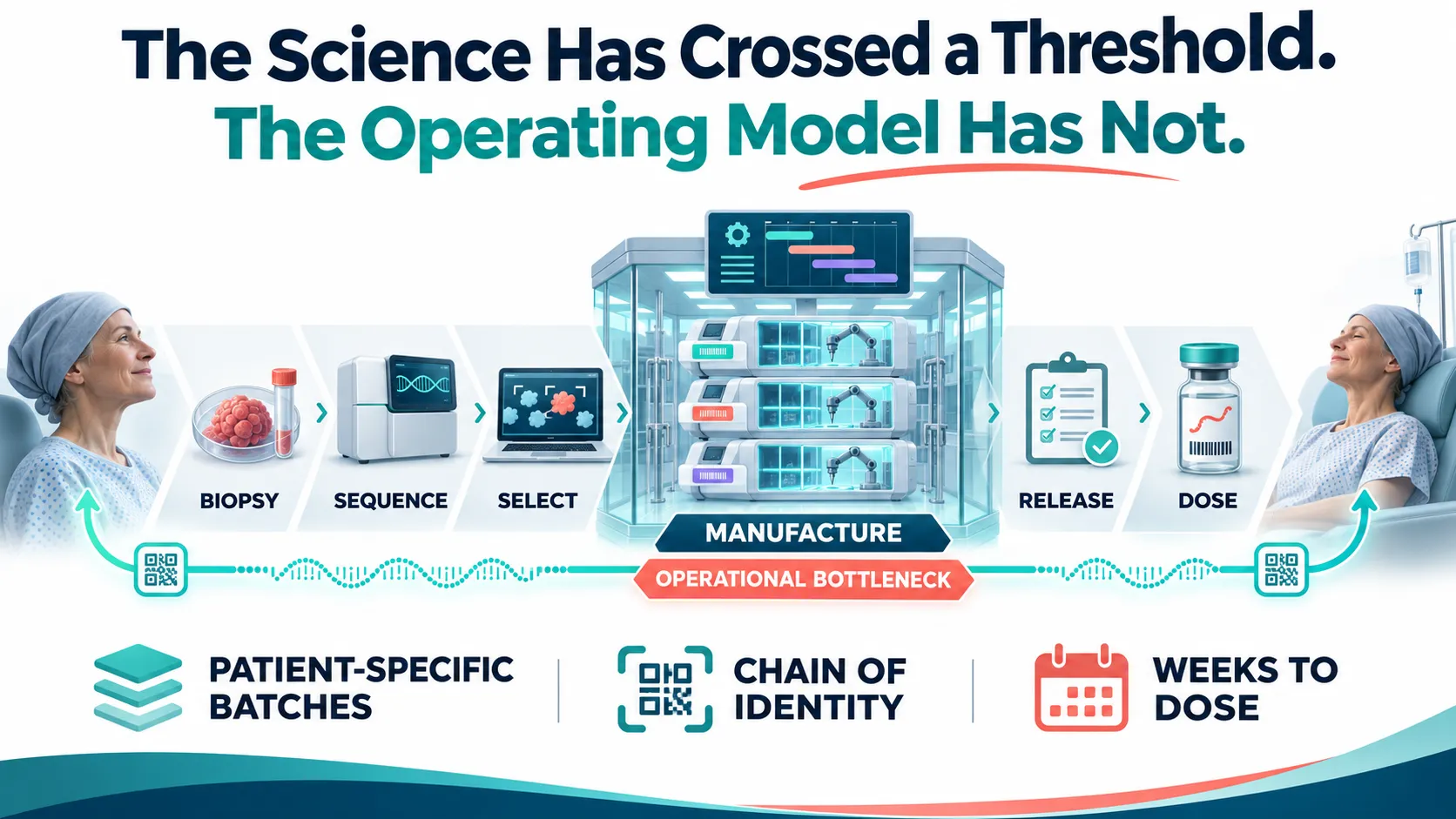
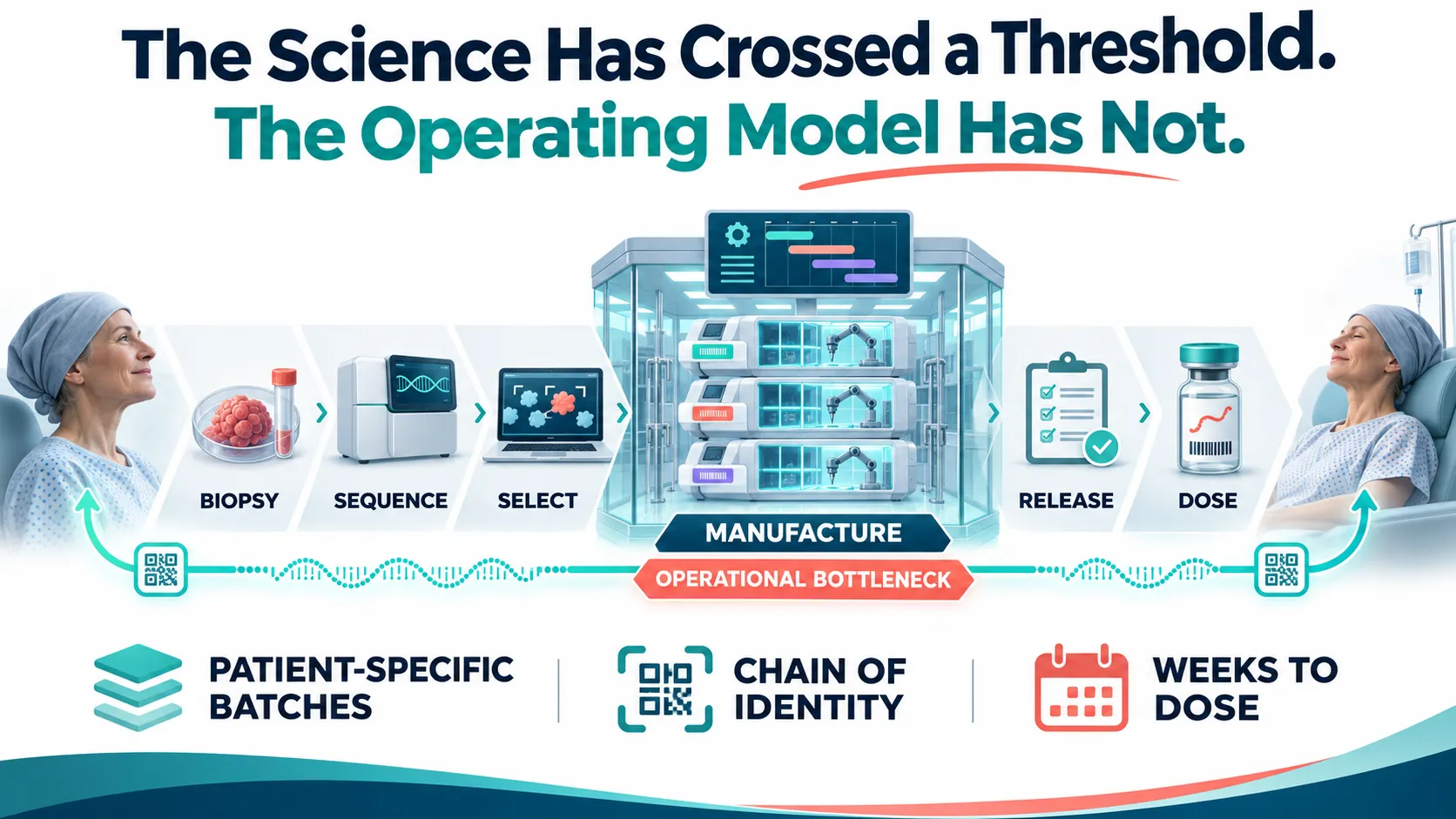
The manufacturing sequence starts before the drug is made. A tumor sample must be collected, sequenced and compared with healthy tissue. Candidate neoantigens are then selected computationally, an individualized mRNA construct is designed, manufactured, purified, released and shipped back to the correct patient. Each step is linked to a single identity.
| STEP 1 | STEP 2 | STEP 3 | STEP 4 | STEP 5 | STEP 6 |
| BIOPSY | SEQUENCE | SELECT | MANUFACTURE | RELEASE | DOSE |
Tumor and blood sample collection | Identify patient-specific mutations | Choose neoantigen targets | Produce patient-specific mRNA batch | QC, identity check and batch release | Return therapy to the patient |
• The operational clock starts at the care site | • Speed and sample quality shape the timeline | • Algorithm quality influences what gets built | • Parallel lot management becomes the scale challenge | • Traceability failures can become product failures | • Delivery timing directly affects treatment value |
Moderna says it has already operationalized an automated process capable of producing patient-specific intismeran batches in parallel, with typical manufacturing turnaround of a few weeks. Industry participants cited by PharmaVoice describe a broader ambition of roughly six to eight weeks from biopsy to dosing.
Five Commercialization Barriers That Matter More After Phase 3
| Barrier | What changes | Commercial risk | What companies need to solve |
| Scale-out, not scale-up | Thousands of unique batches run in parallel | Capacity can become patient-specific rather than volume-specific | Automation, modular suites and parallel batch orchestration |
| Turnaround time | Patients cannot wait through long manufacturing cycles | Clinical benefit can be undermined by slow vein-to-vein style logistics | Faster sequencing, design, release testing and transport |
| Chain of identity | Every batch belongs to one patient | A mix-up is a product failure, not just a logistics error | End-to-end digital identity and traceability |
| Cost per dose | Small-batch economics differ from mass biologics | High COGS can constrain reimbursement and access | Automation, yield improvement and lower-touch processing |
| Indication economics | Hot and cold tumors may respond differently | A single manufacturing platform may support very different clinical value by tumor type | Portfolio prioritization around response, urgency and addressable population |
The Phase 3 Win Does Not Mean the Category Is De-Risked
The field is still clinically uneven. BioNTech and Genentech terminated a Phase 2 colorectal cancer study of autogene cevumeran in 2026 after an independent monitoring board concluded that continuing the study was unlikely to change the efficacy outcome. BioNTech said no new safety signal was identified and a separate pancreatic cancer study continues.
That contrast matters commercially. Personalized cancer vaccines are not one homogeneous market. Tumor biology, mutational burden, treatment setting, combination strategy and time-to-treatment can all change the value proposition. A manufacturing network built for broad oncology commercialization therefore has to remain flexible across indications rather than assume every program will scale in the same way.
Manufacturing Capacity Is Becoming Part of the Product Strategy
BioNTech has been expanding clinical production in Mainz for its individualized neoantigen-specific immunotherapy platform and said it aimed to have commercial production capacity available alongside clinical production for the first time in 2026. Moderna, meanwhile, has built purpose-specific individualized manufacturing capability and maintains a broader global production network.
This matters because personalized manufacturing cannot be treated as a late-stage tech-transfer exercise. Capacity design, digital architecture, testing strategy, release workflow, cold-chain logistics and site redundancy influence how quickly a product can reach a patient and how many patients can be treated at commercial scale.
The Commercial Model May Look More Like Cell Therapy Than a Vaccine Launch
The front end resembles a therapy service network: biopsy collection, sequencing, algorithmic target selection, manufacturing slot allocation, release testing, shipment and scheduling must all work as one coordinated system. That means commercialization teams may need to think less like traditional vaccine marketers and more like advanced-therapy operators.
| Commercial layer | Traditional vaccine model | Individualized mRNA cancer model |
| Production | Large standardized batches | Many patient-specific batches |
| Demand planning | Forecast population-level volume | Forecast patients plus manufacturing slots |
| Distribution | Inventory-driven | Identity- and schedule-driven |
| Launch readiness | Supply + channel + promotion | Supply + sequencing + digital identity + clinical workflow |
Five Priorities Before Commercial Launch
| Priority | Why it matters | Commercial question |
Industrialize the biopsy-to-dose workflow | Turnaround is part of product value | Can every handoff be measured and compressed? |
Build digital chain-of-identity into the operating model | Every batch is patient-specific | Can identity survive every site, system and logistics transfer? |
| Design for parallelization | Commercial scale means more unique batches, not simply bigger tanks | How many patient lots can be run concurrently? |
Control cost before reimbursement pressure arrives | High COGS can limit access | Which steps can be automated or standardized without losing personalization? |
Segment indications by manufacturing urgency and value | Different tumors create different clinical and economic profiles | Where does personalization justify the operational complexity first? |
Request a Customized Report According to Your Business Strategy: https://www.datamintelligence.com/customize/oncology-biosimilars-market
What Is Going to Happen Next?
If regulators ultimately approve intismeran autogene, personalized mRNA cancer vaccines could become one of the first large-scale tests of whether precision medicine can be industrialized without becoming operationally unaffordable. The category will need to prove that it can deliver individualized biology with industrial reliability.
The companies that solve that equation may create a manufacturing model that extends well beyond melanoma. The same infrastructure could support additional individualized oncology programs and, over time, help identify recurring neoantigens that make more standardized off-the-shelf approaches possible.
The next competitive question is therefore bigger than who has the strongest mRNA platform: who can turn a patient-specific medicine into a repeatable commercial system?