


NVIDIA vs AMD vs Broadcom: Who Controls the AI Inference Era?
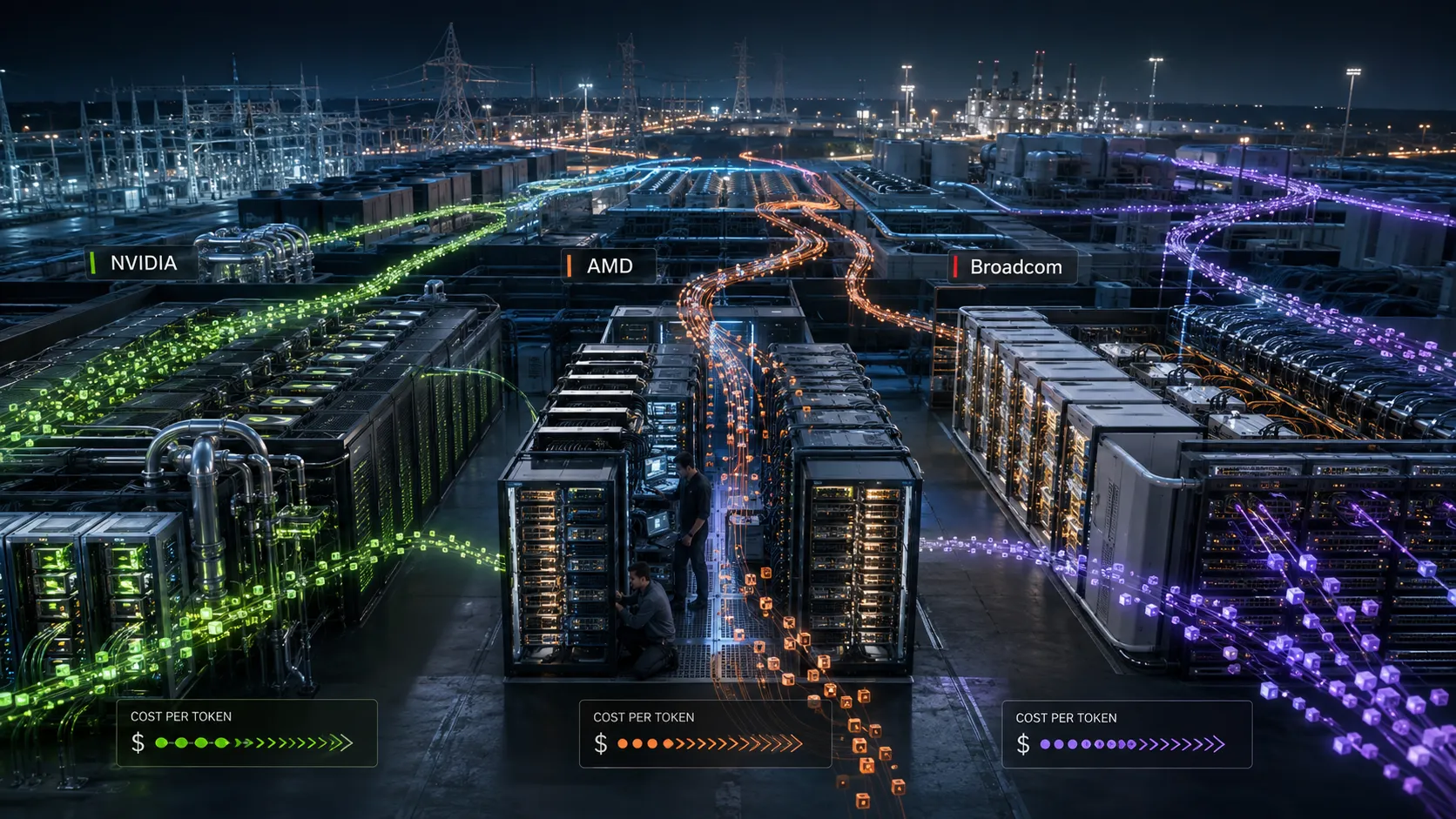
AI infrastructure is moving into a harder phase. Training still matters, but more attention is shifting to inference: serving answers, AI agents, search, coding tools, video and enterprise workloads. That changes what customers buy. Peak chip performance matters less if a system wastes power, leaves accelerators idle, moves data slowly or costs too much for every token it produces. Recent product moves from NVIDIA, AMD and Broadcom all point toward this system-level fight.
As of August 2026, NVIDIA has the strongest position in general-purpose commercial AI inference. Broadcom is becoming a serious threat in hyperscale custom silicon and networking. AMD is building the clearest open alternative, supported by rack-scale systems and a series of targeted acquisitions. DataM Intelligence expects control of inference infrastructure to split across accelerators, custom chips, software, networking and access to power rather than remain with a single chip supplier.
According to DataM Research Report, “The global Artificial Intelligence Chip Market is projected to forecast US $361.14 billion by 2035, growing at a CAGR of 16.64% during 2026 to 2035”
Request for Exclusive Sample: https://www.datamintelligence.com/download-sample/artificial-intelligence-chip-market
Why AI inference changes the chip race
The first AI infrastructure rush rewarded suppliers that could deliver scarce accelerators quickly. The next buying cycle is becoming more focused on how efficiently a complete system converts electricity into useful tokens while keeping latency predictable.
This helps explain why NVIDIA, AMD and Broadcom increasingly discuss racks, networks, memory and software together.
The physical network is changing as well. The Optical Compute Interconnect MSA was established in March 2026 by founding members including AMD, Broadcom, Meta, Microsoft, NVIDIA and OpenAI. Its goal is an open optical architecture for AI scale-up connections, including a multi-vendor supply chain designed to reduce integration risk and vendor lock-in as copper connections become harder to scale.
Inference economics are therefore a system problem. A fast accelerator can lose part of its advantage when memory becomes a bottleneck, the network cannot keep GPUs busy or orchestration leaves costly hardware waiting for work.
NVIDIA: still the company to beat
NVIDIA enters the inference fight with enormous data-center scale and a software ecosystem already used across cloud providers, AI labs and enterprises.
For its fiscal first quarter of 2027, ended April 26, 2026, NVIDIA reported revenue of $81.6 billion. Data Center revenue reached $75.2 billion, up 92% from the prior year. Under the company's previous reporting structure, Data Center networking generated $14.8 billion, up 199% year over year.
The important change is what NVIDIA now sells.
Vera Rubin combines GPU racks, CPU infrastructure, NVLink, Ethernet, storage processing, and NVIDIA Groq 3 LPX, a dedicated accelerator aimed at low-latency inference. NVIDIA says Vera Rubin NVL72 can provide up to 10 times higher inference throughput per watt and inference at one-tenth the cost per token compared with Blackwell. These are NVIDIA's own performance claims and should be validated against each buyer's models and production workload before procurement decisions are made.
NVIDIA is also buying technology around the accelerator.
It acquired SchedMD, the developer of the Slurm workload-management system, in December 2025. NVIDIA Run:ai now provides GPU scheduling, resource allocation and inference orchestration across cloud, hybrid and on-premises infrastructure.
That software layer matters because utilization directly affects inference cost. Improving how frequently expensive accelerators are doing useful work can matter more to a data-center operator than a small difference on a peak-performance benchmark.
NVIDIA's biggest strategic risk comes from its largest customers. AI labs operating at enormous scale can now justify developing chips around their own model architectures and serving patterns.
AMD: buying the pieces needed for an open AI stack
AMD remains much smaller than NVIDIA in data-center scale, but its recent numbers show real progress.
AMD reported $11.5 billion of second-quarter 2026 revenue. Data Center revenue reached $6.7 billion, up 107% year over year, driven by demand for EPYC processors and Instinct GPUs. AMD also said Helios deployments were beginning to ramp.
Helios is AMD's response to the rack-scale AI model.
The system combines MI455X accelerators, 6th Gen EPYC CPUs, Pensando networking and ROCm software. AMD says a Helios rack can provide up to 2.9 exaflops of peak FP4 compute, 31 TB of HBM4 memory and 1.7 PB per second of memory bandwidth. It supports UALink over Ethernet for scale-up and standards-based Ethernet for scale-out.
AMD's acquisition strategy gives a clearer picture of where the company wants to go.
Silo AI added model-development and AI software expertise. ZT Systems brought rack design and hyperscale customer-enablement capabilities. AMD later sold ZT's manufacturing operation to Sanmina while retaining the rack-design and customer teams. MEXT, acquired in June 2026, brought technology aimed at reducing memory bottlenecks.
Then came a particularly important deal.
On August 6, 2026, AMD announced an agreement to acquire Taalas, a Toronto company developing specialized AI inference silicon. AMD says Taalas designs around model dataflows to reduce compute and memory bottlenecks, and plans to integrate the technology with its Instinct roadmap.
That move suggests AMD does not expect every future inference job to be handled by the same general-purpose GPU architecture.
AMD is also changing how it sells AI infrastructure. Its July 2026 agreement with Anthropic covers deployments of up to 2 gigawatts of MI450 Series GPUs in Helios racks, with the first gigawatt scheduled to begin deployment in the first half of 2027.
Deals measured in gigawatts look very different from normal server procurement. Power, rack engineering, software optimization and long-term capacity planning are becoming part of the semiconductor sale.
Broadcom: custom silicon could be the bigger disruption
Broadcom gets less attention from many enterprise AI buyers because it is not marketing a general-purpose accelerator in the same way as NVIDIA or AMD.
At hyperscale, its position is harder to ignore.
Broadcom reported $10.8 billion in AI semiconductor revenue for fiscal Q2 2026, up 143% year over year. The company said it expected AI semiconductor revenue of approximately $16 billion in Q3.
These NVIDIA, AMD and Broadcom revenue figures should not be treated as direct market-share comparisons. Each company reports its data-center and AI businesses differently.
Broadcom's advantage comes from combining custom accelerators with networking.
The company has extended its relationship with Meta to support multi-gigawatt deployments of Meta's MTIA custom silicon.
Its OpenAI relationship is even more revealing. Broadcom and OpenAI agreed to co-develop and deploy 10 gigawatts of OpenAI-designed accelerators and Ethernet-based systems, with deployment planned through 2029.
In June 2026, they unveiled Jalapeño, described as OpenAI's first Intelligence Processor and designed around LLM inference workloads.
This challenges the idea that every large inference workload will continue to run on a merchant GPU.
When a company knows its model architecture, memory behavior and serving pattern at enormous scale, dedicated hardware can be built around those requirements. Broadcom does not need millions of developers to select a Broadcom-branded accelerator. A relatively small number of hyperscale customers can generate very large deployments.
Broadcom is also changing how AI chips are financed
One of the least discussed developments is Broadcom's move beyond conventional semiconductor selling.
In June 2026, Broadcom announced the AI XPV Platform with Apollo and Blackstone. The platform is designed to support more than 20 gigawatts of AI deployments through 2028 and launched with a $35 billion transaction covering more than 1 gigawatt of compute capacity.
This connects silicon, networking, data-center capacity and project finance.
For large inference deployments, that sales model could become as important as chip specifications because many AI infrastructure projects are constrained by capital and available electrical power.
Broadcom also has another route into enterprise inference through VMware.
After completing its VMware acquisition, Broadcom made VMware Cloud Foundation the core of its private and hybrid cloud strategy. VMware Private AI Foundation can run AI workloads using NVIDIA acceleration, which means Broadcom can participate in some NVIDIA-powered private AI deployments while simultaneously supplying custom accelerators and Ethernet infrastructure to hyperscalers.
So, who controls the AI inference era?
DataM Intelligence assesses NVIDIA as the current leader in broad commercial AI inference.
Its advantage comes from the combination of deployed compute, CUDA-centered developer adoption, rack-scale systems, networking, and increasingly deep workload-management software. Its problem is that the largest AI customers now have enough scale to move selected workloads onto their own chips.
Broadcom poses the most serious structural threat at the hyperscale end of inference.
Its work with OpenAI and Meta shows that custom AI accelerators are moving from experimental projects toward multi-gigawatt infrastructure. Broadcom's Ethernet portfolio and AI financing platform allow it to compete on cost per token without rebuilding NVIDIA's developer ecosystem.
AMD is the strongest open full-stack alternative.
Helios, ROCm, Pensando networking, ZT Systems' rack expertise and the planned Taalas acquisition now form a much clearer inference strategy. The remaining test is execution. AMD needs software maturity, fast deployments and high production utilization to match the strength of its hardware roadmap.
The real winner will be decided by token economics
Chip benchmark headlines will continue, but buyers should watch what happens after the accelerator is installed.
Cost per delivered token, tokens per watt, tail latency, memory use and accelerator utilization tell a more useful story about production inference. The interconnect matters too, especially as clusters become larger and optical connections move closer to the compute silicon.
For 2026, NVIDIA remains in front.
Broadcom has a credible path to capture some of the industry's highest-value custom inference workloads. AMD can gain ground with customers that want supplier choice, open infrastructure and an alternative rack-scale platform.
The AI inference era therefore looks less like a single-company monopoly and more like a fight over who can deliver the cheapest reliable token for each type of workload.
Request for Exclusive Sample: https://www.datamintelligence.com/download-sample/artificial-intelligence-chip-market
Frequently Asked Questions
Who is leading AI inference in 2026?
NVIDIA currently leads broad, general-purpose commercial AI inference based on the scale of its Data Center business, software ecosystem, networking portfolio and integrated rack-scale systems.
Why is Broadcom a threat to NVIDIA?
Broadcom helps major AI companies develop custom accelerators and supplies networking technology around those systems. Its 10-gigawatt OpenAI program and expanded multi-gigawatt Meta MTIA partnership show that custom inference silicon is reaching much larger deployment levels.
Can AMD catch NVIDIA in AI inference?
AMD has a credible route where customers want open standards and more supplier choice. Helios and MI400 improve its rack-scale offering, while Taalas, MEXT, Silo AI and ZT Systems add specialized inference, memory optimization, AI software and system-design capabilities. Execution and software adoption remain the main tests.
Will custom AI chips replace GPUs?
They are unlikely to replace GPUs across every workload. General-purpose accelerators remain useful when models and software change frequently. Custom silicon becomes more attractive when a company operates large, repeatable workloads where lower power use or lower cost can justify designing dedicated hardware. Broadcom's OpenAI and Meta programs provide current examples of that shift.
What should enterprises compare before buying AI inference infrastructure?
Enterprises should test cost per delivered token using their own models, latency under real concurrency, power consumption, memory capacity, network performance, software compatibility, orchestration and the ability to move workloads between suppliers. Vendor peak-performance figures should be treated as one input, not the final buying decision.
DataM Intelligence sourcing note: This analysis uses primary sources, including official NVIDIA, AMD and Broadcom financial disclosures, company product documentation and official industry-consortium material. Company performance comparisons are identified as vendor-reported where independent benchmarking was not used.
Read Complete Research Report on AI Cheap Market