


How the Nutraceutical Value Chain Works: From Raw Materials to Consumer Products
The nutraceutical industry has evolved from a relatively simple market for vitamins and dietary supplements into a complex ecosystem spanning specialty ingredients, botanical extracts, functional foods, functional beverages, dietary supplements, advanced formulations, contract manufacturing, quality testing, e-commerce and personalized nutrition.
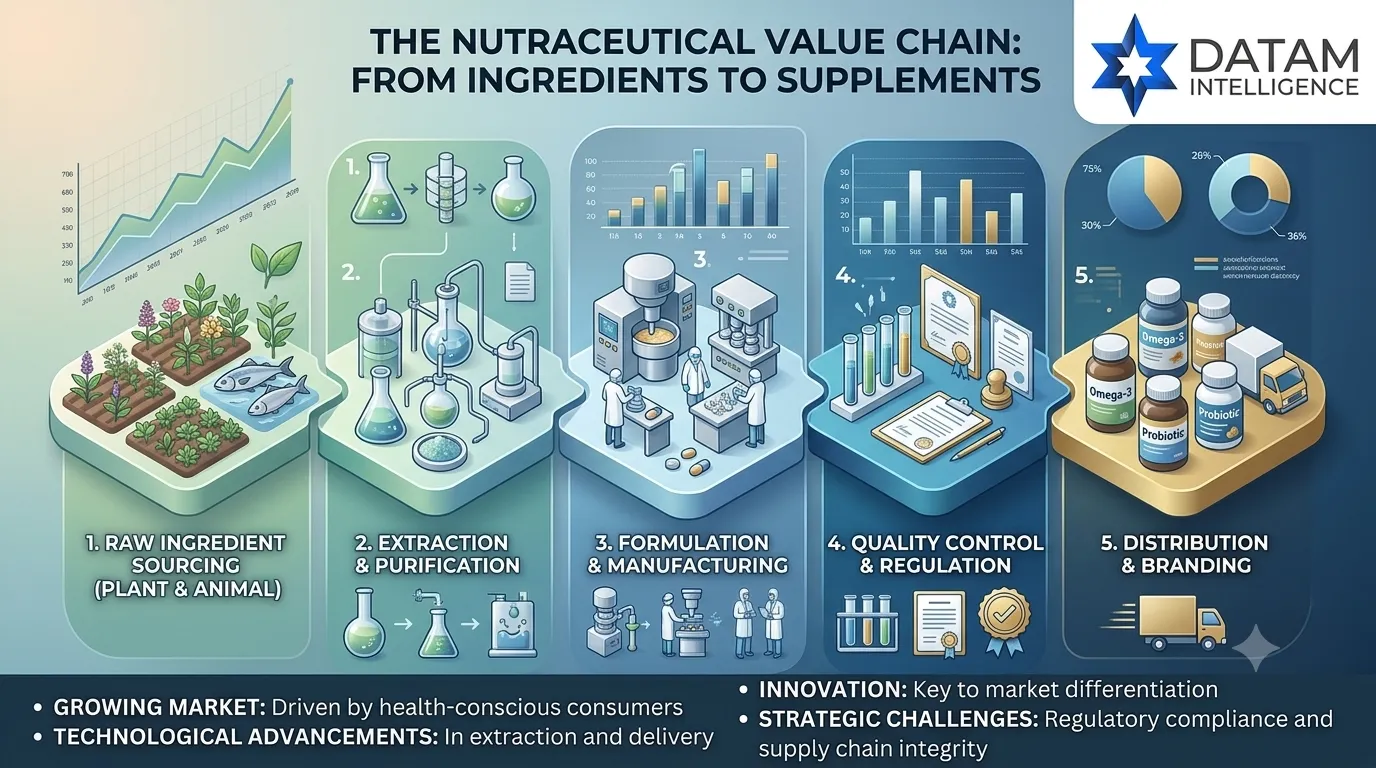
Behind every finished supplement is a value chain that begins with the sourcing of raw materials and ends with the delivery of a finished product to consumers.
Explore Strategic Partnership Opportunities
Leverage DataM Intelligence market insights to identify growth opportunities, strengthen your competitive strategy, and accelerate business expansion. Become a Strategic Partner Today!
The journey can be summarized as:
Raw-material sourcing → Ingredient processing → Standardization → Testing → Formulation → Manufacturing → Quality assurance → Packaging → Distribution → Consumer
Understanding this value chain is increasingly important for manufacturers, ingredient suppliers, investors, retailers and brands because competitive advantage is no longer created at only one stage. Ingredient quality, formulation performance, manufacturing scalability, regulatory compliance, supply-chain resilience and consumer access can all influence the commercial success of a nutraceutical product.
According to DataM Intelligence, the global nutraceuticals market reached US$505.45 billion in 2024 and is projected to reach US$874.97 billion by 2032, expanding at a CAGR of 7.10% during 2025 - 2032. The market is being supported by increasing health awareness, preventive-health priorities, lifestyle-related health concerns, e-commerce expansion and continued product innovation.
This growth creates opportunities across the entire nutraceutical value chain not just in finished supplements.
What Is the Nutraceutical Value Chain?
The nutraceutical value chain is the sequence of activities through which raw materials and bioactive ingredients are transformed into commercially available products that reach consumers through retail, pharmacy, e-commerce and other distribution channels.
The chain includes multiple participants:
- Agricultural and raw-material suppliers
- Botanical and specialty-ingredient producers
- Ingredient processors
- Extraction and fermentation companies
- Testing laboratories
- Formulation and R&D teams
- Contract manufacturers
- Packaging companies
- Distributors
- Retailers
- E-commerce platforms
- Nutraceutical brands
Each participant adds value.
For example, an ingredient supplier may create value through purification, standardization and traceability, while a formulation company creates value by developing a stable and commercially viable combination of ingredients.
A contract manufacturer adds value through production scale, manufacturing expertise and quality systems, while a brand captures downstream value through product positioning, consumer relationships and distribution.
Therefore, the nutraceutical value chain should be viewed as an interconnected ecosystem rather than simply a manufacturing process.
The Nutraceutical Value Chain at a Glance
| Stage | Primary Activity | Value Created |
|---|---|---|
| 1. Raw-material sourcing | Agricultural, botanical, microbial and other inputs | Availability and traceability |
| 2. Ingredient processing | Extraction, purification, drying, fermentation | Ingredient quality and concentration |
| 3. Standardization | Active-compound consistency | Batch-to-batch consistency |
| 4. Testing | Identity, potency, purity and safety testing | Quality assurance |
| 5. Formulation | Ingredient combination and dosage design | Product performance |
| 6. Manufacturing | Conversion into finished dosage forms | Scale and production efficiency |
| 7. Quality & regulatory | Compliance and release testing | Market access and consumer confidence |
| 8. Packaging | Protection, labeling and presentation | Stability and differentiation |
| 9. Distribution | Wholesale, retail, pharmacy and e-commerce | Market reach |
| 10. Consumer delivery | Product purchase and usage | Revenue and customer value |
The importance of managing these stages is well established in nutraceutical and functional-food supply chains, where price, quality, quantity and consistent supply are critical factors. Supplier qualification and multiple sourcing options can also help companies manage supply risks.
1. Raw-Material and Ingredient Sourcing
The nutraceutical value chain begins with the sourcing of raw materials.
Depending on the product, these can include:
- Vitamins
- Minerals
- Botanical extracts
- Herbal ingredients
- Proteins and peptides
- Probiotics
- Prebiotics
- Amino acids
- Omega-3 fatty acids
- Fibers
- Enzymes
- Carotenoids
- Polyphenols
- Other bioactive compounds
DataM Intelligence segments the nutraceutical market by ingredients including herbals, proteins and peptides, vitamins and minerals, prebiotics and probiotics, and other ingredients such as fatty acids and fiber.
The source of these materials can also vary. Plant-based, animal-based and microbial sources represent important parts of the broader nutraceutical ecosystem.
Why ingredient sourcing matters
Ingredient sourcing can directly affect:
- Product cost
- Quality
- Availability
- Traceability
- Sustainability
- Regulatory documentation
- Manufacturing consistency
- Finished-product margins
For natural ingredients, supply can be influenced by agricultural conditions, geography, harvest cycles and processing capabilities.
As a result, companies increasingly need supplier-qualification programs rather than relying exclusively on price when selecting ingredients.
2. Ingredient Processing and Extraction
Raw materials often cannot be incorporated directly into finished supplements.
They may first undergo processes such as:
- Extraction
- Purification
- Concentration
- Fermentation
- Drying
- Milling
- Filtration
- Stabilization
- Encapsulation
- Blending
For botanical ingredients, extraction and standardization can be particularly important because the concentration of active compounds can vary according to the source material and processing conditions.
Advanced processing technologies can therefore transform a relatively common raw material into a higher-value specialty ingredient.
This is one of the points where substantial value can be created in the nutraceutical chain.
3. Standardization and Ingredient Quality
Standardization is essential when manufacturers need consistent ingredient performance across production batches.
For example, a botanical extract may be standardized to a specific level of one or more active compounds.
Standardization helps manufacturers manage:
- Potency
- Consistency
- Formulation accuracy
- Batch reproducibility
- Product specifications
- Quality assurance
The value of an ingredient therefore increasingly depends not only on its source but also on the ability of suppliers to deliver consistent specifications and reliable documentation.
4. Testing and Quality Control
Before ingredients enter commercial formulation, they may need to undergo a range of analytical and quality checks.
Testing can include:
- Identity testing
- Assay or potency testing
- Microbiological analysis
- Heavy-metal testing
- Contaminant screening
- Residual-solvent analysis
- Allergen testing
- Adulteration testing
- Stability testing
Testing laboratories have consequently become an important part of the nutraceutical value chain.
DataM Intelligence's market analysis also highlights the increasing role of testing and quality-related services. In June 2024, RSSL introduced a dietary supplement testing service covering areas including nutrition testing, novel-ingredient evaluation and regulatory support.
For manufacturers, testing is not simply a compliance activity. It can influence product-development timelines, supplier selection and the ability to scale a product into different markets.
5. Research, Development and Formulation
Once ingredients have been qualified, they move into formulation.
This stage connects ingredient science with consumer requirements.
Formulators must consider:
- Ingredient compatibility
- Dosage
- Stability
- Solubility
- Bioavailability
- Taste
- Texture
- Color
- Shelf life
- Manufacturing feasibility
- Target cost
- Regulatory requirements
The desired product format also influences formulation.
DataM Intelligence identifies several major nutraceutical forms, including:
- Capsules and tablets
- Powders
- Liquids
- Other specialized formats
The same ingredient may therefore require completely different formulation strategies depending on whether the final product is a capsule, powder, beverage or other dosage form.
6. Advanced Delivery Systems
The value chain is increasingly moving beyond basic ingredient blending.
Companies are developing delivery technologies designed to improve aspects such as:
- Ingredient stability
- Solubility
- Consumer convenience
- Dosage accuracy
- Shelf life
- Product experience
Examples can include:
- Microencapsulation
- Controlled-release formats
- Emulsification
- Specialized powder systems
- Functional beverage systems
- Advanced softgel technologies
This creates another opportunity for differentiation.
Two companies may use the same active ingredient but create very different commercial products because their delivery systems, formulation expertise and consumer positioning differ.
7. Manufacturing and Scale-Up
Once the formulation is finalized, it must be manufactured at commercial scale.
Manufacturing can be performed by:
- Brand-owned facilities
- Contract manufacturers
- Private-label manufacturers
- Specialized nutraceutical manufacturers
- Integrated food, pharmaceutical or nutrition companies
Typical production activities can include:
Capsules: blending → encapsulation → inspection → packaging
Tablets: blending → granulation → compression → coating → inspection
Powders: blending → sieving → filling → packaging
Gummies: preparation → ingredient incorporation → molding → curing → packaging
Liquids: mixing → homogenization → filling → packaging
The challenge is to move from laboratory or pilot-scale production to consistent commercial manufacturing.
A formulation that performs well in small batches may require adjustments when production volumes increase significantly.
8. Contract Manufacturing and the Changing Value Chain
Contract manufacturers are becoming an increasingly important part of the nutraceutical ecosystem.
For emerging and established brands, outsourcing can provide access to:
- Manufacturing infrastructure
- Specialized equipment
- Production expertise
- Quality systems
- Packaging capabilities
- Scale-up support
- Formulation services
The role of contract manufacturers is also expanding beyond simply producing finished products.
Modern manufacturing partners may contribute to formulation, ingredient sourcing, product development, packaging, quality management and regulatory support.
This means the traditional boundary between “supplier” and “manufacturer” is becoming less distinct.
9. Quality Assurance and Regulatory Compliance
Quality assurance operates across the entire nutraceutical value chain.
Companies need processes for:
- Supplier qualification
- Raw-material inspection
- Production controls
- Batch documentation
- Finished-product testing
- Stability
- Packaging controls
- Traceability
- Complaint handling
- Recall management
Regulatory compliance is particularly complex because nutraceutical products can be classified differently across markets.
DataM Intelligence identifies diverse regulatory frameworks as a significant restraint on the global nutraceutical market. Different countries can have different product classifications, compliance requirements and restrictions around health claims.
For companies pursuing international expansion, regulatory strategy therefore needs to be incorporated early into product development rather than treated as an afterthought.
10. Packaging: Protecting Product Quality
Packaging is another critical stage of the value chain.
Nutraceutical products may be sensitive to:
- Moisture
- Oxygen
- Light
- Temperature
- Physical damage
- Contamination
Packaging therefore needs to protect product integrity throughout storage and distribution.
At the same time, packaging plays a commercial role.
It communicates:
- Product identity
- Ingredient information
- Dosage
- Usage instructions
- Regulatory information
- Brand positioning
As clean-label and sustainability trends develop, packaging decisions are also becoming increasingly important to brand strategy.
11. Distribution and Market Access
After manufacturing and packaging, finished products move through distribution channels.
DataM Intelligence identifies several major channels, including:
- Supermarkets and hypermarkets
- Convenience stores
- Specialty stores
- Drug stores and pharmacies
- E-commerce
- Other distribution channels
The distribution model can significantly influence a product's commercial economics.
A traditional model may involve:
Manufacturer → Distributor → Wholesaler → Retailer → Consumer
A digital model can be much shorter:
Brand → E-commerce/D2C → Consumer
The expansion of e-commerce is therefore changing the downstream nutraceutical value chain and giving brands more direct access to consumers.
12. Consumer and D2C Data
The final stage of the value chain is increasingly data-driven.
Direct-to-consumer channels can provide brands with information about:
- Customer preferences
- Repeat purchases
- Product demand
- Subscription behavior
- Consumer reviews
- Product performance
- Emerging health interests
This information can then flow back into product development.
The result is a more circular model:
Consumer data → Product development → Formulation → Manufacturing → Distribution → Consumer feedback
This feedback loop can help companies respond more rapidly to changing consumer demand.
Where Is the Most Value Created in the Nutraceutical Value Chain?
Not all stages create the same type of value.
Commodity raw materials may compete primarily on cost and availability, while differentiated ingredients can compete on:
- Scientific evidence
- Standardization
- Patents
- Extraction technology
- Clinical substantiation
- Traceability
- Sustainability
Similarly, contract manufacturers can differentiate through:
- Manufacturing capacity
- Formulation expertise
- Quality systems
- Delivery technologies
- Speed to market
- Regulatory capabilities
At the downstream end, brands can capture value through:
- Consumer trust
- Scientific positioning
- Brand recognition
- Product differentiation
- Distribution
- Customer data
This creates several potential value pools rather than a single source of industry profitability.
Major Trends Reshaping the Nutraceutical Value Chain
1. Personalized Nutrition
Personalized nutrition is emerging as an important trend as consumers seek products tailored to individual nutritional requirements.
DataM Intelligence identifies personalized nutrition as a transformative trend driven by technology, health awareness and demand for individualized wellness solutions.
The trend could affect the entire value chain, from ingredient selection and formulation to consumer data collection and product delivery.
2. AI-Enabled Product Development
Artificial intelligence is increasingly being explored across the nutraceutical value chain.
Potential applications include:
- Ingredient discovery
- Formulation optimization
- Consumer trend analysis
- Demand forecasting
- Supply-chain planning
- Manufacturing automation
- Quality monitoring
- Personalized nutrition
DataM Intelligence notes that AI-driven analytics can support personalized nutrition and targeted formulation, while predictive analytics can improve supply-chain management and reduce waste.
3. Evidence-Based Formulations
Consumers and healthcare-oriented buyers increasingly want products supported by credible scientific evidence.
This can increase the importance of:
- Clinical research
- Ingredient substantiation
- Standardized extracts
- Quality testing
- Transparent labeling
- Scientific communication
The result is a gradual shift from purely marketing-led differentiation toward science-supported product positioning.
4. Sustainability
Sustainability is influencing ingredient sourcing, manufacturing and packaging.
Companies are increasingly evaluating:
- Raw-material sourcing
- Agricultural practices
- Production efficiency
- Water and energy consumption
- Packaging materials
- Supply-chain emissions
- Waste reduction
Sustainability can therefore become a value-chain consideration rather than merely a branding message.
5. E-Commerce and Direct-to-Consumer Growth
Online retail is making nutraceutical products more accessible and enabling brands to reach consumers directly.
This is particularly important for emerging brands that may not have extensive physical distribution networks.
Digital channels also provide opportunities for subscription models, personalized recommendations and data-driven product development.
Key Challenges in the Nutraceutical Value Chain
The nutraceutical value chain is becoming increasingly sophisticated, but its expansion also introduces operational, regulatory and commercial complexities. Unlike conventional consumer products, nutraceuticals often depend on agricultural or biological raw materials, specialized processing, strict quality controls, scientific substantiation and market-specific regulatory requirements.
For ingredient suppliers, manufacturers and nutraceutical brands, managing these challenges effectively is critical to maintaining product consistency, supply continuity, regulatory compliance, profitability and consumer trust.
Supply-Chain Disruptions
Nutraceutical companies can be exposed to supply-chain disruptions because many ingredients originate from agricultural, botanical, marine or microbial sources. Weather events, crop failures, changing agricultural conditions, transportation constraints, geopolitical developments and supplier concentration can affect the availability and cost of key ingredients.
Botanical ingredients are particularly sensitive to seasonal availability, geographic sourcing and variations in cultivation and harvesting conditions. A disruption at the upstream level can therefore affect multiple downstream activities, from formulation and production planning to product availability.
Companies are responding by strengthening supplier qualification, developing alternative sourcing strategies, maintaining appropriate inventory levels and increasing supply-chain visibility. For critical ingredients, establishing multiple qualified suppliers can reduce dependency on a single source and improve resilience.
Ingredient Variability
Consistency is one of the most important quality challenges in the nutraceutical industry, particularly when products rely on naturally derived ingredients.
The concentration of active compounds in botanical and agricultural materials can vary according to plant variety, geographic origin, soil conditions, climate, cultivation practices, harvesting time, storage and processing methods.
This variability can make it difficult to achieve consistent specifications across production batches.
Ingredient suppliers therefore increasingly need robust authentication, analytical testing, extraction controls and standardization processes. For manufacturers, supplier qualification should extend beyond price and availability to include specifications, certificates of analysis, traceability, stability data and demonstrated batch-to-batch consistency.
Effective standardization can help transform variable raw materials into more predictable, formulation-ready ingredients.
Regulatory Fragmentation
Regulatory complexity remains one of the major challenges across the global nutraceutical value chain.
Nutraceutical products can be subject to different regulatory frameworks depending on the country, product category, ingredients, dosage form and intended claims. Requirements related to product classification, permitted ingredients, maximum levels, labeling, health claims, safety documentation and manufacturing practices can vary considerably between markets.
This creates additional complexity for companies pursuing international expansion. A formulation developed for one market may require changes before it can be commercialized in another jurisdiction.
Regulatory considerations should therefore be incorporated early in product development. Ingredient selection, formulation, labeling and marketing claims should be evaluated against the requirements of the intended target markets before significant commercialization investment is made.
Manufacturing Capacity and Scale-Up
Increasing demand for nutraceutical products can place pressure on specialized manufacturing capacity.
The challenge is not simply having sufficient production volume. Manufacturers must also maintain consistent quality, formulation integrity, process control and regulatory compliance as production scales.
A product that performs successfully at laboratory or pilot scale may encounter challenges during commercial production. Differences in mixing, compression, encapsulation, drying, filling or other process parameters can affect the final product.
Capacity constraints can become more pronounced for specialized formats, complex formulations and innovative delivery systems.
Contract manufacturers and vertically integrated producers can address some of these challenges by investing in flexible production platforms, automation, process validation and scalable manufacturing technologies. For brands, selecting a manufacturing partner with proven scale-up capabilities can be critical to avoiding production bottlenecks as demand increases.
Quality Assurance and Testing
Quality testing is fundamental to consumer safety and product consistency, but it can also introduce cost and time considerations into the value chain.
Depending on the product and market, testing may involve identity, potency, microbiological quality, contaminants, heavy metals, residual solvents, allergens, adulterants and stability.
Testing requirements can become more complex when products contain multiple active ingredients, botanical extracts or sensitive biological components.
Limited laboratory capacity, specialized analytical methods and testing turnaround times can affect product-development schedules. Companies may also need to conduct additional testing when entering new geographic markets with different regulatory requirements.
For this reason, quality should be embedded throughout the value chain rather than treated as a final-stage inspection. Strong supplier controls, validated processes, documented specifications and risk-based testing can help reduce the probability of quality failures and costly rework.
Cost Pressure and Margin Management
Nutraceutical companies must balance product quality with commercial economics.
The total cost structure can include:
- Raw materials and specialty ingredients
- Ingredient processing and standardization
- Quality testing
- Research and formulation
- Manufacturing
- Packaging
- Regulatory compliance
- Warehousing
- Transportation
- Distribution
- Marketing and customer acquisition
Premium ingredients and advanced delivery technologies may increase product differentiation but can also raise manufacturing costs.
At the same time, consumers may compare nutraceutical products based on price, dosage, ingredient quantity, brand reputation and perceived benefits.
Companies therefore need to optimize the complete value chain rather than focusing exclusively on ingredient or manufacturing costs. Procurement efficiency, production scale, inventory management, packaging optimization and demand forecasting can all influence the final cost structure.
Product Differentiation
The rapid expansion of nutraceutical products has increased competition across categories such as dietary supplements, functional foods, functional beverages, sports nutrition and specialized wellness products.
Simply adding a familiar ingredient to a new product may no longer provide sufficient differentiation.
Brands increasingly need to establish a clear value proposition based on factors such as:
- Scientifically supported ingredients
- Differentiated formulations
- Standardized botanical extracts
- Advanced delivery systems
- Product convenience
- Clean-label positioning
- Traceability
- Sustainability
- Personalized nutrition
- Strong quality credentials
Differentiation also needs to be commercially meaningful. A technically sophisticated formulation may not succeed if consumers cannot understand its value or if the product is difficult to use.
The strongest opportunities are therefore likely to emerge where scientific innovation, formulation expertise, consumer needs and effective brand communication intersect.
Traceability and Supply-Chain Transparency
As scrutiny of ingredient sourcing and product quality increases, traceability is becoming an important consideration across the nutraceutical value chain.
Companies need greater visibility into where ingredients originate, how they were processed and how they move through manufacturing and distribution.
Traceability can support:
- Supplier verification
- Quality investigations
- Batch tracking
- Regulatory compliance
- Recall management
- Sustainability reporting
- Consumer transparency
Digital technologies can increasingly support this process by connecting supplier information, manufacturing records, testing results and distribution data.
For premium and naturally derived ingredients, traceability can also become a commercial differentiator rather than simply a compliance requirement.
Sustainability and Responsible Sourcing
Sustainability presents another emerging challenge, particularly for companies dependent on agricultural and botanical ingredients.
Increasing demand for natural ingredients can place pressure on agricultural resources, biodiversity and local supply systems. Companies must therefore consider the long-term sustainability of their sourcing models.
Key considerations include:
- Responsible cultivation
- Sustainable harvesting
- Water and energy consumption
- Agricultural inputs
- Packaging waste
- Transportation emissions
- Manufacturing efficiency
- Supplier sustainability practices
Sustainable sourcing can require additional investment, but it can also strengthen brand positioning and reduce long-term supply risks.
Forecasting Demand and Managing Inventory
Demand forecasting is particularly challenging in a market influenced by rapidly changing consumer preferences, seasonal demand, social-media trends and emerging health concerns.
Holding excessive inventory can increase storage costs and the risk of ingredient or finished-product expiry. Conversely, insufficient inventory can result in stockouts and lost sales.
This is especially important for ingredients with limited shelf life or strict storage requirements.
Companies are increasingly using data analytics, digital supply-chain systems and demand forecasting tools to improve inventory planning and align procurement with production requirements.
Managing the Balance Between Innovation and Compliance
Innovation is essential for nutraceutical companies, but new ingredients, delivery systems and formulations can introduce additional regulatory and manufacturing complexity.
Companies developing innovative products need to evaluate not only whether an ingredient is scientifically promising, but also whether it can be sourced consistently, tested reliably, manufactured at scale and commercialized within the regulatory framework of the target market.
This makes cross-functional collaboration increasingly important.
R&D, procurement, regulatory affairs, quality, manufacturing and commercial teams need to work together early in the product-development process.
Strategic Implication for Industry Players
The challenges across the nutraceutical value chain are interconnected.
A supply disruption can increase ingredient costs. Ingredient variability can create formulation and quality issues. Regulatory requirements can delay market entry. Limited manufacturing capacity can constrain growth. Testing requirements can extend development timelines. Rising costs can pressure margins, while intense competition can make differentiation more difficult.
As a result, successful nutraceutical companies increasingly need to manage the entire value chain rather than optimizing individual stages in isolation.
The strategic priorities are shifting toward:
Resilient sourcing + standardized ingredients + robust quality systems + scalable manufacturing + regulatory readiness + differentiated formulations + efficient distribution
Companies that can integrate these capabilities or build strong partnerships across them can improve operational resilience while creating stronger competitive positioning in the evolving nutraceutical market.
How the Nutraceutical Value Chain Is Evolving
The traditional nutraceutical model was relatively linear:
Ingredient → Manufacturer → Distributor → Retailer → Consumer
The emerging model is more integrated:
Ingredient Science → Formulation → Manufacturing → Data → Distribution → Consumer Feedback → Product Innovation
This shift means companies can no longer evaluate the value chain purely through manufacturing cost.
Competitive advantage increasingly comes from the ability to coordinate multiple capabilities.
For example, a company with strong ingredient technology but weak manufacturing capabilities may struggle to scale.
Similarly, a brand with strong consumer demand but unreliable ingredient sourcing may face supply disruptions.
The most resilient businesses are likely to develop partnerships across multiple stages.
Nutraceutical Market Outlook: Growth Across the Value Chain
The global nutraceutical market is entering a period of continued expansion.
According to the latest DataM Intelligence assessment, the global nutraceuticals market reached US$505.45 billion in 2024 and is expected to reach US$874.97 billion by 2032, growing at a CAGR of 7.10% during 2025 - 2032.
The report covers the market by product, ingredient, form, distribution channel, application and region, providing a broader view of where growth is emerging across the industry.
The market includes:
- Functional foods
- Functional beverages
- Dietary supplements
- Other nutraceutical products
- Herbal ingredients
- Proteins and peptides
- Vitamins and minerals
- Prebiotics and probiotics
- Other ingredients
It also covers forms such as capsules and tablets, powders and liquids, as well as distribution channels ranging from supermarkets and pharmacies to e-commerce.
What does this growth mean for the value chain?
Market expansion creates opportunities beyond finished-product sales.
Ingredient companies can benefit from demand for differentiated and standardized bioactive ingredients.
Formulation companies can benefit from the need for specialized delivery systems and personalized products.
Contract manufacturers can capture demand from brands seeking scalable production without building their own facilities.
Testing laboratories can benefit from increasing quality, safety and regulatory requirements.
Packaging companies can support growing demand for stable and differentiated formats.
Distributors and e-commerce platforms can capture value through broader consumer access.
Brands can create downstream value through product differentiation, scientific positioning and direct consumer relationships.
The result is a value chain in which growth can be distributed across multiple participants rather than concentrated only in finished supplements.
Analyst Perspective: Where Is the Next Nutraceutical Opportunity?
The future of the nutraceutical industry will increasingly depend on the integration of ingredient innovation, formulation science, manufacturing scalability, regulatory readiness and consumer intelligence.
For ingredient manufacturers, competing purely on volume may become less attractive as buyers seek more differentiated and documented ingredients.
For supplement brands, the ability to develop products with strong formulations, credible quality systems and clear consumer positioning can become increasingly important.
For contract manufacturers, flexible production, formulation support and faster scale-up capabilities can provide competitive differentiation.
For investors, analyzing the industry by value-chain segment can reveal opportunities that are not visible when the nutraceutical sector is treated as a single market.
The most attractive opportunities may emerge where two or more capabilities intersect for example:
Specialty ingredients + clinical evidence
AI + personalized nutrition
Formulation technology + advanced delivery systems
Contract manufacturing + product development
E-commerce + consumer data
Traceability + premium ingredients
This is where the nutraceutical value chain is likely to generate some of its most significant strategic opportunities.
Future of the Nutraceutical Value Chain
The nutraceutical value chain is moving toward a more connected, technology-enabled and consumer-centric model.
Several developments are likely to shape its future:
Greater ingredient specialization
Suppliers will increasingly compete through differentiated ingredients, standardized extracts and specialized bioactive compounds.
More personalized products
Consumer data and digital health technologies could support more targeted nutrition solutions.
Smarter manufacturing
Automation and AI could improve production efficiency, quality control and supply-chain planning.
Stronger traceability
Brands and manufacturers are likely to place greater emphasis on knowing where ingredients originate and how they move through the supply chain.
More sophisticated delivery formats
Capsules, powders and tablets will increasingly coexist with innovative delivery systems designed around stability, convenience and consumer experience.
Direct consumer relationships
D2C and e-commerce channels will continue to change how nutraceutical brands build relationships with consumers.
Conclusion
The journey from an ingredient to a finished supplement involves far more than manufacturing.
It is a coordinated process involving:
Sourcing → Processing → Standardization → Testing → Formulation → Manufacturing → Quality Assurance → Packaging → Distribution → Consumer
Each stage creates a different form of value.
As the global nutraceuticals market grows from US$505.45 billion in 2024 toward a projected US$874.97 billion by 2032, opportunities are emerging across the complete value chain.
For businesses, the strategic question is therefore shifting from “How large is the nutraceutical market?” to “Where is value being created across the nutraceutical ecosystem?”
Companies that can combine reliable ingredient sourcing, scientific formulation, scalable manufacturing, strong quality systems, regulatory readiness and effective consumer access will be better positioned to participate in the next phase of nutraceutical industry growth.
Frequently Asked Questions About the Nutraceutical Value Chain
1. What is the nutraceutical value chain?
The nutraceutical value chain is the end-to-end process that transforms raw materials and bioactive ingredients into finished nutraceutical products through sourcing, processing, testing, formulation, manufacturing, quality assurance, packaging and distribution.
2. What are the main stages of the nutraceutical value chain?
The major stages are raw-material sourcing, ingredient processing, standardization, testing, formulation, manufacturing, quality assurance, packaging, distribution and consumer delivery.
3. What are the main ingredients used in nutraceutical products?
Common ingredient categories include herbals, proteins and peptides, vitamins and minerals, prebiotics and probiotics, fatty acids, fiber and other bioactive ingredients.
4. How are nutraceutical ingredients converted into finished supplements?
Ingredients are sourced and qualified, processed and tested, then incorporated into a formulation. The formulation is manufactured into a finished format such as a capsule, tablet, powder or liquid before quality release, packaging and distribution.
5. Why is ingredient standardization important?
Standardization helps manufacturers maintain consistent ingredient specifications and predictable performance across production batches.
6. What role do contract manufacturers play in the nutraceutical industry?
Contract manufacturers provide production infrastructure and may also support formulation, scale-up, packaging, quality management and other product-development activities.
7. What are the biggest challenges in the nutraceutical supply chain?
Major challenges include raw-material variability, supply disruptions, regulatory differences, testing requirements, manufacturing capacity constraints, logistics and cost pressure.
8. How is AI changing the nutraceutical value chain?
AI can support ingredient discovery, formulation, consumer analysis, demand forecasting, manufacturing automation, quality monitoring, supply-chain management and personalized nutrition.
9. Why is traceability important in nutraceutical manufacturing?
Traceability allows companies to track ingredients and finished products through the supply chain, helping with quality management, supplier verification, regulatory compliance and product investigations.
10. What is the outlook for the global nutraceutical market?
DataM Intelligence estimates that the global nutraceuticals market reached US$505.45 billion in 2024 and is projected to reach US$874.97 billion by 2032, representing a 7.10% CAGR during 2025–2032.
11. Which trends are shaping the nutraceutical value chain?
Key trends include personalized nutrition, AI-enabled formulation and supply-chain management, advanced delivery systems, sustainability, e-commerce, scientific substantiation and differentiated ingredients.
12. Why should companies analyze the nutraceutical value chain?
Value-chain analysis helps companies identify where costs, risks, innovation and competitive advantages occur across sourcing, ingredients, formulation, manufacturing, distribution and consumer engagement.
Key Takeaways
- The nutraceutical value chain begins with raw-material sourcing and ends with consumer delivery.
- Ingredient quality and standardization are foundational to finished-product consistency.
- Formulation and delivery technologies create important opportunities for differentiation.
- Contract manufacturers are increasingly involved in more than basic production.
- Testing, quality assurance and regulatory readiness are critical throughout the chain.
- E-commerce and D2C models are changing downstream distribution.
- AI is creating opportunities in formulation, manufacturing, forecasting and personalized nutrition.
- The global nutraceuticals market was valued at US$505.45 billion in 2024 and is projected to reach US$874.97 billion by 2032.
- The biggest opportunities may emerge where ingredient science, technology, manufacturing and consumer data intersect.