


Quantum computing is no longer being funded like an ordinary emerging technology.
Governments are starting to treat it more like semiconductors, artificial intelligence and advanced telecommunications: a capability they may not want to depend entirely on another country to provide.
DataM Intelligence estimates that North America accounts for approximately 39.12% of global quantum computing market revenue, making it the largest regional market, while Asia-Pacific is the fastest-growing region.
The reason for that regional split goes deeper than the number of quantum computers installed.
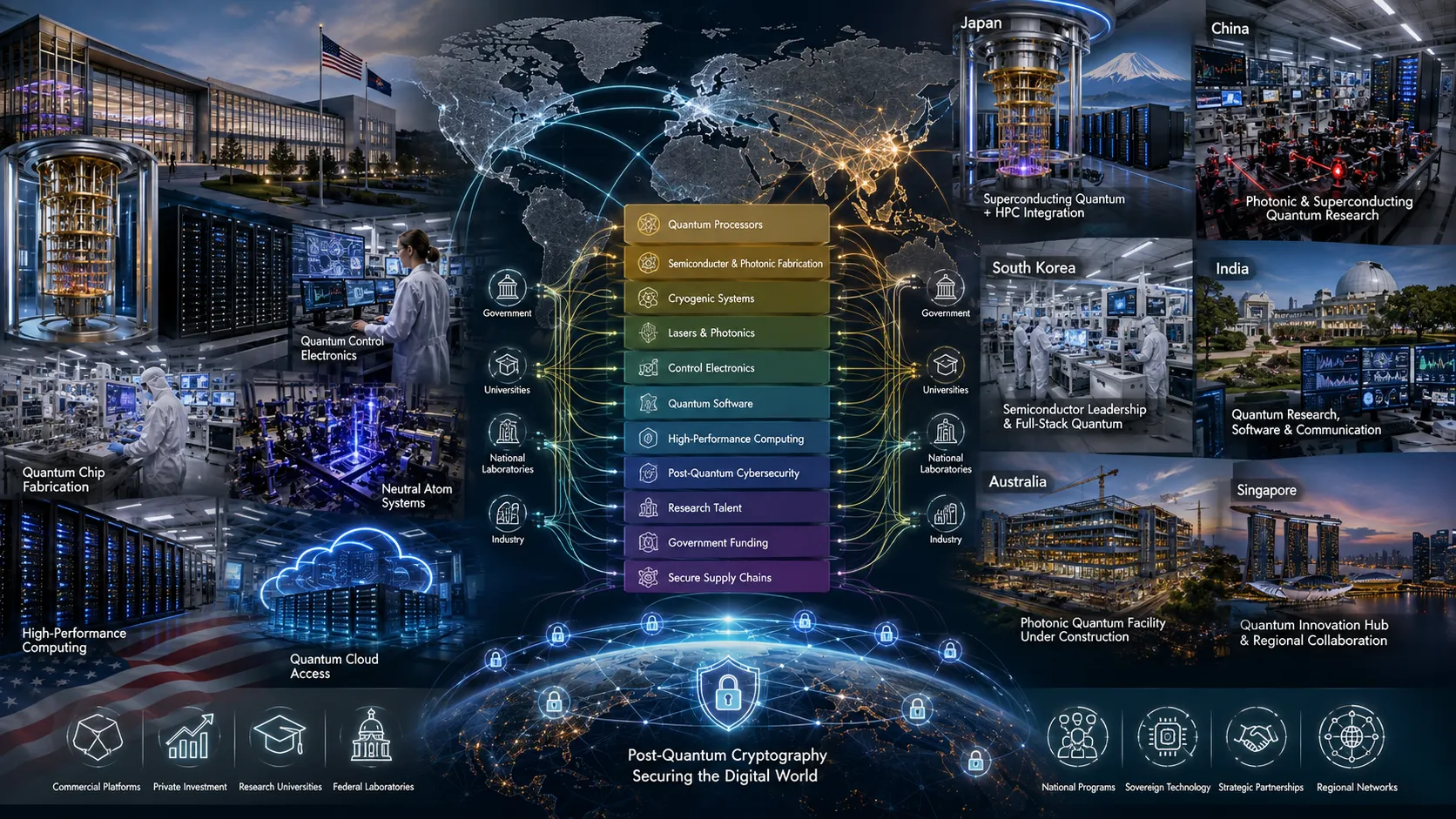
North America currently has a powerful combination of commercial quantum platforms, cloud access, private investment, research institutions and companies such as IBM and Google.
Asia-Pacific, however, is moving quickly toward something different: national quantum infrastructure.
Japan is combining domestic quantum hardware with high-performance computing. South Korea wants its own full-stack quantum computer. India has created national quantum technology hubs. Australia is backing a utility-scale quantum computer. China has placed quantum technology inside its next five-year industrial agenda.
The quantum race is becoming a contest over who owns the hardware, who fabricates the components, who trains the scientists, and who gets access to useful machines first.
Request For Exclusive Sample: https://www.datamintelligence.com/download-sample/quantum-computing-market
The United States Is Moving From Quantum Research to Quantum Industrial Policy
The most important U.S. quantum development in 2026 did not come from a laboratory.
It came from Washington.
On June 22, 2026, the White House issued an executive order directing the federal government to update the National Quantum Strategy and accelerate quantum commercialization, manufacturing, supply-chain development, workforce training and national-security applications. It also created a national effort to develop a quantum computer intended for scientific discovery and directed agencies to examine mechanisms including private-sector partnerships and advance market commitments.
That language represents a shift.
Governments traditionally supported quantum computing by funding basic science.
The new U.S. approach is increasingly concerned with whether commercially useful quantum systems can actually be built in the United States.
In May 2026, the Department of Commerce announced letters of intent covering $2.013 billion in proposed federal incentives for nine American quantum companies, including support for two domestic quantum foundry companies and seven quantum computing companies.
Then in June, the Department of Energy launched Quantum Genesis, with the goal of developing and deploying a scientifically relevant fault-tolerant quantum computer for research and development by 2028.
This is no longer simply a research competition.
The U.S. is starting to build an industrial base around quantum computing.
IBM Is Treating Quantum Manufacturing as Strategic Infrastructure
IBM's latest investment plan reinforces that direction.
In June 2026, IBM announced plans to spend more than $10 billion on quantum computing over five years, covering R&D, manufacturing scale-up, capital expenditure, acquisitions and ecosystem development. IBM says it has deployed more than 90 quantum systems globally and has more than 340 organizations participating in its quantum network.
IBM is also moving deeper into fabrication.
The company announced plans connected to a dedicated quantum wafer foundry in the United States, while continuing toward its stated goal of a large-scale fault-tolerant system in 2029. These remain company roadmap targets rather than guaranteed outcomes.
This illustrates an important change in the competitive metric.
Quantum leadership will not be measured only by who designs a better qubit.
It could depend on who controls the fabrication process, packaging, cryogenic electronics, control hardware, software and access infrastructure around that qubit.
Google Is Hedging Against a Single Quantum Architecture
Google provides another example of how the North American ecosystem is changing.
The company built much of its recent quantum program around superconducting qubits and the Willow processor. In 2025, Google reported a verifiable quantum-advantage experiment using Willow.
But in March 2026, Google announced that its Quantum AI program was expanding into neutral-atom quantum computing as well.
Google said superconducting qubits currently offer advantages in deep, fast circuits, while neutral-atom systems have demonstrated much larger physical qubit arrays and flexible connectivity. The company is pursuing both architectures rather than assuming one approach will solve every scaling problem.
That is strategically important.
The quantum race is not like the conventional CPU market, where companies broadly agree on what a mature processor should look like.
Superconducting systems, trapped ions, neutral atoms, photonics, silicon spins and other approaches are still competing.
A country with several strong hardware approaches therefore has more technological optionality than one relying on a single architecture.
North America's Advantage Also Includes Canada
The North American ecosystem is wider than the United States.
Canada's National Quantum Strategy includes C$360 million in dedicated federal funding and is organized around quantum research, talent and commercialization. The Canadian government says the country has more than 100 companies working on quantum innovation.
This creates another North American advantage: multiple research and commercial clusters can cooperate across borders while still operating inside a relatively integrated technology ecosystem.
Yet North America's lead does not mean Asia-Pacific is simply following.
In several countries, the government is taking a more direct role in creating domestic quantum capability.
Japan Is Building Quantum and Supercomputing Together
Japan's strategy is especially interesting because it does not treat quantum computers as replacements for conventional supercomputers.
RIKEN and Fujitsu unveiled a 256-qubit superconducting quantum computer in 2025 and said they were continuing development toward a 1,000-qubit system planned for 2026. Physical qubit counts should not be used as simple performance rankings across different quantum architectures, but the project demonstrates Japan's push toward domestically developed quantum hardware.
Japan is also building the classical infrastructure around quantum computing.
In June 2026, RIKEN put its new ROQUO supercomputer for a Quantum-HPC Hybrid Platform into operation, supporting deeper integration between quantum processors and conventional high-performance computing.
That could prove more commercially relevant than a standalone quantum machine.
Many useful quantum applications are expected to divide work between classical computers and quantum processors rather than send an entire problem to a quantum system.
Japan is therefore building the surrounding computing stack, not only the quantum processor.
Asia-Pacific Is Starting to Build a Quantum Alliance Network
One of the least discussed developments is the number of new quantum partnerships appearing between Asia-Pacific governments.
Japan signed quantum cooperation arrangements with Singapore in January 2026 and India in May.
On July 27, Australia and Japan signed a new Memorandum of Cooperation covering quantum infrastructure access, commercialization, supply-chain resilience, investment, research and workforce development. The agreement explicitly aims to strengthen quantum cooperation across both countries and the wider Indo-Pacific.
This suggests the regional competition will not simply be United States versus China versus everyone else.
Trusted-country quantum networks are beginning to form.
These relationships can help countries share expensive infrastructure, research talent and supply chains while reducing dependence on strategic competitors.
China Has Put Quantum Into Its Next Industrial Plan
China is pursuing the technology through national industrial policy.
Its 2026 government work agenda identifies quantum technology as one of the future industries the country intends to develop. The draft 15th Five-Year Plan for 2026-2030 also identifies quantum technology among the areas expected to create new economic growth.
China continues to report major hardware advances as well.
In May 2026, Chinese researchers announced Jiuzhang 4.0, a programmable photonic quantum computing prototype designed for highly specialized quantum calculations.
China is also developing more of the software stack domestically. In February 2026, the country's Origin Pilot quantum-computer operating system was opened for public download, a move aimed at lowering development barriers around locally developed quantum systems.
The strategic aim is becoming clearer: hardware research alone is not enough.
A domestic quantum ecosystem requires chips, control equipment, operating systems, algorithms, users and manufacturing capabilities.
South Korea Wants a Sovereign Full-Stack Quantum Computer
South Korea has become one of Asia-Pacific's most aggressive new entrants.
In January 2026, the Ministry of Science and ICT announced its first comprehensive national quantum master plan.
The plan targets 2,000 quantum-related companies and 10,000 quantum professionals by 2035 and calls for development of a domestically built full-stack “K-Quantum Computer.”
The government is also forming a Quantum Technology Council involving large Korean companies including Samsung, LG and SK and plans to link an IonQ system with Korea's national supercomputing infrastructure.
This is an important distinction.
South Korea is not approaching quantum solely as a research discipline. It is attempting to connect it with existing strengths in semiconductors, electronics, telecommunications and manufacturing.
India Is Building Quantum Through National Technology Hubs
India's National Quantum Mission has a budget of ₹6,003.65 crore through 2030-31.
Its objectives include developing intermediate-scale quantum computers with 50 to 1,000 physical qubits across multiple architectures while also developing quantum communications, sensing, materials and devices.
India has created four dedicated thematic hubs covering quantum computing, communications, sensing and metrology, and materials and devices.
This hub model matters because quantum leadership requires specialists in several disciplines at once.
A country may have excellent quantum physicists but still lack fabrication expertise, cryogenic engineering or enough software developers to create practical applications.
National strategies increasingly try to solve all of these gaps together.
Australia Is Converting Research Strength Into Physical Infrastructure
Australia is taking another approach: using government capital to anchor large quantum infrastructure domestically.
The Australian and Queensland governments committed almost A$1 billion to support PsiQuantum's planned fault-tolerant quantum computer project.
In June 2026, PsiQuantum broke ground at its Moreton Bay site in Queensland for the planned utility-scale system.
Australia's National Quantum Strategy also focuses on commercialization, talent, infrastructure, international partnerships and protecting national interests.
This shows why Asia-Pacific can accelerate even while North American companies remain technologically important.
Regional governments are increasingly willing to spend public capital to make sure important quantum infrastructure is located inside their own economies.
The Real Competition Is Over Access, Not Qubit Headlines
The market often treats quantum announcements as a contest over qubit numbers.
That can be misleading.
Different hardware technologies have different error rates, connectivity, gate speeds and operating requirements. A 1,000-qubit machine is not automatically more useful than a smaller system using a different architecture.
For national competitiveness, better questions include:
Can domestic researchers actually access advanced quantum hardware?
Can the country fabricate key components?
Does it have enough engineers to operate the machines?
Can quantum systems connect efficiently to HPC infrastructure?
Does the government have a pathway to buy useful systems?
Can sensitive quantum technology be protected without isolating the research community?
These questions explain why national strategy is becoming so important.
The Quantum Race Is Already Affecting Cybersecurity
Quantum investment also creates a defensive market before fault-tolerant quantum computers arrive.
In June 2026, the White House issued a separate executive order directing the U.S. federal government to accelerate migration toward post-quantum cryptography because future large-scale quantum computers could threaten widely used public-key encryption.
NIST already has three post-quantum cryptography standards ready for implementation and says organizations should begin migration now.
This means countries do not have to wait for a commercially useful quantum computer before quantum technology affects spending.
Cybersecurity migration has already started.
Request for Customized Sample Report as per your Business Requirements: https://www.datamintelligence.com/customize/quantum-computing-market
DataM Intelligence View: North America Leads, but the Gap Is Changing
DataM Intelligence estimates North America's current quantum computing market share at approximately 39.12%, supported by technology companies, cloud access, research institutions, private capital and government investment. Asia-Pacific, however, is the fastest-growing regional market.
North America's strongest advantage is its commercial platform layer.
IBM has a global hardware and software ecosystem. Google remains a major quantum research leader. U.S. federal policy is now moving toward foundries, domestic supply chains and government-backed commercialization.
Asia-Pacific's strongest advantage is the speed at which quantum computing is becoming national infrastructure.
Japan is integrating quantum with HPC. China is building domestic hardware and software. South Korea wants a sovereign full-stack system. India is creating specialized technology hubs. Australia is anchoring utility-scale infrastructure.
But this is not complete technological separation.
IBM already operates or plans systems in Japan, South Korea and India. Australia and Japan are expanding quantum cooperation. Japan and India are doing the same.
The next stage of the quantum market may therefore be defined by competing national ecosystems connected through selected strategic alliances.
The country that wins will not necessarily be the one that announces the largest number of qubits.
It will be the one that can turn quantum science into repeatable manufacturing, usable computing infrastructure, skilled talent and applications that create an advantage beyond classical computing.
Frequently Asked Questions
Which region leads the quantum computing market?
DataM Intelligence estimates that North America currently leads with approximately 39.12% of global quantum computing revenue, while Asia-Pacific is the fastest-growing region.
Why does North America lead quantum computing?
North America combines major technology companies such as IBM and Google with advanced research institutions, cloud access, private capital and government programs. U.S. policy is also moving toward domestic quantum manufacturing and supply-chain development.
Why is Asia-Pacific growing quickly in quantum computing?
Governments across Japan, China, South Korea, India and Australia are treating quantum as a strategic national technology and investing in domestic hardware, research infrastructure, workforce development and commercialization programs.
Is China ahead of the United States in quantum computing?
Both countries have important research capabilities, but there is no single reliable metric that establishes an overall winner. Different quantum architectures perform differently, and practical leadership will depend on error correction, useful applications, manufacturing and system access rather than physical qubit counts alone.
Which companies are important in North American quantum computing?
IBM and Google are two major companies developing quantum computing hardware and software. IBM is pursuing large-scale fault-tolerant systems and expanding manufacturing, while Google is now developing both superconducting and neutral-atom approaches.
Who are important Asia-Pacific quantum players?
Japan's Fujitsu-RIKEN collaboration, China's domestic quantum ecosystem and Australia's PsiQuantum project are notable examples of regional infrastructure development. Government-supported initiatives are also expanding rapidly in India and South Korea.
Why does quantum computing matter for national security?
Quantum technologies could affect encryption, sensing, communications and scientific computing. Governments are therefore investing both in quantum systems and in post-quantum cybersecurity to protect existing digital infrastructure.
Are quantum computers commercially useful today?
Current systems are already used for scientific and application research, but large-scale fault-tolerant quantum computing remains under development. Most near-term enterprise work combines quantum processors with classical computing rather than replacing conventional computers.
Read Complete Research Report: https://www.datamintelligence.com/research-report/quantum-computing-market