


Caffeine occurs naturally in plants such as coffee, tea, cocoa, guarana and kola nut. It can also be manufactured and added as a purified ingredient. The source matters to sourcing and product positioning, but caffeine itself does not become a different stimulant because it came from a plant.
The U.S. Food and Drug Administration says the body handles naturally occurring caffeine and caffeine added to a product in the same way, with no difference in safety between those forms. The FDA also says its policy on the term “natural” was not intended to describe nutritional or health benefits.
The practical question is not simply “Which one is better?” It is: Which source fits the product’s technical requirements, evidence, supply plan and market position?
According to research report published by DataM intellgience “Global Natural Caffeine Market is expected to reach US$ 7,082.14 million by 2032, growing with a CAGR of 7.5% during the forecast period 2026-2032."
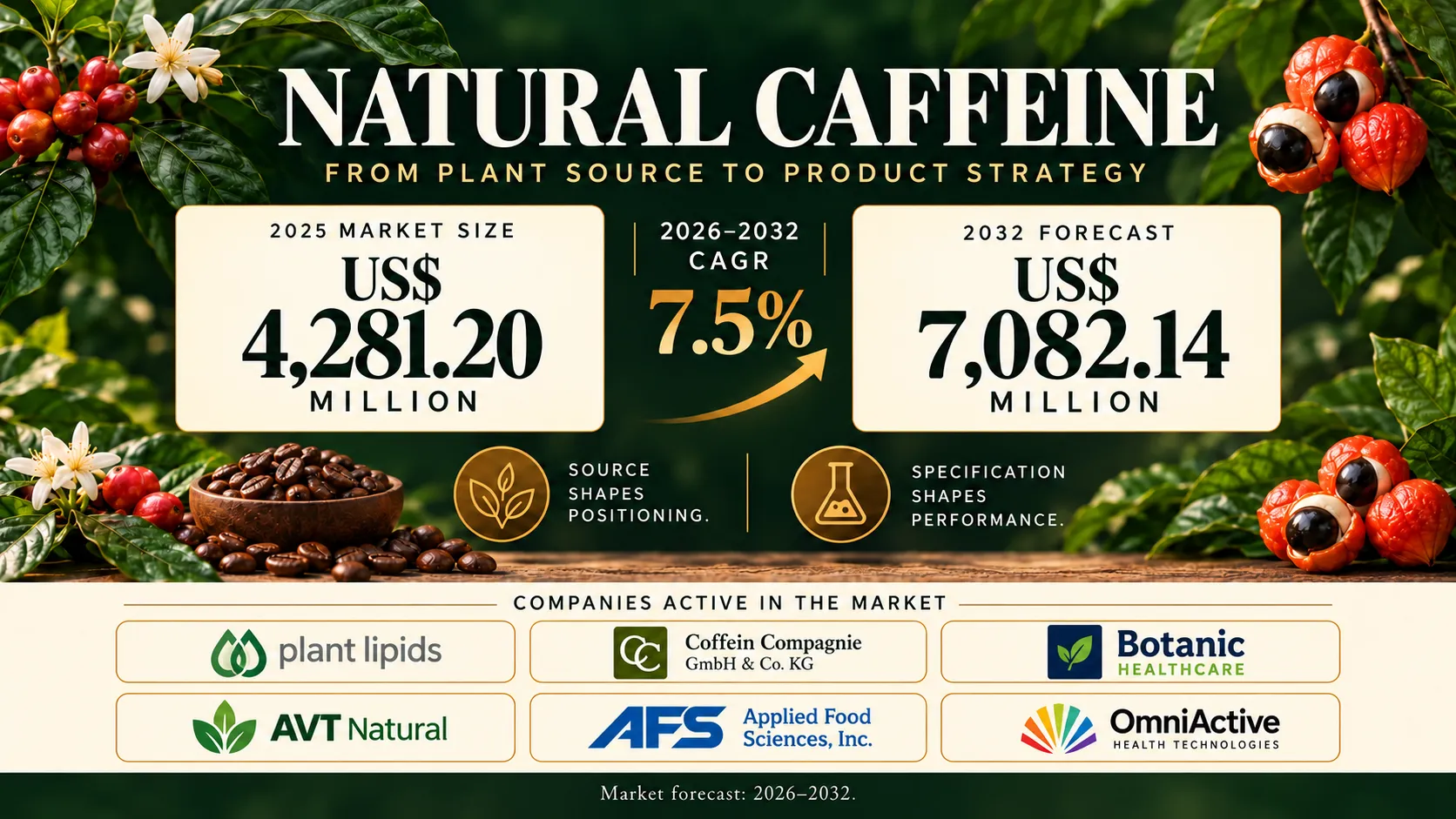
Request for Exclusive Sample: https://www.datamintelligence.com/download-sample/natural-caffeine-market
What “natural caffeine” can mean in a formulation
“Natural caffeine” is often used to describe caffeine supplied through a plant-derived ingredient or extract. Depending on the product, that could mean tea extract, coffee extract, guarana extract or another botanical source. Synthetic caffeine, by contrast, is produced through a manufacturing process and supplied as a caffeine ingredient.
These descriptions identify a source or production route; they do not, by themselves, establish finished-product performance. A botanical extract may include other plant constituents, depending on its specification. A purified caffeine ingredient may have a different composition profile. Companies should obtain the ingredient specification and test it in the intended formulation rather than infer properties from the source label.
What changes-and what does not
The source may change the ingredient documentation, sourcing requirements and product story. It may also affect taste, color, solubility or compatibility in a particular formulation. Those technical effects are ingredient- and product-specific, so they need to be confirmed through supplier data and finished-product testing.
The stimulant itself is caffeine. The FDA says naturally occurring and added caffeine are handled by the body in the same way. That makes claims such as “natural caffeine is safer” or “natural caffeine avoids the crash” difficult to support on the basis of source alone.
| Decision area | What the company should evaluate |
| Caffeine identity and dose | What caffeine level does each serving deliver, and how will it be verified? |
| Formulation | Does the ingredient meet requirements for taste, solubility, stability and processing? |
| Botanical components | Does the extract contain other constituents relevant to the formula or label? |
| Supply | Can the supplier provide consistent specifications, traceability and forecast volume? |
| Positioning | Does the product have evidence for the source-related claim it plans to make? |
| Market access | What labeling and ingredient rules apply in each sales market? |
This comparison is more useful than describing one source as inherently superior. A product team may value botanical provenance; a procurement team may prioritize specification consistency; and a regulatory team may focus on the exact ingredient declaration. The final selection has to work across those requirements.
A source choice is also a supply decision
Natural-source caffeine ties the product to a botanical ingredient or extract. That makes it important to review the source, extraction process, standardization, traceability, available volumes and supplier documentation. The details vary across ingredients and suppliers, so companies should not assume that all “plant-based caffeine” inputs have the same profile.
Purified caffeine may fit a product that needs a defined caffeine input without selecting a botanical source as part of its brand proposition. It still requires supplier qualification, specification review, quality controls and market-specific regulatory assessment.
A sourcing review should ask:
- What is the stated botanical or manufacturing source?
- What is the caffeine concentration and permitted tolerance?
- Which tests verify identity, potency and contaminants?
- What batch-level documents are available?
- Can the supplier support projected demand and lead times?
- Does the ingredient’s sensory or technical profile suit the product?
- Can the company substantiate any source, quality or sustainability claims?
This review helps prevent an avoidable mistake: selecting an ingredient because its name sounds appealing, then discovering that it does not meet the product’s technical needs or cannot support the desired claim.
“Natural” is not a complete label strategy
The word “natural” can carry commercial meaning, but it is not a universal regulatory shortcut. In the United States, the FDA has a longstanding policy on the term, but it has not established a formal definition through rulemaking. The agency also notes that this policy was not intended to address whether “natural” describes a nutritional or health benefit.
Ingredient declarations also depend on product and market rules. FDA guidance says that when caffeine is added as a stand-alone ingredient to packaged food, it must appear in the ingredient list. When a food contains an ingredient that inherently contains caffeine, such as chocolate, the caffeine-containing ingredient is listed, but caffeine may not appear separately as an ingredient. Many products voluntarily state the amount of caffeine they contain.
Markets can take different approaches. For example, Food Standards Australia New Zealand says foods containing guarana must be labeled as containing caffeine. That is a useful reminder that a source described as botanical can still trigger caffeine-related labeling requirements.
Commercial implication: Regulatory review should cover the full formula, product category, label wording and destination market. A claim or ingredient declaration that works in one market should not be assumed to work in another.
Caffeine exposure should be evaluated across the whole product
A product’s caffeine content should be assessed alongside other potential dietary sources, not in isolation. EFSA’s caffeine assessment considers intake from all dietary sources, including food supplements. Its guidance states that single doses up to 200 mg and daily intake up to 400 mg, consumed across the day, do not raise safety concerns for healthy adults in the general population, excluding pregnant women. It also notes that 100 mg can affect sleep in some adults, particularly when consumed close to bedtime. These are population-level assessments, not a target dose for every product or person.
For manufacturers, the useful lesson is that source selection does not replace dose management. Product development should define serving size, intended use, caffeine per serving, instructions and any required advisory statements. The label and marketing copy should reflect the finished product, not just the caffeine ingredient.
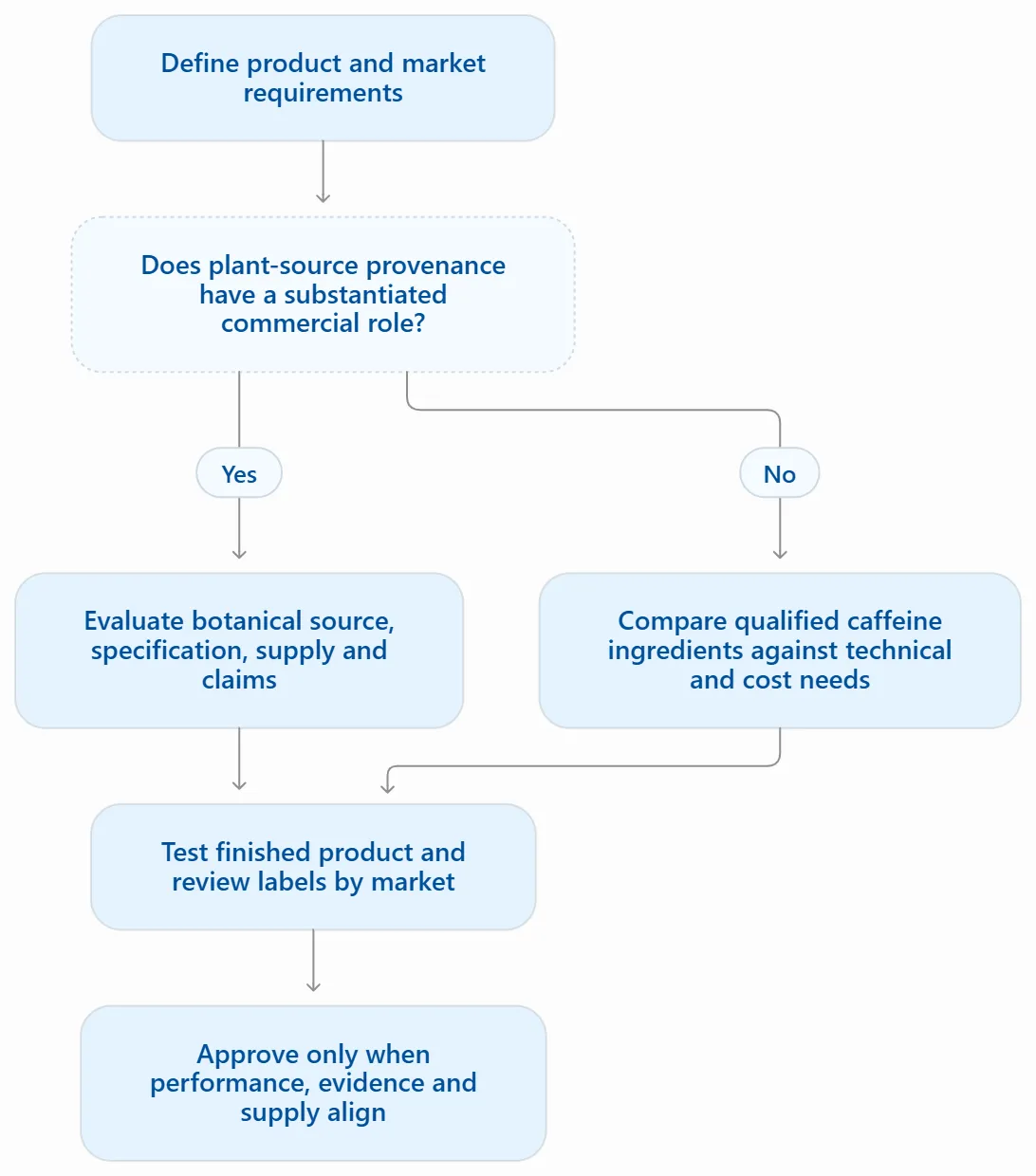
A practical framework for making the choice
A company can make the decision more efficiently by moving through these steps:
- Define the product role. Is caffeine there to support the core proposition, or is it a secondary functional ingredient?
- Set the technical requirements. Specify caffeine dose, product format, taste, stability and processing needs before selecting a source.
- Assess the claim. If “natural,” “plant-derived” or another source claim is important, determine what evidence and supplier records will support it.
- Qualify the supplier. Review specifications, analytical methods, traceability, quality systems, capacity and continuity plans.
- Test the finished formulation. Evaluate caffeine content, sensory properties, stability and compatibility under actual production conditions.
- Review each market. Confirm ingredient declarations, caffeine statements and claim requirements for every intended market.
- Compare total commercial fit. Consider ingredient cost alongside testing, qualification, labeling, supply and reformulation implications.
Expanding in the natural caffeine market? Get tailored support to identify the right partners, assess supply and demand challenges, and understand pricing opportunities: https://www.datamintelligence.com/partner-identification-enquiry/natural-caffeine-market
This framework keeps the discussion focused on the finished product. It also gives product, procurement, regulatory and commercial teams a shared basis for approval.
Which source should a company choose?
A natural source can make sense when plant provenance has a clear role in the product proposition, the supplier can document the source, and the ingredient meets formulation and supply requirements. A purified caffeine ingredient can make sense when it better matches the product specification, sourcing strategy or cost structure.
Neither option wins automatically. The stronger decision is the one the company can support with finished-product data, supplier documentation, compliant labeling and a credible commercial reason.
For beverage and supplement companies, the most defensible strategy is to treat caffeine origin as one input in product design-not as a substitute for dose control, evidence or regulatory review. That approach gives brand teams a clearer claim, procurement teams a more rigorous sourcing brief and product teams a better chance of approving an ingredient that works at scale.
Frequently Asked Questions
Is natural caffeine different from synthetic caffeine?
Caffeine from different sources can have different surrounding ingredient profiles, but the FDA says the body handles caffeine naturally present in coffee or tea the same way as caffeine added to a product.
Is natural caffeine safer?
Source alone does not establish that a product is safer. Safety considerations depend on factors such as dose, use pattern, the finished product and the consumer.
What should a manufacturer request from a caffeine supplier?
At minimum, request the ingredient specification, identity and potency testing details, batch documentation, traceability information, quality records and supply-capacity details.
Does guarana need a caffeine statement on the label?
In Australia and New Zealand, FSANZ guidance says foods containing guarana must be labeled as containing caffeine. Requirements differ by market and product category.
Can a company claim that natural caffeine provides smoother energy?
Not on the basis of source alone. Such a claim would need appropriate evidence for the finished product and review under the rules in each intended market.