


Natural Caffeine & Xanthine Supply Chain Perspective | 2026
| POLICY SHOCK | Aarti Pharmalabs says China removed the export rebate on xanthines from April 2026, structurally lifting Chinese export pricing. |
| SUPPLY RESPONSE | India is scaling backward-integrated xanthine capacity while multinational buyers add second sources and qualify non-China supply. |
| NATURAL CAFFEINE ANGLE | Natural caffeine does not replace synthetic caffeine in every formulation. It adds a premium clean-label sourcing lane that reduces dependence on one chemistry and one geography. |
The Policy Change Matters Because the Supply Base Was Already Concentrated
The caffeine procurement story is splitting into two layers. The first is the conventional xanthine supply chain, where Chinese manufacturers still dominate global competitive capacity. The second is the premium natural-caffeine supply chain, where buyers increasingly care about plant origin, extraction route, traceability and clean-label positioning. A change in Chinese export economics therefore has consequences beyond synthetic caffeine pricing: it changes how buyers value backup capacity, regional qualification and natural-source alternatives.
Request Executive Sample: https://www.datamintelligence.com/download-sample/natural-caffeine-market
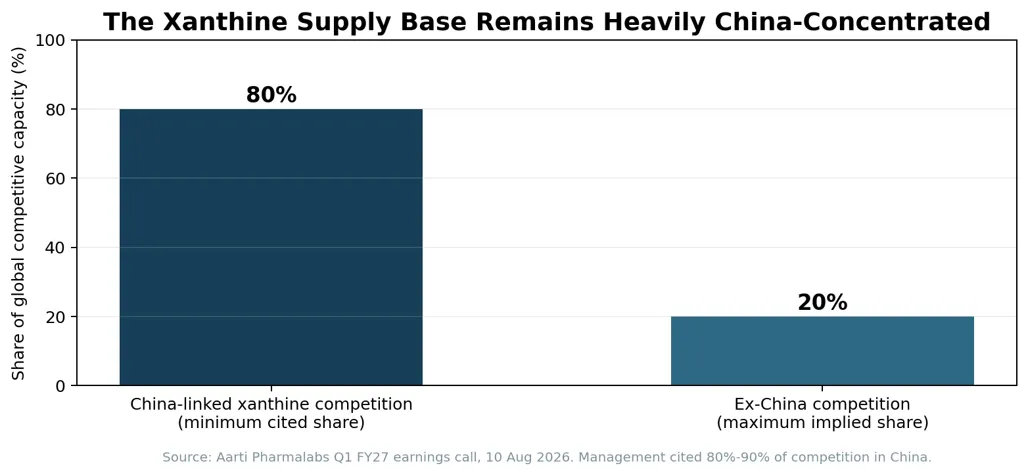
Aarti Pharmalabs management told investors in August 2026 that roughly 80%-90% of global xanthine competition remains China-based, apart from a limited number of producers in India and Europe. That concentration means even a policy change that only affects Chinese export economics can alter negotiations across the global caffeine chain.
The Export-Rebate Change Is a Structural Pricing Reset, Not Just a Freight Shock
Chinese xanthine export rebates were eliminated from April 2026 and described the change as structural for the near term. ICICI Direct separately summarized the withdrawal as a 13% rebate benefit. This matters because an export rebate directly affects the economics of Chinese material sold abroad. Once removed, exporters either absorb the loss, raise realized prices or reduce aggressive export pricing.
| APRIL 2026 Rebate removal | 13% Former Chinese rebate benefit cited by ICICI Direct | 80%-90% China share of xanthine competition cited by Aarti |
India Is Converting China-Plus-One Interest Into Physical Capacity
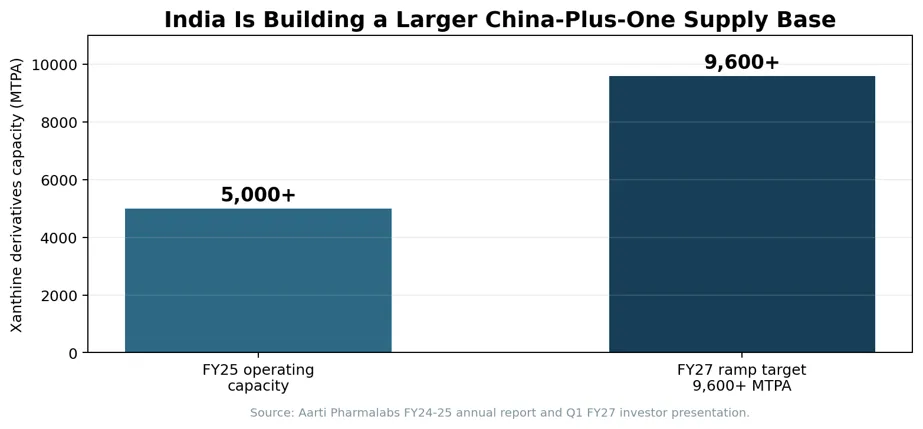
As a result of this, Aarti Pharmalabs are moving from approximately 5,000 MTPA of xanthine capacity in FY25 to more than 9,600 MTPA as its new capacity ramps. Its Q1 FY27 presentation describes the business as fully backward integrated and non-China dependent. Management expects the expansion to lift its global xanthine share from roughly 15%-20% toward 20%-25%. Other companies are also following suite.
Request a Customized Report According to Your Business Strategy: https://www.datamintelligence.com/customize/natural-caffeine-market
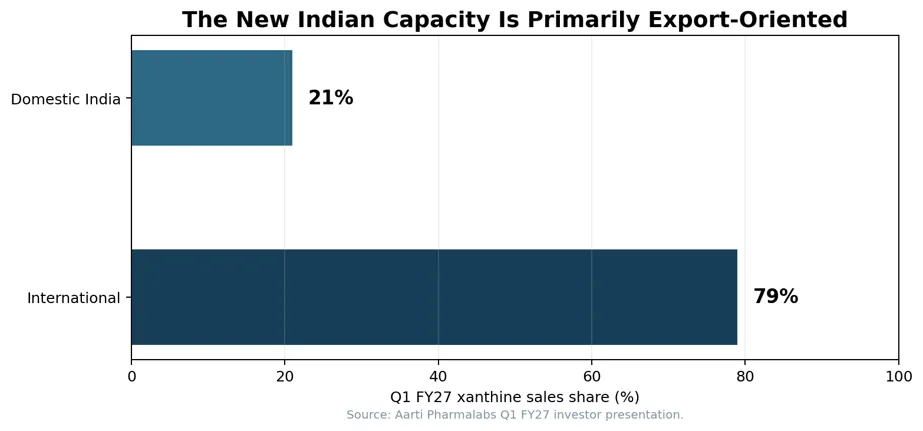
In Q1 FY27, 79% of xanthine sales were international. The new Indian capacity is therefore being built as an export-oriented China-Plus-One supply base, not only for local demand.
Natural Caffeine Becomes More Strategic When Synthetic Supply Becomes Less Predictable
Natural caffeine sits in a different supply chain from synthetic caffeine. It is extracted from botanical sources such as coffee, tea and guarana rather than produced through xanthine synthesis. That distinction is important: Chinese xanthine rebate policy does not directly change the cost structure of natural caffeine. But it can change buyer behavior by making diversified sourcing, origin claims and clean-label positioning more valuable.
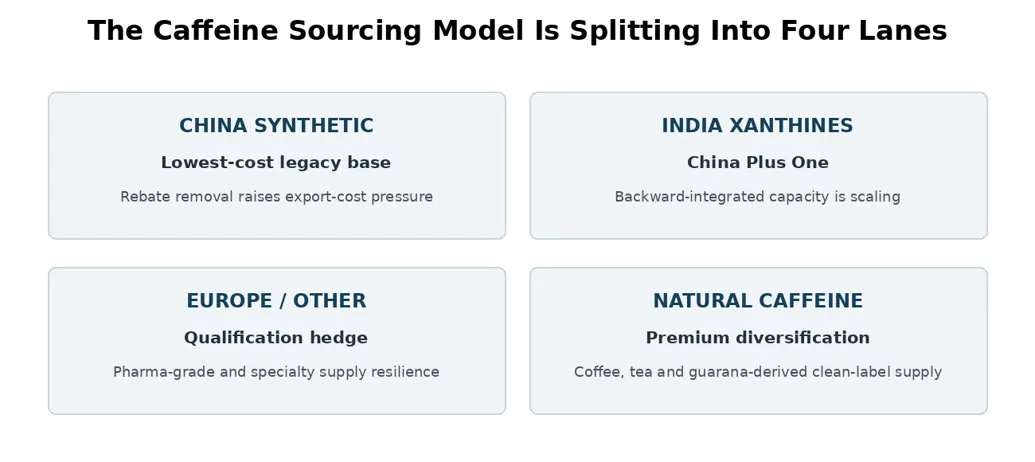
The likely outcome is not a wholesale switch from synthetic to natural caffeine. Synthetic caffeine remains cost-effective, consistent and deeply embedded in beverages, pharmaceuticals and nutraceuticals. Natural caffeine is better viewed as a strategic diversification lane for formulations where botanical origin, traceability or premium positioning can justify the higher ingredient cost.
The Buyer Conversation Is Shifting From Price per Kilogram to Supply Architecture
| Procurement signal | What changed | Natural caffeine implication | Commercial response |
| Chinese export price resets | Rebate economics no longer support old export pricing | Premium between synthetic and natural may narrow in selected applications | Re-run total-cost and formulation economics |
| Second-source mandate | Buyers want qualified non-China capacity | Natural-source suppliers gain a new route into approved vendor lists | Qualify India, Europe and botanical sources in parallel |
| Origin / clean-label demand | Ingredient provenance matters more in consumer products | Coffee-, tea- and guarana-derived caffeine can support differentiation | Bundle sourcing resilience with product-positioning claims |
| Volume security | Large beverage programs need consistent multi-year supply | Natural supply requires tighter source and extraction planning | Use dual sourcing and longer procurement windows |
Why the Next Caffeine Contract Will Be About More Than Price
The China Plus One shift changes the questions procurement teams need to ask. Is the supplier dependent on Chinese intermediates? Is capacity physically available outside China? Can a natural caffeine source meet beverage-grade taste, solubility and labeling requirements? How quickly can a second source be qualified? What happens to landed cost if Chinese export economics change again?
| POLICY / PRICE SIGNAL | SUPPLIER DEPENDENCE | CAPACITY & ORIGIN | FORMULATION FIT | CONTRACT / QUALIFICATION |
What a Natural Caffeine Market Report Needs to Answer Now
A useful 2026-27 market view needs to go beyond demand growth. Buyers need supplier-by-supplier capacity, natural versus synthetic sourcing exposure, botanical feedstock routes, qualification status, price-premium movement, export dependence, beverage versus pharmaceutical mix and the pace at which non-China capacity can actually replace Chinese supply. The policy shock has turned supplier geography into a purchasing variable.
SUPPLY MAP India/Europe alternatives and natural-source suppliers | CAPACITY WATCH Installed, expanded and qualified capacity with ramp-up timing |
PRICE BRIDGE premium and landed-cost sensitivity | BUYER SHIFT Second-source qualification, origin claims and contract restructuring |
The Commercial Takeaway
China is still the dominant force in xanthine chemistry, but the supply chain is becoming less comfortable with single-country dependence. The April 2026 rebate change gives procurement teams a concrete reason to reassess the economics of Chinese material. India is adding export-oriented capacity, while natural caffeine offers a separate premium route for buyers that value plant origin and traceability. The winning suppliers will be those that can prove not just price competitiveness, but origin resilience, capacity certainty and qualification readiness.
Explore the Natural Caffeine Market Report for supplier capacity, sourcing geography, botanical-source analysis, pricing intelligence and China Plus One exposure.