


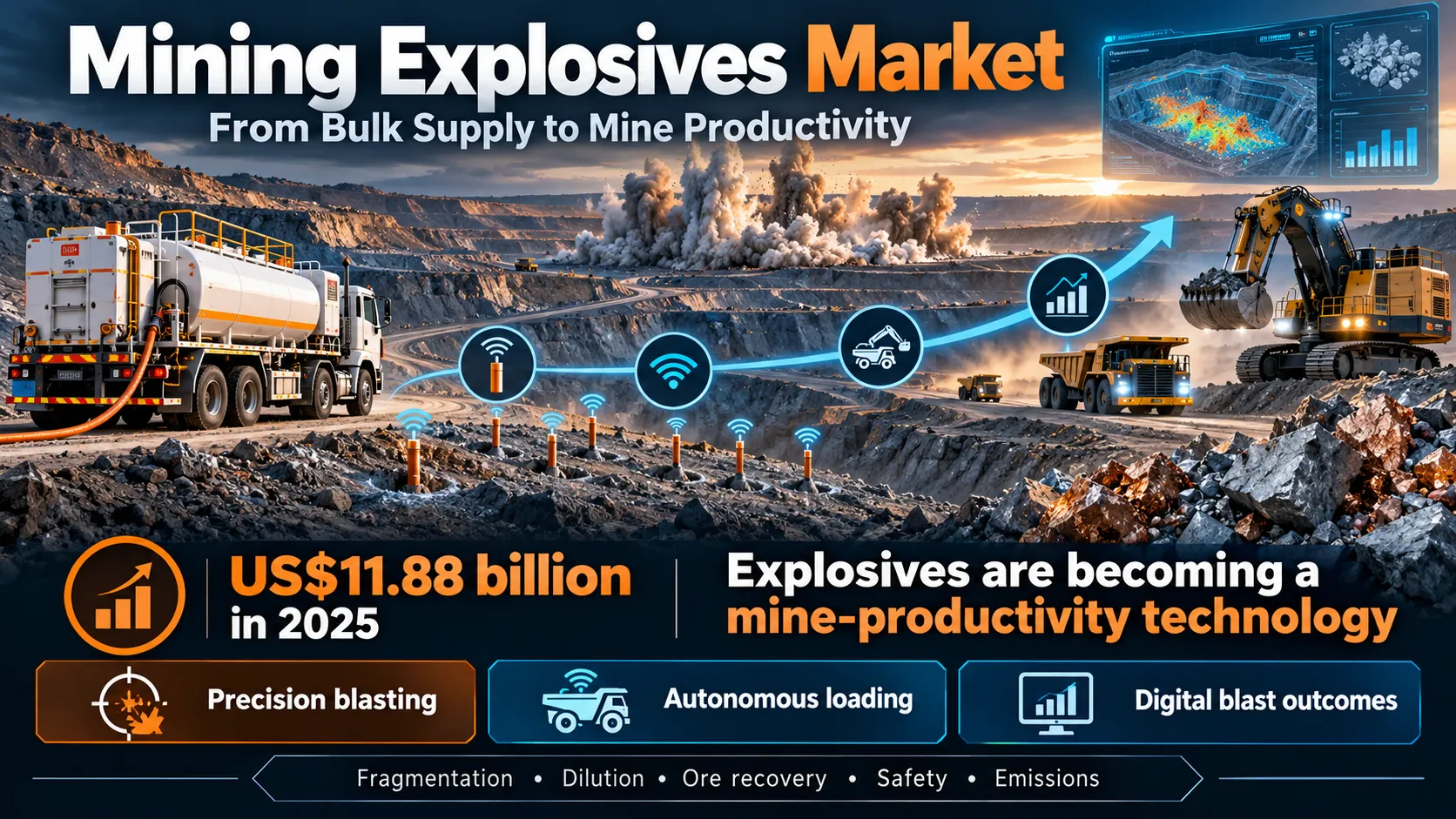
Mining explosives are evolving from a volume-led chemical supply market into a technology-intensive mining productivity category. Bulk emulsions, ammonium nitrate-based products, electronic initiation, wireless blasting and automated loading systems increasingly compete on total mine economics: fragmentation, dilution, ore recovery, cycle time, safety and emissions. Suppliers that can prove better production outcomes are better positioned to secure multi-year mining contracts than those competing predominantly on explosive cost per tonne.
DataM Intelligence values the global Mining Explosives Market at US$11.88 billion in 2025. Demand is supported by copper, gold, iron ore and coal mining, while higher-value opportunities increasingly center on electronic initiation, precision energy placement, autonomous explosives delivery and digitally verified blast outcomes. The procurement conversation is shifting toward mine-wide productivity, safety and reliable supply.
The competitive landscape is led by Orica, Dyno Nobel, Enaex, MAXAM, AECI Mining and Austin Powder. Solar Industries, BME and EPC Groupe add meaningful competition through their regional manufacturing footprints and initiation technology. Following Orica’s 1 June 2026 acquisition of Nelson Brothers’ US explosives business, CEO Sanjeev Gandhi said the transaction would “improve access to key customers” and support “a more diversified and resilient supply platform.” This reflects the increasing premium placed on local availability and distribution scale. In announcing Dyno Nobel’s autonomous blast-bench prototype on 30 September 2026, CTO Dirk Van Soelen said the company had built “a fully operational, end-to-end process” for autonomous blast-hole loading. Both perspectives underline a market shaped by supply resilience and automation.
Request Exclusive Sample: https://www.datamintelligence.com/download-sample/mining-explosive-market
Top 10 Companies Analysis
Orica Limited
Orica combines global bulk explosives production and mining-site delivery with electronic initiation, wireless blasting, digital blast design and geotechnical monitoring. This broad operating model provides commercial leverage in large surface mines and technically complex underground operations.
Orica generated approximately US$5.25 billion of consolidated FY2025 revenue (converted from its published Australian-dollar accounts using the 2025 average exchange rate). This is company-wide revenue, not a mining-explosives-only figure. Its 1 June 2026 completion of the Nelson Brothers explosives acquisition strengthens US production and distribution.
The 4D Underground bulk system, featured in May 2026, varies delivered energy within a blasthole. Orica also reported more than 500,000 WebGen wireless primers fired by February 2026. These systems strengthen its ability to price blasting as an integrated performance service.
Its advantage is global service reach and integration of explosives, digital systems and mine intelligence. The commercial risk is contract complexity and the need to prove measurable gains at each customer site.
Dyno Nobel
Dyno Nobel is a global bulk explosives and initiation supplier with substantial exposure to Australian and North American resource operations. Its portfolio includes electronic initiation, differentiated explosive formulations and mine-site delivery services.
Dyno Nobel reported FY2025 underlying explosives operating earnings equivalent to approximately US$280 million. This is EBIT, not revenue, and is excluded from the revenue comparison table. A directly comparable FY2025 consolidated explosives revenue figure is not presented here.
The company reports deployment of an electric mobile processing unit in 2025 and is developing lower-emission, productivity-focused technology including DeltaE. Such innovations target truck emissions, energy consumption and mine-site efficiency.
A stronger pure-play profile supports mining-focused capital allocation. Customer contracts and ammonium nitrate economics remain important determinants of margin.
Enaex S.A.
Chile-based Enaex is a major blasting-services and explosives company with strengths in Latin American copper mining and an international presence through its broader operating network.
Its parent Sigdo Koppers reported approximately US$4.12 billion in consolidated 2025 revenue. This is parent-group revenue rather than Enaex standalone explosives revenue; the distinction is important when assessing relative scale.
Its competitive direction centers on blasting automation, digital initiation and performance optimization for large open-pit mines, with opportunity to extend these practices into additional geographies.
Its position in copper mining offers exposure to electrification-led metals demand, while regional permitting and contract pricing remain execution risks.
MAXAM
MAXAM is a major privately held provider of blasting solutions, initiation systems and technical services for mining, quarrying and infrastructure. Its positioning is built on formulation expertise and reliable site execution.
2025 Revenue: Not publicly disclosed on a consistently comparable standalone basis.
Digitally assisted blasting, electronic detonators and tailored emulsion products can help operators manage vibration, fragmentation and environmental constraints.
Its international services franchise is valuable, although private-company disclosure makes public peer revenue comparisons difficult.
Solar Industries India
Solar Industries is a fast-growing Indian manufacturer of industrial explosives, initiating systems and defence energetics, with widening international reach. Its commercial mining relevance includes bulk explosives and downstream initiation.
Solar Industries generated approximately US$865 million of consolidated FY2025 revenue, converted to US dollars using the 2025 annual average exchange rate. The group also has defence activities, so this figure is not solely mining explosives revenue.
Scaling electronic detonators and cross-border manufacturing offers an opportunity to capture more value per blast and reduce dependence on conventional bulk explosive volume.
Rapid revenue expansion and exports are strengths; mining buyers should separate its commercial explosives economics from defence growth.
AECI Mining
AECI Mining supplies bulk emulsions, initiation systems and technical services in Africa, Asia-Pacific and other operating markets. Its mining franchise competes through local production, logistics and technical service.
AECI Mining generated approximately US$986 million in 2025 segment revenue (converted to USD at the 2025 annual average exchange rate). Its scope covers mining explosives and mining chemicals; segment EBITDA reached approximately US$152 million.
AECI emphasizes improved product mix, disciplined contract economics and efficient blasting service delivery. Its 2025 segment EBITDA margin rose to about 15%.
Margin improvement despite lower revenue underlines why contract quality can matter more than explosive tonnage.
Austin Powder
Austin Powder is a long-established independent producer of industrial explosives and initiation products with a broad distribution and service network across the Americas and other markets.
2025 Revenue: Not publicly disclosed in a verified, comparable consolidated figure.
Its differentiation rests on dependable supply, site support and modernization of initiation and blasting workflows.
It competes effectively where local manufacturing, long-term customer relationships and operational reliability determine sourcing.
BME (Omnia Group)
BME, part of Omnia, provides commercial explosives and related mining services with substantial African exposure and expanding international operations.
2025 Revenue: A comparable BME standalone figure is not separately disclosed in the materials reviewed. Its parent Omnia publishes broader group and segment results.
Its opportunities include integrated electronic initiation, bulk-emulsion systems and digitized blast planning for customers seeking consistency in fragmentation and safety.
International growth is attractive but demands local licensing, plant availability and strong service capabilities.
EPC Groupe
EPC Groupe is a European explosives and blasting-services supplier active across mining, quarrying and construction, offering regional coverage and site-level expertise.
EPC Groupe recorded approximately US$669 million of consolidated 2025 revenue, converted from reported euro turnover at the 2025 annual average exchange rate. Revenue includes non-explosives activities, so it should not be presented as mining explosives only.
Electronic initiation and specialized blasting services offer routes to compete in regulated, sensitive and technically demanding sites.
Its strengths are regional engineering expertise and responsiveness; its scale is smaller than the largest integrated global operators.
NOF Corporation / Regional Specialists
NOF and other chemical-material suppliers participate in portions of the broader explosives value chain. Their relevance varies significantly by whether they sell energetic materials, inputs, detonators or complete mine-site blast services.
2025 Revenue: No directly comparable mining-blasting revenue figure is disclosed for this specialist-input category.
Specialty chemical know-how matters in formulations and initiation components, while regional firms can innovate in logistics, charging automation and lower-emission products.
Competitor Analysis: Leading Mining Explosives Market Players
| Company | Core position | Last reported figure / scope | Strategic technology |
| Orica | Global bulk explosives, initiation, digital mining | A$8,144.5m group, FY2025 | Wireless blasting; 4D bulk energy control |
| Dyno Nobel | Bulk explosives and initiation | A$434m explosives EBIT, FY2025; not revenue | Pure-play restructuring; electric loading |
| Enaex | Copper-mine blasting services | US$4,119m parent Sigdo Koppers, 2025 | Automated mine blasting |
| MAXAM | Explosives and technical blasting | Not publicly verified | Electronic initiation; formulation |
| Solar Industries | Indian and global explosives / defence | INR 9,837.74 crore group, FY2026 | Initiating systems; international expansion |
| AECI Mining | Integrated mining explosives and services | ZAR 17,622m mining segment, 2025 | Contract mix and productivity |
| Austin Powder | Explosive products and site service | Not publicly verified | Initiation and reliability |
| BME | Mining explosives and electronic initiation | Not separately verified | Digital initiation and blast optimization |
| EPC Groupe | Regional blasting and explosives | Not separately verified | Specialized regulated-site blasting |
| NOF / specialists | Upstream and specialist inputs | Not comparable | Chemical formulations and components |
Request Exclusive Sample: https://www.datamintelligence.com/download-sample/mining-explosive-market
Who Are the Rising Companies Influencing the Market?
Companies outside the established global leaders are gaining attention through sharper regional and technical specialization:
- Solar Industries - Strategic focus: expand international industrial-explosives manufacturing and electronic-initiation capacity to win more integrated mine contracts.
- BME (Omnia Group) - Strategic focus: scale its African-origin bulk-emulsion and digital-initiation offering across new international mining territories.
- EPC Groupe - Strategic focus: strengthen European civil-explosives scale and its technical blasting and software capabilities.
- Regional Indonesian and Latin American suppliers - Strategic focus: localized production and mine-site service to shorten delivery cycles and secure ammonium nitrate supply.
Major Mergers, Acquisitions and Portfolio Restructuring
- 1 June 2026 - Orica completed its purchase of 100% of Nelson Brothers’ US explosives joint-venture business. The transaction expands domestic emulsion manufacturing, storage and distribution coverage, improving access to quarrying and construction customers.
- 30 June 2026 (announced 1 July) - Dyno Nobel completed the sale of Phosphate Hill to Ryowa II GPS, concluding its fertilisers separation and sharpening its focus as a global explosives company.
- 24 February 2026 - EPC Groupe and Société Suisse des Explosifs announced exclusive negotiations to combine civil explosives and drilling-and-blasting operations. This is a proposed combination, not a completed acquisition.
Recent Innovations and Their Potential Impact
- 4 August 2026 - Orica advanced its Surface Mining Automation Program, including autonomous blasthole measurement and tele-remote mobile manufacturing units. Potential impact: fewer personnel on active blast benches, improved execution consistency and tighter links between design and field data.
- 2 September 2026 - Dyno Nobel highlighted improvements in manufacturing-process consistency and the expansion of its mobile processing unit network in Groundbreakers Issue 3. Potential impact: more reliable site supply, replicable operating standards and reduced training complexity.
- 30 September 2026 - Dyno Nobel unveiled an end-to-end Autonomous Bench prototype for blasthole inspection, initiation-system placement and explosives loading, with a planned mining trial in Utah. Potential impact: reduced worker exposure and the possibility of operating blast benches in areas previously constrained by access or safety risks. The technology remains at prototype/trial stage.
Greg Rigby, Orica Vice President, Explosives and Automation Systems, described the 4D development goal as “expanded energy ranges, and enhanced efficiency and precision”. His comment underscores the move from standardized charges toward geology-specific blasting performance (Orica, 23 April 2025).
Dyno Nobel CEO Mauro Neves described the first half of 2026 as “the beginning of a new era for Dyno Nobel” as the company completed its transition toward a pure-play explosives focus (Dyno Nobel, 11 May 2026). That strategic change could intensify competition for contracts where technology, service capability and cost predictability are central.
What Is Driving Competition in the Market?
Mining output and mine expansion remain fundamental demand drivers, particularly for copper, gold, iron ore and selected battery minerals. Yet higher blasting volumes do not necessarily imply stronger supplier margins. Ammonium nitrate input costs, on-site manufacturing, explosives logistics and multi-year contract escalation clauses remain decisive.
The strongest competitive differentiation increasingly comes from fragmentation consistency, lower dilution, vibration control, autonomous loading and digital feedback loops. Better blasts can improve downstream crushing and hauling productivity. Suppliers therefore need to demonstrate economic value across the mine, rather than optimize explosive consumption in isolation.
Safety and sustainability add further selection criteria: remote initiation, reduced worker exposure, emissions from mobile processing equipment, and energy-efficient blasting programs. Buyers also value security of ammonium nitrate supply, local regulatory compliance and operational continuity. This favors integrated providers, while leaving opportunity for nimble local champions and specialty technology suppliers.
By 2035, competitive advantage is going to accrue to manufacturers that combine secure regional explosive supply with electronic initiation, digital mine data and measurable blast-performance gains. The market is best analyzed through both explosives revenue and the broader customer value generated by blasting services.