


Mining Explosives Market Size and Overview
The global mining explosives market reached US$11.88 billion in 2025 and is expected to reach US$39.97 billion by 2035, growing with a CAGR of 12.9% during the forecast period 2026-2035.
Market growth is supported by expanding copper, iron ore, coal, gold, and critical mineral extraction, increasing overburden removal requirements, rising investments in surface and underground mining operations, and growing adoption of advanced blasting technologies.
Increasing demand for efficient rock fragmentation and improved mining productivity is accelerating the adoption of ammonium nitrate fuel oil (ANFO), heavy ANFO, and bulk emulsion explosives. Mining operators are increasingly prioritizing high-performance explosive formulations, automated charging systems, and digital blast optimization technologies to reduce operational costs, improve blasting accuracy, and enhance mine-to-mill efficiency.
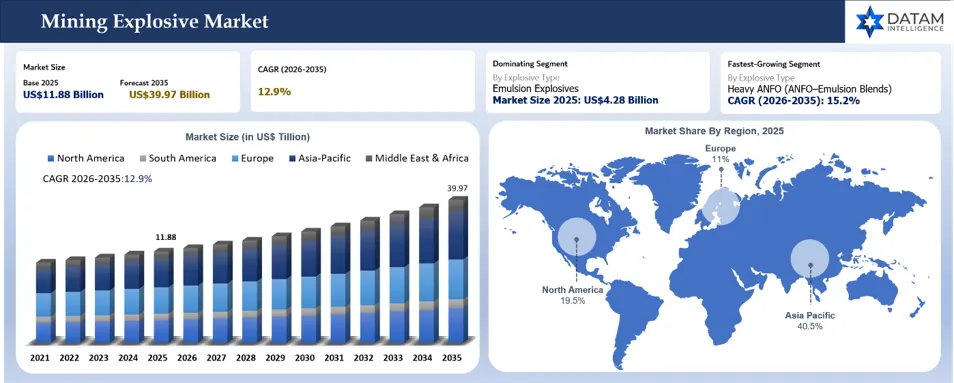
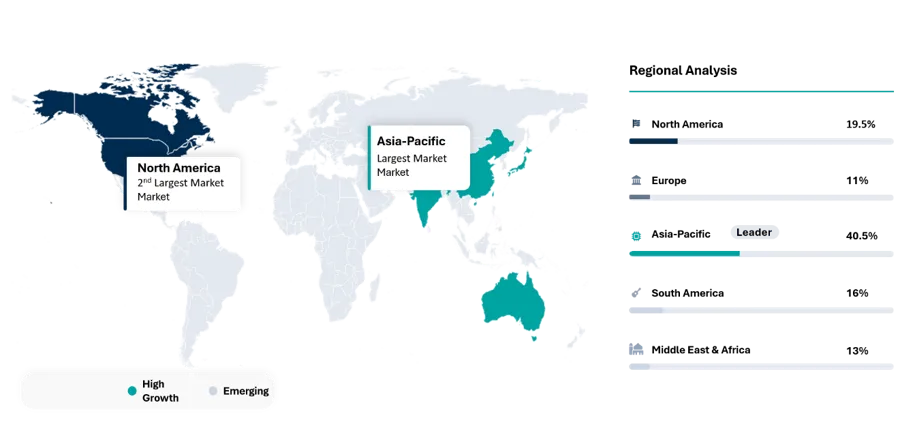
Asia-Pacific maintains a leading position, supported by extensive coal mining in China and India, iron ore extraction in Australia, and mineral production across Indonesia. Leading manufacturers, including Orica Limited, Dyno Nobel Limited, Enaex S.A., MAXAM, AECI Limited, and Solar Industries India Limited, are strengthening manufacturing capabilities, regional supply networks, and integrated blasting solutions. Ammonium nitrate price volatility, stringent explosives regulations, and environmental compliance requirements remain key challenges influencing competitive positioning and long-term market development.
Mining Explosives Market Key Takeaways
- The global mining explosives market was valued at US$11.88 billion in 2025 and is estimated to reach US$39.97 billion by 2035, representing an implied CAGR of approximately 12.9% during 2026-2035. Market growth is supported by expanding copper, iron ore, coal, gold, and critical mineral extraction, increasing overburden removal requirements, rising investments in surface and underground mining operations, and growing adoption of advanced blasting technologies.
- Increasing demand for efficient rock fragmentation and improved mining productivity is accelerating the adoption of ammonium nitrate fuel oil (ANFO), heavy ANFO, and bulk emulsion explosives. Mining operators are increasingly prioritizing high-performance explosive formulations, automated charging systems, and digital blast optimization technologies to reduce operational costs, improve blasting accuracy, and enhance mine-to-mill efficiency.
- Asia-Pacific maintains a leading position, supported by extensive coal mining in China and India, iron ore extraction in Australia, and mineral production across Indonesia. Leading manufacturers, including Orica Limited, Dyno Nobel Limited, Enaex S.A., MAXAM, AECI Limited, and Solar Industries India Limited, are strengthening manufacturing capabilities, regional supply networks, and integrated blasting solutions. Ammonium nitrate price volatility, stringent explosives regulations, and environmental compliance requirements remain key challenges influencing competitive positioning and long-term market development.
Mining Explosives Market Industry Trends and Strategic Insights
- The global mining explosives market is transitioning from conventional ammonium nitrate fuel oil (ANFO) and packaged explosive products toward advanced bulk emulsions, high-energy explosive formulations, and precision blasting technologies. This shift is improving rock fragmentation, mining productivity, and operational safety while increasing emphasis on explosive efficiency, environmental compliance, automated loading systems, and cost-effective mineral extraction across surface and underground mining operations.
- Leading companies, including Orica Limited, Dyno Nobel Limited, Enaex S.A., MAXAM, AECI Limited, Austin Powder Company, and Solar Industries India Limited, are strengthening their competitive positions through advanced explosive formulations, manufacturing capacity expansion, strategic partnerships, and integrated blasting solutions. Growing demand for copper, iron ore, gold, coal, and critical minerals is supporting explosives consumption, while investments in mining infrastructure, underground extraction, and large-scale open-pit operations are creating opportunities for specialized explosive products and technologies.
- Mining explosives manufacturers are increasingly shifting toward high-performance emulsion explosives, heavy ANFO formulations, and customized bulk explosive delivery systems that offer improved water resistance, controlled energy distribution, consistent fragmentation, and reduced operational costs. Variable-energy blasting technologies, automated explosive charging systems, digital blast optimization, and environmentally improved explosive formulations are gaining importance as mining companies seek to enhance ore recovery, reduce explosive wastage, improve blasting accuracy, and minimize environmental impacts.
- Commercial differentiation is expected to move beyond conventional explosive pricing and supply volumes toward product performance, fragmentation efficiency, technical service capabilities, supply reliability, and customized blasting solutions. Next-generation technologies incorporating automated bulk loading, variable-density emulsions, remote charging systems, digital blast design, and advanced explosive energy management could significantly reshape competitive positioning, supplier relationships, mining operating costs, and long-term procurement strategies.
- Sustainable competitive advantage will increasingly depend on maintaining reliable ammonium nitrate supply chains, strengthening regional explosive manufacturing and distribution networks, developing environmentally responsible formulations, and meeting stringent safety and regulatory requirements. Companies demonstrating superior blasting performance, localized production capabilities, strong technical support, efficient logistics, and long-term relationships with mining operators are likely to strengthen their market positioning and capture growth opportunities through 2035.
Mining Explosives Market Scope
| Metrics | Details | |
| 2025 Market Size | US$11.88 Billion | |
| 2035 Projected Market Size | US$39.97 Billion | |
| CAGR (2026-2035) | 12.9% | |
| Largest Market | Asia-Pacific | |
| Fastest Growing Market | South America | |
| By Explosive Type | Ammonium Nitrate Fuel Oil (ANFO), Heavy ANFO (ANFO-Emulsion Blends), Emulsion Explosives (Excluding Heavy ANFO), Slurry and Water Gel Explosives, Nitroglycerin-Based Explosives and Other Explosive Formulations | |
| By Product Form | Bulk Explosives and Packaged Explosives | |
| By Mining Method | Surface Mining and Underground Mining | |
| By Application | Overburden and Waste-Rock Removal, Production Blasting, Mine Development and Access Blasting, Secondary Rock Fragmentation and Other Blasting Applications | |
| By End-Use Industry | Coal Mining (Thermal Coal Mining, Metallurgical Coal Mining and Other Coal Mining), Metal Mining (Ferrous Metal Mining, Base Metal Mining, Precious Metal Mining and Other Metal Mining) and Nonmetallic Mineral Mining (Aggregates and Construction Stone Quarrying, Industrial Minerals Mining, Fertilizer Minerals Mining and Other Nonmetallic Mineral Mining) | |
| By Region | North America | U.S., Canada, Mexico |
| Europe | Germany, UK, France, Spain, Italy, Poland | |
| Asia-Pacific | China, India, Japan, Australia, South Korea, Indonesia, Malaysia, Singapore, Vietnam, Thailand, Philippines, Taiwan | |
| South America | Brazil, Argentina | |
| Middle East and Africa | Israel, Saudi Arabia, UAE, Turkiye, South Africa, Nigeria | |
| Report Insights Covered | Competitive Landscape Analysis, Company Profile Analysis, Market Size, Share, Growth | |
Why does this report matter in 2026?
The global mining explosives market is undergoing significant transformation in 2026, driven by expanding copper, iron ore, coal, and critical mineral extraction, increasing mining depths, and growing demand for efficient rock fragmentation. Rising adoption of bulk emulsion explosives, automated charging systems, and precision blasting technologies is reshaping operational efficiency, mining safety, and explosive consumption patterns.
Competitive intensity is increasing as Orica, Dyno Nobel, Enaex, MAXAM, AECI, and Solar Industries expand manufacturing capabilities, strengthen regional supply networks, and develop advanced explosive formulations. Ammonium nitrate supply constraints, stringent safety regulations, and digital blasting solutions are influencing procurement strategies, production costs, and competitive positioning.
Mining Explosives Market White Space & Investment Opportunities
- Next-Generation Bulk Emulsion Explosives: Invest in high-energy bulk emulsions, variable-density formulations, and water-resistant explosive technologies to improve fragmentation efficiency, reduce explosive consumption per tonne of material, and capture demand from deep open-pit and water-bearing mining operations.
- Automated Explosive Charging and Precision Blasting: Expand investment in automated bulk loading systems, remote-controlled underground charging equipment, and digital blast optimization technologies to address workforce safety challenges, improve charging accuracy, reduce operational downtime, and strengthen integration with autonomous mining operations.
- Localized Explosives Manufacturing and Supply Infrastructure: Establish regional emulsion manufacturing facilities, mobile manufacturing units, and ammonium nitrate storage and distribution networks near major copper, gold, iron ore, and coal mining clusters to reduce transportation costs, improve supply reliability, and secure long-term contracts with mining operators.
- Low-Emission Explosive Formulations and Environmental Compliance: Develop formulations and blasting solutions that reduce nitrogen oxide emissions, limit nitrate leaching, and improve explosive energy utilization to address tightening environmental requirements and growing demand for environmentally responsible mining practices.
Mining Explosives Market Future Transformation
Over the next decade, the global mining explosives market will transition toward precision blasting, automated explosive charging, and advanced bulk emulsion technologies. Growing demand for copper, iron ore, gold, and critical minerals will accelerate investments in high-energy formulations, variable-density explosives, and integrated blasting solutions. Digital blast design and remote-controlled charging systems will improve fragmentation efficiency, operational safety, and mining productivity.
Commercial differentiation will increasingly depend on explosive performance, ammonium nitrate supply security, localized manufacturing capabilities, and environmental compliance. Companies investing in automated loading infrastructure, optimized explosive formulations, and reliable distribution networks will strengthen competitive positioning and capture growth opportunities through 2035.
Mining Explosives Market Buyer Decision-Making Criteria
Major Buyer Decision-Making Criteria:
- Explosive Energy Performance and Rock Fragmentation Efficiency
- Cost per Tonne of Rock Broken
- Explosive Safety and Handling Requirements
- Product Reliability and Consistent Blast Performance
- Ammonium Nitrate Supply Security and Explosives Availability
- Bulk Explosive Loading and Delivery Capabilities
- Water Resistance and Geological Compatibility
- Regulatory Compliance and Environmental Performance
- Technical Support and Blast Optimization Services
- Supplier Reputation and Manufacturing Reliability
- Local Manufacturing and Distribution Network
- Long-Term Supply Contracts and Pricing Stability
Mining Explosives Market Economic & Investment Analysis
The global mining explosives market is attracting investment as expanding copper, gold, iron ore, and critical mineral extraction strengthens demand for efficient blasting solutions. Capital allocation is increasingly focused on bulk emulsion manufacturing, automated charging systems, and localized explosive production facilities to improve operational efficiency and supply reliability.
Leading manufacturers, including Orica, Dyno Nobel, Enaex, MAXAM, and Solar Industries, are strengthening manufacturing capabilities and regional distribution networks. Future investment opportunities will concentrate on high-performance explosive formulations, digital blast optimization, ammonium nitrate supply security, and environmentally compliant technologies. Mining expansion and long-term supply contracts will support investment prospects through 2035.
Mining Explosives Market Investment Trends
- Capital allocation is increasing toward bulk emulsion manufacturing facilities, mobile manufacturing units, and localized explosive production infrastructure as suppliers strengthen regional supply networks and secure long-term mining contracts.
- Investment is accelerating in high-performance emulsion explosives, heavy ANFO formulations, variable-density explosives, and water-resistant blasting solutions to improve rock fragmentation, explosive efficiency, and productivity across surface and underground mining operations.
- Mining explosives manufacturers are expanding investments in automated explosive charging systems, digital blast optimization platforms, remote-controlled loading technologies, and predictive fragmentation analytics to enhance operational safety, reduce blasting costs, and improve mining efficiency.
- Funding is increasingly directed toward ammonium nitrate supply security, regional storage infrastructure, advanced explosive manufacturing equipment, and distribution network expansion to mitigate raw material price volatility and supply disruptions.
- Strategic investments are expanding across copper, gold, iron ore, and critical mineral mining regions, particularly Australia, Chile, Peru, Indonesia, and Africa, as suppliers pursue manufacturing partnerships, regional expansion, and long-term explosive supply agreements.
Strategic Indicators for Global Mining Explosives Market
High Regulation Impact
The global mining explosives market operates under stringent regulations governing explosive manufacturing, storage, transportation, handling, and blasting operations. In the United States, the Bureau of Alcohol, Tobacco, Firearms and Explosives (ATF) regulates commercial explosives, while the Mine Safety and Health Administration (MSHA) oversees blasting safety at mining sites. European Union regulations impose additional requirements concerning explosive conformity, traceability, and hazardous material transportation.
Regulatory compliance is particularly critical for ammonium nitrate handling, explosive storage facilities, and underground blasting operations. Increasing environmental scrutiny regarding nitrogen oxide emissions, nitrate contamination, and blasting-induced vibrations is encouraging manufacturers to develop safer formulations and strengthen operational compliance systems..
High Investment Activity
Investment activity in the global mining explosives market is increasing as manufacturers expand bulk emulsion production, localized manufacturing infrastructure, and automated blasting technologies. Rising copper, gold, iron ore, and critical mineral extraction is supporting capital allocation toward mobile manufacturing units, ammonium nitrate storage facilities, and advanced explosive formulations.
Leading companies, including Orica, Dyno Nobel, Enaex, MAXAM, and Solar Industries, are strengthening production capabilities and regional supply networks. Investment priorities increasingly include variable-density emulsions, remote-controlled charging systems, digital blast optimization, and supply chain security. Long-term mining contracts, operational efficiency, and regional manufacturing advantages will influence investment returns through 2035..
Regional Expansion Opportunity
Regional expansion opportunities in the global mining explosives market are strengthening across mineral-rich economies with expanding extraction activities. Asia-Pacific, particularly Australia, China, India, and Indonesia, offers opportunities supported by iron ore, coal, copper, and critical mineral production. Latin America, especially Chile and Peru, presents opportunities through copper mining investments, increasing stripping requirements, and large-scale open-pit operations.
Africa offers expansion potential across gold, copper, platinum-group metals, and other mineral extraction activities. Regional competitiveness increasingly depends on localized emulsion manufacturing, ammonium nitrate availability, transportation infrastructure, regulatory approvals, and relationships with mining operators. Suppliers establishing reliable production and distribution networks can capture long-term contracts.
Government Policy Support
Government policies influence the global mining explosives market through mineral development initiatives, domestic manufacturing incentives, mining concessions, and explosives safety regulations. Policies supporting critical mineral extraction, copper production, and mining infrastructure development can strengthen demand for commercial blasting products. Australia, Canada, India, and mineral-rich African economies are pursuing initiatives to expand domestic mineral processing and mining investment.
Government support for industrial infrastructure, transportation networks, and regional manufacturing can encourage localized explosives production. However, licensing requirements, ammonium nitrate controls, environmental approvals, and hazardous material transportation restrictions remain important considerations. Effective policy implementation and permitting efficiency will influence mining explosives investment through 2035.
Value-Based Pricing Intelligence
Value-based pricing in the global mining explosives market increasingly depends on fragmentation efficiency, explosive energy performance, supply reliability, and total mining operating costs. Buyers evaluate explosives beyond purchase price by considering cost per tonne of rock broken, downstream crushing efficiency, equipment productivity, and blast consistency. Bulk emulsions and customized explosive formulations can command pricing premiums when measurable operational improvements justify additional expenditure.
Ammonium nitrate costs, freight expenses, site accessibility, and contract duration significantly influence regional pricing structures. Suppliers offering integrated explosive delivery, technical support, digital blast optimization, and consistent product performance can strengthen customer retention and negotiate performance-linked supply agreements.
Disruption Analysis of Mining Explosives Market
The global mining explosives market is undergoing significant disruption as manufacturers transition from conventional ANFO and packaged explosives toward advanced bulk emulsions, automated charging systems, and precision blasting technologies. Leading companies, including Orica, Dyno Nobel, Enaex, MAXAM, and AECI, are increasingly competing on explosive performance, operational safety, and integrated blasting capabilities.
Technological disruption is accelerating through variable-density emulsions, remote-controlled explosive loading, digital blast optimization, and predictive fragmentation analytics. Growing adoption of automated mining operations and environmentally improved explosive formulations is reshaping procurement strategies, reducing operational costs, and strengthening demand for technologically advanced blasting solutions through 2035.
Mining Explosives Market BCG Matrix: Company Evaluation
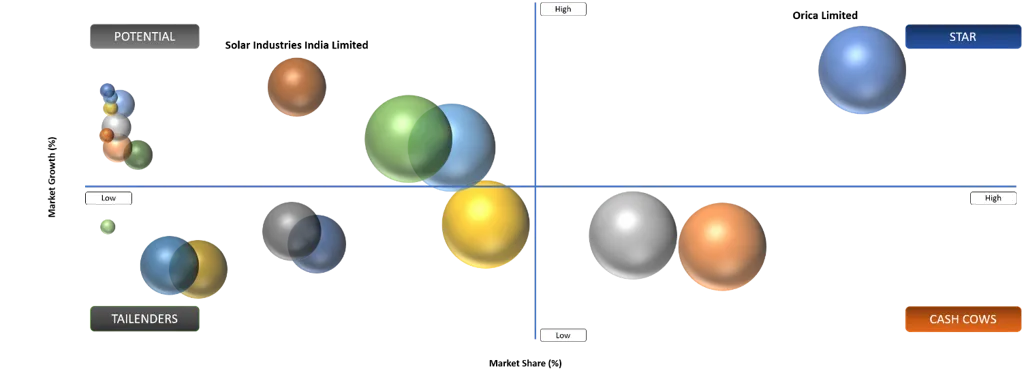
STAR
Orica Limited, Dyno Nobel Limited, Enaex S.A., MaxamCorp Holding, S.L.U., AECI Limited, and Austin Powder Company are positioned in the Star category based on their established mining explosives portfolios, extensive geographic presence, manufacturing capabilities, and long-term relationships with major mining operators. Orica and Dyno Nobel maintain strong positions in bulk emulsions, ANFO, and integrated blasting solutions, while Enaex, MAXAM, and AECI demonstrate significant capabilities in commercial explosives manufacturing and technical blasting services. Competitive differentiation among Star players increasingly depends on automated explosive charging, advanced emulsion formulations, ammonium nitrate supply security, digital blast optimization, and localized manufacturing infrastructure.
POTENTIAL
Solar Industries India Limited, Omnia Holdings Limited, Hanwha Corporation, Oy Forcit Ab, FAMESA EXPLOSIVOS S.A.C., and Guangdong Hongda Holdings Group Co., Ltd. are positioned in the Potential category based on their regional manufacturing strengths, specialized explosive formulations, and opportunities for geographic expansion. Solar Industries demonstrates capabilities in industrial explosives manufacturing, while Omnia's BME business provides bulk explosives and blasting solutions across mining-intensive regions. Hanwha and FORCIT maintain specialized commercial explosives portfolios, while FAMESA and Guangdong Hongda offer exposure to Latin American and Chinese mining operations. Future competitiveness will depend on capacity expansion, supply chain reliability, technological differentiation, and international market penetration.
Mining Explosives Market Dynamics
Driver Impact Analysis
| Driver | Market Growth Impact (%) | Demand Concentration | Impacted Use Case | Strategic Impact |
Expanding Copper, Iron Ore and Critical Mineral Extraction | 15% | Asia-Pacific and South America | Open-Pit Production Blasting and Ore Fragmentation | Increases bulk explosives consumption, strengthens long-term supply contracts and supports manufacturing capacity expansion. |
Increasing Overburden Removal and Mining Depths | 10.2% | Australia, China, India and Indonesia | Overburden Blasting, Waste-Rock Removal and Underground Mine Development | Raises explosive consumption intensity and accelerates demand for high-energy emulsions and heavy ANFO formulations. |
Growing Adoption of Bulk Emulsions and Precision Blasting Technologies | 5% | Australia, North America and South Africa | Automated Explosive Charging, Controlled Fragmentation and Underground Blasting | Encourages investment in advanced explosive formulations, automated loading systems and digital blast optimization solutions. |
Driver: Expanding Copper, Iron Ore and Critical Mineral Extraction
Expanding copper, iron ore, and critical mineral extraction is a major growth driver for the global mining explosives market, supported by rising demand for electrification infrastructure, renewable energy technologies, and industrial raw materials. Increasing investments in large-scale copper mines across Chile, Peru, and Australia, alongside iron ore production in Australia and Brazil, are strengthening demand for bulk ANFO, heavy ANFO, and emulsion explosives. Expanding open-pit operations and higher waste-to-ore stripping requirements are increasing blasting volumes and explosive consumption. Mining companies are prioritizing efficient rock fragmentation to reduce drilling, hauling, and downstream crushing costs.
Growing development of deeper mineral deposits and increasingly complex ore bodies is also encouraging adoption of high-energy, water-resistant explosive formulations. Suppliers with localized manufacturing facilities, reliable ammonium nitrate procurement, and integrated technical support capabilities are better positioned to secure long-term contracts. Continued investment in mineral extraction is expected to support explosives demand through 2035, although commodity-price fluctuations and mining project delays may influence growth.
Restraint Impact Analysis
| Restraint | Drag on Market Growth (%) | Primary Impact Area | Impacted Use Case | Strategic Impact |
Ammonium Nitrate Price Volatility and Supply Constraints | 20.10% | Asia-Pacific, Europe and Latin America | ANFO, Heavy ANFO and Bulk Emulsion Manufacturing | Increases production costs, compresses supplier margins and creates pricing uncertainty in long-term mining contracts. |
Stringent Explosives Storage, Transportation and Blasting Regulations | 35% | North America, Europe and Australia | Explosives Manufacturing, Hazardous Material Transportation and Mine-Site Blasting | Raises compliance expenditure, extends licensing timelines and restricts market entry for smaller manufacturers. |
Mining Commodity Price Volatility and Project Delays | 15% | South America, Africa and Asia-Pacific | Open-Pit Production Blasting, Mine Development and Overburden Removal | Delays mine expansions, reduces blasting activity and weakens demand visibility for explosives suppliers. |
Restraint: Ammonium Nitrate Price Volatility and Supply Constraints
Ammonium nitrate price volatility and supply constraints represent a significant restraint on the global mining explosives market, as ammonium nitrate is a primary raw material used in ANFO, heavy ANFO, and emulsion explosive formulations. Fluctuations in natural gas prices, fertilizer production economics, and regional ammonium nitrate availability directly influence explosives manufacturing costs. Supply disruptions, transportation restrictions, and dependence on imported ammonium nitrate can increase procurement expenses, particularly across mining-intensive regions in Australia, Latin America, and Africa. Manufacturers operating under fixed-price mining contracts face additional margin pressure when raw material costs rise unexpectedly.
Increasing regulatory scrutiny surrounding ammonium nitrate storage, handling, and international transportation further complicates supply chain management. Mining explosives suppliers are responding through long-term procurement agreements, regional storage infrastructure, supplier diversification, and localized manufacturing investments. However, smaller manufacturers with limited purchasing power and distribution capabilities remain particularly exposed to price fluctuations and supply interruptions. Continued ammonium nitrate supply uncertainty could constrain production flexibility, increase explosive prices, and affect supplier profitability through 2035.
Mining Explosives Market Segment Analysis
The global mining explosives market is segmented based on explosive type, product form, mining method, application, end-use industry and region.
Emulsion Explosives Dominate the Global Mining Explosives Market
The emulsion explosives segment is expected to maintain a leading position in the global mining explosives market in 2025, supported by its superior water resistance, consistent blasting performance, and widespread adoption across surface and underground mining operations. Increasing copper, iron ore, gold, and coal extraction is strengthening demand for bulk emulsion formulations, particularly in water-bearing geological conditions where conventional ANFO offers limited performance. Mining operators increasingly prefer emulsion explosives for reliable rock fragmentation, improved operational safety, and compatibility with automated charging systems. Expanding large-scale mining operations and investments in advanced blasting technologies are expected to support the segment's market position through 2035.
Mining Explosives Market Geographical Penetration
U.S. Mining Explosives Market Landscape
The United States mining explosives market is supported by coal production, metal mining, limestone quarrying, and construction aggregate extraction. Demand for ANFO, heavy ANFO, and bulk emulsion explosives is concentrated in large-scale surface mining operations, particularly where continuous overburden removal and production blasting are required. Major suppliers, including Orica, Dyno Nobel, and Austin Powder, compete through explosive performance, localized manufacturing, distribution networks, and technical blasting support.
Increasing adoption of automated charging systems, advanced emulsion formulations, and digital blast optimization is strengthening operational efficiency. However, ammonium nitrate costs, mining commodity fluctuations, and stringent ATF and MSHA requirements continue influencing supplier profitability and investment decisions.
Japan Mining Explosives Market Outlook
Japan's mining explosives market is primarily supported by limestone extraction, crushed stone quarrying, and selected industrial mineral operations, reflecting the country's relatively limited large-scale metallic ore and coal mining activities. Demand is concentrated in controlled rock fragmentation, quarry production blasting, and mineral extraction supporting cement, steel, and construction material industries. Domestic manufacturers, including NOF CORPORATION, serve specialized industrial explosives requirements, while stringent safety standards influence product selection and distribution.
Future opportunities will increasingly depend on efficient quarry blasting, mechanized charging technologies, and consistent explosive performance. Limited domestic mining expansion, environmental restrictions, and regulatory compliance requirements are expected to constrain volume growth through 2035.
Mining Explosives Market Competitive Landscape
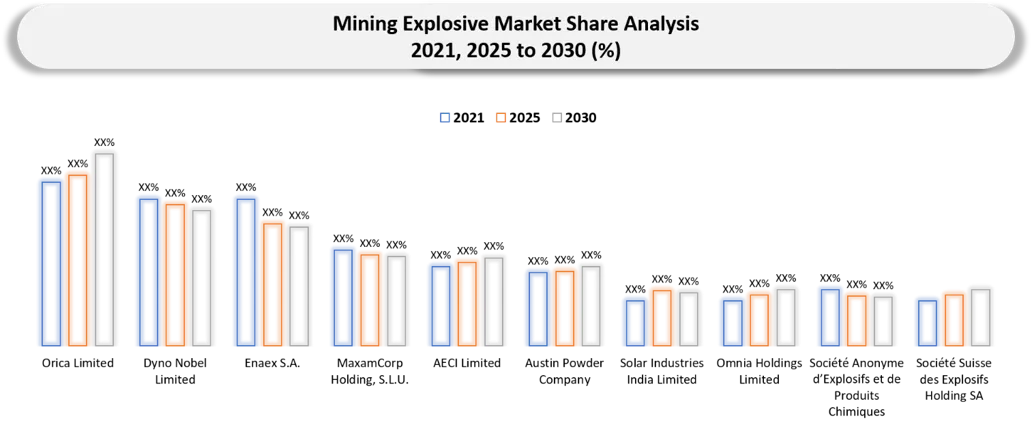
- The global mining explosives market is moderately consolidated, characterized by the presence of multinational explosives manufacturers, regional suppliers, and specialized commercial blasting solution providers. Major players, including Orica Limited, Dyno Nobel Limited, Enaex S.A., MAXAM, AECI Limited, Austin Powder Company, Solar Industries India Limited, and Omnia Holdings Limited, maintain competitive positions through extensive manufacturing networks, diversified explosive portfolios, and long-term mining supply contracts. Competition is concentrated in bulk emulsions, ANFO, heavy ANFO, and packaged explosives, where product performance, supply reliability, and cost efficiency influence procurement decisions.
- Competitive differentiation is increasingly driven by advanced emulsion formulations, automated explosive charging technologies, digital blast optimization, and localized manufacturing capabilities. Orica and Dyno Nobel maintain established positions in integrated blasting solutions, while Enaex, MAXAM, and AECI strengthen their regional presence through technical expertise and mining partnerships. Chinese and Indian manufacturers are expanding their competitive influence through production capacity, regional distribution networks, and cost-efficient explosive manufacturing. Ammonium nitrate supply security, stringent safety regulations, and growing demand for precision blasting are expected to reshape competitive positioning and supplier strategies through 2035.
Key Companies of Mining Explosives Market
- Orica Limited (Australia)
- Dyno Nobel Limited (Australia)
- Enaex S.A. (Chile)
- MaxamCorp Holding, S.L.U. (Spain)
- AECI Limited (South Africa)
- Austin Powder Company (United States)
- Solar Industries India Limited (India)
- Omnia Holdings Limited (South Africa)
- Société Anonyme d’Explosifs et de Produits Chimiques (France)
- Société Suisse des Explosifs Holding SA (Switzerland)
- Hanwha Corporation (South Korea)
- NOF CORPORATION (Japan)
- Oy Forcit Ab (Finland)
- FAMESA EXPLOSIVOS S.A.C. (Peru)
- Nelson Brothers, LLC (United States)
- Keltech Energies Limited (India)
- Guangdong Hongda Holdings Group Co., Ltd. (China)
- Anhui Jiangnan Chemical Industry Co., Ltd. (China)
- Poly Union Chemical Holding Group Co., Ltd. (China)
- Sichuan Yahua Industrial Group Co., Ltd. (China)
- Hubei Kailong Chemical Group Co., Ltd. (China)
- Shanxi Huhua Group Co., Ltd. (China)
- PT DAHANA (Indonesia)
- PT Multi Nitrotama Kimia (Indonesia)
- NITROERG S.A. (Poland)
- Explosia a.s. (Czech Republic)
Mining Explosives Market Major Pain Points
- Ammonium Nitrate Price Volatility and Supply Chain Disruptions: Heavy dependence on ammonium nitrate exposes mining explosives manufacturers to natural gas price fluctuations, fertilizer industry demand, production disruptions, and hazardous material transportation restrictions. Rising feedstock costs compress supplier margins, particularly under fixed-price mining contracts, while inconsistent availability affects manufacturing schedules and mine-site explosive supply.
- Stringent Explosives Regulations and High Compliance Costs: Strict licensing, storage, transportation, manufacturing, and blasting safety requirements increase operating costs and create barriers to market entry. Regional differences in explosives regulations, environmental permitting, and hazardous material handling standards complicate international expansion, restrict distribution flexibility, and extend approval timelines for manufacturing facilities.
- Mining Commodity Price Volatility and Project Delays: Fluctuations in copper, iron ore, coal, and gold prices influence mine production plans, capital expenditure, and blasting activity. Delayed mining projects, production curtailments, and unfavorable stripping economics reduce explosives demand visibility, create capacity utilization challenges, and increase revenue uncertainty for manufacturers dependent on long-term mining contracts.
- Hazardous Explosives Logistics and Remote Mine-Site Supply Constraints: Explosives transportation restrictions, limited hazardous-material storage infrastructure, and remote mining locations increase distribution costs and complicate inventory management. Suppliers serving geographically isolated operations face higher freight expenses, complex delivery scheduling, and substantial investment requirements for local production, storage, and technical support infrastructure.
- Environmental Restrictions and Blasting Performance Challenges: Increasing scrutiny of nitrogen oxide emissions, nitrate contamination, ground vibrations, and flyrock hazards raises environmental compliance requirements for mining operators and explosives suppliers. Water-bearing geological conditions, inconsistent rock characteristics, and fragmentation variability further complicate explosive selection, potentially increasing blasting costs and reducing operational efficiency.
Mining Explosives Market Recent Developments
- September 2026 - Dyno Nobel Limited: Dyno Nobel unveiled its fully autonomous blast-hole inspection and loading system, designed to automate explosive charging and initiation-system deployment in mining operations. The technology is expected to undergo trials at Mariana Minerals' Copper One mine in Utah, United States, strengthening automated blasting capabilities and reducing personnel exposure to hazardous areas.
- August 2026 - Orica Limited: Orica announced advancements in its Surface Mining Automation Program, incorporating autonomous blast-hole measurement and remotely operated mobile manufacturing units. The initiative aims to improve explosive loading efficiency, minimize personnel exposure in high-risk blasting zones, and accelerate the adoption of digitally integrated surface mining operations.
- June 2026 - Orica Limited: Orica reported that its 4D Bulk System and Blast Design for Outcome technology helped Lundin Mining's Candelaria operation in Chile reduce drilling and blasting costs by 16% across more than 200 blasts. The implementation demonstrated the commercial benefits of variable-energy explosive formulations, optimized blast patterns, and reduced explosive consumption in large-scale mining operations.
Analyst View / Opinion on Mining Explosives Market
- The global mining explosives market is undergoing significant transformation, driven by expanding copper, iron ore, gold, and critical mineral extraction, increasing overburden removal requirements, and growing adoption of advanced blasting technologies. Manufacturers are increasingly prioritizing high-performance emulsion explosives, heavy ANFO formulations, automated charging systems, and localized manufacturing capabilities to improve operational efficiency, blasting safety, and long-term competitiveness.
- Leading companies, including Orica Limited, Dyno Nobel Limited, Enaex S.A., MAXAM, AECI Limited, Austin Powder Company, Solar Industries India Limited, and Omnia Holdings Limited, are strengthening their competitive positions through advanced explosive formulations, regional manufacturing investments, integrated blasting solutions, and long-term mining supply agreements. Ammonium nitrate procurement security, technical service capabilities, and reliable mine-site delivery networks are becoming critical competitive differentiators.
- Mining explosives manufacturers are increasingly transitioning from conventional explosive supply toward customized bulk emulsion systems, variable-density formulations, and precision blasting solutions. Growing adoption of digital blast design, automated explosive loading, and predictive fragmentation analytics is enabling mining operators to optimize explosive energy distribution, reduce downstream crushing costs, improve equipment productivity, and strengthen mine-to-mill performance.
- Commercial differentiation is expected to shift beyond explosive pricing and supply volumes toward cost per tonne of rock broken, fragmentation consistency, operational safety, and total mining productivity. Suppliers offering integrated technical support, automated loading infrastructure, optimized explosive formulations, and measurable blasting performance improvements are likely to strengthen customer retention and secure higher-value, long-term mining contracts.
- Sustainable competitive advantage will increasingly depend on ammonium nitrate supply resilience, strategically located manufacturing facilities, regulatory compliance, and exposure to high-growth mineral extraction regions. Companies demonstrating cost-efficient production, strong distribution capabilities, advanced blasting technologies, and established relationships with mining operators are positioned to capture growth opportunities through 2035.
Mining Explosives Market Target Audience
| INDUSTRY | WHO SHOULD BUY THIS REPORT? | REASON TO BUY THIS REPORT |
| Mining Explosives Manufacturers | CEOs, Business Development Heads, Product Portfolio Managers, Commercial Strategy Teams | Evaluate mining explosives market size, explosive formulation demand, competitive positioning, manufacturing capacity expansion and geographic growth opportunities. |
| Mining and Quarrying Companies | Mine Operations Directors, Procurement Heads, Blasting Engineers, Mining Strategy Managers | Assess explosive consumption trends, supplier capabilities, blasting cost optimization, product performance and long-term procurement strategies. |
Explosive Chemicals and Raw Material Suppliers | Commercial Directors, Sales Heads, Supply Chain Managers, Business Development Teams | Identify ammonium nitrate demand, raw material procurement opportunities, explosives manufacturing requirements and regional supply chain gaps. |
Blasting Technology and Equipment Providers | Technology Directors, Product Development Heads, Engineering Managers, Innovation Teams | Evaluate demand for automated explosive charging, bulk loading systems, digital blast optimization and advanced blasting technologies. |
Mining Contractors and Blasting Service Providers | Managing Directors, Contract Managers, Operations Heads, Technical Service Managers | Identify outsourcing opportunities, mining project demand, regional contract potential and opportunities for integrated blasting solutions. |
Investment Firms and Financial Institutions | Investment Directors, Private Equity Professionals, M&A Advisors, Financial Analysts | Assess industry growth potential, competitive consolidation, manufacturing investment opportunities, acquisition targets and long-term profitability. |
Explosives Distributors and Logistics Providers | Distribution Heads, Logistics Directors, Supply Chain Executives, Regional Sales Managers | Evaluate regional explosives demand, hazardous material transportation requirements, storage infrastructure needs and distribution network expansion opportunities. |
Government and Mining Regulatory Authorities | Mining Policy Advisors, Regulatory Affairs Directors, Industrial Development Officials | Understand explosives industry development, manufacturing localization opportunities, safety compliance requirements and mineral extraction investment trends. |
| Mining Explosives Manufacturers | CEOs, Business Development Heads, Product Portfolio Managers, Commercial Strategy Teams | Evaluate mining explosives market size, explosive formulation demand, competitive positioning, manufacturing capacity expansion and geographic growth opportunities. |
| Mining and Quarrying Companies | Mine Operations Directors, Procurement Heads, Blasting Engineers, Mining Strategy Managers | Assess explosive consumption trends, supplier capabilities, blasting cost optimization, product performance and long-term procurement strategies. |
Why Choose DATAM?
- Data-Driven Insights: Access granular intelligence covering mining explosives market size, explosive type shares, bulk and packaged explosives demand, mining methods, blasting applications, end-use industry trends, competitive positioning, regional market shares, and country-level growth opportunities.
- Primary Research Validation: Benefit from insights supported by discussions with mining explosives manufacturers, mining operators, blasting contractors, explosives procurement specialists, ammonium nitrate suppliers, mining engineers, distribution partners, and industry decision-makers to strengthen market estimates and demand assessments.
- Expert Analyst Consultations: Engage directly with mining industry analysts for customized guidance on explosive formulation benchmarking, competitor positioning, market entry strategies, blasting technology adoption, ammonium nitrate pricing dynamics, regulatory developments, and investment opportunities across major mining regions.
- Customized Market Intelligence: Receive tailored analysis covering country-level mining explosives consumption, ANFO and emulsion explosives demand, surface and underground mining requirements, supplier benchmarking, manufacturing capacity expansion, hazardous material logistics, regional supply chain challenges, emerging blasting technologies, and strategic growth opportunities through 2035.
What DATAM Uniquely Provides
- Comprehensive Market Segmentation: In-depth segmentation of the mining explosives market by explosive type, product form, mining method, blasting application, end-use industry, and geography, including market size, revenue shares, growth forecasts, and country-level demand analysis.
- Competitive Landscape and Supplier Benchmarking: Detailed analysis of leading mining explosives manufacturers covering ANFO, heavy ANFO, emulsion and slurry explosive portfolios, manufacturing capabilities, regional production networks, pricing strategies, technological advancements, supply chain integration, competitive positioning, and geographic expansion strategies.
- Explosives Economics and Supply Chain Intelligence: Comprehensive assessment of bulk and packaged explosive demand, ammonium nitrate procurement costs, manufacturing economics, explosives consumption patterns, hazardous material transportation, regulatory compliance, mine-site supply infrastructure, and long-term procurement strategies across coal, metal, and nonmetallic mineral mining operations.
- Emerging Technologies and Investment Opportunities: Detailed evaluation of advanced bulk emulsions, variable-density explosive formulations, automated charging systems, remote-controlled loading technologies, digital blast optimization, and predictive fragmentation analytics, highlighting commercialization potential, operational efficiency improvements, regional investment opportunities, and competitive transformation through 2035.




























































