


Mining Explosives Competitive Intelligence | November 2026
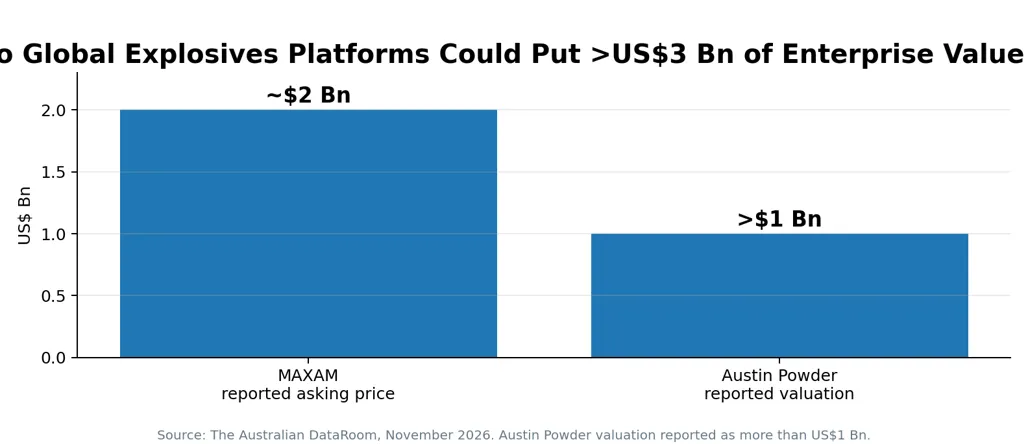
| DEAL SIGNAL | MAXAM is reportedly being marketed at about US$2 Bn, while Austin Powder could command more than US$1 Bn - putting two globally distributed explosives platforms into play at the same time. |
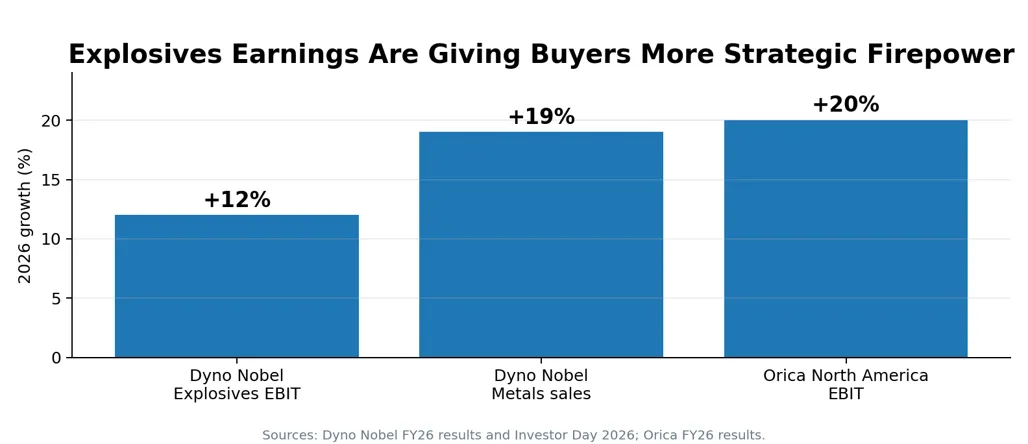
| WHY NOW | Gold, copper and transition-metal mining are supporting strong explosives earnings. Dyno Nobel reported 12% growth in explosives EBIT and 19% metals sales growth, while Orica’s North America EBIT rose 20%. |
| COMMERCIAL QUESTION | Which regional plants, bulk-delivery networks, detonator capabilities and mine relationships could change hands - and where will consolidation create supplier gaps or stronger bundled-service competitors? |
This Is Not a Normal Bolt-On Cycle
The mining explosives market is entering a more consequential phase of consolidation. In November 2026, The Australian reported that Rhone Capital is seeking buyers for MAXAM at an indicated value of about US$2 billion, while American Industrial Partners is also open to offers for Austin Powder at a valuation above US$1 billion. Orica and Dyno Nobel have both been identified as potential strategic buyers.
The scale matters. These are not local distributors. MAXAM sells in more than 60 countries and operates more than 80 industrial facilities. Austin Powder spans five operating regions and operates detonator factories in the United States, Mexico and the Czech Republic. Acquiring either platform would move manufacturing, distribution, customer access and technical capability at the same time.
Request Exclusive Sample: https://www.datamintelligence.com/download-sample/mining-explosive-market
What Buyers Are Really Acquiring: Route-to-Mine Infrastructure
Explosives M&A is fundamentally different from buying a commodity chemical plant. The value sits in regulated manufacturing permits, ammonium-nitrate supply, bulk-emulsion plants, magazines, mobile manufacturing units, detonator capacity, field service teams and long-standing mine relationships. That network can take years to replicate organically.
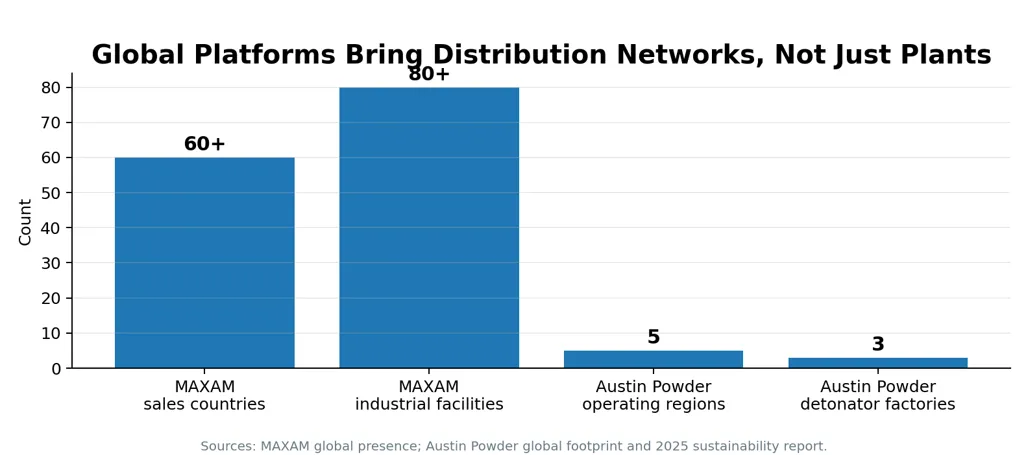
MAXAM reports more than 40 subsidiaries in over 30 countries, sales into more than 60 countries and more than 80 industrial facilities. Austin Powder’s footprint covers North America, Latin America, Europe, Asia Pacific and Africa, with manufacturing and distribution across multiple mining jurisdictions. For a strategic buyer, the prize is therefore geographic density and customer adjacency as much as explosives volume.
Orica Has Already Shown the North American Playbook
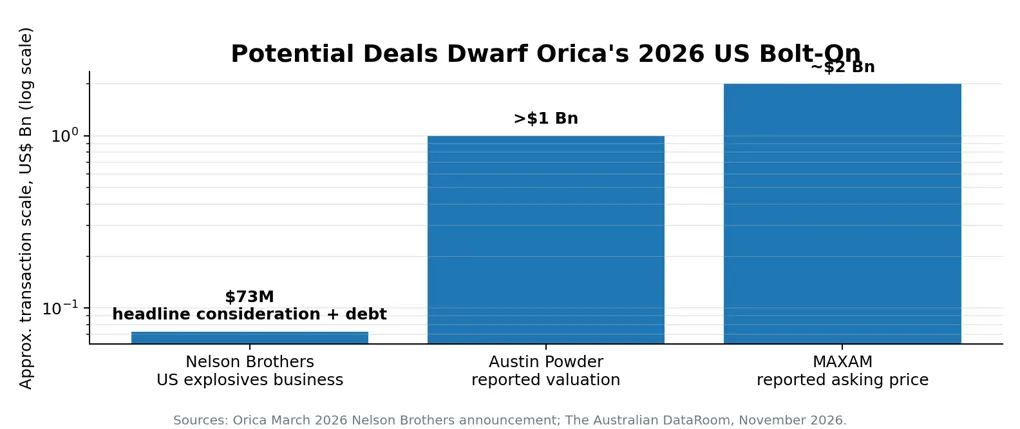
Orica completed its acquisition of the Nelson Brothers US explosives business on 1 June 2026. The March agreement involved US$25 million of purchase consideration plus retirement of US$48 million of debt. The deal gave Orica four wholly owned emulsion plants, initiating-system magazines, mobile bulk-delivery equipment, more storage and direct customer channels in US quarry and construction markets.
That transaction is strategically relevant because it shows what the majors are trying to own: the local infrastructure that secures supply and puts technical teams closer to customers. But the reported MAXAM and Austin Powder valuations are on an entirely different scale.
Why 2026 Earnings Make Consolidation More Plausible
The potential deal wave is arriving while explosives earnings are being supported by metals activity rather than a weak-cycle scramble for survival. Dyno Nobel reported FY26 explosives EBIT of A$485 million, up 12% year over year. Its Investor Day materials showed metals sales up 19% over the prior year, with new contracts in Canada and the United States.
Orica’s North American operations delivered a 20% EBIT uplift in FY26, supported by Western Canadian activity, strong US gold and copper mining, and the integration of Nelson Brothers. Orica’s overall Blasting Solutions EBIT reached A$881 million.
Request a Customized Report According to Your Business Strategy: https://www.datamintelligence.com/customize/mining-explosive-market
Dyno Nobel Has Also Removed the Fertiliser Diversion
Dyno Nobel completed the sale of Phosphate Hill in June 2026, concluding its fertiliser separation and transforming the company into a pure-play global explosives business. The timing matters: management is now explicitly focused on commercial explosives, growth mining corridors, premium technology and energetics rather than allocating capital between explosives and fertiliser assets.
That does not mean Dyno Nobel will necessarily acquire MAXAM or Austin Powder. It does mean the company enters the current deal environment with a cleaner strategic mandate and with explosives already producing record FY26 earnings.
The Consolidation Pressure Is Broader Than Two Sale Processes
The November sale reports sit on top of several structural shifts already underway. Orica has added Nelson Brothers and strengthened its North American supply network. Dyno Nobel has exited fertilisers and is directing resources toward metals, Africa and Latin America. Both companies are investing in higher-value blasting technologies, digital optimisation and stronger downstream customer access.
At the same time, gold and copper are strategically attractive commodities for explosives suppliers because mine expansions, stripping activity and deeper pits create durable drilling-and-blasting demand. Dyno Nobel explicitly cited strong copper, gold and iron-ore performance in the Americas, while Orica cited favourable gold and copper fundamentals across North America and its digital businesses.
Five M&A Signals Mining Explosives Buyers Should Track
| Signal | What it reveals | Likely market impact | Report question |
| MAXAM sale process | A global platform may change control | European, LATAM and mining-account overlap | Which plants and mine contracts are strategically valuable? |
| Austin Powder availability | US-led global network could be contested | North American density and detonator capability become acquisition targets | Where would buyer concentration increase? |
| Orica bolt-ons | Security of supply is becoming an M&A rationale | More vertically integrated regional delivery networks | Which independent suppliers remain? |
| Dyno pure-play pivot | Capital allocation is now explosives-centric | More capacity for organic growth or M&A | Which geographies fit the new portfolio? |
| Gold/copper contract wins | Metals growth is underwriting expansion | Higher value placed on mine relationships and technology | Which commodity corridors are gaining demand? |
The Competitive Map Could Change Faster Than Mine Demand
Mining companies typically view explosives supply through the lens of reliability, fragmentation performance and cost per tonne. M&A adds another variable: who controls the local plant, magazine, detonator line, mobile fleet, digital platform and technical team serving the mine after the transaction closes?
For suppliers and procurement teams, that makes ownership changes commercially important before the transaction is complete. A buyer may rationalise overlapping sites, bundle blasting technology with bulk explosives, redirect capital toward higher-growth regions or use a larger supply network to compete for multi-mine contracts.
Why the Mining Explosives Report Matters Now
A headline that “MAXAM may be sold” is not enough to support a sourcing or competitive decision. The useful questions sit beneath the transaction: which countries and facilities overlap with Orica, Dyno Nobel and Austin Powder, which mining customers are exposed, how ammonium-nitrate and detonator supply would change, where regulatory approvals may be difficult and which regional independents become the next logical targets.
The DataM Intelligence Mining Explosives report is designed to connect those layers - company positioning, regional supply, product and technology capabilities, mine-level demand, competitive share and recent strategic developments - so buyers can see where consolidation is likely to create the next opportunity or supply risk.
Explore the Mining Explosives Market Report - map the companies, regional supply networks, mine-demand corridors and strategic moves shaping the next consolidation cycle.