


Micro Nuclear Reactors | Commercialization & Deployment Perspective 2026
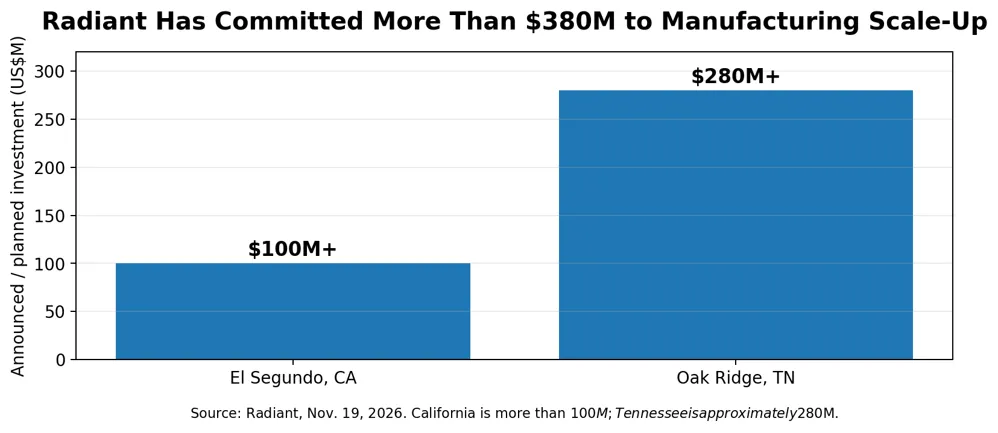
| MANUFACTURING SHIFT | Radiant has moved from reactor development into a two-site manufacturing strategy exceeding $380M, with first commercial deliveries targeted for 2028. |
| ORDER-BOOK SIGNAL | A 20-unit Equinix preorder plus an Army award for 15 Radiant units creates one of the clearest disclosed microreactor order pipelines in the sector. |
| COMMERCIAL QUESTION | Which vendors can convert government-backed prototypes into repeatable factory output, licensed deployment and bankable commercial power contracts? |
The Factory Build-Out Is Now Measurable
The microreactor sector is beginning to show the characteristics of an industrial market rather than a research program. On November 19, 2026, Radiant announced more than $100 million for an expanded El Segundo manufacturing footprint and approximately $280 million for its Oak Ridge, Tennessee campus. The California site will assemble initial commercial Kaleidos units, while Oak Ridge is intended to provide fueling, refueling and high-volume production capability.
Request Executive Sample: https://www.datamintelligence.com/download-sample/micro-nuclear-reactors-market
The significance is not simply the dollar value. Radiant says the El Segundo expansion adds about 200,000 square feet and enables multiple Kaleidos units to be assembled in parallel, while the 81-acre Oak Ridge campus is being built around an integrated fuel-and-manufacturing model. Initial customer deliveries are targeted for 2028.
A Real Order Book Is Emerging - But Instruments Matter
The most important commercial development is the move from expressions of interest to disclosed purchase and deployment instruments. Equinix has a preorder agreement for 20 Radiant Kaleidos units. At 1 MW per unit, that represents 20 MW of prospective microreactor capacity tied to a major data-center operator. Separately, the U.S. Army awarded Radiant up to $750 million to develop and deploy 15 Kaleidos units under Janus, with deployment beginning in 2028 and all 15 expected by 2030.
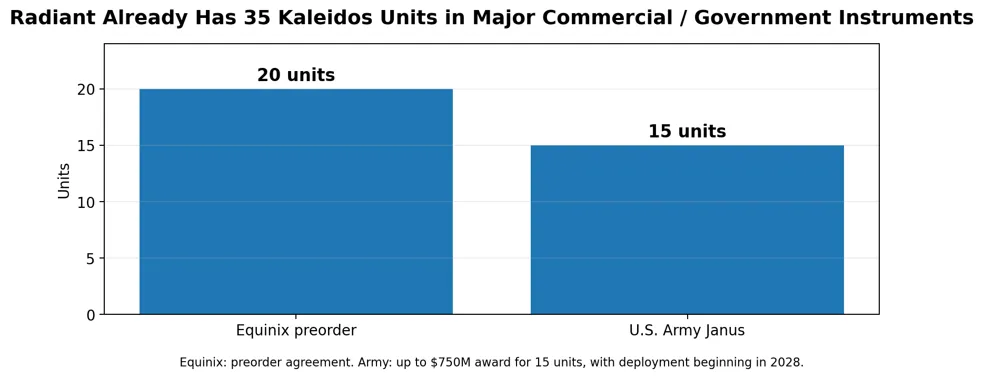
This does not mean all 35 units are identical in commercial status. The Equinix instrument is a preorder agreement, while the Army award is a milestone-based government deployment contract. For market intelligence, that distinction matters: disclosed unit counts should be separated into binding orders, funded government awards, preorders, MOUs and feasibility studies rather than aggregated into one pipeline number.
The Army Is Creating a Multi-Vendor Industrialization Program
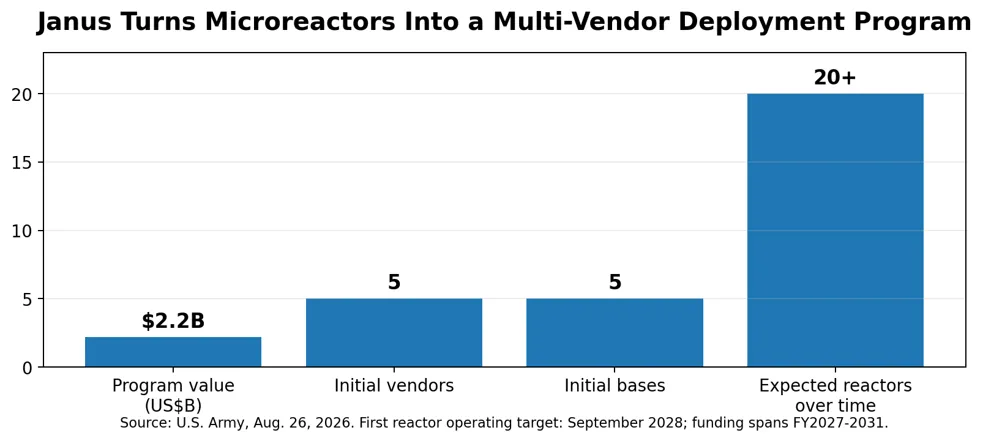
The U.S. Army’s Janus program is broader than a single demonstration. In August 2026, the Army selected Antares Nuclear, BWXT Advanced Technologies, General Atomics Electromagnetic Systems, Radiant and Westinghouse Government Services, each paired with an initial military installation. The program provides up to $2.2 billion across FY2027-FY2031 and expects more than 20 microreactors across Department of War installations over time.
Request a Customized Report According to Your Business Strategy: https://www.datamintelligence.com/customize/micro-nuclear-reactors-market
The timetable should be read carefully. September 2028 is the target for the first Army-regulated reactor to be operating on a military installation. It is not a deadline for all 20+ reactors. This phased structure is commercially important because each operating unit can create a reference site, regulatory record and manufacturing-learning cycle that developers can carry into commercial data-center, industrial and remote-power markets.
Microreactor Commercialization Is Building in Layers
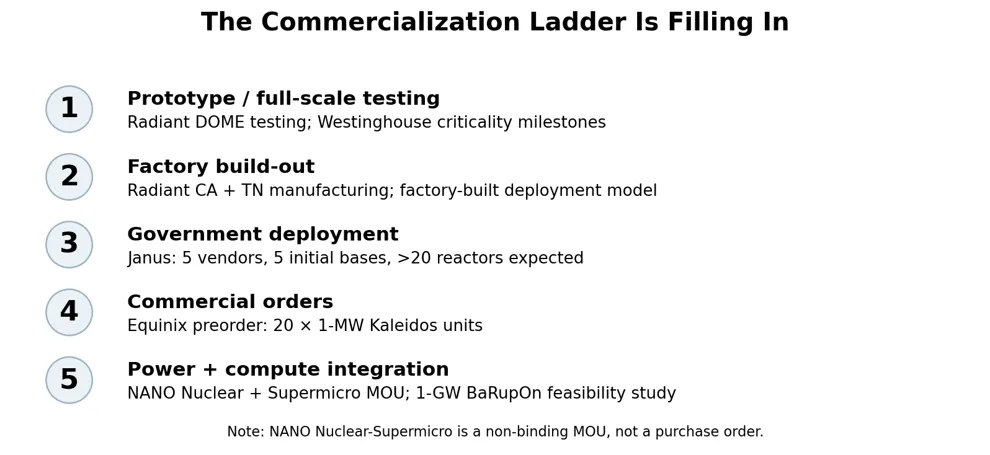
The market is now developing across five layers at once: full-scale testing, factory capacity, military deployment, commercial preorders and infrastructure integration. That is different from earlier cycles in which reactor developers could point to design work but had limited evidence of manufacturing infrastructure or customer-backed deployment paths.
Data Centers Are Becoming a Distinct Commercial Pull
Data-center demand is increasingly shaping reactor product strategy. Equinix’s 20-unit Radiant preorder is the clearest disclosed unit purchase in this segment. NANO Nuclear and Supermicro, meanwhile, signed a May 2026 MOU to explore integration of microreactors with AI servers, cooling systems and data-center infrastructure. The companies describe a potential architecture for self-powered and grid-independent AI infrastructure, but the MOU is exploratory and should not be treated as a binding equipment order.
NANO Nuclear separately completed a feasibility study for BaRupOn evaluating a staged path toward 1 GW of KRONOS MMR-supplied power for an AI data-center and manufacturing campus in Texas. Again, this is a feasibility-stage opportunity rather than booked reactor revenue, but it shows the size of the power loads developers are now designing around.
The Fuel Chain Is Moving Into the Commercial Equation
Production scale is not just a reactor-factory problem. Radiant signed a multi-year contract with Centrus in September 2026 for domestic HALEU supply to support multiple Kaleidos deployments, with deliveries expected before the end of the decade. Radiant has also disclosed additional fuel-supply arrangements and plans to fuel reactors at its Oak Ridge site. As order books grow, HALEU availability, TRISO fabrication, transport and refueling logistics become direct determinants of delivery capacity.
Commercial Signals That Matter for the Microreactor Report
| Signal | What to Track | Why It Matters |
| Order quality | Binding order vs preorder vs MOU vs study | Separates bankable demand from early-stage pipeline |
| Factory readiness | Output capacity, fueling, test assets, workforce | Determines whether order books can convert into deliveries |
| Deployment milestones | First criticality, license, first site, fleet ramp | Shows where technical risk is being removed |
| Fuel security | HALEU, TRISO, fabrication and transport contracts | Can become the binding constraint even after reactor design matures |
Why This Changes the Microreactor Investment Thesis
The commercial question is no longer whether microreactors can attract interest. The harder question is which developers can simultaneously clear four bottlenecks: licensed reactor performance, factory throughput, assured nuclear fuel and customer-specific project execution. A developer that clears only one or two of those gates may still have a compelling technology, but it does not yet have a repeatable product business.
Radiant’s 2026 progression is therefore strategically important because manufacturing capex, Army deployment, commercial preorder demand and fuel contracting are beginning to converge around the same product. Westinghouse is also reducing technical risk through eVinci criticality testing and Army selection, while NANO Nuclear is building a data-center integration pipeline. The sector is still early, but the evidence base is becoming measurable enough to compare vendors on industrial readiness rather than concept maturity alone.
What Buyers Need From a Micro Nuclear Reactors Report
A useful report should go beyond reactor design descriptions. Buyers need a project-level view of who has committed capital, which plants are under construction, annual production assumptions, license status, fuel suppliers, government awards, commercial order instruments, customer applications, first-power dates, unit economics, ownership models and site-by-site deployment risk. The difference between a 20-unit preorder and a non-binding MOU can be more important than a headline pipeline total.
For data-center, defense, mining and remote-power buyers, the most valuable intelligence is therefore the conversion funnel from prototype to operating fleet: test milestone -> manufacturing readiness -> fuel security -> license -> customer contract -> first deployment -> repeat production. That is where the next competitive separation in microreactors is likely to occur.