


Oncology Commercialization & Biosimilar Strategy Perspective
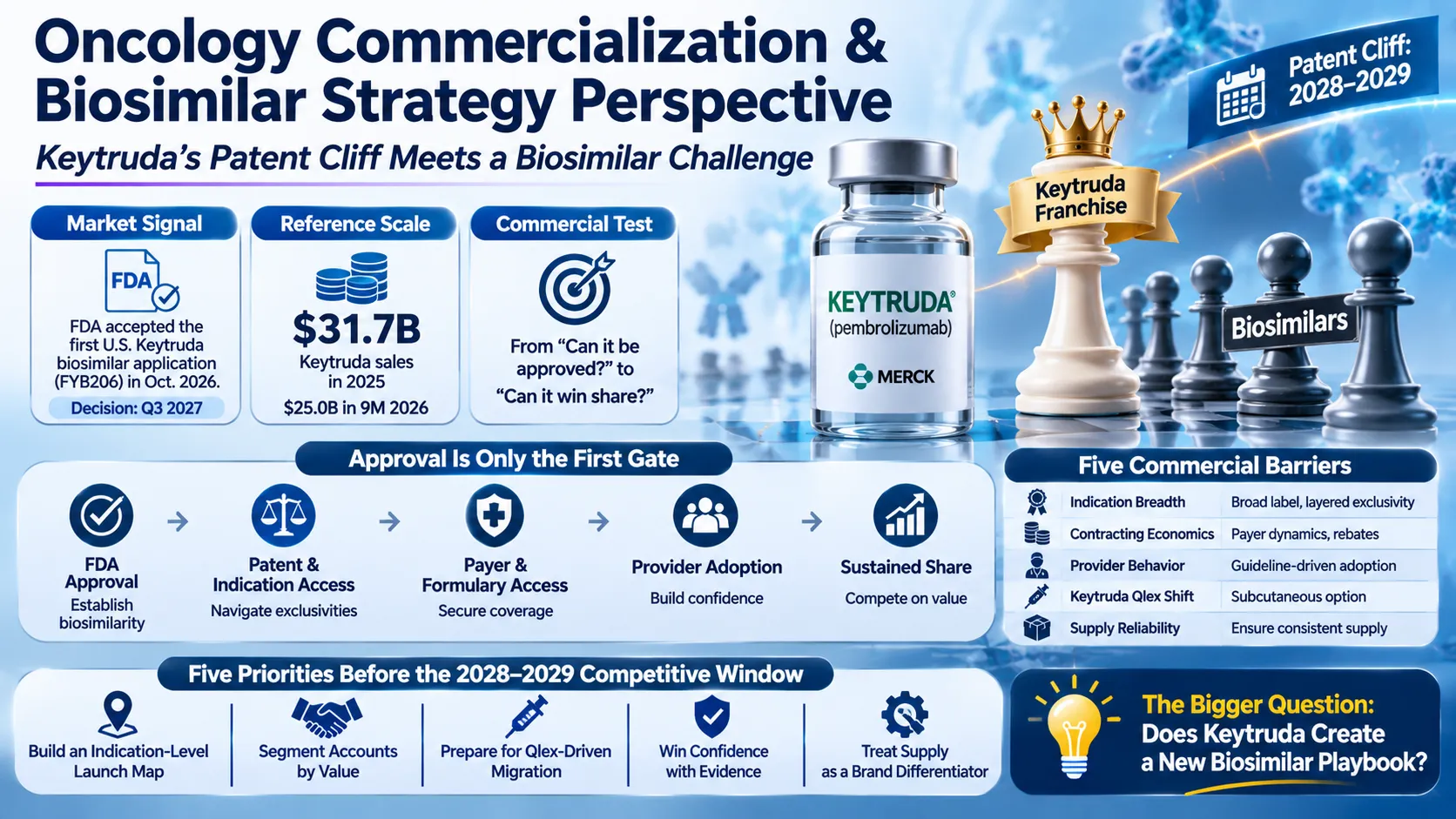
| MARKET SIGNAL | FDA accepted the first publicly announced U.S. application for a proposed Keytruda biosimilar in October 2026. A decision on FYB206 could come in Q3 2027. |
| REFERENCE SCALE | Keytruda and Keytruda Qlex generated $31.7 billion in 2025 sales. Merck reported another $25.0 billion during the first nine months of 2026. |
| COMMERCIAL TEST | The biosimilar challenge is moving from “Can it be approved?” to “Can it win formulary access, provider adoption and share from an entrenched oncology franchise?” |
The Patent Cliff Is Real. The Market Cliff Is Less Certain.
Keytruda is approaching one of the most consequential loss-of-exclusivity events in biopharma. Merck says biosimilar competition could begin as early as December 2028 in the United States, while two composition-of-matter patents expire in May and November 2029. The company expects the franchise to be materially affected by biosimilar competition across 2028 and 2029.
The first serious test is already moving through FDA. Formycon and Zydus announced on October 13, 2026 that FDA accepted the BLA for FYB206, their proposed pembrolizumab biosimilar. The program followed a pathway agreed with FDA that did not require a comparative Phase III efficacy trial. Under the current review timeline, a decision could arrive in the third quarter of 2027.
That accelerates the regulatory clock. It does not guarantee rapid commercial substitution. Keytruda is embedded across dozens of tumor settings, health-system pathways and oncology purchasing relationships. For biosimilar developers, the harder question may be how much of that commercial infrastructure can actually be displaced.
Request Executive Sample: https://www.datamintelligence.com/download-sample/oncology-biosimilars-market
Why This Is Not a Normal Biosimilar Launch
The reference product is still growing while the biosimilar field is preparing to enter. Merck reported $8.6 billion in Keytruda/Keytruda Qlex sales in Q3 2026, including $830 million from the subcutaneous Keytruda Qlex formulation. That means incoming biosimilars are not chasing a static IV franchise. They may be entering as Merck shifts part of the treatment experience toward a newer administration format.
Approval Is Only the First Gate
| FDA APPROVAL | PATENT & INDICATION ACCESS | PAYER & FORMULARY ACCESS | PROVIDER ADOPTION | SUSTAINED SHARE |
Establish biosimilarity and label scope | Navigate litigation, exclusivities and carve-outs | Secure coverage under medical benefit and institutional pathways | Build confidence among oncologists and health systems | Compete on net cost, supply reliability and workflow fit |
Five Commercial Barriers Could Decide Who Actually Wins Share
| Barrier | Why it matters | What could slow adoption | What biosimilar companies need to solve |
| Indication breadth | Keytruda spans a very broad oncology label. Some uses can remain protected by orphan or other exclusivity. | A biosimilar may launch with a narrower practical addressable market than the headline Keytruda franchise suggests. | Map indication-by-indication access, exclusivity and litigation risk before commercial forecasting. |
Contracting and formulary economics | Oncology biologics are influenced by payer medical-benefit policy, health-system formularies, GPOs and network economics. | A lower list price alone may not overcome established contracts, rebates or provider economics. | Build net-price scenarios and account-level contracting strategies before launch. |
| Provider switching behavior | Cancer treatment is protocol-driven and physician confidence matters. | Hospitals may prefer to wait for stronger real-world experience or clear payer direction. | Invest in medical education, switching evidence and account-level clinical engagement. |
| Reference-product evolution | Keytruda Qlex is already shifting part of the franchise toward subcutaneous administration. | A biosimilar designed around IV pembrolizumab may compete with a moving reference experience. | Model the future treatment workflow, not only today's reference formulation. |
| Supply reliability | Large oncology systems need predictable supply across multiple indications and sites. | A discount loses value if supply interruptions create treatment or inventory risk. | Treat manufacturing resilience and service levels as commercial differentiators. |
PBMs Matter - but Oncology Has a Wider Gatekeeper Map
The current biosimilar debate often focuses on PBMs and rebate structures. Those incentives matter across the U.S. drug market, but pembrolizumab is primarily an oncology-administered biologic. Market access therefore depends on a broader group of decision makers: commercial and Medicare payers, health systems, integrated delivery networks, oncology practices, GPOs, specialty distributors and hospital pharmacy and therapeutics committees.
FDA has been trying to reduce the development burden for biosimilars. In 2025 and 2026 the agency advanced guidance intended to reduce unnecessary comparative efficacy studies and make interchangeability easier. The economic problem is that regulatory efficiency does not automatically create utilization. FDA has noted that biologics account for roughly 5% of prescriptions but 51% of U.S. drug spending, while biosimilar market share remains below 20%.
For Keytruda biosimilars, that gap between regulatory approval and commercial adoption is likely to become the central strategic issue.
Merck Is Already Changing the Battlefield
Merck is not waiting for the patent cliff. The company is expanding the Keytruda franchise into earlier-stage cancers and growing Keytruda Qlex, its subcutaneous formulation. Qlex generated $830 million in Q3 2026, up from $463 million in Q2 as physician and patient adoption increased.
That creates an important strategic asymmetry. A biosimilar competitor may achieve analytical and pharmacokinetic similarity to pembrolizumab while still entering a market where the incumbent has changed administration convenience, broadened earlier-stage use and deepened provider familiarity.
The launch strategy therefore cannot be built around price alone. It needs to identify where IV use remains structurally sticky, where Qlex changes the equation and where health systems have the strongest financial reason to move volume.
Five Priorities Before the 2028-2029 Competitive Window
| Priority | Why it matters | Commercial question |
Build an indication-level launch map | Not every Keytruda indication will become equally accessible at the same time. | Which tumors can be targeted immediately and which remain constrained by exclusivity or litigation? |
Segment accounts by switching economics | Health systems differ in reimbursement, contracting and buy-and-bill incentives. | Where does a lower net acquisition cost create a genuine institutional benefit? |
| Prepare for Qlex-driven migration | The reference franchise is shifting toward a subcutaneous option. | Which settings will remain IV-heavy enough for biosimilar displacement? |
Win confidence before price competition peaks | Oncologists and formulary committees need trust in continuity of care. | What evidence and service model will make switching operationally comfortable? |
| Treat supply as part of the brand | High-volume oncology centers cannot tolerate unreliable availability. | Can the launch support national-scale demand without creating allocation risk? |
Request a Customized Report According to Your Business Strategy: https://www.datamintelligence.com/customize/oncology-biosimilars-market
The Bigger Question: Does Keytruda Create a New Biosimilar Playbook?
FYB206 could become an important regulatory precedent because its development program moved forward without a comparative Phase III efficacy trial. If FDA approval arrives on the expected timeline, other pembrolizumab biosimilar developers may gain greater confidence in a more analytics- and PK-led development model.
But the bigger precedent may be commercial. Keytruda is too large, too clinically broad and too deeply embedded in oncology workflows for a biosimilar launch to be judged only by approval date and discount level. The winners will need to combine regulatory execution with indication strategy, payer access, institutional contracting, physician adoption and reliable supply.
The first Keytruda biosimilar may prove that approval can be accelerated. The market will decide whether adoption can be accelerated too.