


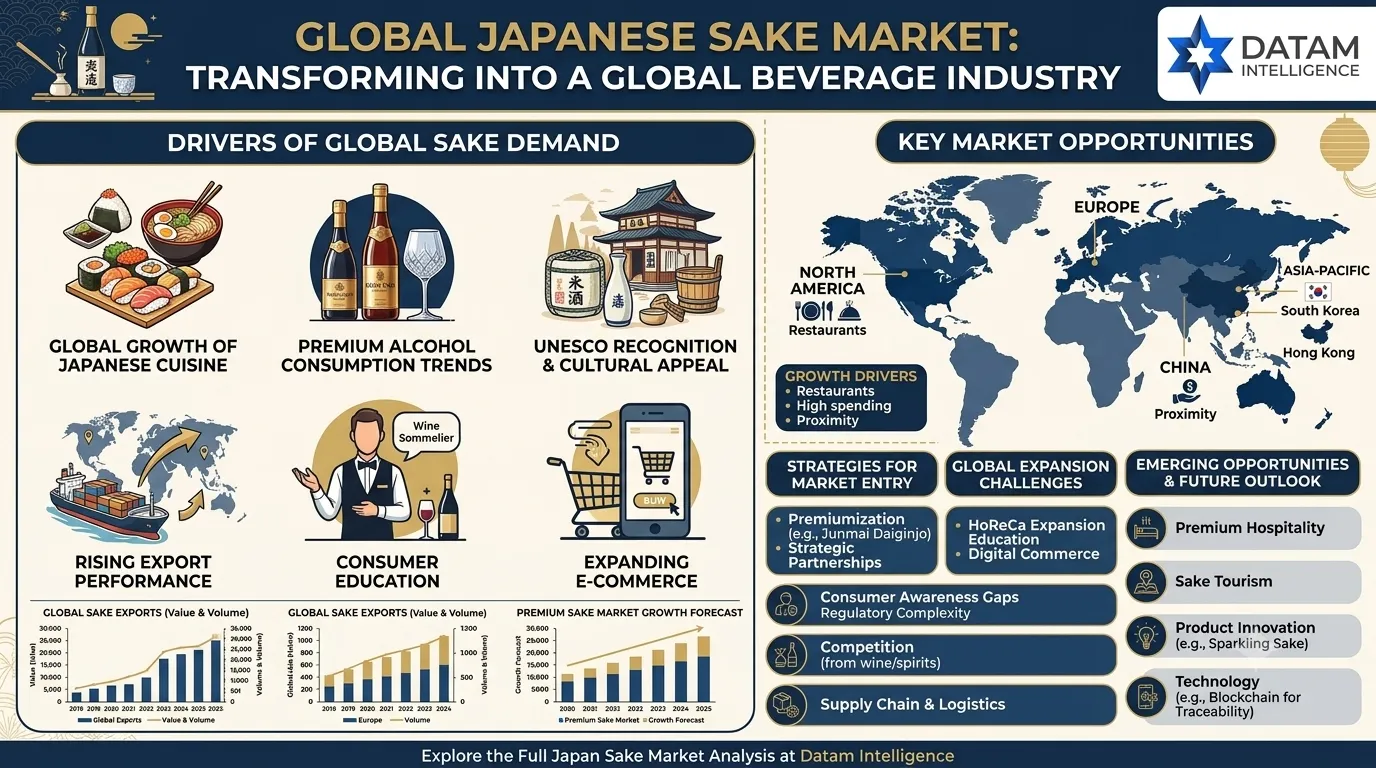
For centuries, sake has been deeply embedded in Japanese culture, traditions, and celebrations. Today, however, Japanese sake brands are transforming from domestic heritage producers into global beverage companies. As consumer demand for premium, authentic, and culturally rich alcoholic beverages continues to rise, sake is finding new audiences across North America, Europe, Southeast Asia, and emerging international markets.
The global sake market industry is experiencing a significant shift. Export growth, premiumization, digital commerce, and strategic partnerships are enabling Japanese breweries to reach consumers far beyond Japan's borders. According to industry data, sake exports have expanded across more than 80 countries, with strong growth recorded in the United States, Canada, the United Kingdom, France, Australia, and South Korea.
For beverage companies, distributors, investors, and hospitality businesses, understanding how Japanese sake brands are entering and scaling in international markets offers valuable insights into future growth opportunities.
Explore the Full Japan Sake Market Analysis
Gain deeper insights into market size, growth forecasts, export trends, competitive landscape, distribution channels, consumer behavior, and investment opportunities in the Japan sake industry.
Access the comprehensive Japan Sake Market report to evaluate emerging opportunities, regional growth trends, and strategic expansion pathways shaping the future of the global sake industry. Click here to Request Sample Report Now!
Why Global Demand for Japanese Sake Is Rising
The global demand for Japanese sake is growing steadily as international consumers increasingly embrace premium alcoholic beverages, authentic cultural experiences, and diverse dining options. What was once considered a traditional Japanese beverage consumed primarily within Japan is now gaining recognition in global markets as a premium product that combines heritage, craftsmanship, and unique flavor profiles. Several market forces are driving this expansion, creating new opportunities for sake producers, distributors, retailers, and investors.
Growth of Japanese Cuisine Worldwide
The worldwide popularity of Japanese cuisine has become one of the strongest catalysts for sake market growth. The expansion of sushi restaurants, ramen chains, izakayas, fine-dining establishments, and Japanese fusion concepts has introduced sake to a broader consumer base across North America, Europe, and Asia-Pacific. For many consumers, restaurant experiences serve as their first introduction to sake, often leading to future purchases through retail stores and online platforms.
Key growth drivers include:
- Rapid expansion of Japanese restaurants and food service chains globally
- Increased consumer exposure to sake through authentic dining experiences
- Growing popularity of Japanese food culture among younger consumers
- Rising adoption of sake pairings in fine dining and hospitality sectors
- Expansion of fusion cuisine that incorporates sake into non-traditional dining experiences
Premium Alcohol Consumption Trends
Global consumers are increasingly shifting toward premium alcoholic beverages that offer authenticity, craftsmanship, and unique production stories. Similar to premium wine, craft beer, and artisanal spirits, sake benefits from growing consumer interest in high-quality beverages with strong cultural heritage and production expertise.
Premium sake categories such as Junmai, Ginjo, and Daiginjo are particularly appealing to consumers seeking differentiated drinking experiences. The focus on traditional brewing techniques, carefully selected ingredients, and regional craftsmanship aligns well with broader premiumization trends across the beverage industry.
Factors supporting premium sake demand include:
- Rising consumer preference for premium and super-premium alcoholic beverages
- Growing appreciation for artisanal and craft production methods
- Increased demand for authentic cultural products and experiences
- Higher spending among consumers seeking quality over quantity
- Strong interest in premium beverage categories among younger demographics
UNESCO Recognition Strengthening Cultural Appeal
The international recognition of traditional Japanese sake brewing practices has enhanced the beverage's global reputation and cultural value. Recognition of sake's historical and cultural significance helps position it as more than just an alcoholic beverage—it becomes a representation of Japanese heritage, craftsmanship, and tradition.
This cultural prestige strengthens consumer interest, particularly among audiences seeking authentic products with meaningful stories and historical significance. As cultural tourism and global appreciation for Japanese traditions continue to grow, sake is benefiting from increased visibility and stronger premium positioning.
Benefits of cultural recognition include:
- Enhanced global awareness of traditional sake brewing methods
- Stronger premium positioning in international markets
- Increased consumer trust in product authenticity and quality
- Greater appeal among consumers interested in cultural and heritage products
- Improved brand storytelling opportunities for sake producers
Rising Export Performance
Growing export performance demonstrates the increasing acceptance of sake in international markets. Japanese sake exports have expanded significantly over the past decade, supported by stronger distribution networks, increased consumer awareness, and rising demand for premium imported beverages.
Markets such as the United States, Canada, the United Kingdom, France, Germany, South Korea, and Australia have emerged as important growth destinations. The increase in export value is particularly notable, indicating strong demand for premium and higher-margin sake products rather than volume-driven growth alone.
Key export growth indicators include:
- Rising export volumes across major international markets
- Strong growth in export value driven by premium product demand
- Expanding distribution partnerships worldwide
- Increased presence in retail, hospitality, and e-commerce channels
- Growing consumer acceptance of sake as a premium global beverage
Together, these factors are transforming sake from a domestically focused beverage into a globally recognized premium alcohol category. As consumer awareness continues to increase and international distribution networks expand, Japanese sake brands are expected to capture significant growth opportunities across established and emerging global markets.
Key Global Market Entry Strategies Used by Japanese Sake Brands
As competition intensifies in the global premium beverage industry, Japanese sake producers are adopting sophisticated market entry strategies to build international brand recognition, expand distribution networks, and capture new consumer segments. Rather than relying solely on exports, leading breweries are investing in premium positioning, strategic partnerships, consumer education, and digital commerce to establish a sustainable presence in international markets. These approaches are helping sake evolve from a niche cultural product into a globally recognized premium alcoholic beverage category.
1. Premiumization as a Global Growth Strategy
Premiumization has become one of the most effective strategies for Japanese sake brands seeking international growth. Instead of competing with mass-market alcoholic beverages on price, many producers are focusing on high-value product categories that emphasize quality, craftsmanship, heritage, and exclusivity.
Global consumers increasingly associate premium products with authenticity and superior production standards, making sake well-positioned to benefit from broader premium beverage trends. By highlighting traditional brewing methods, regional identities, and limited production capabilities, sake brands can command higher price points while strengthening their brand equity.
Key premiumization strategies include:
- Expanding premium and super-premium categories such as Junmai Ginjo and Junmai Daiginjo
- Launching limited-edition and seasonal sake collections
- Promoting artisanal and craft brewing techniques
- Differentiating products based on regional brewing traditions and terroir
- Investing in luxury packaging, bottle design, and premium branding
- Positioning sake alongside premium wines, whiskies, and craft spirits
Premiumization not only improves profitability through higher margins but also attracts consumers seeking unique and culturally authentic drinking experiences.
2. Strategic Distribution Partnerships
Successfully entering international markets requires strong local market knowledge, regulatory expertise, and established distribution infrastructure. To overcome these challenges, Japanese sake producers increasingly form strategic partnerships with regional distributors, importers, hospitality operators, and retail organizations.
These partnerships enable brands to accelerate market penetration while reducing the operational complexities associated with entering new geographies. Local partners also provide valuable insights into consumer preferences, purchasing behavior, and regulatory compliance requirements.
Common distribution partnerships include:
- Beverage importers specializing in premium alcohol products
- National and regional alcohol distributors
- Japanese and Asian restaurant groups
- Hospitality and hotel operators
- Luxury retailers and specialty beverage stores
- Duty-free and travel retail channels
By leveraging established distribution ecosystems, sake producers can improve product availability, strengthen brand visibility, and enhance market access across multiple regions.
3. Restaurant and HoReCa Channel Expansion
For many Japanese sake brands, the hospitality sector serves as the primary gateway to international markets. Hotels, restaurants, cafés, bars, and catering businesses (HoReCa) provide an ideal environment for introducing sake to consumers who may be unfamiliar with the category.
Restaurant-based consumption allows consumers to experience sake alongside professionally curated food pairings, helping overcome barriers related to product awareness and consumption habits. Premium dining environments also reinforce sake's positioning as a sophisticated and high-quality beverage.
Benefits of HoReCa-focused expansion include:
- Greater consumer education through sommeliers and beverage specialists
- Enhanced food pairing opportunities that highlight sake's versatility
- Stronger premium and luxury brand positioning
- Increased visibility among high-spending consumer segments
- Higher-value consumption occasions and repeat purchase potential
- Opportunities to build brand credibility before entering retail channels
Fine-dining establishments, luxury hotels, and upscale Japanese restaurants continue to play a critical role in shaping consumer perceptions and driving global adoption of sake.
4. Consumer Education and Brand Storytelling
Unlike wine, beer, or spirits, sake remains a relatively unfamiliar category for many international consumers. As a result, education has become a fundamental component of successful market expansion strategies.
Leading sake producers recognize that consumer awareness directly influences purchasing decisions. Many brands invest heavily in educational initiatives designed to explain brewing methods, flavor profiles, serving styles, and food pairing opportunities. At the same time, storytelling helps communicate the cultural heritage and craftsmanship that differentiate sake from competing beverage categories.
Popular consumer engagement initiatives include:
- Guided tasting events and product demonstrations
- Professional masterclasses and certification programs
- Partnerships with sommeliers and beverage experts
- Food and sake pairing experiences
- Cultural marketing campaigns highlighting Japanese traditions
- Brewery heritage storytelling and brand history content
- Educational content distributed through digital channels
These initiatives help build consumer confidence, improve product understanding, and strengthen long-term brand loyalty in international markets.
5. E-Commerce and Digital Commerce Expansion
Digital transformation is becoming increasingly important for sake producers seeking global growth. E-commerce platforms provide direct access to consumers, allowing brands to expand beyond traditional retail limitations and reach new audiences more efficiently.
The rise of online alcohol sales, specialty beverage marketplaces, and social commerce platforms has created additional opportunities for sake brands to increase visibility and generate sales in markets where physical distribution networks may still be developing.
Key digital growth strategies include:
- Direct-to-consumer (DTC) online sales platforms
- Partnerships with specialty alcohol e-commerce marketplaces
- Distribution through major online retailers
- Subscription-based sake discovery programs
- Digital marketing and influencer collaborations
- Social commerce campaigns targeting younger consumers
- Virtual tasting events and online educational experiences
Digital channels also provide valuable consumer insights, enabling producers to better understand purchasing behavior, optimize marketing strategies, and identify emerging market opportunities.
Which Global Markets Offer the Biggest Opportunities for Japanese Sake Brands?
The global expansion of Japanese sake is being driven by strong demand across developed and emerging markets, where consumers are increasingly exploring premium alcoholic beverages with cultural authenticity and unique production stories. While Japan remains the traditional center of sake production, international markets are becoming increasingly important growth engines for breweries seeking revenue diversification and long-term expansion.
Leading opportunities are emerging across North America, Europe, and Asia-Pacific, supported by expanding Japanese cuisine, premium beverage consumption trends, stronger distribution networks, and growing consumer awareness of sake categories. From an investment and business perspective, markets with high purchasing power, established hospitality sectors, and increasing demand for imported premium beverages are expected to remain key growth destinations.
United States: The Largest Strategic Growth Market for Japanese Sake
The United States represents one of the most attractive and strategically important markets for Japanese sake producers. The country has witnessed increasing consumer acceptance of sake, supported by the rapid expansion of Japanese restaurants, sushi establishments, luxury dining experiences, and premium alcohol consumption trends.
Sake adoption in the U.S. is moving beyond traditional Japanese restaurants, with growing availability in specialty beverage stores, online platforms, and high-end hospitality venues. Consumers are increasingly exploring sake as a premium alternative to wine and spirits, particularly among younger and affluent demographics seeking unique beverage experiences.
Key growth drivers in the U.S. market include:
- Expansion of Japanese cuisine and sushi restaurant networks
- Rising consumer preference for premium and craft alcoholic beverages
- High purchasing power and willingness to experiment with imported beverages
- Growing adoption of sake in fine dining and luxury hospitality segments
- Increased availability through retail and e-commerce distribution channels
- Rising interest in Japanese culture, food, and lifestyle products
Analyst Perspective:
The United States is expected to remain a priority market for Japanese sake brands due to its combination of strong consumer spending, mature alcohol distribution infrastructure, and growing demand for premium imported beverages. Brands that invest in consumer education, restaurant partnerships, and localized marketing strategies are likely to achieve stronger market penetration.
Europe: Growing Demand for Premium and Craft Beverage Experiences
Europe is emerging as a high-potential market for Japanese sake, driven by increasing interest in premium beverages, culinary experiences, and craft alcohol categories. European consumers have a strong appreciation for products with heritage, craftsmanship, and regional identity, making sake well aligned with existing premium beverage trends.
Countries such as the United Kingdom, France, Germany, and the Netherlands are becoming important markets due to their sophisticated food cultures, expanding Asian restaurant sectors, and established premium alcohol consumption patterns.
Sake is increasingly being introduced through Michelin-starred restaurants, luxury hotels, specialty alcohol retailers, and beverage pairing programs, helping improve consumer awareness and acceptance.
Key growth opportunities in Europe include:
- Growing demand for premium and artisanal alcoholic beverages
- Increasing popularity of Japanese cuisine and culinary tourism
- Strong restaurant and hospitality sector adoption
- Rising interest in food and beverage pairing experiences
- Expansion of specialty importers and premium alcohol retailers
- Growing consumer preference for authentic international products
Analyst Perspective:
Europe presents significant long-term growth potential for premium sake producers. The region's established appreciation for wine culture and craft beverages creates favorable conditions for sake brands that focus on education, premium positioning, and storytelling around Japanese brewing traditions.
South Korea: A Fast-Growing Asian Market Opportunity
South Korea has emerged as one of the fastest-growing international markets for Japanese sake, supported by geographic proximity, cultural connections, and increasing consumer interest in premium alcoholic beverages.
The country's strong Japanese food culture, expanding restaurant sector, and growing demand for imported premium beverages are creating favorable conditions for sake market expansion. Japanese dining concepts, including sushi restaurants, izakayas, and premium Japanese-style bars, continue to introduce sake to new consumer segments.
Key market growth drivers include:
- Strong consumer familiarity with Japanese cuisine and culture
- Increasing demand for premium imported alcoholic beverages
- Expansion of Japanese restaurants and hospitality concepts
- Growing interest in high-quality and specialty beverages
- Improved availability through retail and online channels
Analyst Perspective:
South Korea offers strategic advantages for Japanese sake producers due to its geographic proximity, consumer familiarity, and strong cultural connection with Japan. The market provides opportunities for both established premium brands and emerging craft sake producers seeking regional expansion.
China and Hong Kong: Opportunities in Premium Luxury Beverage Segments
China and Hong Kong continue to represent important opportunities for Japanese sake exporters, particularly within the premium and luxury beverage segments. Despite fluctuations caused by economic conditions, consumer sentiment, and trade-related challenges, demand remains strong among affluent consumers seeking imported and high-quality alcoholic beverages.
Hong Kong's position as an international trading hub and luxury consumption center makes it an important gateway for premium sake brands entering broader Asian markets. Similarly, China's growing affluent consumer base continues to create opportunities for premium Japanese beverage products.
Key growth opportunities include:
- Strong demand for luxury and imported alcoholic beverages
- Growing interest among affluent consumers in premium Japanese products
- Expansion of Japanese restaurants and luxury hospitality venues
- Increasing adoption of premium sake in gifting and social occasions
- Opportunities through high-end retail and specialty distributors
Analyst Perspective:
China and Hong Kong remain strategically valuable markets for Japanese sake brands targeting premium consumers. While market conditions require careful localization and regulatory planning, long-term opportunities remain attractive due to strong demand for Japanese craftsmanship, luxury beverages, and authentic cultural products.
Challenges Facing Global Sake Expansion
Despite the strong growth potential of the global sake market, Japanese producers face several challenges as they expand into international markets. Unlike established alcoholic beverage categories such as wine, beer, and spirits, sake requires significant consumer education, market development, and operational investment to achieve widespread adoption.
Successful global expansion depends not only on increasing product availability but also on building consumer understanding, navigating regulatory environments, creating effective distribution networks, and differentiating sake in an increasingly competitive premium beverage landscape.
Consumer Awareness and Education Gaps
One of the primary challenges facing Japanese sake brands in international markets is limited consumer awareness and understanding of the product category. While sake has gained recognition globally, many consumers remain unfamiliar with its different varieties, flavor profiles, brewing methods, and appropriate serving styles.
Unlike wine or whiskey, where consumers often have established knowledge of regions, classifications, and tasting characteristics, sake requires additional education to communicate its unique value proposition.
Key consumer education challenges include:
- Limited awareness of different sake categories such as Junmai, Ginjo, and Daiginjo
- Lack of familiarity with serving temperatures and consumption styles
- Limited understanding of flavor profiles and quality differences
- Need for greater awareness of sake and food pairing opportunities
- Misconceptions that sake is a single beverage category rather than a diverse product segment
To overcome these barriers, leading sake producers are investing in tasting events, educational programs, sommelier partnerships, digital content, and hospitality training initiatives. Building consumer knowledge will remain essential for driving repeat purchases and long-term category growth.
Regulatory Complexity Across International Markets
Expanding into global markets requires sake producers to navigate complex and varying alcohol regulations across different countries and regions. Each market has unique requirements related to product labeling, taxation, import licensing, distribution permissions, and alcohol marketing restrictions.
These regulatory differences can increase operational costs and create challenges for smaller breweries with limited international experience.
Major regulatory challenges include:
- Differences in alcohol import regulations across countries
- Complex labeling and packaging requirements
- Import duties and taxation policies
- Licensing requirements for distributors and retailers
- Compliance with local alcohol advertising regulations
- Changing government policies affecting beverage imports
Developing strong partnerships with experienced importers and regional distributors is becoming increasingly important for sake brands seeking efficient market entry and regulatory compliance.
Competition from Established Premium Alcohol Categories
Japanese sake operates within a highly competitive global alcoholic beverage market, where established categories such as wine, craft beer, whiskey, and premium spirits already have strong consumer loyalty and brand recognition.
While sake offers unique cultural and production advantages, it must compete for consumer attention and spending within the broader premium beverage segment.
Competitive challenges include:
- Strong brand loyalty toward established alcohol categories
- Limited shelf space in international retail channels
- Consumer preference for familiar beverage formats
- Competition from rapidly growing craft beverage segments
- Need to justify premium pricing compared with other luxury beverages
To differentiate themselves, sake brands must emphasize their unique attributes, including traditional brewing heritage, Japanese craftsmanship, regional identity, and versatility in food pairing. Effective storytelling and brand positioning will be critical in establishing sake as a premium global beverage category.
Supply Chain and Distribution Challenges
Maintaining product quality while expanding internationally presents significant supply chain challenges for sake producers. Sake is a delicate product that requires careful handling, storage conditions, and efficient logistics management to preserve freshness and quality.
As brands expand into distant markets, investments in supply chain infrastructure become increasingly important.
Key operational challenges include:
- Managing transportation and logistics costs
- Maintaining product quality during international shipping
- Developing cold-chain capabilities for premium sake varieties
- Ensuring consistent product availability across markets
- Building reliable relationships with international distributors
- Managing inventory across multiple regions
For premium sake brands, supply chain efficiency is particularly important because product quality directly influences consumer perception and brand reputation.
Emerging Opportunities for Investors and Businesses in the Global Sake Market
The future growth potential of the global sake industry extends beyond traditional beverage consumption. As international demand continues to rise, new opportunities are emerging across hospitality, tourism, product innovation, and technology-driven value creation. Investors, beverage companies, distributors, and entrepreneurs are increasingly exploring the broader sake ecosystem, where premium experiences, digital transformation, and evolving consumer preferences are creating new avenues for growth.
Japanese sake is transitioning from a traditional alcoholic beverage into a premium lifestyle product, supported by changing consumer behavior and increasing demand for authentic, experience-based offerings.
Premium Hospitality: Expanding Sake Experiences in Luxury Segments
The hospitality industry is becoming an important growth channel for premium sake brands. Luxury hotels, resorts, Michelin-starred restaurants, and high-end dining establishments are increasingly incorporating sake into curated beverage programs to enhance guest experiences and differentiate their offerings.
Sake is being positioned alongside premium wines, whiskies, and craft spirits as a sophisticated beverage choice that complements fine dining experiences. Beverage directors and sommeliers are increasingly exploring sake pairings with diverse cuisines, helping introduce the category to affluent international consumers.
Key opportunities in premium hospitality include:
- Integration of premium sake selections in luxury hotels and resorts
- Expansion of sake pairing menus in fine-dining restaurants
- Collaboration between breweries and hospitality brands
- Development of exclusive sake collections for luxury consumers
- Increased demand for trained sake specialists and sommeliers
- Growth of premium beverage experiences for high-value customers
Analyst Perspective:
The hospitality sector offers a strategic pathway for sake brands to build awareness and establish premium positioning. By creating memorable consumption experiences, brands can strengthen consumer engagement and encourage long-term loyalty.
Sake Tourism: Creating New Cultural and Experience-Based Revenue Streams
Sake tourism is emerging as a promising opportunity as global travelers increasingly seek authentic cultural experiences. Similar to wine tourism in regions such as France, Italy, and California, sake brewery visits are becoming an attractive part of Japan's cultural tourism ecosystem.
Visitors are showing growing interest in exploring traditional breweries, learning about brewing techniques, participating in tastings, and experiencing the heritage behind Japanese sake production.
Growth opportunities in sake tourism include:
- Brewery tours and guided tasting experiences
- Cultural workshops focused on traditional brewing methods
- Regional tourism programs connecting breweries with local food experiences
- Premium travel packages combining cuisine, culture, and sake
- International marketing of Japanese brewing regions
Analyst Perspective:
Sake tourism provides breweries with opportunities to generate additional revenue streams while strengthening brand storytelling. These experiences create deeper emotional connections between consumers and producers, supporting premium pricing and global brand recognition.
Craft and Sparkling Sake Innovation: Expanding Consumer Appeal
Product innovation is becoming a key growth driver as sake producers seek to attract younger consumers and expand beyond traditional customer segments. New product formats, flavor profiles, and modern branding approaches are helping introduce sake to audiences who may not traditionally consume the beverage.
Sparkling sake, fruit-infused varieties, low-alcohol options, and innovative packaging formats are gaining attention among consumers interested in lighter, more accessible, and experience-driven beverages.
Key innovation trends include:
- Development of sparkling sake products
- Introduction of modern flavor variations
- Creation of lower-alcohol and approachable sake options
- Premium limited-edition product launches
- Modern packaging and branding strategies
- Targeted marketing toward younger and international consumers
Analyst Perspective:
Innovation will play a critical role in expanding sake's consumer base globally. By balancing traditional craftsmanship with modern product development, producers can attract new demographics while maintaining the authenticity that differentiates sake from other alcoholic beverages.
Technology and Traceability: Building Trust Through Digital Transformation
Technology adoption is becoming increasingly important as sake producers expand internationally and respond to growing consumer expectations around transparency, quality, and sustainability.
Breweries are increasingly implementing digital solutions to improve production efficiency, monitor quality standards, enhance supply chain visibility, and communicate product authenticity to global consumers.
Technology-driven opportunities include:
- Digital quality control systems for brewing consistency
- Blockchain and traceability solutions for product authentication
- Supply chain monitoring and transparency tools
- Sustainability tracking and resource management
- Digital platforms for consumer engagement and education
- Data-driven insights for international market expansion
These technologies help producers strengthen consumer trust, particularly in overseas markets where buyers increasingly value information about product origin, production methods, and sustainability practices.
Analyst Perspective: The Future of Global Sake Expansion
The internationalization of sake represents one of the most significant transformations in the global alcoholic beverage industry. While domestic consumption in Japan has faced long-term challenges, export growth and premiumization are creating a new growth engine for producers.
Brands that successfully combine traditional craftsmanship with modern distribution, consumer education, and digital engagement strategies are likely to capture the greatest share of future demand. As premium beverage consumers continue seeking authentic and culturally meaningful experiences, Japanese sake is well positioned to expand its global footprint across both mature and emerging markets.