


Sake Market Size and Growth
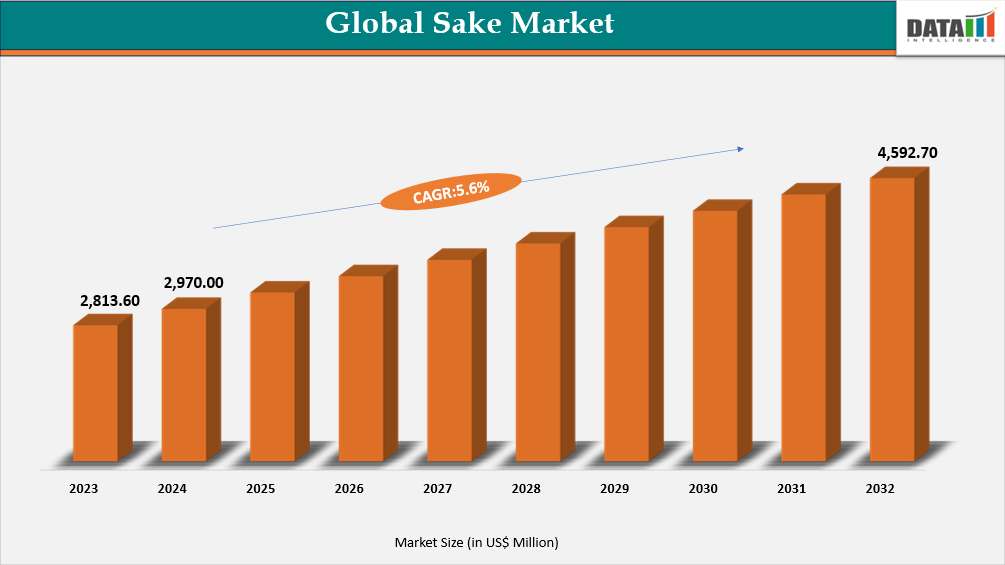
Global Sake Market size reached US$ 3,135.2 million in 2025 and is expected to reach US$ 5,162.7 million by 2033, growing at a CAGR of 5.6% during the forecast period 2026-2033.
The global sake market is undergoing a significant structural shift, moving from a traditionally Japan-centric category to a rapidly expanding international segment.
This momentum strengthened further, when sake exports increased by 6% in both value and volume, reaching ¥43.5 billion and extending distribution to a record 80 countries. Growth has been particularly strong in the UK, US, and Germany, where brands such as Akashi-Tai report robust performance, including a 42% rise in total sales, an 83% increase in on-trade placements, and an 88% surge in sparkling sake demand in the UK, highlighting the accelerating shift in consumption toward international markets.
Industry organizations such as the Japan Sake & Shochu Makers Association (JSS) and the Sake Brewers Association of North America (SBANA) are playing a pivotal role in sustaining this growth. Through sommelier partnerships, trade fairs, masterclasses, Sake Week activations, and targeted education programs in emerging European markets, these groups are improving trade expertise, facilitating menu integration, and enhancing consumer understanding of sake’s styles and quality distinctions, supporting the category’s continued international expansion.
Sake Market Scope
| Metrics | Details |
| By Product Type | Junmai-shu (Pure Rice Sake), Honjozo-shu, Ginjo-shu, Futsu-shu (Table Sake), Sparkling Sake, Aged Sake (Koshu), Other Specialty Types |
| By Rice Polishing Ratio | Ultra-Premium (≤ 50%), Premium (51%–60%), Mid-Range (61%–70%), Standard (≥ 71%) |
| By Packaging Format | Glass Bottles, PET Bottles, Cans, Cartons / Tetra Packs, Others |
| By Distribution Channel | On-Trade (HoReCa), Off-Trade (Retail), E-commerce, Institutional / B2B |
| By End Consumer | Traditional Consumption, Restaurant & Hospitality Use, Gifting & Ceremonial Use, Mixology / Cocktails, Culinary Use |
| By Region | North America, South America, Europe, Asia-Pacific, Middle East and Africa |
| Report Insights Covered | Competitive Landscape Analysis, Company Profile Analysis, Market Size, Share, Growth |
Explore the Future of the Sake Market
Get a comprehensive sample report covering Sake Market trends, product innovations, competitive landscape, application insights, consumer preferences, and growth opportunities. Request your sample today to understand the factors shaping the next generation of the global sake industry. Request Sample Report Today!
Sake Market Dynamics
Rapid Expansion of International Demand
Rapid growth in international demand has become the primary driver of the global sake market, offsetting Japan’s domestic decline. In 2024, exports rose 6% year-on-year to ¥43.5 billion, with 3.45 million cases shipped worldwide at an average price of ¥1,050 per 750 ml. This expansion occurred despite Asia’s 3% overall decline, driven by weakening consumption in China, where imports fell 8.11% in volume and 6.32% in value, alongside declines in Hong Kong (–13.43% volume; –15.06% value) and Taiwan (–6.9% volume).
Growth is now being led by North America, Europe, and select Asia-Pacific markets. The US delivered strong gains with a 23.08% increase in volume and 25.86% increase in value, supported by rising adoption in fine-dining channels. Other markets also reported substantial expansion, including Canada (+38.07% volume; +37.93% value), Australia (+27.44% volume; +21.38% value), France (+17.86% volume; +12.97% value), and the UK (+4.96% volume; +17.16% value).
Consumer interest is strengthening rapidly in Europe, evidenced by a 1,000% surge in sake sales reported by Berry Bros. & Rudd and a 214% increase in online searches at Waitrose. Meanwhile, South Korea stands out in Asia with 16.77% volume growth and 29.09% value growth, highlighting robust premiumization in the market.
Sake Market Segmentation Analysis
The global sake market is segmented based on product type, rice polishing ratio, packaging format, distribution channel, end-consumer and region.
Junmai-shu ((Pure Rice Sake) Leads the Global Market with 35.65% Share Due to Its Pure Rice Composition and Growing Preference for Authentic, Additive-Free Sake
Global demand for Junmai-shu is rising rapidly as consumers increasingly seek purity, authenticity, and craftsmanship in premium alcoholic beverages. Junmai-shu, produced solely from rice, water, koji, and yeast, aligns closely with global preferences for clean-label, additive-free, and naturally crafted drinks. This has positioned pure-rice sake as the fastest-growing segment within premium sake categories, especially in mature markets such as North America, Western Europe, South Korea, and Singapore, where consumers and sommeliers value its umami richness, food-pairing versatility, and wine-like complexity.
Junmai’s alignment with sustainability, provenance, and terroir-driven positioning has strengthened its role as the fastest-growing premium segment. Breweries are leveraging eco-friendly production, limited editions, and cultural storytelling to differentiate in export markets and appeal to high-value consumer segments.
In April 2025, Kojima Sohonten strengthened this momentum with the launch of Toko AIGAMO, brewed from pesticide-free Dewa Sansan rice cultivated using the solar-powered Aigamo Robo. Supported by its carbon-neutral, all-Junmai transition since 2020, the brewery achieved 1.5× export growth vs. 2019 and secured the 2024 IWC top award, reinforcing demand for sustainably produced Junmai.
Similarly, in November 2025, Niizawa Sake Brewery advanced the ultra-premium segment with NIIZAWA Junmai Daiginjo 2025 and KIZASHI 2025, both crafted with an exceptional 7% polishing ratio. Featuring exclusive ARTLOGUE-selected label artworks, these limited editions strengthened Niizawa’s luxury positioning and highlighted how artistic collaboration and precision brewing are expanding global interest in high-end Junmai-shu.
Honjozo-shu Holds a Strong Market Share Owing to Its Smooth Flavor and Wider Consumer Appeal for Light, Easy-to-Drink Sake
Honjozo-shu holds a leading share in the global sake market due to its smooth, light-bodied profile that appeals to both traditional drinkers and new consumers seeking easy-to-drink alcoholic options. Its balanced flavor and lower rice-polishing requirements make it more affordable to produce and distribute, helping it penetrate diverse markets worldwide. The style’s versatility across casual dining, bars, and mixology further strengthens its global presence. As demand rises for approachable premium sake, Honjozo-shu remains the preferred choice for mainstream consumers.
Sake Market Geographical Penetration
DOMINATING MARKET:
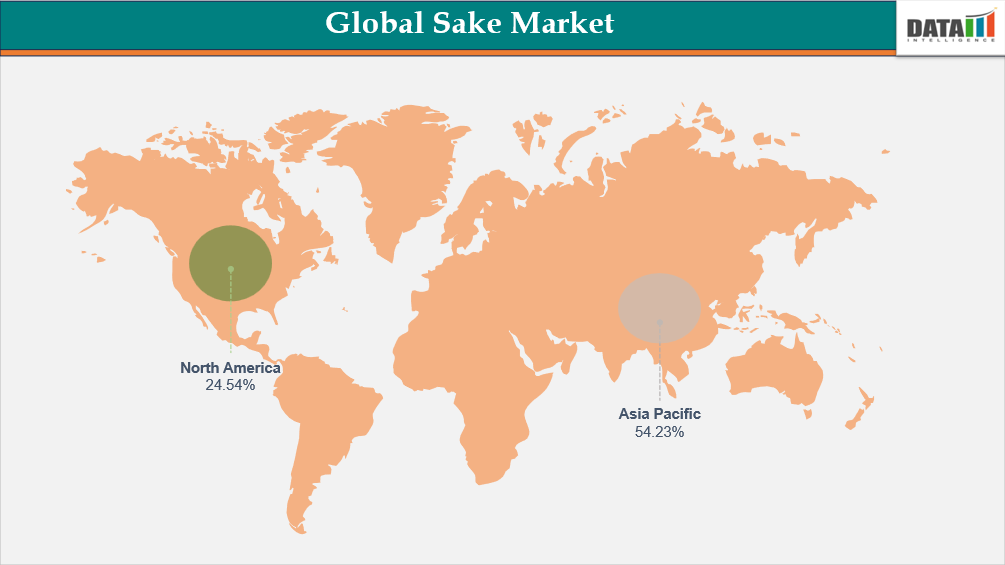
Asia-Pacific Leads the Global Sake Market with 54.23% Share Due to Its Strong Cultural Roots and Expanding Regional Production & Consumption Base
The Asia-Pacific region remains the largest export destination for Japanese sake, accounting for 61% of total export value, but demand has grown increasingly uneven across markets.
In contrast, South Korea has emerged as the strongest growth market in Asia with continued growth into 2024. Demand is supported by a depreciated yen, growing cultural affinity among younger consumers, and the rapid expansion of Japanese-style pubs and modern dining concepts. This positions South Korea as a key driver of regional demand and a critical counterbalance to Greater China’s contraction.
India Sake Market Outlook
India’s sake market is emerging rapidly as rising urbanization, premium alcohol demand, and global culinary exposure boost consumer interest. The category is still niche, but growing popularity among young adults and upscale restaurants is expanding its footprint.
Japan Sake Market Trends
Japan’s sake market remains culturally significant despite a long-term decline in domestic consumption, with volumes now at only 24% of their historical peak, according to the Japan Sake and Shochu Association (JSS). Even with this slowdown, sake maintains a strong presence in Japanese dining traditions and premium food culture. Per capita adult consumption stands at 3.8 liters, surpassing wine at 3.2 liters, showing its continued preference over similar beverages. The market is also experiencing renewed attention globally following UNESCO’s recognition of traditional brewing techniques. As international demand rises, Japan’s producers are increasingly focusing on premiumization and export-driven growth to sustain the sector.
FASTEST GROWING MARKET:
North America Holds a Growing Share in the Global Sake Market Driven by Rising Premium Alcohol Demand and Expanding Japanese Dining Culture
North America is capturing a growing share of the global sake market as consumers increasingly seek premium, authentic, and globally inspired alcoholic beverages. The expanding Japanese restaurant scene, along with rising interest in craft and artisanal drinks, has significantly boosted sake visibility across major cities. Younger consumers and mixologists are also experimenting with sake-based cocktails, further widening its appeal. Strong import activity and retail availability, supported by cultural events and tasting programs, continue to accelerate market penetration. As a result, North America is steadily emerging as one of the fastest-growing sake-consuming regions worldwide.
US Sake Market Insights
The US sake market is expanding rapidly as consumers embrace premium, craft, and innovative beverage options across restaurants, retail, and mixology. Rising Japanese cuisine popularity and broader acceptance of low-ABV and alternative drinks are driving demand nationwide. In December 2024, Arkansas-based Origami Sake launched ZERO, the first non-alcoholic sake in the US, highlighting the market’s shift toward inclusive, modern sake experiences. This innovation reflects growing domestic production, supported by the country’s strong rice supply and artisanal brewing culture. As imports surge and local brands scale, the US is becoming one of the fastest-growing and most influential sake markets globally.
Canada Sake Market Industry Growth
Canada’s sake market is gradually expanding as consumers show increasing interest in premium Asian beverages and multicultural dining experiences. Growing availability in liquor stores, Japanese restaurants, and specialty retailers is boosting consumer exposure and trial. The market benefits from rising demand for low-ABV, smooth, and versatile alcoholic options suited for both drinking and food pairing. With imports increasing and local craft experimentation beginning to emerge, Canada is becoming a promising secondary growth market for sake in North America.
Regulatory Analysis
Regulation in Japan is anchored in the Liquor Tax Act, which strictly defines Junmai, Ginjo, and Daiginjo categories based on rice-polishing ratios, ingredient purity, and brewing methods. Expansion of certified Geographical Indications such as Nadagogo, Harima, and Yamagata has strengthened provenance controls, requiring proof of regional water sources, rice origin, and local production. Export-bound sake must meet Japan’s tightened certification requirements covering polishing ratio, koji usage, pasteurization method, and ingredient accuracy.
In the US, regulatory pressure has intensified following the 2024–2025 tariff shift that raised duties on imported sake to 15%, directly affecting pricing. The TTB’s COLA approval enforces detailed labeling, including koji disclosure, Junmai purity requirements, allergen statements, and specific storage instructions for unpasteurized nama sake. Importers must also comply with FSMA traceability and foreign facility registration, with certain states imposing strict cold-chain rules for premium and raw styles.
The European Union enforces some of the strictest standards globally, including mandatory energy and ingredient labeling for all alcoholic beverages and legally protecting “Nihonshu” as a GI restricted to Japan. EU customs apply rigorous chemical testing for preservatives, pesticide residues, and ABV accuracy, while markets such as France and Germany require validated cold-chain documentation for sake to mitigate microbiological risks.
Across Asia, regulatory environments vary but heavily influence market entry. China applies GB standards with pre-approved Chinese labeling and heightened inspections following geopolitical tensions and seafood-related restrictions. South Korea’s layered liquor taxes and mandatory labeling of rice origin and bottling dates elevate compliance costs, while Singapore maintains transparent GI rules but high-value documentation standards. Southeast Asian markets—including Thailand, Malaysia, and Indonesia, add excise, advertising, and controlled-distribution requirements that importers must navigate to scale sake penetration.
Sake Market Competitive Landscape
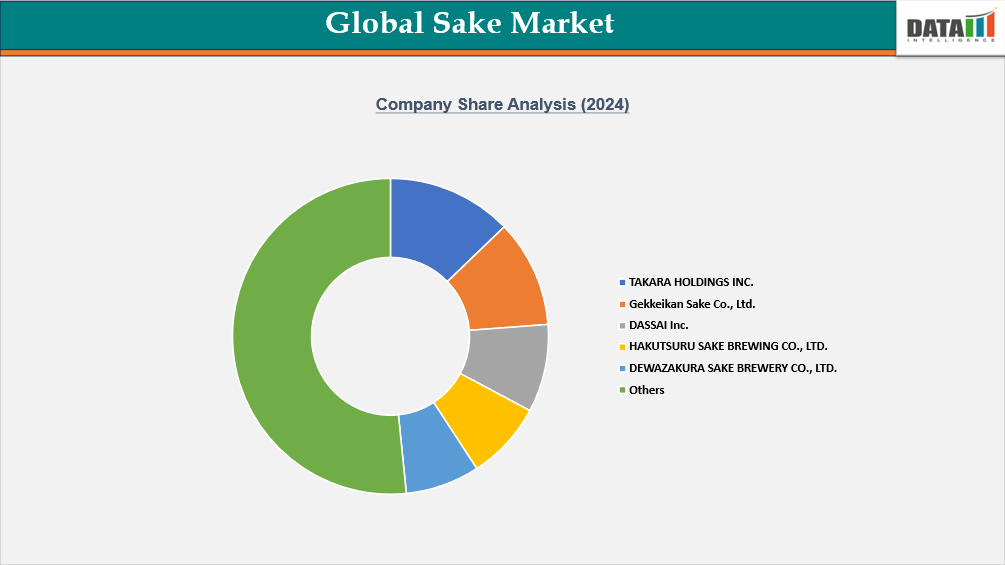
- The global sake market is fragmented, shaped primarily by craftsmanship, regional provenance, and premium quality differentiation rather than large-scale industrial innovation.
- Key players such as TAKARA HOLDINGS INC., Gekkeikan Sake Co., Ltd., DASSAI Inc., HAKUTSURU SAKE BREWING CO., LTD. and DEWAZAKURA SAKE BREWERY CO., LTD. dominate the market through strong R&D capabilities and diversified application portfolios.
- “Breweries are increasingly emphasizing authenticity, traditional brewing methods, and region-specific craftsmanship to meet rising consumer demand for premium, provenance-driven sake.
- Rising export collaborations and distribution partnerships in North America and Europe are intensifying competition as breweries work to secure market access and expand their global footprint.
Key Developments in Sake Market
June 2026: Hakutsuru Sake Brewing Co. launched “HAKUTSURU SAKE CRAFT No.19 Cacao,” a limited-edition sake developed by fermenting sweet-style Junmai Daiginjo mash with cacao mass. The company tested cacao from multiple origins before selecting Dominican cacao to achieve a balance between chocolate-like aroma and sake characteristics.
April 2026: Hakutsuru Sake Brewing Co. began operating a newly established dedicated paper-pack bottling facility, designed to strengthen production capabilities and expand contract filling services. The facility represents an investment in specialized sake packaging and manufacturing infrastructure.
- March 2026: Gekkeikan Co. launched “Gekkeikan Studio no.7,” an experimental sake applying research into lactone aroma compounds and oak-barrel maturation. The product combines fruity sake-derived aromas with aromas from charred oak, demonstrating continued experimentation in sake flavor engineering.
Sake Market Investment & Funding Landscape
Investment and funding in the sake market have increasingly gravitated toward premiumization, export expansion, and craft‑brewing innovation. Investors are backing small‑scale domestic breweries and artisanal sake makers to meet growing global and niche demand. Capital is also flowing into supply‑chain improvements, such as modernization of bottling, cold‑chain logistics, and quality‑preservation infrastructure — to support export ambitions.
| Company | Investment/Funding | Year | Details | |
| Clear (Operator of SAKE HUNDRED & SAKETIMES) | Funding | March, 2025 | Clear raised new funding led by HIRAC FUND, with additional investment from SMBC Venture Capital, bringing total funds to 2.44 billion yen (US$16 million). The investment will support SAKE HUNDRED’s accelerated global expansion through executive hiring, overseas promotions, and international pairing events. The brand has rapidly grown its presence across Asia and beyond, contributing to the rise of high-end sake, with its flagship product driving an increase in premium offerings industry-wide. | |
What Sets This Global Sake Market Intelligence Report Apart
- Latest Data & Forecasts – Comprehensive, up-to-date insights and projections through 2032. Coverage includes global value by product type, rice polishing ratio, packaging format, distribution channel, and end-consumer segments. Scenario forecasts with region-level splits (North America, Europe, Asia-Pacific, South America, Middle East and Africa) and sensitivity to factors such as regulatory reclassification and raw-material costs.
- Regulatory Intelligence – Actionable analysis of regulatory frameworks that materially affect sake commercialization, revenue by country, allowable label claims, permitted doses, import/export controls and advertising restrictions.
- Competitive Benchmarking – Standardized profiling and benchmarking of leading pharma and nutraceutical players, contract manufacturers and e-commerce specialists active in the market.
- Geographic & Emerging Market Coverage – Region-by-region market sizing, growth drivers, reimbursement dynamics, cultural/consumer behavior and market access considerations. Focus on high-growth or regulatory-uncertain markets.
- Actionable Strategies – Identify opportunities for launching innovative products, while leveraging strategic partnerships and supply chain integration for maximum ROI.
- Pricing & Cost Analysis – In-depth assessment of price trends, raw material costs and sustainability-driven cost efficiencies across regional markets.
- Expert Analysis – Insights from industry experts such as clinical sleep specialists, regulatory affairs professionals and key manufacturing companies.
Why Choose DataM?
Technological Innovations: Explores advancements in sake brewing, quality-control, analytical, and production technologies, including precision control of rice polishing, koji cultivation, fermentation management, yeast selection, brewing-water analysis, filtration, pasteurization, and sensory evaluation, highlighting how technology and scientific research support consistency, product quality, flavor development, and production efficiency. Research from Japan’s National Research Institute of Brewing (NRIB) also covers metabolomic analysis and the relationship between brewing variables and sensory characteristics.
Product Performance & Market Positioning: Evaluates sake products based on key characteristics such as rice variety, polishing ratio, koji and yeast selection, brewing water, fermentation conditions, flavor profile, alcohol content, maturation, and product style, helping stakeholders understand differentiation across premium, specialty, traditional, and mainstream sake offerings. The Japan Sake and Shochu Makers Association notes that rice polishing, water, koji, yeast, and fermentation temperature can significantly influence the resulting sake profile.
Real-World Evidence: Highlights the application and commercialization of sake across breweries, restaurants, hospitality, specialty beverage retailers, food-service channels, and international markets, with attention to product preservation, premiumization, food pairing, brewery tourism, and export development. Japan's National Tax Agency maintains official statistics and industry surveys covering sake producers, transactions, and exports.
Market Updates & Industry Changes: Tracks developments across sake production, brewing research, product innovation, export activity, international promotion, distribution, and changing consumer access to Japanese alcoholic beverages. Official Japanese government resources provide updated information on sake exports, export destinations, industry conditions, international promotion, and market-development initiatives.
Competitive Strategies: Analyzes how breweries and sake producers strengthen their market position through product differentiation, premium sake development, distinctive brewing techniques, yeast and rice selection, quality management, export expansion, international promotion, distribution partnerships, and direct engagement with consumers through brewery experiences and tourism.
Pricing & Market Access: Examines pricing differences associated with rice variety, polishing ratio, production methods, product category, maturation, packaging, brand positioning, distribution channel, and market destination. The report also assesses market access through breweries, wholesalers, specialty retailers, restaurants, hospitality businesses, e-commerce channels, importers, distributors, and international beverage networks. The relationship between rice polishing and production yield is specifically recognized as an important factor influencing sake pricing.
Market Entry & Expansion: Identifies opportunities arising from international interest in Japanese sake, export-market development, premium and specialty product positioning, food-service adoption, tourism-related experiences, and expansion of distribution networks. It also evaluates strategies such as localized product positioning, importer and distributor partnerships, international promotion, brewery tourism, and portfolio diversification to support entry into emerging markets. Japan's National Tax Agency publishes official resources covering international promotion, export trends, export destinations, and brewery-tourism initiatives.
Target Audience
- Sake Breweries & Sake Producers
- Rice Growers & Sake Rice Suppliers
- Koji & Sake Yeast Suppliers
- Alcoholic Beverage Manufacturers & Distributors
- Importers, Wholesalers & Specialty Beverage Retailers
- Restaurants, Hotels & Food-Service Operators
- Beverage Investors & Market Expansion Companies



























































