


Japan Electronics Market at a Strategic Inflection Point
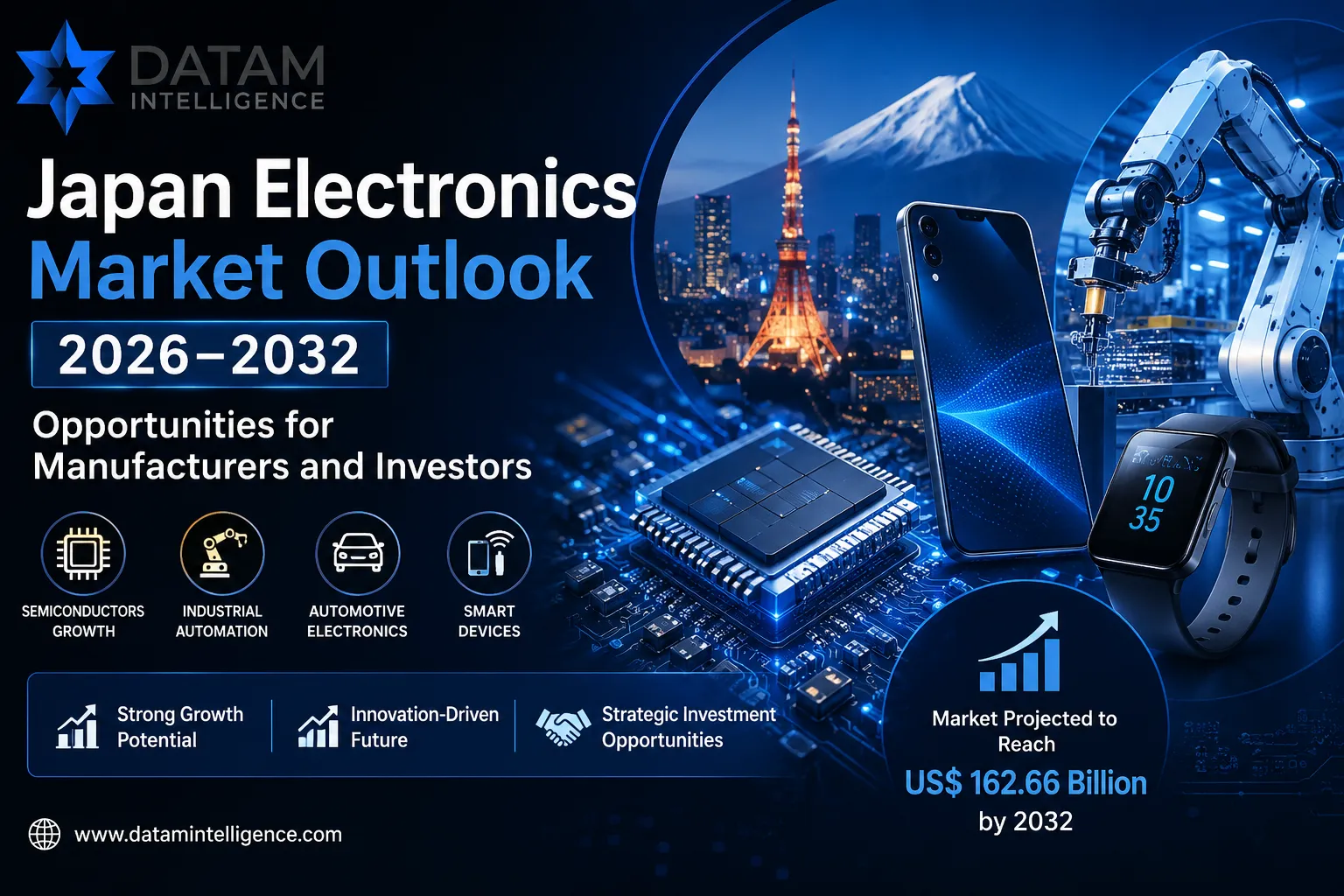
The Japan electronics market is entering a transformative growth phase driven by semiconductor demand, AI-enabled manufacturing, automotive electronics expansion, and next-generation consumer devices. Valued at over US$116 billion in 2024, the market is projected to exceed US$162.66 billion by 2032, supported by steady innovation and strong export competitiveness.
Japan remains a global powerhouse in precision electronics manufacturing, high-end semiconductors, robotics, sensors, and consumer electronics innovation, making it a critical hub for investors, OEMs, and global supply chain stakeholders.
Recent macroeconomic and industrial trends including AI infrastructure expansion, global chip shortages, EV electrification, and IoT adoption are reshaping Japan’s electronics ecosystem and unlocking long-term investment opportunities.
What’s Covered in the Report
- Overview of the Japan Electronics Market
- Market size, growth trends, and forecast analysis
- Key drivers, challenges, and opportunities
- Segmentation by product type and application
- Competitive landscape and key market players
- Regulatory and industry insights
- Impact of technology advancements and innovation trends
- Regional and country-level analysis within Japan
Download Free Sample Research Report
Japan Electronics Market Overview (2026 - 2032 Forecast)
The Japan electronics industry is characterized by a mature yet rapidly evolving ecosystem.
Key highlights:
- Market Size (2024): US$116.15 billion
- Projected Market Size (2032): US$162.66 billion
- CAGR (2025–2032): ~4.3%
- Fastest-growing segments: Consumer electronics, semiconductors, IoT devices
- Dominant segment: Semiconductors & electronic components
Japan’s electronics sector is deeply integrated with automotive, industrial automation, telecommunications, healthcare devices, and smart infrastructure systems, making it a foundational pillar of its industrial economy.
Key Growth Drivers in the Japan Electronics Market
1. Semiconductor Demand Surge Driven by AI and EV Expansion
The semiconductor industry is the backbone of Japan’s electronics market. Growth is accelerating due to:
- AI computing infrastructure demand
- High-bandwidth memory (HBM) expansion
- Electric vehicle (EV) electronics integration
- Industrial robotics and automation systems
Japan’s semiconductor ecosystem benefits from strong global positioning in sensor technologies, image processing chips, and power electronics.
2. Expansion of Consumer Electronics & Smart Devices
Consumer electronics remain a high-value segment driven by:
- Smartphones and wearable devices
- Smart home ecosystems
- Gaming and entertainment electronics
- Next-generation foldables and AR/VR devices
The shift toward connected, intelligent, and energy-efficient devices is reshaping consumer demand patterns.
3. Industrial Automation & Robotics Leadership
Japan continues to lead in:
- Factory automation systems
- Precision robotics
- Industrial control systems
- Smart manufacturing (Industry 4.0 / Society 5.0)
This positions Japan as a global hub for advanced manufacturing electronics integration.
4. Government-Led Digital Transformation (Society 5.0)
Japan’s Society 5.0 initiative is accelerating:
- AI integration into manufacturing
- Smart cities and infrastructure
- IoT-enabled industrial ecosystems
- Green electronics and energy-efficient systems
This policy framework is significantly boosting long-term electronics investment stability.
Market Trends Shaping the Future of Japan Electronics Industry
The Japan electronics industry is undergoing a structural transformation driven by technological disruption, geopolitical realignment, and accelerating demand for intelligent, connected systems. Between 2026 and 2032, these trends are expected to redefine competitive dynamics across semiconductors, consumer electronics, automotive systems, and industrial applications. Below are the key forces shaping the market’s long-term evolution.
1. AI-Driven Semiconductor Supercycle
The global rise of artificial intelligence is triggering a new semiconductor supercycle, fundamentally reshaping demand across the electronics value chain. As AI workloads expand across cloud computing, edge devices, autonomous systems, and enterprise applications, semiconductor consumption is reaching unprecedented levels.
Key Demand Drivers:
Memory Chips (HBM, DRAM, NAND)
AI models require massive data processing capacity, significantly increasing demand for high-bandwidth memory (HBM), advanced DRAM, and high-density NAND storage. These components are essential for training and deploying large-scale AI models.
Logic ICs (CPUs, GPUs, AI Accelerators)
The growth of generative AI and machine learning is driving demand for advanced logic integrated circuits capable of handling complex computations efficiently. This includes GPUs, NPUs, and custom AI accelerators used in hyperscale data centers.
Advanced Packaging Technologies
As transistor scaling becomes more complex, advanced packaging solutions such as chiplets, 2.5D/3D integration, and heterogeneous integration are becoming critical for performance optimization and energy efficiency.
Japan’s Strategic Position:
Japan is strengthening its global leadership in semiconductor materials, precision manufacturing equipment, and advanced substrate technologies, which are essential enablers of next-generation chip production.
Impact: This supercycle is positioning Japan as a foundational supplier in the global AI semiconductor ecosystem rather than just a finished-chip producer.
2. Miniaturization & High-Precision Electronics
The demand for smaller, faster, and more energy-efficient electronics is accelerating across industries, driving innovation in miniaturized and high-precision components.
Key Growth Areas:
Compact Sensors
Sensors are becoming smaller yet more powerful, enabling applications in smartphones, industrial automation, healthcare devices, and automotive systems. Japan remains a global leader in sensor accuracy and reliability.
High-Performance Microelectronics
Advanced microelectronics are essential for high-speed computing, robotics, and industrial control systems. These components require extreme precision engineering and stable performance under demanding conditions.
Energy-Efficient Components
As sustainability becomes a global priority, demand is rising for low-power semiconductors and energy-optimized electronic systems that extend battery life and reduce heat generation.
Industry Impact:
This trend is especially critical for automotive electronics, IoT ecosystems, and smart manufacturing systems, where compact design and efficiency directly influence product competitiveness.
Impact: Japan’s expertise in precision engineering gives it a strong competitive advantage in the global shift toward miniaturized, high-efficiency electronics.
3. Premiumization of Consumer Electronics
The consumer electronics market in Japan is transitioning from mass production to value-driven innovation and premium product positioning. Rather than competing solely on volume, manufacturers are focusing on differentiation through design, quality, and advanced features.
Key Strategic Shifts:
High-End Design-Driven Devices
Japanese brands are increasingly prioritizing aesthetics, durability, and user experience, creating premium devices that appeal to global high-income consumer segments.
Luxury Consumer Electronics Segments
There is growing demand for exclusive, high-performance electronics such as premium audio systems, flagship smartphones, and high-fidelity entertainment devices.
Limited-Edition Innovation Cycles
Manufacturers are adopting shorter, innovation-driven product cycles with limited releases to enhance brand exclusivity and market excitement.
Market Impact:
This strategy reinforces Japan’s global reputation for engineering excellence, reliability, and technological sophistication, particularly in niche and premium categories.
👉 Impact: Premiumization is enabling higher profit margins and brand value expansion despite slower volume growth in mature consumer markets.
4. Supply Chain Localization & Resilience
Global supply chains are undergoing a major restructuring due to geopolitical tensions, trade restrictions, and lessons learned from recent semiconductor shortages. Japan is actively repositioning itself within a more localized and resilient electronics ecosystem.
Key Strategic Developments:
Semiconductor Production Localization
Companies are increasing investment in domestic semiconductor fabrication facilities to reduce dependency on overseas manufacturing hubs.
Supply Chain Diversification Across Asia-Pacific
Firms are building multi-country supply networks across Taiwan, South Korea, Vietnam, and India to mitigate geopolitical and logistical risks.
Expansion of Domestic Manufacturing Capacity
Japan is incentivizing local production through government subsidies and policy support, particularly in advanced semiconductor and critical electronics sectors.
Market Impact:
These changes are reshaping global supply chain architecture, with a stronger emphasis on redundancy, security, and regional self-sufficiency.
Impact: Japan is emerging as a strategic stability hub in the global electronics supply chain, especially for high-value and high-precision components.
Collectively, these trends signal a shift toward a high-value, innovation-led electronics ecosystem in Japan, characterized by AI-driven semiconductor demand, precision engineering leadership, premium consumer positioning, and resilient supply chain structures.
For investors and industry stakeholders, these transformations present long-term opportunities in advanced semiconductors, AI hardware, automotive electronics, and next-generation consumer technologies, positioning Japan as a core pillar of the global electronics economy through 2032 and beyond.
Segment Analysis: Japan Electronics Market
Semiconductor & Components Segment
- Largest market share contributor
- Driven by automotive, AI, and industrial demand
- Strong growth in power electronics and sensors
Consumer Electronics Segment
- Fastest-growing segment
- Expansion of smart devices and wearables
- High export demand in premium product categories
Industrial Electronics Segment
- Stable long-term demand
- Critical for robotics and automation systems
- Strong integration with manufacturing sector
Investment Opportunities in Japan Electronics Market
The Japan electronics market is rapidly evolving into a high-value investment ecosystem driven by semiconductor innovation, AI hardware expansion, automotive electrification, and next-generation consumer technologies. For global investors, OEMs, and technology funds, Japan offers a structurally strong environment backed by deep R&D capabilities, advanced manufacturing infrastructure, and government-led digital transformation initiatives. Below are the most attractive investment avenues shaping the sector’s long-term growth trajectory.
1. Semiconductor Manufacturing & Materials
Semiconductors remain the backbone of Japan’s electronics ecosystem and represent one of the most lucrative investment segments due to their critical role in AI, automotive, industrial automation, and consumer electronics.
High ROI Potential Areas:
Chip Fabrication Equipment
Japan is globally recognized for its precision equipment manufacturing, particularly in lithography support tools, wafer processing systems, and inspection technologies. Rising global demand for advanced chips is driving sustained capital inflows into fabrication infrastructure.
Semiconductor Materials
Japan dominates several upstream semiconductor materials, including photoresists, silicon wafers, specialty gases, and high-purity chemicals. These materials are essential for advanced chip production nodes, making this segment highly resilient and strategically important.
Advanced Packaging Solutions
With Moore’s Law slowing, advanced packaging technologies such as 2.5D/3D integration, chiplet architecture, and heterogeneous integration are becoming critical. Japan is increasingly investing in packaging innovation to support AI and high-performance computing (HPC) demand.
Investment Insight: This segment offers long-term stability with strong global dependency on Japanese supply chain inputs, making it a low-volatility, high-strategic-value investment category.
2. AI Hardware Ecosystem
Japan is positioning itself as a key enabler of the global AI infrastructure boom, particularly through high-performance computing components and intelligent hardware systems.
Key Opportunities Include:
AI Accelerators
Demand for specialized AI chips used in machine learning, generative AI, and edge computing is surging. Japan’s semiconductor firms are increasingly collaborating on high-efficiency, low-power AI accelerator technologies.
Data Center Components
The expansion of cloud computing and AI workloads is driving demand for advanced servers, cooling systems, power management units, and high-speed interconnects. Japan’s precision engineering strengths provide a competitive advantage in this space.
Memory-Intensive Computing Systems
AI workloads require high-bandwidth memory (HBM) and next-generation DRAM solutions. Japan plays a critical role in memory technology supply chains, particularly in materials and component innovation.
Investment Insight: AI hardware represents one of the fastest-growing sub-segments, with strong alignment to global hyperscaler expansion and enterprise AI adoption.
3. Automotive Electronics (EV Transition)
Japan’s automotive electronics sector is undergoing a structural transformation driven by electric vehicles (EVs), autonomous driving systems, and smart mobility technologies.
Key Growth Areas:
Power Semiconductors
These components are essential for EV power management, energy efficiency, and charging systems. Demand is accelerating due to global EV adoption and Japan’s focus on next-generation mobility platforms.
ADAS Systems (Advanced Driver Assistance Systems)
Japan is a leader in sensor-based automotive safety technologies, including radar, LiDAR integration, camera modules, and AI-driven driving assistance systems.
Battery Management Electronics
Efficient battery management systems (BMS) are critical for EV performance, safety, and lifecycle optimization. Japan’s expertise in precision electronics supports innovation in this segment.
Investment Insight: Automotive electronics offer long-term structural growth, supported by electrification mandates and global mobility transformation trends.
4. Smart Consumer Devices
Japan’s consumer electronics sector is shifting toward premiumization, connectivity, and immersive digital experiences, creating strong investment opportunities in next-generation devices.
Investment Potential Areas:
Wearables
Smartwatches, health monitoring devices, and biometric sensors are witnessing strong adoption driven by aging populations, healthcare digitization, and fitness trends.
Smart Home Devices
IoT-enabled home ecosystems, including energy management systems, security devices, and connected appliances, are expanding rapidly as consumers adopt smart living solutions.
AR/VR Hardware Platforms
Augmented reality and virtual reality technologies are gaining traction in gaming, enterprise training, and industrial applications, with Japan contributing advanced display and sensor technologies.
Investment Insight: Consumer electronics is evolving from volume-driven production to innovation-led, high-margin niche segments focused on lifestyle integration and digital experiences.
Strategic Outlook
Across all segments, Japan’s electronics industry is shifting toward high-value innovation clusters centered on semiconductors, AI infrastructure, electrification, and smart ecosystems. Investors entering this market benefit from:
- Strong government support for advanced manufacturing
- Global dependency on Japanese semiconductor materials and equipment
- High barriers to entry ensuring competitive protection
- Deep integration with global tech supply chains
Collectively, these factors position Japan as a strategic long-term investment destination in the global electronics value chain through 2032 and beyond.
Competitive Landscape: Key Industry Players
Japan’s electronics ecosystem is led by globally recognized corporations including:
- Sony Group Corporation
- Panasonic Holdings
- Mitsubishi Electric
- Toshiba Corporation
- Fujitsu
- NEC Corporation
- Murata Manufacturing
- TDK Corporation
- Keyence Corporation
These companies are heavily investing in AI, semiconductor innovation, and advanced manufacturing technologies to maintain global competitiveness.
Regional Outlook: Japan’s Role in Global Electronics Supply Chain
Japan remains a critical node in the global electronics ecosystem due to:
- Advanced semiconductor material production
- High-precision manufacturing capabilities
- Strong R&D infrastructure
- Strategic partnerships with US and Asia-Pacific tech firms
Recent trends show increased collaboration across Taiwan, South Korea, and the US semiconductor ecosystem, strengthening Japan’s global influence.
Future Outlook (2026–2032)
The Japan electronics market is expected to evolve into a high-value, innovation-driven ecosystem, characterized by:
- AI-native semiconductor manufacturing
- Fully automated smart factories
- Sustainable electronics production
- Expansion of high-margin premium electronics
By 2032, Japan will remain a global leader in precision electronics, semiconductor materials, and industrial automation systems.
Conclusion: Strategic Opportunities for Investors and Manufacturers
The Japan electronics market presents strong long-term opportunities for:
- Semiconductor investors targeting AI-driven demand cycles
- Electronics manufacturers expanding into premium device segments
- Technology firms investing in automation and robotics ecosystems
With consistent innovation, strong policy support, and global supply chain integration, Japan is positioned as a high-value electronics investment destination through 2032 and beyond.