


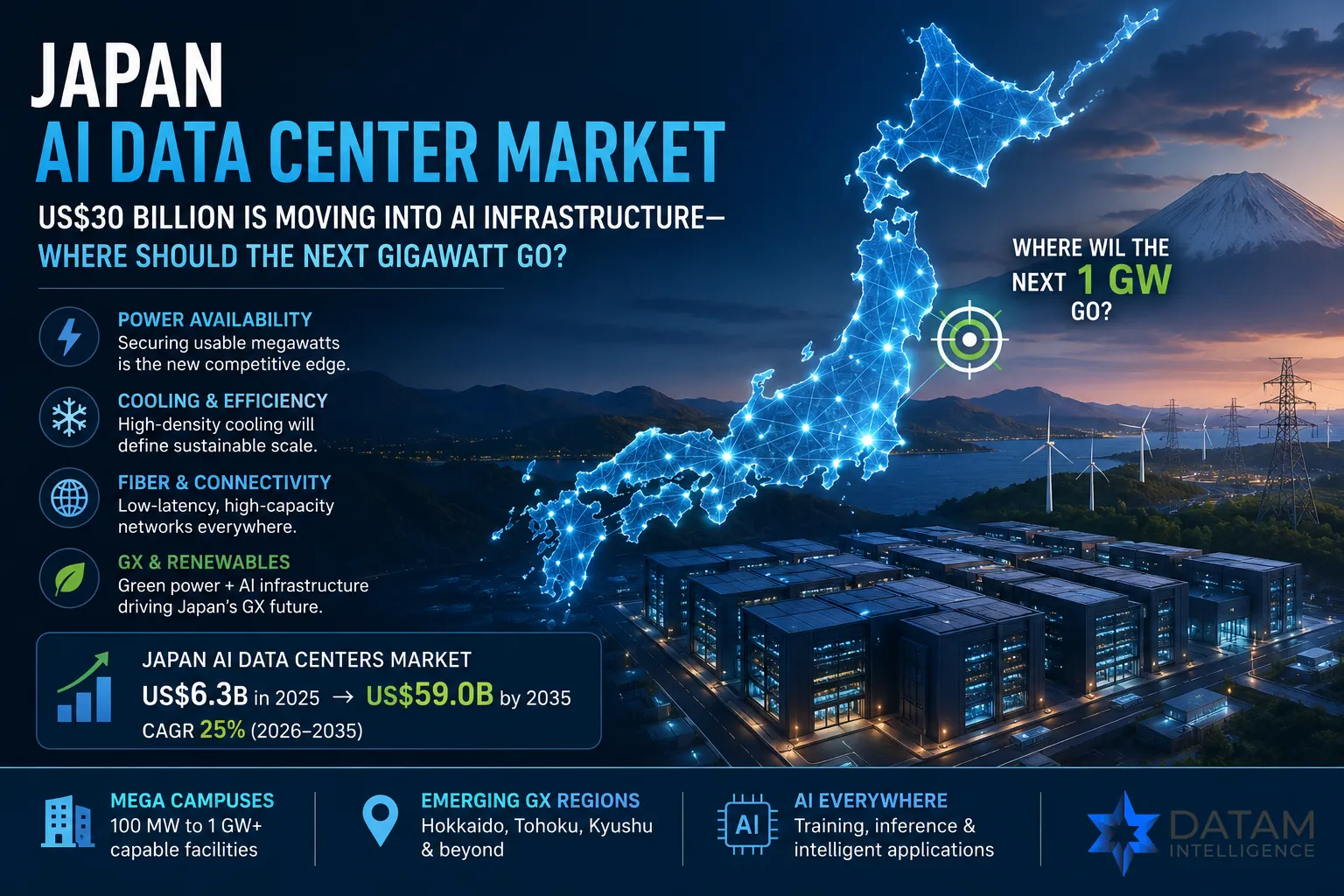
Japan’s AI Data Center Problem Is Becoming a Power-Location Problem
For years, Tokyo and particularly the wider Greater Tokyo ecosystem offered an obvious answer to data center location strategy: build close to Japan's largest concentration of enterprises, cloud users, connectivity, and digital traffic.
AI is weakening that assumption.
Large GPU clusters consume electricity at a scale that makes proximity to the customer only one variable in the location equation. Japan's government has effectively acknowledged this through its Watt-Bit Collaboration strategy, which seeks to coordinate electricity infrastructure, telecommunications networks and data center development rather than allowing all three to be planned separately.
Japan's 2025 Energy White Paper makes the underlying problem unusually clear: data centers remain concentrated around major consumption centers-particularly within roughly 50 kilometres of Otemachi-while significant renewable generation is located farther away. The policy response is increasingly based on placing energy-intensive industries closer to suitable clean-power resources and then strengthening communications infrastructure around them.
That changes the investment map.
In April 2026, METI shortlisted nine areas for the data-center-cluster category of its GX Strategic Area initiative: Hokkaido, Akita, Miyagi, Tochigi, Ibaraki, Toyama, Kagawa, Fukuoka and Kagoshima.
This should not be read simply as a regional-development program. It is an early indication of where Japan wants new electricity-intensive digital infrastructure to become technically easier to accommodate.
For developers planning 100 MW, 300 MW or eventually gigawatt-scale campuses, the site-selection question is therefore becoming:
Where can power, fiber, cooling, renewable procurement and grid expansion be secured together?
That is different from asking where land is cheapest.
Request For Exclusive Sample on Japan AI Data Center Market
Tokyo Will Remain Essential-but Not Every AI Workload Needs to Stay There
Tokyo is unlikely to lose its role as Japan's primary digital interconnection market. Financial services, enterprise inference, low-latency workloads, cloud interconnection, and corporate data will continue to support metropolitan capacity.
What could change is what Tokyo capacity is used for.
Training a frontier-scale model does not necessarily require the same physical proximity to users as real-time inference does. That opens an opportunity to separate Japan's AI infrastructure into two layers: high-value metro capacity serving latency-sensitive workloads and larger regional facilities handling energy-intensive training, batch processing, and some forms of distributed inference.
NTT is already testing the technology required to make this model practical.
In March 2026, NTT and Kyocera Communication Systems demonstrated remote AI processing in which video from a logistics warehouse in Nagareyama, Chiba was processed at a 100% renewable-energy-powered data center in Ishikari, Hokkaido, using NTT's IOWN All-Photonics Network. The project also tested remote robot control and real-time warehouse analysis.
NTT has gone further. Its June 2026 IOWN AI Fund announcement explicitly argues that power constraints and inference-driven AI are likely to push infrastructure away from architectures dominated solely by giant centralized data centers toward distributed optical AI data centers and medium-sized edge facilities connected through optical networks.
That may become one of Japan's most important AI infrastructure differentiators.
Rather than forcing every GPU into Tokyo, Japan could move compute toward electricity while moving data over increasingly efficient optical networks.
Hokkaido Is Becoming More Than Japan’s “Cold Climate” Data Center Story
Hokkaido is usually discussed in simple terms: cooler temperatures, renewable energy and cheaper land.
The more important issue is that policymakers and utilities are beginning to expose actual infrastructure information to investors.
The Hokkaido Government's data center promotion program now identifies 66 kV substations in locations considered by data center developers. Across listed substations in Sapporo, Ebetsu, Takikawa, Tomakomai and surrounding areas, published operating capacity totalled 2,822 MW as of January 29, 2026.
That does not mean 2.8 GW is immediately available for new AI facilities. Grid availability is far more complicated than a headline capacity number.
What matters is the sales method.
Japanese regions are starting to market themselves to data center investors with power infrastructure information, not simply industrial-land brochures.
Hokkaido also has an increasingly credible compute ecosystem. METI has backed domestic GPU-cloud capacity, including support for Sakura Internet's infrastructure, while the Hokkaido Bureau of Economy, Trade and Industry launched a 2026 initiative examining AI implementation as part of a wider semiconductor and AI industrial cluster.
If high-capacity optical connectivity continues improving, Hokkaido could increasingly compete for large AI training clusters while Tokyo retains workloads where milliseconds matter commercially.
Osaka Is Demonstrating Another Strategy: Convert Industrial Power Assets Into AI Infrastructure
The smartest Japanese AI data center project may not be a greenfield hyperscale campus.
KDDI's Osaka Sakai Data Center provides a different blueprint.
KDDI acquired the former Sharp Sakai plant in April 2025 and reused existing high-capacity electrical and cooling infrastructure. The resulting AI facility began operating in January 2026. KDDI says the reuse strategy allowed it to complete the data center in roughly six months rather than following a conventional multiyear greenfield development cycle.
This matters because Japan contains industrial sites originally engineered for semiconductor, display, electronics and advanced-manufacturing operations. Some already possess characteristics AI developers struggle to obtain on new sites: large electrical connections, heavy structural capacity, cooling infrastructure, industrial zoning and access to skilled engineering labour.
The Osaka Sakai facility also shows how the product being sold is changing.
KDDI is not simply offering racks. It has installed NVIDIA GB200 NVL72 systems, direct liquid cooling, up-to-100-Gbps connectivity and domestic data-management capabilities. Customers can access GPU infrastructure while keeping sensitive information inside Japan. KDDI is already positioning the platform for pharmaceuticals, manufacturing simulations, and development of Japanese AI models.
This is a crucial shift in Japan's data center sales model:
Sell compute outcomes, sovereignty, and industry-specific AI capability-not only megawatts and floor space.
Kansai Is Quietly Building a Second AI Infrastructure Gravity Centre
KDDI is not alone.
In April 2026, NTT DATA opened its Keihanna OSK11 Data Center in Kyoto, providing 30 MW of IT capacity in the Osaka–Kyoto corridor. The facility uses dual power substations and is designed for cloud and AI workloads.
Kansai therefore deserves more attention than it typically receives in discussions dominated by Tokyo.
Osaka and Kyoto combine large enterprise markets, advanced manufacturing, pharmaceuticals, universities, international connectivity and a meaningful distance from Tokyo for business-continuity purposes.
More importantly, projects such as Sakai show that Kansai can offer something Tokyo increasingly struggles to provide quickly: large, reusable industrial sites with serious electrical infrastructure already attached.
For companies trying to deploy AI capacity quickly, the availability of a suitable former industrial property could eventually be worth more than obtaining cheaper undeveloped land.
Liquid Cooling Is Moving From an Engineering Choice to a Site-Selection Requirement
AI infrastructure is also changing what an acceptable Japanese data center looks like.
KDDI's Sakai facility combines conventional cooling with direct liquid cooling, while KDDI says it became the company's first large-scale commercial deployment of liquid cooling.
This matters because next-generation AI facilities cannot assume that legacy air-cooled data halls will accommodate every future GPU configuration.
Japan is simultaneously tightening energy-efficiency expectations. The Agency for Natural Resources and Energy says designated data-center operators are being targeted toward PUE of 1.4 or below by fiscal 2030, while newly constructed facilities beginning in fiscal 2029 will be expected to achieve PUE of 1.3 or below after the applicable operating period.
Facilities being designed in 2026 therefore need to think beyond today's GPU.
Cooling topology, water availability, heat rejection, rack density, electrical distribution, and future retrofit costs can determine whether a facility built now remains competitive in 2030.
The Next Battle Is GPU-as-a-Service, Not Just Colocation
Perhaps the least discussed change in Japan is how AI infrastructure is being commercialized.
METI's domestic computing initiatives have supported GPU-cloud infrastructure from companies including Sakura Internet, KDDI and SoftBank.
SoftBank began providing a beta GPU-cloud service using its Infrinia AI Cloud OS in Japan in May 2026 and said in July that it intends to move toward gigawatt-scale AI data center construction in Japan once preparations are in place.
That creates a market where operators increasingly compete on:
- GPU availability and utilization;
- sovereign computing environments;
- liquid-cooled high-density capacity;
- model training and inference services;
- private network integration;
- enterprise AI platforms;
- workload orchestration across multiple locations; and
- access to renewable or lower-carbon electricity.
The commercial unit is moving from “rack per month” toward “compute capacity delivered when and where the customer needs it.”
That shift could ultimately be more disruptive than the construction boom itself.
So Where Should Japan’s Next Gigawatt Go?
There probably should not be a single answer.
Greater Tokyo should remain Japan's premium location for interconnection-heavy and latency-sensitive enterprise inference.
Osaka–Kyoto has an increasingly strong case for sovereign AI, manufacturing, pharmaceuticals, disaster diversification and rapid conversion of industrial infrastructure.
Hokkaido is becoming a credible destination for electricity-intensive training and distributed compute where optical networking can reduce the penalty of geographic distance.
Fukuoka, Kagoshima, and other GX Strategic Area candidates deserve close attention because government infrastructure policy is explicitly trying to connect future data center clusters with suitable electricity and telecommunications systems.
The winning locations will not necessarily have the cheapest land.
They will be the locations where developers can answer five questions before committing billions of dollars:
How many megawatts are genuinely deliverable? How quickly can they be connected? Can next-generation racks be cooled economically? Can clean electricity be contracted at scale? And can the compute be sold profitably once the building is finished?
Blackstone's reported US$30 billion commitment makes Japan's opportunity impossible to ignore.
But the real contest will be decided below the headline-in substations, industrial brownfield sites, liquid-cooling loops, optical networks, GPU-cloud platforms, and long-term electricity agreements.
Japan's AI data center race is no longer simply about building more capacity.
It is becoming a race to put the right compute next to the right power and connect it intelligently to the rest of Japan.
Read Complete Research Report: https://www.datamintelligence.com/research-report/japan-ai-data-center-market