


Introduction: Smart Hospitals Are Becoming the Next Healthcare Investment Frontier
Healthcare systems worldwide are moving beyond traditional hospital models toward intelligent, connected, and data-driven environments. Smart hospitals combine advanced technologies such as artificial intelligence, IoT-enabled medical devices, cloud platforms, automation, predictive analytics, and digital healthcare solutions to improve clinical outcomes and operational efficiency.
The global smart hospitals market is experiencing strong growth as hospitals increasingly adopt digital infrastructure to enhance patient monitoring, streamline workflows, reduce operational costs, and enable personalized care delivery. According to DataM Intelligence analysis, the global smart hospitals market is projected to grow significantly during 2026 - 2035, supported by rising adoption of AI, IoT, cloud computing, and automation technologies.
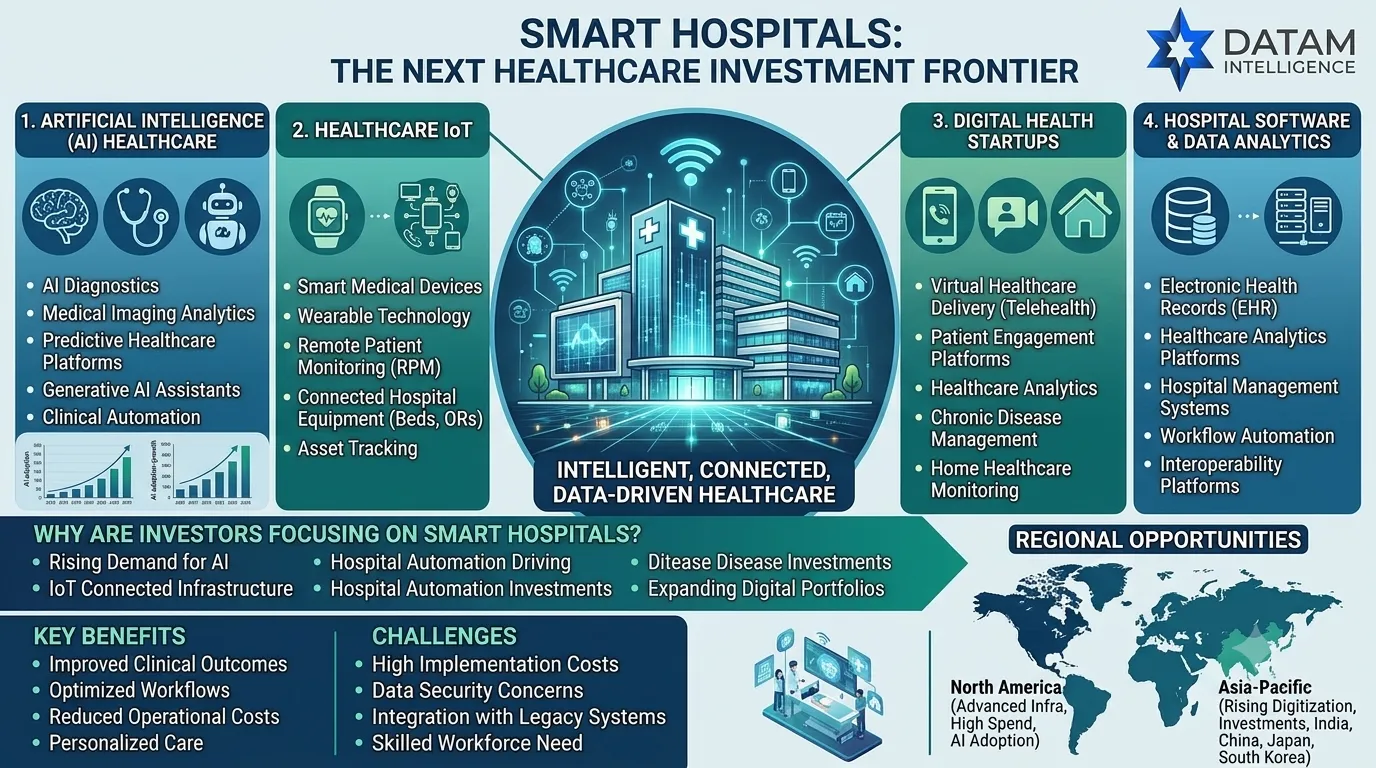
Explore the Smart Hospitals Market Report by DataM Intelligence to understand market size, growth trends, competitive landscape, technology adoption, and future investment opportunities.
For healthcare technology companies and investors, smart hospitals represent a high-growth opportunity where software providers, medical device companies, AI developers, cybersecurity firms, and digital health startups can participate in the transformation of healthcare delivery.
What Are Smart Hospitals?
Smart hospitals are digitally connected healthcare facilities that use advanced technologies to improve patient care, hospital management, and operational performance.
Unlike conventional hospitals that rely heavily on manual processes, smart hospitals integrate:
- Artificial Intelligence (AI)
- Internet of Things (IoT)
- Cloud Computing
- Big Data Analytics
- Robotics
- Connected Medical Devices
- Remote Patient Monitoring
- Digital Health Platforms
- Automation Systems
These technologies enable hospitals to collect real-time healthcare data, improve clinical decision-making, automate workflows, and deliver more efficient patient experiences.
Why Are Investors Focusing on Smart Hospitals?
1. Rising Demand for AI-Powered Healthcare Solutions
Artificial intelligence is becoming one of the most important growth drivers in smart hospital adoption. AI solutions are helping healthcare providers improve diagnostics, automate documentation, predict patient risks, and optimize resource utilization.
Healthcare organizations are increasingly exploring AI applications including:
- AI-assisted medical imaging
- Predictive analytics
- Clinical decision support systems
- Virtual nursing assistants
- Automated administrative workflows
Recent hospital deployments demonstrate growing interest in AI-driven clinical workflows, including diagnostic assistance and operational optimization.
For technology companies, AI healthcare platforms represent a significant opportunity to build scalable solutions for hospitals globally.
2. IoT and Connected Healthcare Infrastructure Creating New Opportunities
The Internet of Things is transforming hospitals into connected ecosystems where medical devices, patient monitoring systems, and hospital infrastructure communicate in real time.
Smart hospital IoT applications include:
- Remote patient monitoring
- Smart beds
- Connected medical equipment
- Asset tracking systems
- Environmental monitoring
- Automated inventory management
IoT adoption allows hospitals to improve patient safety, reduce equipment downtime, and optimize operational efficiency.
Companies developing healthcare IoT platforms, sensors, connectivity solutions, and analytics tools are positioned to benefit from increasing hospital digitization.
3. Hospital Automation Driving Technology Investments
Healthcare providers are facing increasing pressure from:
- Rising patient volumes
- Healthcare worker shortages
- Operational inefficiencies
- Increasing healthcare costs
Automation technologies are helping hospitals improve productivity through:
- Robotic process automation
- Automated pharmacy systems
- Smart scheduling platforms
- Digital workforce management
- Robotic logistics
As hospitals prioritize cost optimization, automation providers are expected to become important partners in digital transformation initiatives.
4. Healthcare IT Companies Expanding Digital Healthcare Portfolios
Technology companies are expanding their healthcare offerings by developing integrated smart hospital ecosystems.
Key investment areas include:
AI Healthcare Platforms: Companies are developing AI-based solutions for diagnostics, analytics, and clinical support.
Cloud Healthcare Infrastructure: Cloud platforms enable hospitals to securely manage healthcare data and scale digital applications.
Cybersecurity Solutions: Connected hospitals require advanced cybersecurity systems to protect sensitive patient information.
Digital Patient Engagement: Mobile healthcare platforms, virtual care solutions, and remote monitoring tools are improving patient experiences.
Key Investment Opportunities in the Smart Hospitals Market
The transformation from traditional healthcare facilities to intelligent, connected, and data-driven hospitals is creating significant investment opportunities across multiple technology segments. Healthcare technology companies, investors, and startups are focusing on solutions that improve operational efficiency, enhance patient outcomes, reduce healthcare costs, and enable predictive and personalized care.
The most attractive investment opportunities within the smart hospitals ecosystem are emerging across artificial intelligence, healthcare IoT, digital health platforms, and hospital software infrastructure.
1. Artificial Intelligence Healthcare Companies
Artificial intelligence has emerged as one of the most promising investment areas within the smart hospitals market. AI technologies are enabling healthcare providers to move from reactive treatment models toward predictive, personalized, and automated healthcare delivery.
Healthcare organizations are increasingly adopting AI-powered solutions to improve diagnostic accuracy, optimize clinical workflows, reduce administrative burdens, and support faster decision-making.
Key Investment Areas:
AI Diagnostics
AI-powered diagnostic platforms are transforming disease detection by analyzing medical images, clinical data, and patient records with high speed and accuracy.
Investment opportunities exist in solutions focused on:
- AI-assisted radiology and imaging analysis
- Early disease detection platforms
- Pathology automation
- AI-based clinical decision support systems
- Precision medicine applications
These solutions help hospitals improve diagnostic efficiency, reduce physician workload, and deliver faster patient care.
Medical Imaging Analytics
Medical imaging represents a major opportunity area as hospitals increasingly integrate AI into radiology and diagnostic workflows.
AI-based imaging analytics platforms can assist healthcare professionals by identifying abnormalities, prioritizing critical cases, and improving diagnostic confidence.
Growth opportunities include:
- AI-powered MRI and CT scan analysis
- Automated image interpretation
- Workflow optimization tools for radiology departments
- Cloud-based imaging intelligence platforms
Companies developing scalable AI imaging solutions are positioned to benefit from increasing demand for advanced diagnostic technologies.
Predictive Healthcare Platforms
Predictive analytics is enabling hospitals to identify potential health risks before they become critical.
These platforms analyze large volumes of healthcare data to predict:
- Patient deterioration risks
- Hospital readmission probability
- Disease progression patterns
- Resource requirements
- Patient care pathways
Investment in predictive healthcare technologies is increasing as hospitals seek to improve clinical outcomes while reducing operational costs.
Generative AI Healthcare Assistants
Generative AI is creating new opportunities within smart hospitals by supporting healthcare professionals with intelligent digital assistants.
Applications include:
- Automated clinical documentation
- AI-powered medical assistants
- Patient communication platforms
- Healthcare knowledge management systems
- Administrative workflow automation
As hospitals face increasing pressure to improve efficiency, generative AI solutions are expected to become an important component of future healthcare infrastructure.
Clinical Automation Solutions
AI-driven automation is helping hospitals streamline repetitive clinical and administrative processes.
Investment opportunities include:
- Automated patient scheduling
- AI-assisted workflow management
- Smart decision-support systems
- Automated reporting and documentation
- Virtual healthcare assistants
Companies developing healthcare automation platforms can support hospitals in reducing operational complexity and improving workforce productivity.
2. Healthcare IoT Companies
The Internet of Things (IoT) is a critical technology foundation for smart hospitals, enabling real-time connectivity between medical devices, healthcare systems, and patients.
Healthcare IoT companies are attracting investment as hospitals increasingly require connected infrastructure to improve monitoring, operational efficiency, and patient safety.
Key Investment Areas:
Smart Medical Devices
Smart medical devices equipped with sensors and connectivity features are transforming healthcare delivery.
Investment opportunities include:
- Connected patient monitoring devices
- Smart infusion pumps
- Intelligent diagnostic equipment
- Sensor-enabled medical devices
- Automated healthcare equipment
These technologies enable continuous monitoring, real-time data collection, and improved clinical decision-making.
Wearable Healthcare Technology
Wearable devices are expanding healthcare beyond hospitals by enabling continuous patient monitoring.
Growth opportunities include:
- Smart watches for health monitoring
- Remote vital sign tracking devices
- Chronic disease monitoring wearables
- Patient activity tracking solutions
Wearable healthcare technology supports preventive care models and improves management of chronic conditions.
Remote Patient Monitoring Solutions
Remote patient monitoring (RPM) is becoming a key growth area as healthcare systems adopt hybrid care models.
Investment opportunities include platforms that enable monitoring of:
- Heart rate
- Blood pressure
- Blood glucose levels
- Oxygen saturation
- Chronic disease indicators
RPM solutions help hospitals reduce unnecessary admissions, improve patient engagement, and extend healthcare services beyond traditional facilities.
Connected Hospital Equipment
Smart hospitals require connected infrastructure where medical equipment communicates seamlessly with hospital information systems.
Opportunities include:
- Smart beds
- Connected operating rooms
- Asset tracking systems
- Automated inventory management
- Equipment monitoring platforms
Companies providing connected hospital ecosystems are expected to benefit from increasing healthcare infrastructure modernization.
3. Digital Health Startups
Digital health startups are playing an important role in accelerating healthcare innovation by developing technology-driven solutions that improve accessibility, efficiency, and patient engagement.
Investors are increasingly focusing on startups that address healthcare challenges through scalable digital platforms.
Key Investment Areas:
Virtual Healthcare Delivery
Telehealth and virtual care platforms are transforming healthcare access by enabling remote consultations and digital patient management.
Growth opportunities include:
- Telemedicine platforms
- Virtual care solutions
- Remote consultation technologies
- Digital healthcare marketplaces
These solutions are becoming increasingly important as healthcare providers adopt flexible care delivery models.
Patient Engagement Platforms
Smart hospitals are placing greater emphasis on improving patient experience through digital engagement solutions.
Investment opportunities include:
- Patient communication platforms
- Mobile healthcare applications
- Digital appointment systems
- Patient education platforms
These technologies help improve patient satisfaction, increase healthcare accessibility, and strengthen provider-patient relationships.
Healthcare Analytics Solutions
Healthcare analytics startups are helping hospitals convert large amounts of healthcare data into actionable insights.
Applications include:
- Population health analytics
- Healthcare performance monitoring
- Patient behavior analysis
- Operational intelligence platforms
Analytics solutions enable healthcare providers to make evidence-based decisions and improve resource allocation.
Chronic Disease Management Platforms
With increasing prevalence of chronic diseases, digital platforms focused on long-term disease management represent a significant investment opportunity.
Key areas include:
- Diabetes management solutions
- Cardiovascular disease monitoring
- Digital therapeutics
- Personalized care platforms
These solutions support continuous patient engagement and reduce healthcare costs through preventive management.
Home Healthcare Monitoring
The shift toward decentralized healthcare is increasing demand for home-based monitoring solutions.
Investment opportunities include:
- Remote care platforms
- Connected home medical devices
- Elderly care technology
- Virtual nursing solutions
These technologies enable hospitals to extend care delivery beyond traditional healthcare settings.
4. Hospital Software and Data Analytics Providers
Hospital software infrastructure serves as the backbone of smart healthcare ecosystems. As hospitals digitize operations, demand is increasing for integrated software platforms that manage clinical information, workflows, and operational data.
Key Investment Areas:
Electronic Health Records (EHR)
EHR systems are fundamental to smart hospital transformation by enabling secure digital management of patient information.
Growth opportunities include:
- Cloud-based EHR platforms
- Interoperable healthcare records
- AI-integrated EHR solutions
- Patient data management systems
Advanced EHR platforms enable better coordination between healthcare providers and improve clinical decision-making.
Healthcare Analytics Platforms
Healthcare analytics providers help hospitals analyze clinical and operational data to improve efficiency.
Investment opportunities include:
- Predictive analytics platforms
- Hospital performance dashboards
- Clinical intelligence solutions
- Revenue cycle analytics
These platforms allow healthcare organizations to optimize resources and improve overall performance.
Hospital Management Systems
Modern hospital management systems are enabling automation across administrative and operational functions.
Key opportunities include:
- Hospital information systems
- Patient flow management
- Inventory management software
- Workforce optimization platforms
These solutions improve hospital efficiency while reducing operational challenges.
Workflow Automation Platforms
Automation platforms are helping hospitals streamline repetitive processes and improve productivity.
Growth areas include:
- Digital scheduling systems
- Automated billing solutions
- AI-powered administrative tools
- Robotic process automation
As healthcare organizations focus on cost optimization, workflow automation is expected to become a major investment area.
Interoperability Platforms
Healthcare interoperability is becoming essential as hospitals integrate multiple digital systems.
Investment opportunities include platforms that enable:
- Healthcare data exchange
- Integration between medical devices and software systems
- Cross-platform communication
- Secure healthcare information sharing
Interoperability solutions will play a critical role in creating fully connected smart hospital ecosystems.
Conclusion: Smart Hospital Technologies Offer Long-Term Growth Potential
The smart hospitals market presents diverse investment opportunities across AI, IoT, digital health, and healthcare software segments. As healthcare providers worldwide accelerate digital transformation, technology companies that deliver scalable, secure, and intelligent solutions will be positioned to capture significant growth opportunities.
Investors and businesses entering the smart hospital ecosystem can benefit from rising demand for connected healthcare infrastructure, automation, predictive analytics, and patient-centric digital solutions. The future of healthcare will increasingly depend on intelligent technologies that enable safer, faster, and more efficient care delivery.
Regional Opportunities in Smart Hospital Investments
North America
North America remains a major market due to:
- Advanced healthcare infrastructure
- High healthcare technology spending
- Strong AI adoption
- Presence of leading healthcare technology companies
Asia-Pacific
Asia-Pacific represents a major growth opportunity due to:
- Increasing healthcare digitization
- Rising healthcare investments
- Growing demand for advanced medical infrastructure
Countries such as India, China, Japan, and South Korea are accelerating digital healthcare initiatives.
To explore more details, Request a Sample Report Today!
Challenges Investors Should Consider
Although smart hospitals offer significant growth opportunities, investors should evaluate challenges including:
High Implementation Costs
Building smart hospital infrastructure requires investment in:
- Digital systems
- Connected devices
- Data platforms
- Cybersecurity
Data Security Concerns
Connected healthcare environments increase cybersecurity requirements due to sensitive patient data.
Integration With Legacy Systems
Many hospitals still operate with existing systems that require modernization and interoperability.
Skilled Workforce Requirements
Successful smart hospital implementation requires healthcare professionals trained in digital technologies.
Future Outlook: Smart Hospitals Will Define the Next Generation of Healthcare
The future of healthcare will increasingly depend on intelligent, connected, and automated hospital ecosystems.
As healthcare providers focus on improving efficiency, reducing costs, and enhancing patient outcomes, investments in smart hospital technologies are expected to accelerate.
Technology companies that develop scalable AI, IoT, cloud, automation, and digital healthcare solutions will be positioned to capture emerging opportunities in this rapidly evolving market.
The smart hospital transformation is not only a technology shift—it represents a fundamental change in how healthcare services are delivered globally.
Frequently Asked Questions (FAQ)
What are smart hospital investment opportunities?
Smart hospital investment opportunities include artificial intelligence healthcare platforms, IoT-enabled medical devices, hospital automation systems, cloud healthcare infrastructure, cybersecurity solutions, and digital health platforms. These technologies help hospitals improve patient care, operational efficiency, and healthcare delivery through connected and data-driven systems.
Why are healthcare companies investing in smart hospitals?
Healthcare companies are investing in smart hospitals to improve operational efficiency, enhance patient outcomes, reduce costs, and enable data-driven healthcare delivery.
Which technologies are driving smart hospital growth?
The major technologies driving smart hospital growth include artificial intelligence, Internet of Things, cloud computing, big data analytics, robotics, and automation.
What is the future of smart hospitals?
Smart hospitals are expected to become more connected, automated, and AI-driven, enabling predictive healthcare, personalized treatment, and efficient hospital management.
Smart hospitals represent one of the most promising investment opportunities in healthcare technology. As hospitals worldwide accelerate digital transformation, companies offering AI, IoT, automation, and healthcare software solutions are positioned for long-term growth.