


India’s 80th Independence Day speech was easy to read as a long list of national targets.
For business leaders, investors and manufacturers, there was a more important message underneath it.
India wants to own more of the value chain.
Not only mobile-phone assembly, but semiconductor manufacturing. Not only electricity consumption, but nuclear technology and energy security. Not only using artificial intelligence, but developing AI talent, infrastructure and domestic innovation. Not only buying defence systems, but exporting them. Not only building roads and ports independently, but connecting them into a more efficient industrial logistics system.
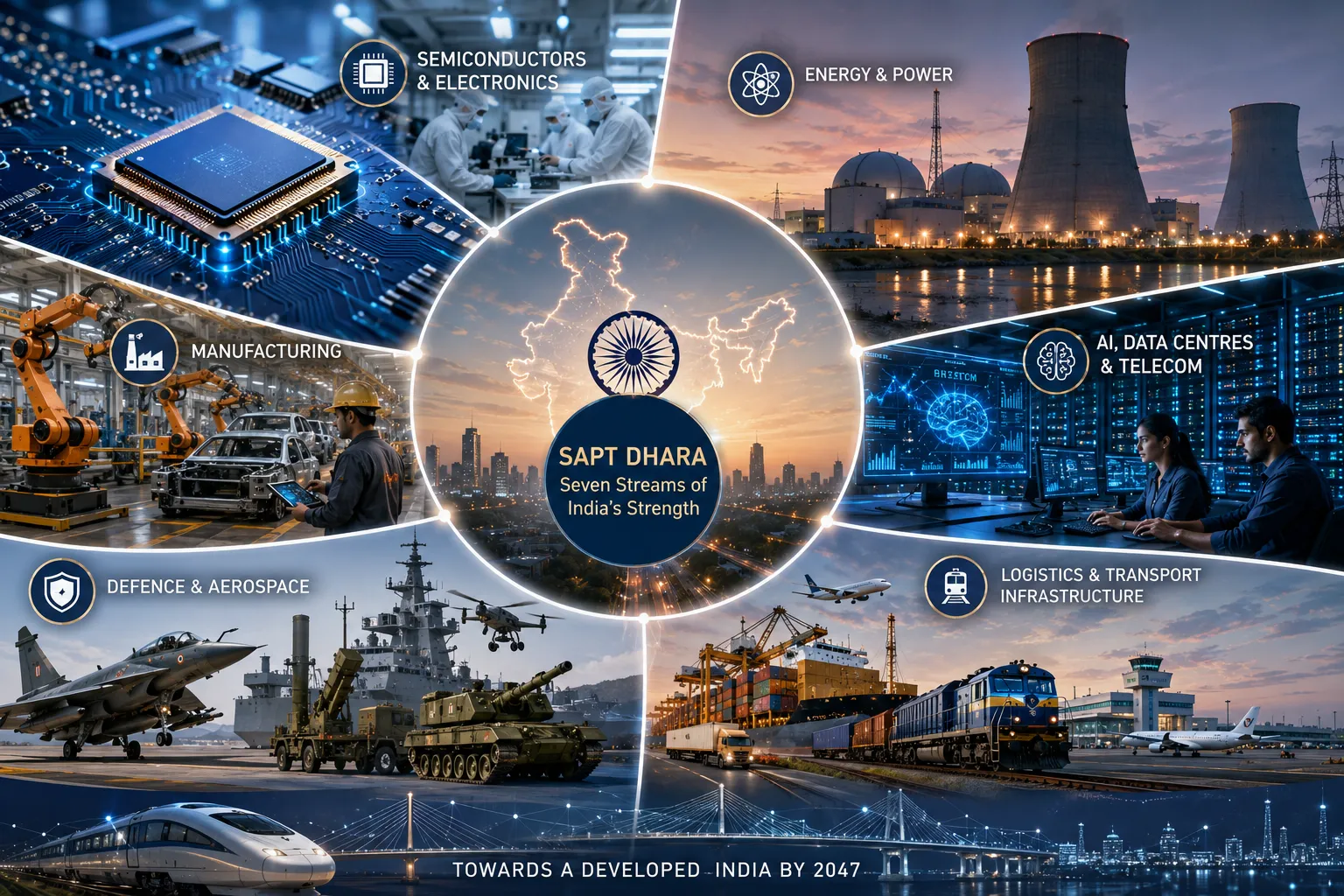
Prime Minister Narendra Modi grouped much of this strategy under a new framework called Sapt Dhara, or seven streams of national strength: manufacturing; agriculture and food production; technology and innovation; Gati Shakti infrastructure; defence; the green and blue economy; and India's soft power. The Prime Minister said these areas should help accelerate India's push toward becoming a developed economy by 2047.
The important point, however, is that Sapt Dhara is not one new law or one investment scheme.
It is better understood as an industrial-policy direction. Some pieces are already backed by legislation and funding. Others are new targets. Some remain strategic ambitions whose business impact will depend on future budgets, regulations and execution.
DataM Intelligence identifies five industries where the impact could be particularly important: semiconductors and electronics, energy and power, AI and digital infrastructure, defence and aerospace, and logistics and transport infrastructure.
Why This Speech Matters More to Industry Than a Normal Independence Day Address
Three words appeared repeatedly in the Prime Minister's manufacturing message:
cost, quality and scale.
India's earlier manufacturing story was frequently built around import substitution. The 2026 message goes further. The stated objective is to build complete value chains-from components and design to finished products-and make India a trusted part of global supply chains.
That changes the benchmark.
A factory does not become globally competitive simply because it is located in India. Its products must compete on cost, reliability, precision, delivery time and quality.
The same logic runs through the semiconductor, defence, energy and infrastructure announcements.
The policy direction is therefore less “make more in India” and increasingly “control more strategic stages of what India makes.”
That difference creates the five biggest industrial opportunities.
1. Semiconductors and Electronics: From Assembly to the Chip Itself
Semiconductors received unusually direct attention in the Red Fort speech.
The Prime Minister said India had begun building India Semiconductor Manufacturing capability and expected another five to eight facilities to come into operation over the coming years.
The more detailed Ministry of Electronics and IT data shows how quickly the project pipeline is developing.
As of May 2026, 12 semiconductor projects had been approved under the India Semiconductor Mission with cumulative planned investment of around ₹1.64 lakh crore. Two projects had already started commercial shipments, while another two were expected to begin commercial shipments soon.
The latest approvals are also widening the type of semiconductor activity taking place in India.
One project covers GaN-based Mini/Micro-LED technology and foundry services, while another covers outsourced semiconductor assembly and testing for discrete semiconductors used in areas including power electronics, automotive systems and industrial automation.
Request Sample on India Semiconductor Manufacturing Market: https://www.datamintelligence.com/download-sample/india-semiconductor-manufacturing-market
Why this is bigger than semiconductor fabs
The opportunity extends into:
- semiconductor packaging and testing
- specialty chemicals and gases
- clean-room equipment
- precision manufacturing
- power electronics
- chip-design services
- compound semiconductors such as GaN
- semiconductor equipment maintenance
- industrial water treatment
- electronics manufacturing
That means semiconductor policy can create industrial demand well outside the fab itself.
There is also a second strategic link.
India's National Critical Mineral Mission is attempting to strengthen domestic mineral supply chains from exploration through processing and recycling. By July 2026, 56 critical-mineral blocks and 11 exploration-licence blocks had been successfully auctioned.
The chip strategy is therefore beginning to connect with a larger resource-security strategy.
DataM Intelligence view: India's semiconductor opportunity should no longer be measured only by whether it builds a leading-edge logic fab. Packaging, power devices, compound semiconductors, design, materials and electronics supply chains can become meaningful businesses even before India matches the world's most advanced manufacturing nodes.
2. Energy and Power: AI Is Making Electricity a Strategic Technology
The second major beneficiary could be India's power industry.
The reason is straightforward: semiconductors, AI infrastructure, data centres, advanced manufacturing and electrified transport all require large and increasingly reliable electricity supplies.
The Prime Minister linked future technology development directly with energy security and reiterated India's target of reaching 100 GW of nuclear power capacity by 2047.
This target is no longer only political language.
The SHANTI Act has been enacted to enable wider public- and private-sector participation in nuclear power. The Department of Atomic Energy said in February 2026 that 17 reactors totalling 13.6 GW, including the Prototype Fast Breeder Reactor, were at different stages of implementation and that current projects could take installed nuclear capacity to roughly 22 GW by 2031-32.
That private-sector opening could be particularly important.
India's nuclear expansion will require much more than reactor operators. It can create demand across:
- nuclear-grade forgings and specialty steel
- pumps and valves
- turbines and generators
- control systems
- engineering and construction
- electrical equipment
- cooling technologies
- nuclear fuel services
- small modular reactor technology
The speech also reinforced investment in solar, green hydrogen, storage and domestic oil and gas exploration. The Prime Minister said India's solar capacity had reached 160 GW and highlighted the opening of previously restricted offshore areas for energy exploration.
This makes energy security, rather than any single fuel, the larger investment story.
Request Sample on Small Modular Reactor Market: https://www.datamintelligence.com/download-sample/small-modular-reactor-market
The overlooked connection: data centres
India's technology ambitions cannot scale independently of electricity infrastructure.
Training one crore people in AI will attract attention. But large AI models, domestic cloud platforms and data centres will require dependable generation, transmission, cooling and power electronics.
Energy companies could therefore become indirect beneficiaries of India's AI policy.
DataM Intelligence view: Nuclear power may be the most important structural change because opening the industry to wider private participation can create an industrial ecosystem that previously had limited room for private capital. Grid equipment, storage and distributed renewable energy should grow alongside it.
3. AI, Data Centres and Telecom: India Wants to Build AI Capability, Not Only AI Users
One of the clearest new announcements was the target to train one crore young Indians in AI skills within one year.
That is a workforce target rather than an AI-industry investment by itself.
But it sits on top of a broader infrastructure program.
The IndiaAI Mission already carries a government outlay of approximately ₹10,371.92 crore over five years, covering compute capacity, foundation models, datasets, applications, future skills, startup financing and safe and trusted AI.
The Red Fort speech also tied India's technology strategy to quantum computing, robotics, space, data centres and the ambition to develop Made-in-India 6G technologies.
This produces several different commercial opportunities.
The first is computing infrastructure
India needs GPUs, servers, networking, storage, data-centre power, cooling and cloud capacity if local companies and universities are to build rather than merely consume AI.
The second is Indian-language and domestic AI
Skills and compute access can help software companies build models suited to Indian languages, public services, healthcare, agriculture and enterprise workflows.
The third is telecom
A Made-in-India 6G ambition pushes investment further into radio equipment, optical networks, semiconductor design, telecom software and research.
The fourth is robotics
AI that moves into factories, logistics centres and machines creates demand for sensors, industrial computers, motors, machine vision and edge-computing hardware.
The important shift is that India is starting to describe compute, models, data, talent and energy as connected national capabilities, rather than treating AI as only a software-services opportunity.
DataM Intelligence view: India's traditional IT strength gives it a large talent base, but the next competitive test will be whether it can add domestic computing infrastructure, commercially useful models and intellectual property. Training numbers matter less if skilled workers still depend entirely on imported technology stacks.
Request sample on DCIM Market: https://www.datamintelligence.com/download-sample/data-center-infrastructure-management-dcim-market
4. Defence, Aerospace, Drones and Cybersecurity: The Target Is Now Export Leadership
Defence was the fifth stream in the Sapt Dhara framework.
The language was noticeably different from traditional self-reliance messaging.
The Prime Minister called not only for domestic defence manufacturing but for India to become a global supplier of next-generation technologies, specifically mentioning drones, counter-drone systems, hypersonic technologies and cybersecurity.
The industrial base is already expanding.
India's defence production reached a record ₹1.78 lakh crore in FY2025-26, with the private sector accounting for around ₹42,000 crore, or 24% of output.
Defence exports reached ₹38,424 crore in FY2025-26, up 62.66% from the previous financial year. Indian defence products were exported to more than 80 countries, according to the Ministry of Defence.
This creates opportunities well beyond large defence contractors.
The next supply chain includes:
- drones and counter-drone equipment
- radars and sensors
- electronic warfare
- aerospace components
- propulsion
- unmanned systems
- secure communications
- cybersecurity
- advanced materials
- precision machining
- maintenance, repair and overhaul
- military software
The government's plan for a modern voluntary Civil Defence network could create another demand category around resilient communications, emergency systems, cybersecurity and protection of infrastructure such as data centres, factories, banks and refineries.
Aerospace is particularly important
The speech also highlighted India's progress toward domestically manufactured aircraft and growing aviation maintenance activity.
That fits a wider change already visible across India's aerospace industry: the country is moving from component supply and licensed production toward aircraft assembly, advanced engineering and, increasingly, attempts to control critical technologies.
DataM Intelligence view: defence could become one of the strongest export-led manufacturing stories if India succeeds in moving from supplying components to owning complete platforms, intellectual property and upgrade rights.
5. Logistics, Ports, Rail and Transport Infrastructure: The Cost of Making in India Depends on Moving in India
Manufacturing policy will struggle if factories can produce cheaply but cannot move goods efficiently.
That is why Gati Shakti is one of the most commercially important parts of Sapt Dhara.
The Prime Minister called for faster multimodal connections spanning high-speed rail, highways, inland waterways, airports and ports, while positioning ports as industrial-development centres rather than simple loading and unloading points.
The existing project pipeline is already significant.
By August 2026, the Ports Ministry had identified 182 port and connectivity projects worth ₹1.09 lakh crore under PM Gati Shakti. Major-port cargo-handling capacity had reached 1,728 million tonnes per annum by March 2026.
Indian Railways also reported 142 operational Gati Shakti Cargo Terminals by July 2026, supporting freight movement in industries including cement, steel, power and agriculture.
The business opportunity therefore extends across:
- industrial warehouses
- logistics parks
- ports and terminals
- freight rail
- highways
- inland waterways
- cold chains
- airport cargo
- industrial real estate
- digital logistics platforms
- port equipment and automation
The strategic significance is easy to miss.
A semiconductor factory, defence plant or food-processing unit cannot become a global export hub on manufacturing efficiency alone.
Its suppliers and finished products have to move predictably.
DataM Intelligence view: Gati Shakti may create fewer headlines than AI or semiconductor fabs, but lower and more predictable logistics costs can improve the competitiveness of almost every other industry included in India's 2047 agenda.
What About Agriculture, Food Processing and the Green Economy?
They should not be ignored.
Agriculture and food processing form an explicit Sapt Dhara stream, with the government encouraging farm-to-export supply chains, globally branded Indian foods, millets, spices, fruits and chemical-free agriculture.
Green hydrogen, renewable energy, storage, green mobility, fisheries, ocean technologies and coastal tourism are also explicitly included.
DataM Intelligence's top-five selection does not represent an official government ranking. It prioritises sectors where the Red Fort announcements combine high capital intensity, existing government programs and strong spillover into other industries.
Agriculture and food processing could still be among the largest employment beneficiaries.
The Smartest Part of the Strategy Is Also the Hardest Part
The individual targets receive headlines.
Seven or eight semiconductor facilities.
One crore AI-skilled workers.
100 GW of nuclear capacity.
Drones and hypersonics.
High-speed transport.
But India's real challenge is connecting these ambitions.
A semiconductor industry needs uninterrupted electricity.
AI data centres need both chips and power.
Defence manufacturers need semiconductors, critical minerals and precision engineering.
Export factories need ports and efficient freight.
EVs and storage need critical minerals.
Advanced manufacturing needs skilled workers.
This is why Sapt Dhara is more useful when viewed as an industrial system rather than seven separate sector policies.
If these programs are implemented independently, India may create isolated areas of success.
If they are connected, the country can capture a larger portion of the value chain.
What Businesses Should Watch After the Speech
Investors and companies should not treat every Independence Day target as an immediate revenue opportunity.
The next evidence will come from implementation.
Watch whether semiconductor projects move from approvals to commercial production; whether private investment follows the SHANTI Act into nuclear projects; whether AI skilling connects with actual jobs and domestic computing capacity; whether defence exports move toward higher-value complete systems; and whether Gati Shakti produces measurable reductions in freight time and logistics friction.
The other important metric is domestic value added.
Assembly alone will not deliver the strategic self-reliance described in the speech.
India needs more domestic design, engineering, materials, intellectual property, and high-value components.
That is the difference between participating in a global supply chain and controlling an important part of it.
DataM Intelligence View: India’s Next Industrial Story Is About Controlling the Stack
The biggest message from India's 80th Independence Day address was not a single scheme.
It was a change in ambition.
India wants to move:
from importing chips to producing them;
from buying energy to securing it;
from providing IT labour to developing AI capability;
from importing defence platforms to exporting technology;
and from building individual infrastructure projects to creating integrated industrial corridors.
That transition will not happen automatically.
Capital availability, technology access, execution speed, state-level regulation, land, skilled labour, power availability and global competitiveness will determine how much of the strategy becomes commercial reality.
But the direction of policy is increasingly clear.
India does not want to remain only a large consumer market or a lower-cost manufacturing location.
It wants to own more of the technology, infrastructure and industrial capacity behind its growth.
If that strategy is executed well, semiconductors, energy, AI infrastructure, defence and logistics could become five of the most important industrial pillars of India's next decade.
And the companies worth watching will not necessarily be those selling the final product.
Some of the biggest opportunities could appear one or two layers deeper-in components, power equipment, precision manufacturing, critical materials, industrial software, testing, logistics and infrastructure.
That may be the most important business message hidden inside the Red Fort speech.
Frequently Asked Questions
What is Sapt Dhara in India's 2026 Independence Day speech?
Sapt Dhara is a seven-part strategic framework covering manufacturing, agriculture and food production, technology and innovation, Gati Shakti infrastructure, defence, green and blue economy, and India's soft power.
Is Sapt Dhara a new government scheme?
Not in the conventional sense. It is a strategic framework announced by the Prime Minister. Some measures referenced within it already have legislation, budgets or existing programs, while others are targets or policy directions that require further implementation.
Which five industries could see the biggest impact?
DataM Intelligence identifies semiconductors and electronics; energy and power; AI, data centres and telecom; defence and aerospace; and logistics and transport infrastructure as the five most directly exposed industrial areas.
What did the Prime Minister announce about AI?
The Prime Minister announced a target to train one crore young people in AI skills within one year. This builds on the existing IndiaAI Mission, which has a government outlay of ₹10,371.92 crore over five years.
What is India's nuclear target?
India is targeting 100 GW of nuclear power capacity by 2047. The SHANTI Act enables wider public- and private-sector participation in the nuclear sector.
How many semiconductor projects has India approved?
As of May 2026, 12 semiconductor projects had been approved under the India Semiconductor Mission, representing planned cumulative investment of around ₹1.64 lakh crore.
Why could defence be a major beneficiary?
The policy direction is moving beyond import substitution toward defence exports and domestic development of technologies including drones, counter-drone systems, hypersonics and cybersecurity. Defence production and exports both reached record levels in FY2025-26.
Why is logistics important to this strategy?
India's manufacturing competitiveness depends on moving components and finished goods efficiently. PM Gati Shakti connects ports, railways, highways, airports, and waterways to support more integrated industrial supply chains.