


India's Battery Supply Chain Has a Problem: Can Cell Manufacturing Scale Before Import Dependence Hardens?
| KEY TREND | Battery demand is scaling faster than domestic cell production while upstream materials, equipment, separators and refined critical minerals remain import dependent. |
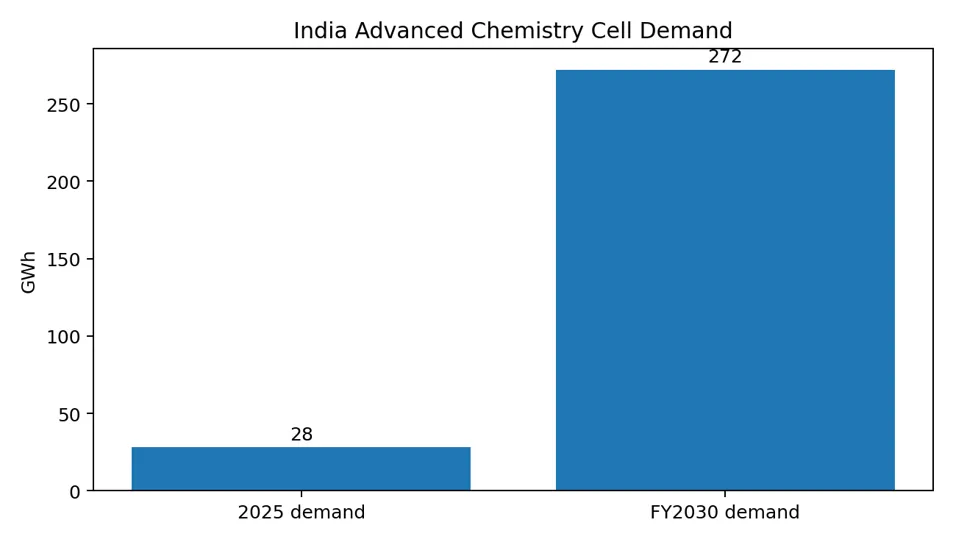
| MARKET OUTLOOK | India advanced chemistry cell demand rises from 28 GWh in 2025 to about 272 GWh by FY2030 while operational cell manufacturing remains only a small fraction of that requirement. |
| RECOMMENDED FOR | Battery manufacturers, BESS developers, critical mineral suppliers, policy teams |
DataM Analyst View
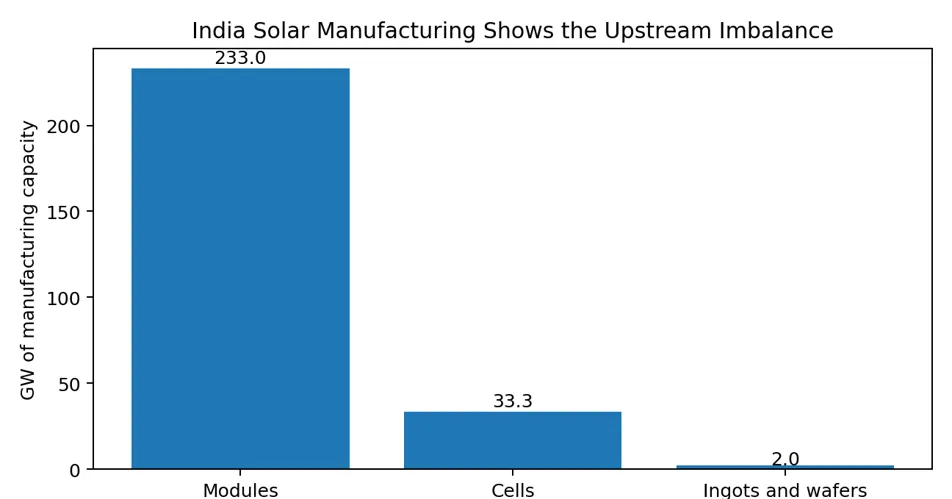
India is entering a battery investment cycle with a familiar structural risk. The country can build pack assembly, container integration and even cell plants quickly, yet the value chain can remain dependent on imported cells, cathode materials, anode materials, separators, equipment and refined critical minerals. The solar industry offers a useful warning. India built 233 GW of module manufacturing capacity by June 2026, but module capacity reached nearly seven times cell capacity and 116 times ingot and wafer capacity. The result is a downstream manufacturing base that still depends heavily on imported upstream inputs.
Battery manufacturing is now at a similar decision point. India used 28 GWh of advanced chemistry cells in 2025. IEEFA projects demand at roughly 272 GWh by FY2030. Yet operational domestic lithium ion cell capacity remains extremely small compared with demand. The core issue is therefore broader than gigafactory announcements. India needs a connected manufacturing system that includes cells, cathode active materials, anodes, electrolytes, separators, refining, process equipment and qualification know how.
Source: IEEFA and DataM Intelligence
Battery Demand Is Scaling Faster Than the Domestic Cell Base
Battery demand is no longer a future story. Electric vehicles already account for roughly 60% of India’s advanced chemistry cell demand while stationary and grid storage account for the balance. The demand curve becomes much steeper through 2030 as EV penetration rises and the power system adds larger storage projects.
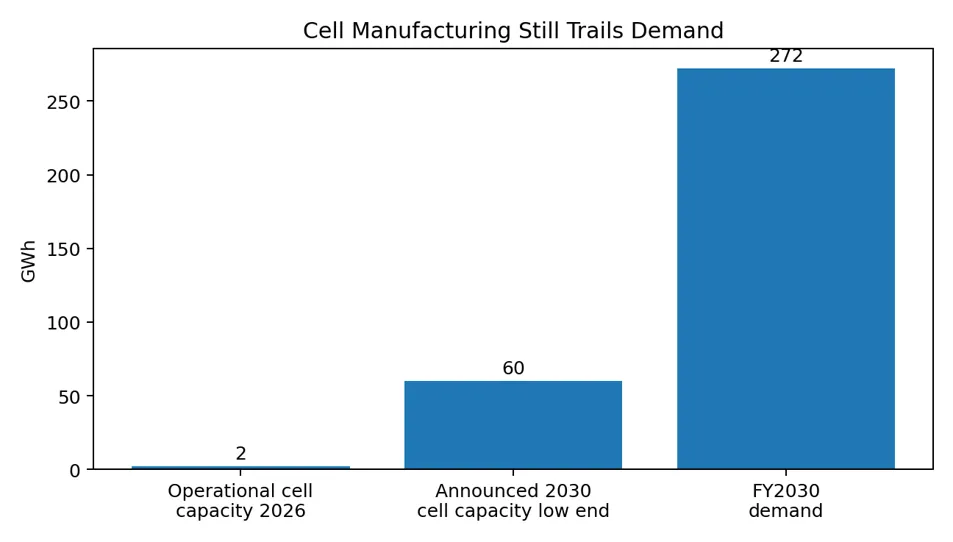
The manufacturing response is still concentrated downstream. IEEFA reported that India had about 60 GWh of installed battery pack manufacturing capacity while cell manufacturing was around 1 GWh at the end of 2025. By October 2026, Energy Storage News cited around 2 GWh of operational cell capacity with announced 2030 cell capacity of only 60 to 70 GWh. Even the lower end of that announced pipeline remains far below projected FY2030 demand of 272 GWh.
Source: IEEFA
Explore DataM Intelligence: Lithium Ion Battery Market
The Solar Supply Chain Shows Why Downstream Scale Is Not Enough
India’s solar manufacturing experience is the most relevant comparison because it shows how quickly downstream capacity can expand without eliminating upstream exposure. Module manufacturing has become a major domestic industry. The upstream chain has developed much more slowly.
IEEFA and JMK Research reported 233 GW of module manufacturing capacity as of June 2026. That was nearly seven times cell capacity and 116 times ingot and wafer capacity. The implied capacities are about 33.3 GW for cells and only 2.0 GW for ingots and wafers. Module factories were also operating at just 35% to 40% utilisation, below the 50% to 65% level the report identifies as more sustainable.
The battery lesson is direct. Building pack and container capacity before cells, components and materials are competitive can create a large domestic manufacturing footprint without creating strategic supply security. It can also leave local manufacturers structurally exposed to price changes, export restrictions and technology access decisions made outside India.
Source: DataM Intelligence
China Exposure Extends Beyond Cells Into Materials and Manufacturing Know How
The supply chain challenge is deeper than cell imports. China refines about 74% of global lithium, 80% of cobalt and controls 98% of lithium iron phosphate cathode active material production according to IEEFA. India’s lithium refining capacity is effectively zero. Domestic cobalt refining is only about 2,060 tonnes per year.
Technology access has also become a constraint. Nikkei reported in September 2026 that Indian groups including Amara Raja and JSW were tempering battery cell ambitions as partnerships with Chinese companies became more difficult. Amara Raja has accelerated internal research and development to compensate for lost external know how. This turns battery manufacturing into a technology sovereignty issue as well as a raw material issue.
Manufacturing equipment is another underappreciated bottleneck. Separator production illustrates the problem. Ultra thin separators require tight process control across extrusion, stretching and solvent extraction. ET Manufacturing notes that defect rates for separators below 16 microns can be about 27% higher than for conventional 20 to 25 micron products while startup yield losses can reach 15% to 20%. Battery OEM qualification programs can require 12 to 24 months, which means poor scale up engineering can delay commercialization even when the factory shell is ready.
Explore DataM Intelligence: Battery Material Market
BESS Growth Makes the Supply Chain Problem More Urgent
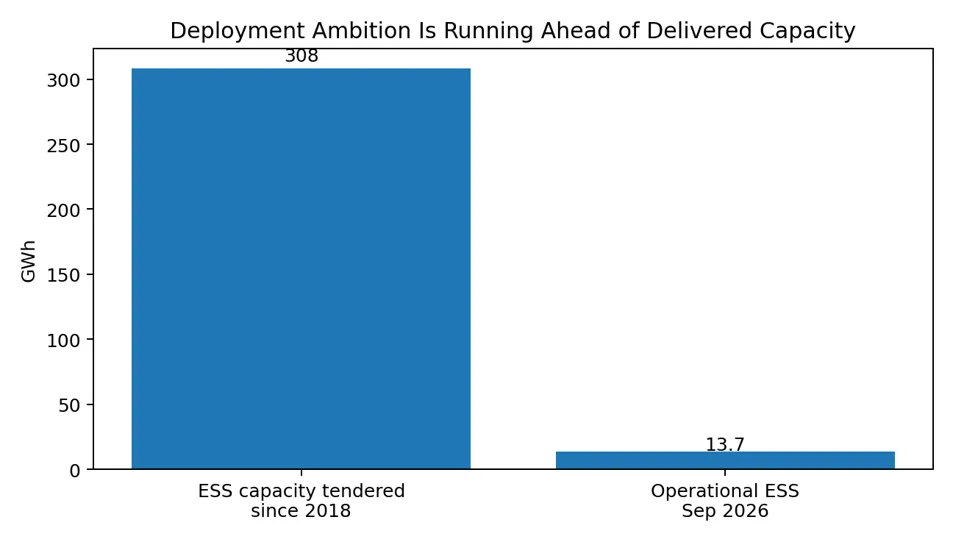
The stationary storage market is accelerating at the same time as electric mobility. India has issued 215 energy storage linked tenders since 2018 representing 308 GWh of capacity. Energy Storage News reported that only 13.7 GWh was operational by September 2026, although deployment had increased sharply during the year.
The pipeline is becoming larger and more sophisticated. Grid forming storage, renewable plus storage and merchant projects are expanding. Solar plus BESS tariffs fell from INR 6.99 per kWh in 2018 to INR 3.13 per kWh by January 2026, yet standalone BESS tariffs rose after late 2025 lows as raw material costs increased. This shows why procurement risk is becoming part of project economics. Low tender prices cannot compensate for unreliable cell access or delayed deliveries.
Source: India Energy Storage Alliance
Explore DataM Intelligence: Battery Energy Storage System Market
Import Dependence Is Becoming a Balance Sheet Issue
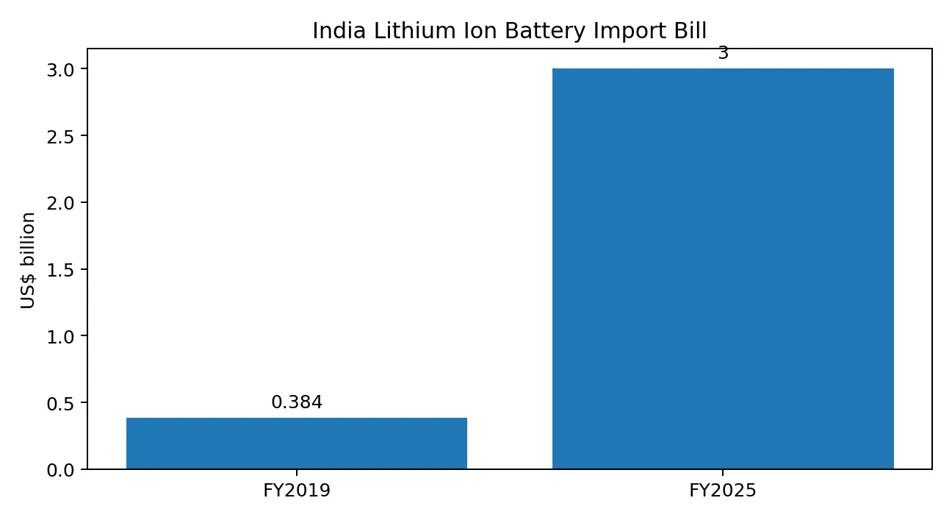
India’s lithium ion battery import bill rose from US$384 million in FY2019 to more than US$3 billion in FY2025. At a cell price of US$85 per kWh, IEEFA estimates that meeting 272 GWh of FY2030 demand entirely with imported cells would imply an annual import bill above US$23 billion.
That figure explains why localization is moving from industrial policy to energy security. The objective is no longer to replace every imported component immediately. The priority is to identify the parts of the chain where local capability meaningfully reduces exposure. Cells, cathode active materials, anode materials, separators and refining are high priority because they determine cost, technology access and the ability to keep factories running when cross border supply becomes constrained.
Source: IEEFA
Solar Versus Batteries: The Supply Chain Pattern Buyers Should Watch
| Supply chain issue | Solar PV lesson | Battery risk | Procurement implication |
| Downstream first | Module capacity scaled much faster than cells, wafers and polysilicon. | Pack and BESS integration can scale faster than cells and cell materials. | Measure local value by upstream depth rather than assembly capacity. |
| China concentration | Wafer and polysilicon dependence remained high despite domestic module growth. | Cells, LFP cathode materials, graphite processing and refining remain highly China exposed. | Qualify alternative suppliers before capacity is urgently needed. |
| Technology transfer | Equipment plus process know how determine yield and competitiveness. | Separator extrusion, coating, formation and cell process control can constrain ramp up. | Procure process expertise with equipment rather than treating machinery as a standalone purchase. |
| Policy sequencing | PLI, import duties plus approved manufacturer rules supported demand for local modules. | Battery policy needs coordinated support for refining, components, cells plus demand visibility. | Align procurement rules with realistic localization milestones. |
What a Resilient Battery Supply Chain Needs Next
The next phase requires upstream sequencing. Critical mineral refining needs to develop alongside long term offtake agreements with mineral producing countries. Cell component capacity needs to expand across cathode materials, anodes, electrolytes and separators. Cell manufacturing targets also need timelines that reflect qualification, yield ramp and process learning rather than only nameplate capacity.
There is also a strong case for building capability in manufacturing equipment plus process engineering. A domestic gigafactory that depends on imported process know how can remain exposed even when the building, workforce and utilities are local. This is the same lesson solar manufacturing is now confronting at the wafer and polysilicon stages.
The advantage is that India can apply the solar experience earlier in the battery cycle. The country already has demand visibility, a large domestic market and active private sector investment. The risk is spending the next five years expanding downstream capacity while the most strategic inputs remain externally controlled.
Explore DataM Intelligence: Critical Minerals Market