

Mainframe Market & Enterprise Infrastructure Perspective | 2026
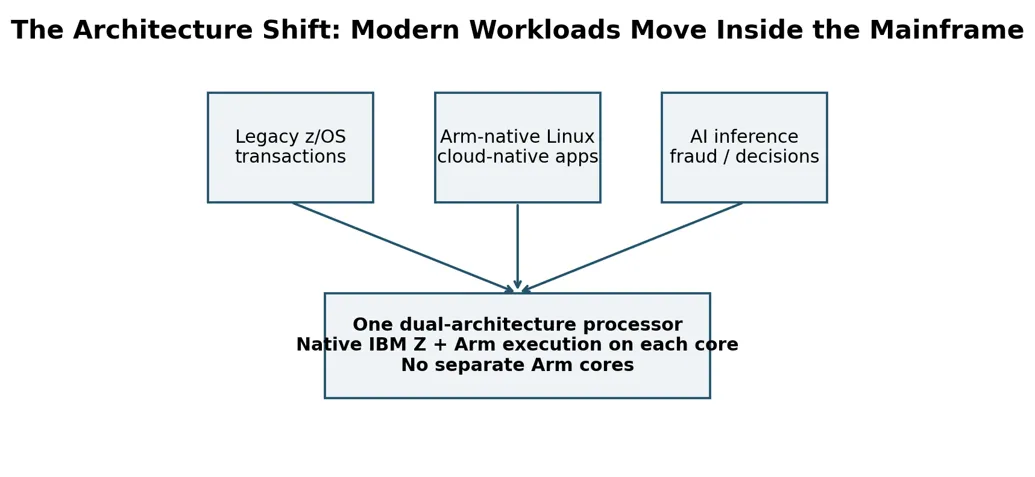
| ARCHITECTURE SHIFT | IBM is developing the first dual-architecture mainframe processor, designed so each core can natively execute IBM Z / LinuxONE and Arm instructions without a separate Arm core complex. |
| AI SHIFT | The same roadmap embeds AI inference acceleration into the transaction path, extending IBM Z from transaction processing toward real-time decisioning and cloud-native software coexistence. |
| COMMERCIAL QUESTION | Which enterprises will accelerate refresh cycles because Arm-native applications, AI inference and legacy transaction workloads can converge on the same highly secure system? |
IBM Is Trying to Collapse the Mainframe / Cloud-Native Boundary
IBM’s August 24, 2026 Hot Chips announcement changes the modernization debate. The next-generation processor is being designed to allow Arm-native Linux environments to run simultaneously with z/OS and Linux on IBM Z. The important architectural detail is that IBM is not proposing separate Arm cores beside separate mainframe cores. Each core is designed to execute both instruction sets natively.
That matters because enterprises have historically modernized around the mainframe by moving selected workloads outward - to distributed Linux servers, cloud platforms or external AI infrastructure. A native Arm software ecosystem inside future Z and LinuxONE systems could reverse part of that pattern. Modern cloud-native applications could move closer to the transactional data instead of forcing the data to move toward them.
Request Sample: https://www.datamintelligence.com/download-sample/mainframe-market
The Hardware Roadmap Is More Radical Than a Normal Refresh
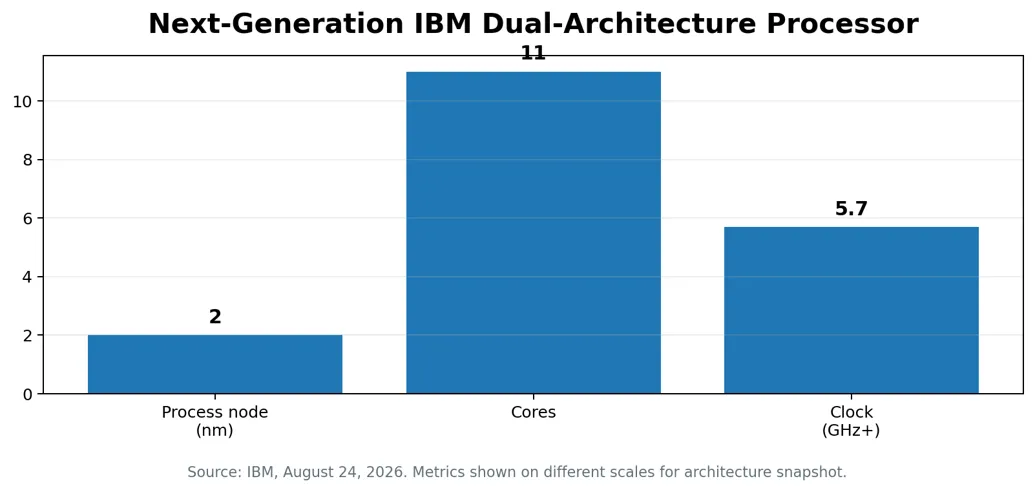
The announced design is built on a 2 nanometer technology node with 11 high-performance cores operating above 5.7 GHz. IBM also describes a dedicated on-chip data processing unit for I/O acceleration, large cache architecture and AI inference accelerators for in-transaction fraud detection. These are roadmap specifications for future IBM Z and LinuxONE systems, not a generally available processor today.
Why Arm Changes the Enterprise Planning Equation
Arm brings access to an ecosystem IBM says now spans more than 22 million developers. For banks, insurers, governments and other mainframe-heavy organizations, that creates a new modernization option: preserve z/OS transaction systems while bringing selected Arm-native Linux applications onto the same platform. The value is not simply “more software.” It is the possibility of reducing network hops, external data movement and cross-platform integration between core transaction systems and newer services.
| Workload layer | Traditional pattern | Dual-architecture direction | Commercial implication |
| Core transactions | z/OS / Linux on Z | Remain on Z | Protect installed mission-critical workload |
| Cloud-native services | Often external x86 / Arm cloud | Arm-native Linux can run on future Z | More workloads can sit close to data |
| AI inference | External GPUs / separate AI tiers or on-chip Z AI | In-transaction acceleration plus Arm AI ecosystem | Lower-latency decisioning, less data movement |
| Modernization | Rewrite / migrate / integrate | Coexist on one platform | Creates a new refresh and consolidation case |
AI Has Already Moved Into the Transaction Path
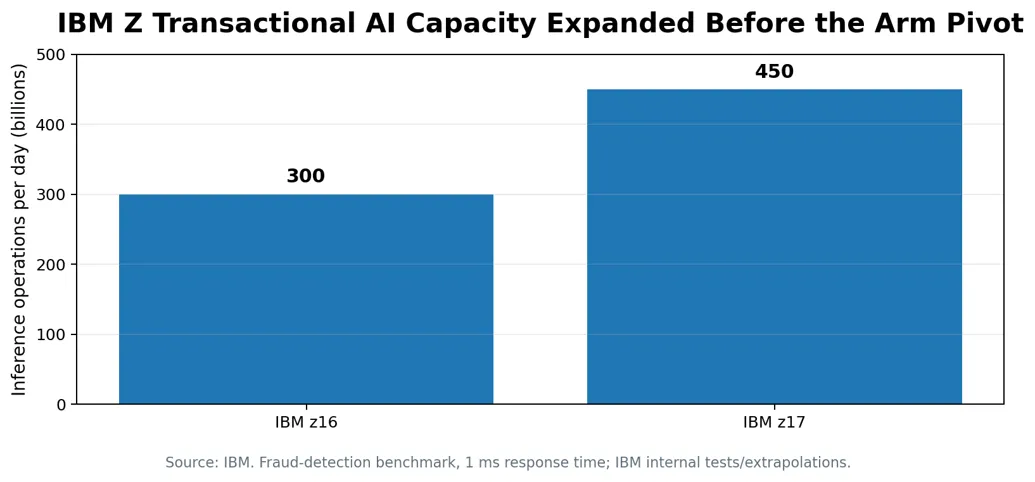
The dual-architecture processor arrives after IBM had already shifted AI processing onto the mainframe. IBM z17 can process up to 450 billion inference operations per day at 1 millisecond response time in IBM’s fraud-detection benchmark, compared with 300 billion on z16. IBM also says idle integrated AI accelerators can lift inference throughput by up to 7.5x versus z16.
This changes where AI economics are calculated. Fraud scoring, anti-money-laundering models, claims analysis and recommendation models can execute while the transaction is still in flight. IBM’s own modernization argument is that copying data out to another analytics platform introduces latency, governance complexity and additional infrastructure cost. The next-generation Arm capability potentially broadens the software that can participate in that in-platform workflow.
The Mainframe Is Also Becoming a Larger In-Memory Platform
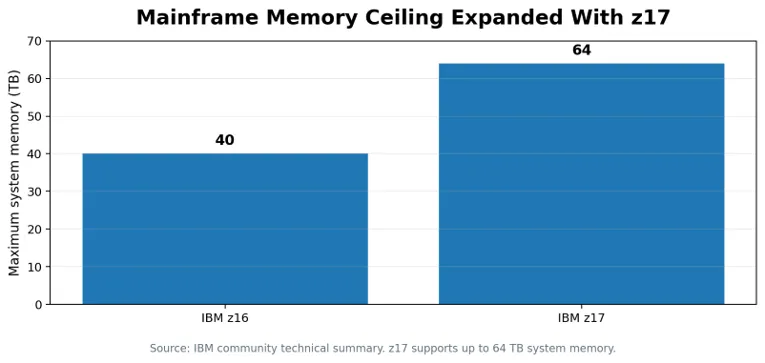
The memory expansion is commercially relevant because Arm-native services and multi-model AI become more useful when they can access large transactional datasets without forcing data off-platform. The refresh decision therefore increasingly spans processor architecture, memory footprint, AI acceleration and software placement rather than just MIPS growth.
Four Signals Mainframe Suppliers and Enterprise Buyers Should Track
| Signal | What it reveals | Likely market impact | Commercial action |
Arm-native application qualification | Enterprise is testing workloads for future Z / LinuxONE placement | New modernization and consolidation projects | Map application portfolio before hardware RFQ |
| Transactional AI expansion | Fraud, AML or decisioning is moving into core processing | Higher AI accelerator and memory utilization | Quantify cost of external AI data movement |
z17 refresh / capacity expansion | Customer already values on-platform AI | Higher probability of next-generation adoption | Track refresh cycle, MIPS and memory headroom |
Cloud repatriation / cost pressure | External compute economics are being challenged | More workloads become candidates for mainframe consolidation | Compare TCO at workload level |
Request a Customized Report According to Your Business Strategy: https://www.datamintelligence.com/customize/mainframe-market
The Bigger Market Shift: The Mainframe Is Absorbing Adjacent Workloads
The strategic change is not that Arm replaces IBM Z. It is that future IBM Z and LinuxONE systems are being designed to absorb more of the software stack that enterprises previously placed beside the mainframe. That can change application modernization budgets, hybrid-cloud architecture, security design and infrastructure procurement at the same time.
For the Mainframe market, the opportunity is therefore broader than system replacement. Buyers need to know which installed bases are approaching refresh, which organizations have large Arm-native or cloud-native portfolios, where AI is being inserted into transaction flows, how memory and accelerator demand are changing and which industries face the strongest data-residency and latency constraints.
Why This Requires Mainframe Market Intelligence
A roadmap announcement alone does not reveal the revenue opportunity. The commercial value comes from connecting hardware generations with installed systems, application portfolios, modernization projects, AI use cases, software ecosystems and enterprise buying cycles. The most attractive accounts will be those where a normal refresh is becoming a broader architecture-consolidation decision.
Mainframe Market Report: Track hardware refresh cycles, workload migration, AI adoption, enterprise modernization priorities and vendor positioning before the next procurement cycle is locked.