


Generalized myasthenia gravis (gMG) is entering a more competitive treatment era. The U.S. Food and Drug Administration’s November 2026 approval of KLYGEFA (gefurulimab-gaks) adds a once-weekly, self-administered complement inhibitor to a market that already includes FcRn blockers, other complement therapies and B-cell-directed treatment. For pharmaceutical leaders, the milestone matters beyond one brand: it raises the importance of how mechanism, route, treatment burden, patient eligibility and durability combine to shape product positioning.
DataM Intelligence estimates the global generalized myasthenia gravis treatment market at US$6.4 billion in 2025, with the market projected to reach US$11.1 billion by 2035 at a 5.8% CAGR. North America is the largest regional market, while Asia-Pacific is projected to grow fastest. The forecast reflects expansion of targeted treatment choices and competitive investment; it should not be interpreted as a forecast of any one product’s sales.
Request Exclusive Sample: https://www.datamintelligence.com/download-sample/generalized-myasthenia-gravis-treatment-market
KLYGEFA: a new C5 option with a distinct delivery profile
KLYGEFA, developed by Alexion, AstraZeneca Rare Disease, is approved in the United States for adults with anti-acetylcholine receptor (AChR) antibody-positive gMG. It is a dual-binding nanobody C5 inhibitor administered subcutaneously once a week through an autoinjector. The FDA decision was based on the Phase III PREVAIL trial, which enrolled 260 patients. At Week 26, the trial met its primary endpoint: the MG-ADL score treatment difference versus placebo was -1.6 points (95% CI: -2.4 to -0.8; p<0.0001). AstraZeneca reported improvement as early as Week 1 and sustained through one year.
The differentiation question is not whether weekly self-administration is universally preferable. It is whether some patients and clinicians will value that option when weighing treatment frequency, route, monitoring, disease control and individual care needs. KLYGEFA’s nanobody design and C5 mechanism add a new profile within complement inhibition, but there is no head-to-head evidence establishing superiority over other gMG treatments. Product comparisons should therefore focus on approved labels, study designs and treatment logistics rather than indirect efficacy claims.
Japan is already an approved market for KLYGEFA, according to AstraZeneca. The U.S. milestone is consequently a new regulatory event for the American market, while Japan’s strategic questions center on local access, reimbursement, specialist adoption and competitive fit.
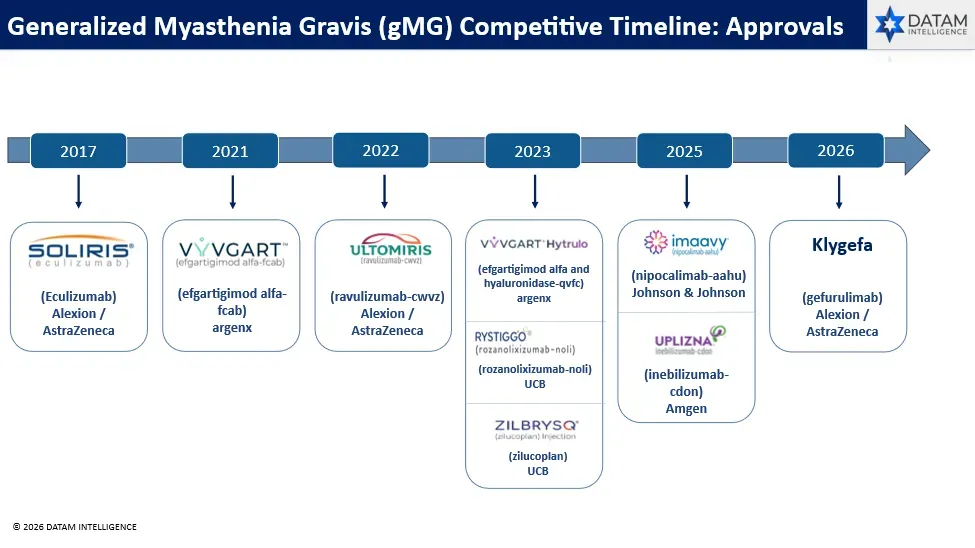
FDA-approved drugs for generalized myasthenia gravis
The approved landscape now spans three principal targeted approaches. The products are not interchangeable: they differ in target, formulation, administration schedule and labeled patient population. The table gives a concise market view; clinicians should consult current prescribing information for complete indications, dosing and safety requirements.
| Treatment approach | FDA-approved options | Competitive dimension |
| Complement C5 inhibition | KLYGEFA (gefurulimab), SOLIRIS (eculizumab), ULTOMIRIS (ravulizumab), ZILBRYSQ (zilucoplan) | C5 inhibition across distinct modalities, routes and dosing schedules; current gMG labels focus on adults with AChR-positive disease. |
| FcRn inhibition | VYVGART (efgartigimod alfa), VYVGART HYTRULO (efgartigimod alfa and hyaluronidase), RYSTIGGO (rozanolixizumab), IMAAVY (nipocalimab) | Reducing circulating IgG through different molecules and delivery options; eligibility varies by product and label. IMAAVY is indicated for patients aged 12 and older with AChR- or MuSK-positive gMG. |
| B-cell depletion | UPLIZNA (inebilizumab) | CD19-directed treatment for adults with AChR- or MuSK-positive gMG, adding a B-cell-targeted strategy to treatment sequencing. |
Within C5 inhibition, SOLIRIS and ULTOMIRIS are intravenous monoclonal antibodies, ZILBRYSQ is a subcutaneous peptide, and KLYGEFA is a weekly subcutaneous nanobody. Route and schedule can shape the care setting and patient experience, but convenience has to be considered alongside safety requirements and clinical outcomes. Complement inhibitors carry serious infection risks, including meningococcal infection; vaccination and risk-management instructions in product labeling are central to their use.
FcRn therapies act through a different pathway by reducing circulating IgG, including disease-associated antibodies. VYVGART and VYVGART HYTRULO offer intravenous and subcutaneous formulations of efgartigimod; RYSTIGGO is a subcutaneous FcRn inhibitor; IMAAVY is administered by intravenous infusion and is labeled for AChR- or MuSK-positive patients aged 12 and older. In 2026, the FDA expanded the VYVGART and VYVGART HYTRULO labels to include adults with gMG regardless of antibody serotype, broadening the competitive discussion around eligible populations.
UPLIZNA works differently: it targets CD19-expressing B-cell lineage populations. Its approval for adults with AChR- or MuSK-positive gMG gives treatment decision-makers another mechanism to assess, with its own administration, safety and sequencing considerations. The broader shift is from a market led by symptomatic control and broad immunosuppression to one where targeted therapies compete across several points in disease biology.
gMG pipeline: the next competitive wave
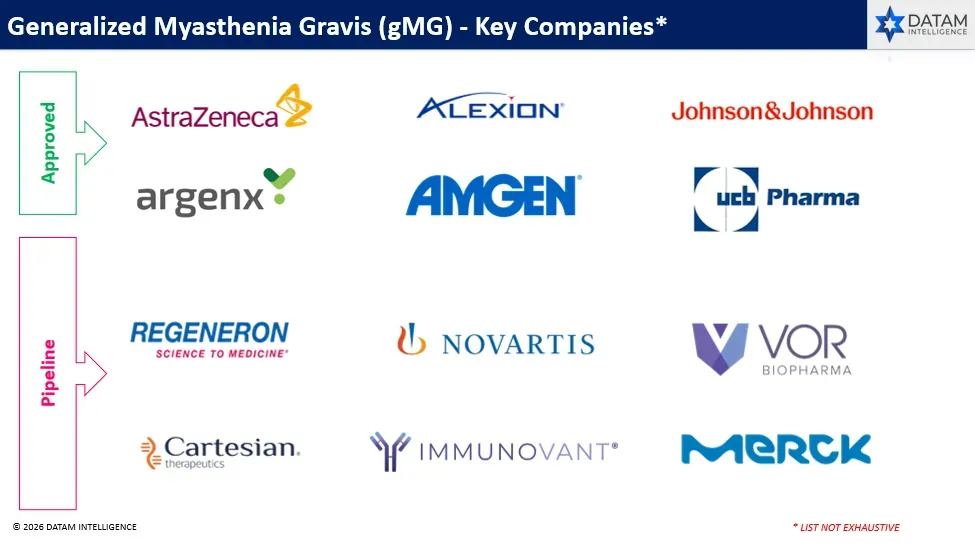
The pipeline is not a single race toward another approval. It is a set of bets on different intervention points, patient groups and treatment models. The following programs had active gMG-specific development or regulatory activity identified in 2026; investigational therapies are not approved and their safety and efficacy have not been established for routine use.
Cemdisiran - Regeneron. This small-interfering RNA therapy targets C5 and is being studied as monotherapy and in a combination program with pozelimab. The FDA and EMA accepted the gMG regulatory applications in 2026; Regeneron reported an FDA decision was expected in November. The program is strategically notable because it approaches complement suppression through RNA interference and a less frequent subcutaneous schedule. Any potential regulatory outcome or market impact must be assessed only after a decision and label are confirmed.
Cladribine - Merck KGaA. The MyClad Phase III trial is recruiting and evaluates an oral formulation in gMG, including efficacy, safety and longer-term treatment questions. Its progress will test whether a lymphocyte-depleting oral approach can establish a role alongside biologics, subject to trial results and regulatory review.
Empasiprubart - argenx. This C2 inhibitor is under Phase II investigation in gMG, including studies evaluating monotherapy and add-on use with efgartigimod in selected patients. It targets an upstream point in the classical complement pathway, offering a different research question from terminal C5 inhibition. Its gMG program remains investigational; the company’s Phase III empasiprubart programs in other neuromuscular indications should not be presented as gMG trials.
Telitacicept - Vor Bio and development partners. Vor Bio reported completion of enrollment in its global Phase III UPSTREAM MG study in September 2026, with primary-endpoint results expected in the first half of 2027. Telitacicept inhibits BAFF and APRIL signaling, a strategy aimed at B-cell and plasma-cell biology. Enrollment completion is a development milestone, not evidence that the treatment is effective or will be approved.
KYV-101 - Kyverna Therapeutics. ClinicalTrials.gov lists KYSA-6 as a recruiting Phase II/III study of an autologous CD19 CAR T-cell therapy in gMG. CAR-T approaches are being investigated for their potential to produce deeper immune-cell effects; they also raise distinct questions about patient selection, treatment intensity, safety, delivery infrastructure and durability. These programs remain early relative to approved chronic therapies and require clinical validation.
For competitive intelligence teams, pipeline tracking should separate active gMG trials from assets studied only in other diseases, completed programs and terminated studies. Phase, recruitment status, sponsor, trial population, route and next expected milestone should be checked against registry records and company disclosures before publication. A molecule’s development in another autoimmune condition is not evidence of an active gMG program.
Request a Customized Report According to Your Business Strategy: https://www.datamintelligence.com/customize/generalized-myasthenia-gravis-treatment-market
Market Outlook and strategic implications
The market’s projected growth reflects several connected forces: greater use of targeted mechanisms, ongoing refinement of patient selection, continued investment in clinical development, and competition to reduce treatment burden while maintaining disease control. North America currently leads, supported by established specialty care and uptake of advanced therapies. Asia-Pacific is forecast to grow fastest, but this regional estimate does not establish Japan-specific growth, access or market share.
For U.S. executives, KLYGEFA moves the focus from regulatory achievement to launch execution. Payer access, specialist familiarity, patient identification, administration preference and fit within treatment pathways will influence commercial adoption. AstraZeneca estimates that around 98,500 people in the United States are diagnosed with gMG, including about 81,000 who are AChR-positive. These epidemiology estimates describe a potential population, not the number of people who will be eligible for, covered for or prescribed a particular product.
For Japan, where KLYGEFA is already approved, decision-makers should assess local reimbursement, treatment practice, specialist uptake and competitive positioning directly. U.S. approval does not determine Japanese access or uptake. The country’s opportunity should be evaluated using local market evidence rather than extrapolating from the U.S. launch or the broader Asia-Pacific forecast.
Across both markets, product strategy will depend on more than mechanism novelty. Leaders should monitor how clinicians weigh route and dosing, label breadth, clinical evidence, safety management, treatment sequencing and payer criteria. Pipeline programs involving complement, FcRn, B-cell and cell-based approaches may reshape the field, but their commercial significance will depend on demonstrated benefit, acceptable risk, regulatory outcomes and real-world adoption.
The approval of KLYGEFA is therefore best understood as a competitive signal, not a market-share conclusion. For companies planning portfolios, partnerships or market access, the lasting question is which treatment profiles can meet distinct patient and system needs while building credible differentiation. DataM Intelligence’s Generalized Myasthenia Gravis Treatment Market report provides further analysis of market sizing, segmentation, competitors and pipeline developments through 2035.