


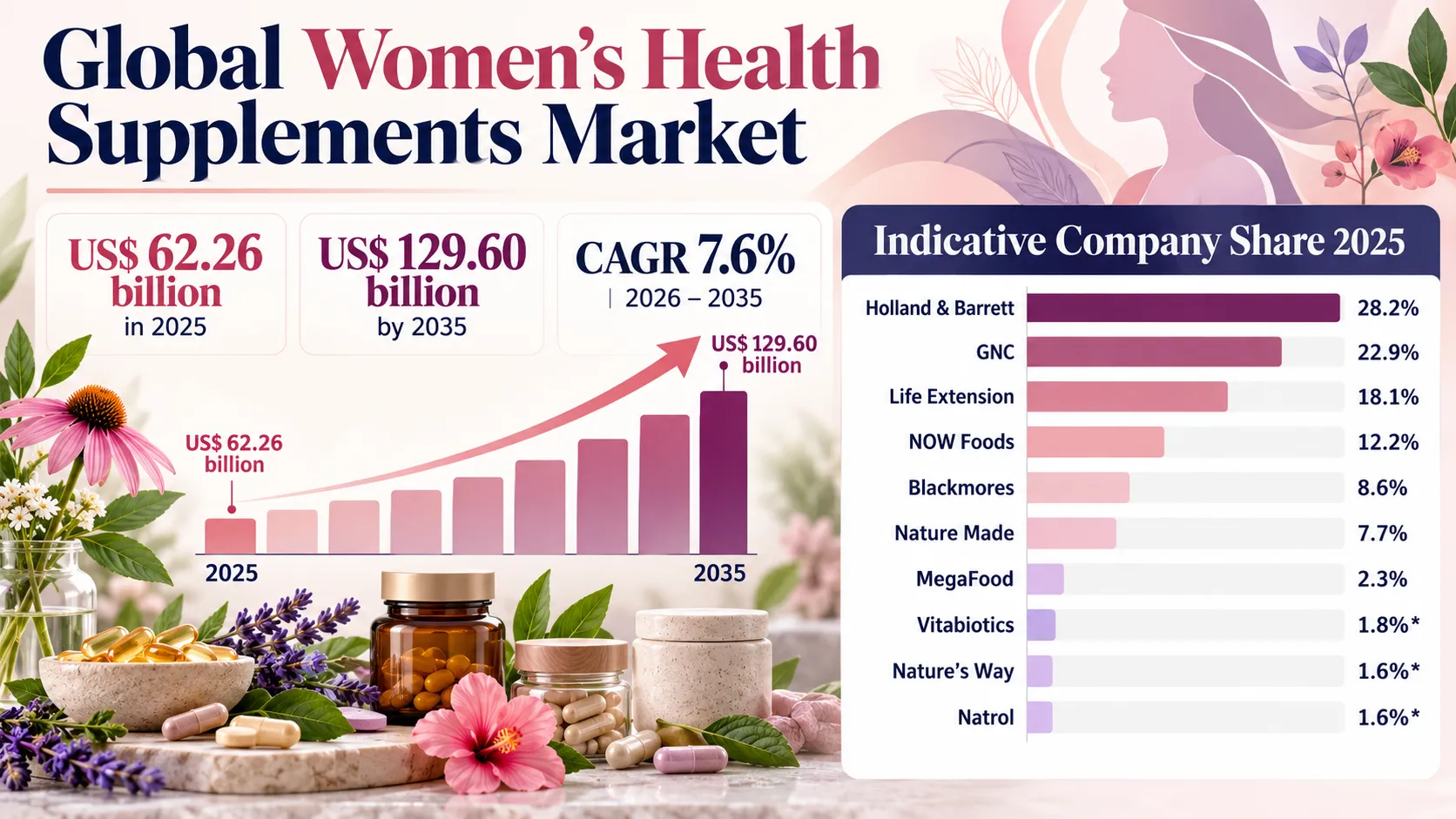
The global women’s health supplements market reached US$62.26 billion in 2025 and is projected to reach US$129.60 billion by 2035, expanding at a 7.6% CAGR from 2026 to 2035. The numbers show a large and durable opportunity, but they do not capture the market’s most important change: women’s health is no longer being treated as a small extension of the general wellness category.
Consumers, retailers and health platforms increasingly seek products for defined life stages and needs—fertility, pregnancy, perimenopause, menopause, bone health, stress, sleep, beauty-from-within and healthy aging. Vague “hormone balance” claims, uncertain botanical sourcing and low-transparency labels are becoming commercial liabilities.
This is changing the basis of competition. The next decade will not be won simply by adding more products to a vitamin portfolio. It will favour businesses that understand women’s needs at different life stages, can substantiate their positioning and can deliver products through the channels where trust is built.
Request Sample: https://www.datamintelligence.com/download-sample/womens-health-supplements-market
A Market Expanding Beyond Conventional Vitamins
Historically, women’s supplements were concentrated around multivitamins, prenatal products, iron, calcium and beauty nutrition. These categories remain essential, particularly where nutrient gaps, pregnancy planning or bone health are major consumer concerns. However, the category is now widening into more nuanced areas of wellbeing.
Perimenopause and menopause are central examples. These life stages were underrepresented in mainstream nutrition portfolios, despite changing needs around sleep, mood, cognition, bone health and metabolism. Brands are now creating products around defined daily-support needs rather than one universal formula.
Women’s health is also extending into preventive aging. Consumers are increasingly interested in preserving mobility, muscle mass, skin quality, mental clarity and energy as they age. As a result, the traditional boundary between women’s vitamins, active nutrition, beauty supplements and healthy-aging products is becoming less clear. This convergence is commercially significant because it increases both basket size and repeat-purchase potential.
The most successful product portfolios will not treat every woman as one audience. They will segment by life stage, health objective, dietary preference, purchase behaviour and preferred channel.
The Higher-Trust Imperative: Quality and Communication Matter More
Recent regulatory and safety developments have underlined the risks of weak quality control in the supplement sector. FDA action involving herbal weight-loss products that may have contained toxic yellow oleander instead of the declared botanical ingredient is a reminder that ingredient identity cannot be assumed. For women’s health brands, this matters especially because consumers may use supplements consistently and may be managing sensitive health needs, including pregnancy, menopause or medication use.
Quality assurance is therefore becoming a growth strategy. Businesses need a documented approach to raw-material qualification, botanical authentication, contaminant testing, label accuracy, supplier audits and adverse-event monitoring. Clear specifications and reliable manufacturing documentation strengthen access to premium retail, practitioner-led channels and international expansion.
Communication is equally important. Women’s health is receiving more attention from product developers and investors, but consumer messaging must remain precise. Health claims should be proportionate to the evidence and should not imply diagnosis, treatment or prevention of disease. This is particularly important in categories such as menopause, fertility, stress, metabolic health and weight management, where consumer interest is high and regulatory scrutiny can follow quickly.
Science and transparency can support pricing power while reducing the risk of compliance incidents, delisting and reputational damage.
Personalization Is Moving from Marketing Claim to Business Model
Personalized nutrition is becoming more relevant to women’s health because a single product recommendation often fails to reflect different needs across age, diet, lifestyle and health goals. The planned acquisition of Vitable by Elixinol Wellness is part of a broader movement toward digital assessment, recurring supplement plans and individualised wellness journeys.
For brands, personalization must be more than an online questionnaire. It should connect a stated goal with a rational recommendation, appropriate dosage form, useful education and a credible reason to continue purchasing. Done well, it can improve retention and support cross-selling across wellness portfolios.
The operational challenge is balancing relevance with simplicity. Consumers may welcome targeted recommendations, but they do not want a confusing catalogue or an expensive regime of too many products. The most effective models will offer a curated pathway: a clear core product, optional additions based on defined needs and transparent guidance on expected use.
Artificial intelligence can make recommendations scalable, but companies must set clear boundaries between wellness guidance and medical advice.
Women’s Health Reaches Mainstream Retail
The expansion of Midi Health supplements into Ulta Beauty stores demonstrates how women’s health is moving beyond specialist wellness sites and pharmacy shelves. It places midlife-focused products in a retail environment where beauty, self-care and wellness already overlap.
This channel shift matters for two reasons. First, it makes women’s health more visible and approachable. Products for menopause, stress, fibre intake, cognitive support and metabolic wellbeing can be discovered alongside established beauty and personal-care routines. Second, it raises the standard for brands seeking shelf space. Retail buyers will look at claims discipline, ingredient differentiation, packaging clarity, consumer education, margin structure and the ability to maintain repeat demand.
Omnichannel strategy will be essential. Direct-to-consumer sales offer education and subscription potential; physical retail offers visibility and scale; pharmacies and practitioner channels add credibility. The key is aligning the product’s complexity and evidence with its purchase environment.
Convenient Formats Are Turning Supplements into Daily Rituals
Women’s health supplementation is increasingly being designed around adherence, not only ingredients. Capsules and tablets will remain important, but powders, liquid shots, gummies, stick packs and ready-to-drink products are gaining attention because they can fit easily into daily routines.
Recent activity in beauty-from-within and longevity nutrition illustrates this move. RalivON’s ready-to-drink approach borrows from functional beverages, while Olive Tree People’s colostrum–hydroxytyrosol concept highlights demand for premium, traceable ingredients.
Format innovation must still meet technical and commercial requirements. Liquid products may face greater formulation and shelf-life complexity. Gummies need careful attention to sugar content, ingredient stability and dose delivery. Powders must dissolve well and offer an acceptable sensory experience. The winning format will be the one that improves adherence without undermining efficacy, label clarity or unit economics.
India’s Growing Importance in the Women’s Health Supply Chain
India is becoming more important to the global nutraceutical industry as a source of formulations, dosage-form expertise, botanical ingredients and contract manufacturing capacity. Recent activity by companies seeking to expand into nutraceuticals and food ingredients reflects the growing appeal of the sector for pharmaceutical-adjacent businesses.
For women’s health supplement companies, India can provide opportunities across softgels, tablets, capsules, powders and liquid formulations. Procurement teams should evaluate quality systems, source documentation, export-market compliance, intellectual-property protection and the ability to scale specialised products consistently.
India is also a major consumer opportunity. Brands that understand local tastes, affordability, regulation and distribution can use it as both a market and supply-chain partner.
Companies Defining the Competitive Landscape
The women’s health supplements category includes retailers, branded supplement businesses and consumer-health groups with distinct strategies. The following companies are especially important to track because they influence product discovery, consumer trust, formulation trends or international market access.
- Holland & Barrett is influential in product discovery, category education, merchandising and private-label wellness.
- GNC is a major supplement retail and brand platform, with broad consumer reach across physical and digital channels.
- Life Extension reflects demand for science-led healthy-aging, cognitive and targeted nutritional support.
- NOW Foods is a benchmark for accessible pricing, category breadth and quality-focused natural-product positioning.
- Blackmores remains a key Asia-Pacific wellness player with brand recognition in regulated vitamins and minerals markets.
Nature Made, MegaFood, Vitabiotics, Nature’s Way and Natrol also warrant close attention. Retail scale, practitioner credibility, science-led branding and regional distribution can each create a defensible position.
The Commercial Outlook Through 2035
The Women’s Health Supplements Market projected growth from US$62.26 billion in 2025 to US$129.60 billion by 2035 reflects more than expanding consumer interest in wellness. It indicates a reorganisation of the market around trusted, targeted and convenient nutrition.
The best opportunities will be found in products that meet a clear women’s-health need, communicate benefits responsibly and deliver an experience consumers want to repeat. Commercial success will depend on the right evidence standard, format, price point and channel.
For investors, manufacturers, retailers and product teams, the question is no longer whether women’s health supplements will grow. The question is which companies can earn trust in a category where personal relevance and scientific credibility increasingly determine purchase decisions.
DataM Intelligence supports businesses with market intelligence on women’s health supplements, competitor activity, consumer demand, formulation trends, distribution models and country-level opportunity assessment.