


AI Infrastructure Is Turning Grid Access Into the GCC’s Next Scarce Resource
The GCC data center story is moving from real estate and cloud capacity into the power system. Regional data center capacity is expected to roughly triple to more than 3 GW over the next five years, with Saudi Arabia and the UAE accounting for more than 80% of expected additions through 2030. The physical constraint is increasingly not whether a campus can be financed or land can be secured, but whether high-voltage grid capacity, substations, transformers, switchgear and cables can be delivered early enough to energize it.
The scale change is visible in the project pipeline. HUMAIN’s planned Riyadh AI campus includes a 380/132/33 kV distribution network, 500 MVA and 200 MVA substations and a 2,000 MVA bulk supply point. In the UAE, the Stargate/UAE-US AI campus has a 5 GW full-buildout ambition, while Dubai is simultaneously expanding a transmission network that already contained 402 transmission substations by mid-2026.
For electrical equipment companies, EPCs, utilities and energy developers attending ADIPEC 2026, the commercial message is straightforward: the next AI data center deal can be won or lost at the grid connection stage. Companies that understand which projects have credible transmission access, where new 400/380/220/132 kV capacity is being tendered and where long-lead equipment is constraining energization will be better positioned than suppliers reacting only after data halls enter construction.
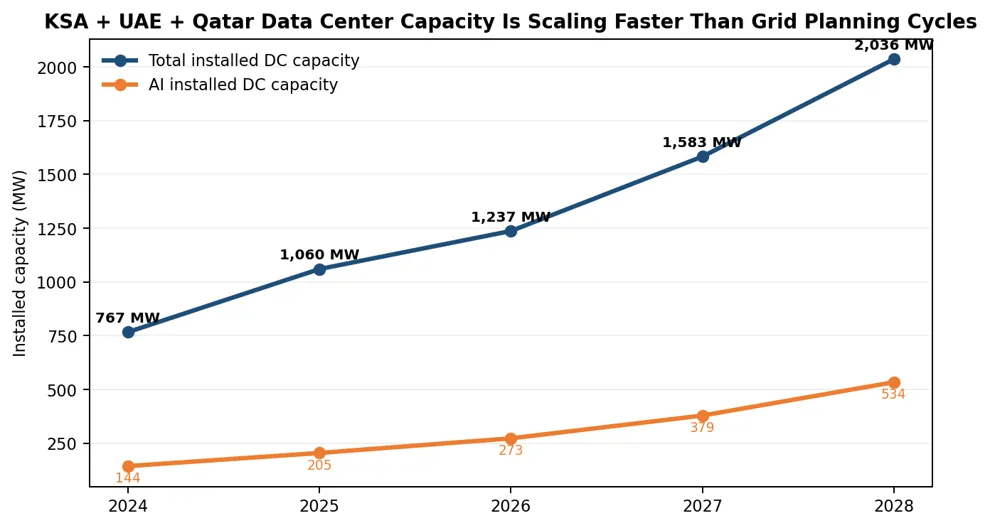
Source: Dii Desert Energy, MENA Energy Outlook 2026
Explore ElectroIQ Intelligence
Discover how ElectroIQ helps you track electrical equipment demand, monitor lead times and identify emerging market opportunities: https://www.datamintelligence.com/electroiq
GCC Data Center Growth Is Becoming a High-Voltage Grid Problem
The region’s data center buildout is increasingly measured in hundreds of megawatts rather than tens. S&P Global expects GCC capacity to rise to more than 3 GW over the next five years, while Saudi Arabia and the UAE are expected to add roughly 2-3 GW of IT power by 2030. At that scale, the grid connection is no longer a routine utility service. A single hyperscale campus can require its own bulk supply point, multiple high-voltage substations, duplicated transformer capacity and dedicated transmission circuits.
This matters because IT load understates the electrical infrastructure that must be developed around a campus. Facility load includes cooling, pumps, UPS losses, distribution losses, security and ancillary systems. A 1 GW IT campus can therefore require materially more than 1 GW of grid-side power depending on PUE and redundancy design. The grid must also accommodate contingency conditions, maintenance outages and N+1 or 2N architectures, so transformer MVA and feeder capacity can exceed the nominal IT load by a wide margin.
The consequence is a new category of “grid lock”: data centers can be commercially announced but remain constrained by transmission studies, new substations, utility interconnection, transformer slots and energization schedules. In markets where several hyperscalers, industrial projects and utility expansion programmes are competing simultaneously, the queue for grid equipment becomes as important as the queue for land.
Saudi Arabia: AI Campuses Are Pulling 380 kV Infrastructure Into Data Center Planning
Saudi Arabia provides the clearest example of AI shifting data center procurement upstream into transmission infrastructure. Installed data center capacity increased from roughly 68 MW in 2021 to around 440 MW in 2025, while HUMAIN is targeting multi-gigawatt AI capacity over the next decade. One planned 6 GW Riyadh campus is already being designed around a 380/132/33 kV electrical network, two dedicated substations rated at 500 MVA and 200 MVA and a 2,000 MVA bulk supply point.
The national grid is expanding at the same time. Saudi Energy added and energized 49 new transmission substations and 131 transmission transformers during H1 2026. Cumulative transmission substation capacity reached 559,831 MVA, while transmission network length reached 108,141 circuit-km. The company’s earlier 2030 target was 1,650 transmission substations, showing that AI is entering a grid that is already absorbing renewables, storage, industrial load and interconnections.
That overlap is strategically important. AI developers are not the only buyers of 380 kV GIS, large power transformers, protection systems and EHV cable. Saudi Arabia is also connecting tens of gigawatts of renewable power and battery storage. The result is competition for engineering capacity, OEM factory slots and commissioning resources across generation, transmission, industry and digital infrastructure.
UAE: Data Center Growth Is Colliding With an Accelerating Transmission Buildout
The UAE is the second anchor market. S&P expects Saudi Arabia and the UAE together to dominate GCC data center additions, while the UAE-US AI campus in Abu Dhabi has a stated 5 GW full-buildout ambition and an initial 1 GW expected over the next three years. This means power infrastructure in Abu Dhabi and Dubai will increasingly be evaluated not just for normal urban and industrial growth, but for clusters of concentrated 24/7 digital demand.
Dubai’s grid data illustrates the pace of preparation. DEWA commissioned eight 132 kV substations in H1 2026 with 1,200 MVA of conversion capacity and also commissioned a 400/132 kV substation with 2,000 MVA of capacity. It is building 65 additional 132 kV substations and one 400 kV station, and plans tenders for more than 30 further 132 kV substations over the next three years. By mid-2026 Dubai had 402 transmission substations, including 28 at 400 kV and 374 at 132 kV.
For AI developers, the value of a site will therefore depend increasingly on proximity to transmission capacity and the timing of future substations. For electrical suppliers, the opportunity is broader than the data center fence line: every new cluster can pull through 400/132 kV transformation, 132 kV GIS, underground cables, protection and control, reactive power equipment and downstream MV distribution.
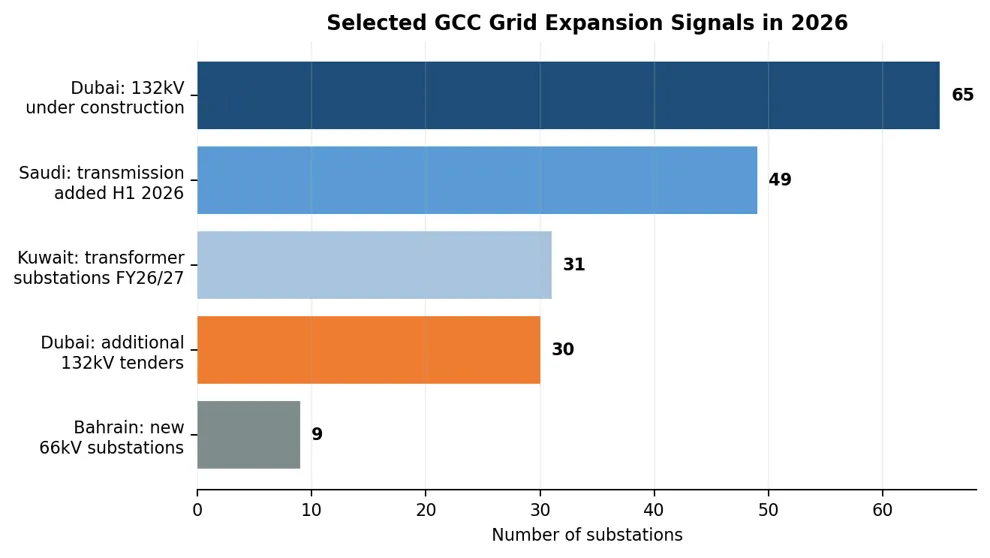
Source: Saudi Energy H1 2026; DEWA July 2026; Kuwait MEWRE; Bahrain EWA
Explore ElectroIQ Intelligence
Discover how ElectroIQ helps you track electrical equipment demand, monitor lead times and identify emerging market opportunities: https://www.datamintelligence.com/electroiq
Qatar, Kuwait, Bahrain and Oman Are Becoming Grid-Intensive Digital Nodes
The second wave of GCC opportunity is emerging outside the two largest data center markets. Qatar’s 2026 transmission expansion programme includes new 132/11 kV and 66/11 kV substations, a new 400/220/132 kV substation and 400 kV EHV cable packages. Qatar had 415 primary substations by May 2024; by the end of 2024 its system included 15 substations at 400 kV, 49 at 220 kV and 114 at 132 kV. Peak network load reached 10,220 MW in summer 2024.
Kuwait is moving from general grid reinforcement into data-center-specific infrastructure. The Ministry of Electricity, Water and Renewable Energy plans 31 transformer substations during the current fiscal year and is separately tendering three 132/11 kV main substations to serve a cloud data center project, with award expected in early 2027. That is a direct example of digital infrastructure creating identifiable HV equipment demand before the computing facility is energized.
Bahrain’s focus is reinforcing the national backbone. The new Al Jasra 400/220 kV station increased transformer capacity from 975 MVA to 2,000 MVA and lifted GCC interconnection capacity from 926 MW to 1,359 MW. EWA is also planning nine additional 66 kV substations adding about 420 MVA of firm capacity between 2026 and 2028.
Oman is now moving rapidly up the AI infrastructure curve. A consortium announced plans in October 2026 for a data center complex in Salalah of up to 400 MW, with grid connection, 400 MW of solar generation and battery storage under development. At the same time, Oman and the GCC Interconnection Authority are implementing a $700 million, 400 kV direct interconnection that includes a roughly 530 km double-circuit line and new 400 kV substations. OETC also commissioned three 132 kV substations in Dhofar in 2026 alongside 267 km of transmission lines.
| Market | Data-center / AI signal | High-voltage grid signal | What suppliers should track |
| Saudi Arabia | ~440 MW installed in 2025; multi-GW HUMAIN pipeline | 49 new transmission substations in H1 2026; 6 GW campus includes 380/132/33 kV network | 380 kV GIS, bulk supply points, large transformers, HV cable, protection |
| UAE | 5 GW UAE-US AI campus full-buildout ambition | Dubai: 65 x 132 kV substations + 1 x 400 kV under construction | 400/132 kV transformation, 132 kV GIS, underground cable, grid studies |
| Qatar | Capacity rising from a smaller base; cloud and AI localization | 2026 expansion includes new 400/220/132 kV substation and 400 kV cables | EHV cable, GIS, transformers, retrofit packages |
| Kuwait | Cloud data center project moving through utility connection | 3 dedicated 132/11 kV substations; 31 transformer substations planned | 132 kV equipment, feeders, transformers, EPC packages |
| Bahrain | Smaller data center market, stronger regional interconnection role | Al Jasra 400/220 kV; 2,000 MVA transformer capacity; 9 new 66 kV substations | 400/220 kV cable, transformers, reactors, 66 kV substations |
| Oman | Proposed 400 MW Salalah AI campus; growing AI-ready pipeline | $700m 400 kV GCC interconnect; new 400 kV and 132 kV stations | Grid connection, renewable + BESS integration, EHV transmission |
The Bottleneck Is Not Generation Alone: Transformers, GIS, Cables and Protection Can Set the Schedule
GCC countries have strong generation expansion options, including gas, solar, storage and regional interconnection. The more immediate schedule risk is often the equipment between generation and the server rack. A high-voltage data center connection requires large transformers, GIS or AIS, EHV cable, bus systems, protection relays, control systems, harmonic filtering and commissioning expertise. These are engineered packages with qualification and factory-test requirements that do not compress easily.
Global lead-time indicators show why project teams increasingly procure electrical equipment before building design is fully mature. Power and substation transformers are being quoted at more than 160 weeks in some markets, generator step-up transformers around 144 weeks and medium-voltage switchgear around 44 weeks on broad market indices, with data-center-specific engineered configurations often longer. Rystad Energy notes that grid equipment can still run two to three years behind schedule in some markets.
The GCC is exposed because its demand surge is synchronized with grid expansion in North America, Europe and Asia. Even where regional EPC capacity is available, transformer cores, bushings, high-voltage breakers, cable systems and specialized test slots draw on global manufacturing pools. This means a project can have land, financing and a power purchase arrangement yet still miss energization because one critical substation package is late.
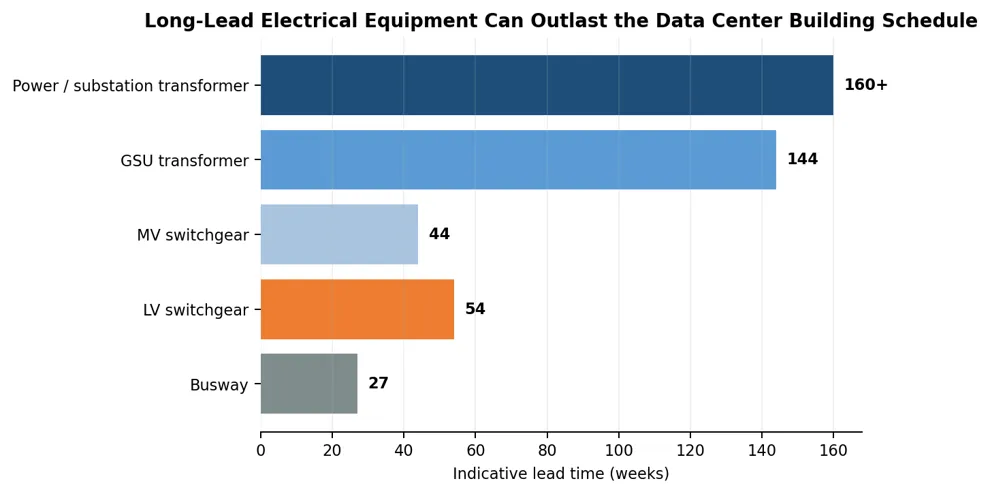
Source: DataM ElectroIQ Lead Time Index
Explore ElectroIQ Intelligence
Discover how ElectroIQ helps you track electrical equipment demand, monitor lead times and identify emerging market opportunities: https://www.datamintelligence.com/electroiq
Grid Locks Will Change Where Data Centers Are Built and How They Are Contracted
The first strategic shift is site selection. Proximity to an existing 400/380/220/132 kV node, available transformer bays and a utility’s near-term transmission plan can be more valuable than low land cost. A site that appears cheaper can become uneconomic if a new bulk supply point, EHV line or multi-year substation programme is required before first power.
The second shift is toward phased energization. Instead of waiting for a full campus connection, developers can sequence blocks of load around available grid capacity, temporary generation, BESS or modular substations. This makes the utility’s connection roadmap part of the data center construction schedule and pushes electrical procurement into the earliest development stages.
The third shift is commercial. Utilities and grid companies increasingly become strategic partners rather than service providers. Saudi Energy’s 2026 agreements with HUMAIN and other digital-infrastructure players explicitly connect power-infrastructure planning with AI expansion. Center3 and Saudi Electricity Project Development Company are also working on early-stage feasibility, substation design and regulatory groundwork for future data centers. That is a signal that grid studies are moving ahead of final campus construction decisions.
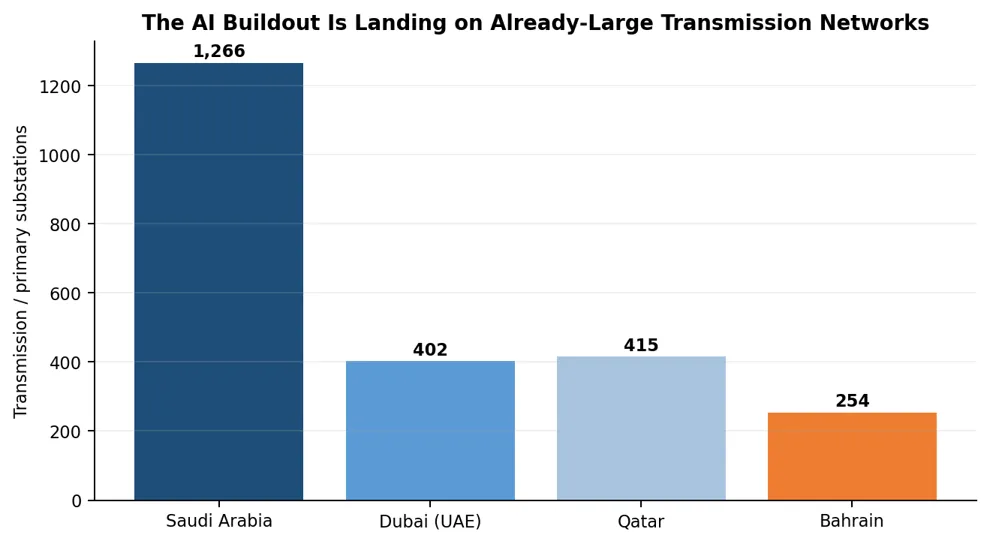
Source: Saudi Energy; DEWA; KAHRAMAA; Bahrain EWA
Explore ElectroIQ Intelligence
Discover how ElectroIQ helps you track electrical equipment demand, monitor lead times and identify emerging market opportunities: https://www.datamintelligence.com/electroiq
The Commercial Opportunity Is Moving Upstream From the Data Hall to the Substation
For transformer, switchgear, cable and grid-automation companies, the highest-value opportunity often appears months or years before server procurement. A project enters the electrical opportunity pipeline when the developer requests load studies, reserves grid capacity, tenders a bulk supply point or begins route planning for EHV cable. By the time the data center EPC tender is public, major high-voltage packages may already be specified.
This favors suppliers that can provide more than equipment. Utilities and hyperscalers increasingly need application engineering, grid-code compliance, protection studies, digital substations, factory-slot visibility, local service teams and commissioning support. In a constrained market, a supplier able to offer a credible delivery date can win share even at a higher equipment price because months of earlier energization can be worth more than the hardware saving.
The second opportunity is in adjacent infrastructure. New AI clusters require additional utility substations, renewable connections, gas generation, BESS, transmission cable, reactive power equipment and grid automation. The addressable project is therefore larger than the data center electrical room: it extends across the power system built to make the campus possible.
What ADIPEC 2026 Attendees Need to Know
ADIPEC 2026 arrives at the point where AI is becoming an energy-infrastructure topic rather than only a technology topic. The event expects more than 239,000 attendees, 2,250+ exhibiting companies and 1,800+ speakers, and its expanded programme explicitly includes AI, grids, infrastructure and industrial execution. For companies selling into the GCC power value chain, the data center buildout should therefore be treated as one of the region’s major new load classes alongside oil and gas, industry, cities and electrification.
| ADIPEC question | Why it matters for GCC data center grid locks |
Where is firm power actually available? | Announced AI capacity can be much larger than immediately connectable grid capacity. Ask for the BSP/substation and energization plan, not only campus MW. |
Which voltage level is the project entering? | 380/400 kV projects create a different vendor set and lead-time profile from 132 kV or MV connections. |
Has the transformer slot been secured? | Large transformers can remain on multi-year lead times and can become the true COD driver. |
Is the utility expanding the local node? | Projects near planned substations and transmission corridors have a materially different delivery risk from greenfield grid extensions. |
Can generation and grid connection be phased? | Gas, solar, BESS and modular grid infrastructure can support staged energization when full utility capacity is delayed. |
Who owns the early engineering relationship? | The vendor engaged during grid studies and substation design can influence specification before the main EPC package is tendered. |
Turn Market Signals into Business Opportunities
Explore equipment-level intelligence to support procurement planning, supplier evaluation and strategic market expansion: https://www.datamintelligence.com/electroiq
For equipment manufacturers, EPCs and investors attending ADIPEC, the practical opportunity is to map AI/data center announcements against transmission projects and procurement windows. The projects most likely to convert into near-term electrical orders are those with defined utility counterparties, identified substation voltages, visible cable routes, transformer capacity and an energization sequence. That is a more useful commercial filter than headline campus capacity alone.
ElectroIQ Can Help Separate Announced Capacity From Actionable Grid Opportunities
DataM Intelligence’s ElectroIQ solution is designed to connect the project layer with the electrical-equipment layer. Its Project Tracker can help commercial teams follow GCC data centers, utility substations, generation and industrial projects by stage, geography and timing, while the Lead Time Tracker adds visibility into constrained transformers, switchgear, cables and other critical packages. Used together, the objective is not simply to identify where AI capacity has been announced, but where grid work is advancing and where an equipment or delivery constraint creates a near-term sales opportunity.
The Next GCC AI Bottleneck Will Be Measured in MVA and Not Limited to MW
The GCC has the capital, land, energy resources and policy ambition to become a major AI infrastructure region. The limiting factor is increasingly the speed at which generation can be converted into reliable high-voltage capacity at the exact sites where computing clusters are being built. That makes substations, transformers, EHV cables and grid engineering strategic infrastructure for the AI economy.
The most important shift for suppliers is timing. Data center opportunity is moving upstream into transmission planning. Companies that wait for a finished data hall specification may arrive after the critical electrical decisions have already been made. Companies that follow bulk supply points, 400/380/220/132 kV tenders, utility capacity additions and long-lead equipment slots can enter the project earlier and compete where schedule certainty has the highest value.
For ADIPEC attendees, this is the central takeaway: the region’s AI buildout is creating a new wave of grid infrastructure investment and a new competition for the same high-voltage equipment already required by renewables, industrial expansion, oil and gas electrification and cross-border interconnection.