


Executive Summary
Enterprise AI agents have emerged as one of the most significant technology investment priorities in 2026. Organizations are transitioning from pilot programs to production-scale deployments, integrating autonomous AI agents across customer service, operations, software engineering, cybersecurity, knowledge management, and business process automation.
Enterprise AI Agent Investment Is Shifting Toward Scalable Business Automation
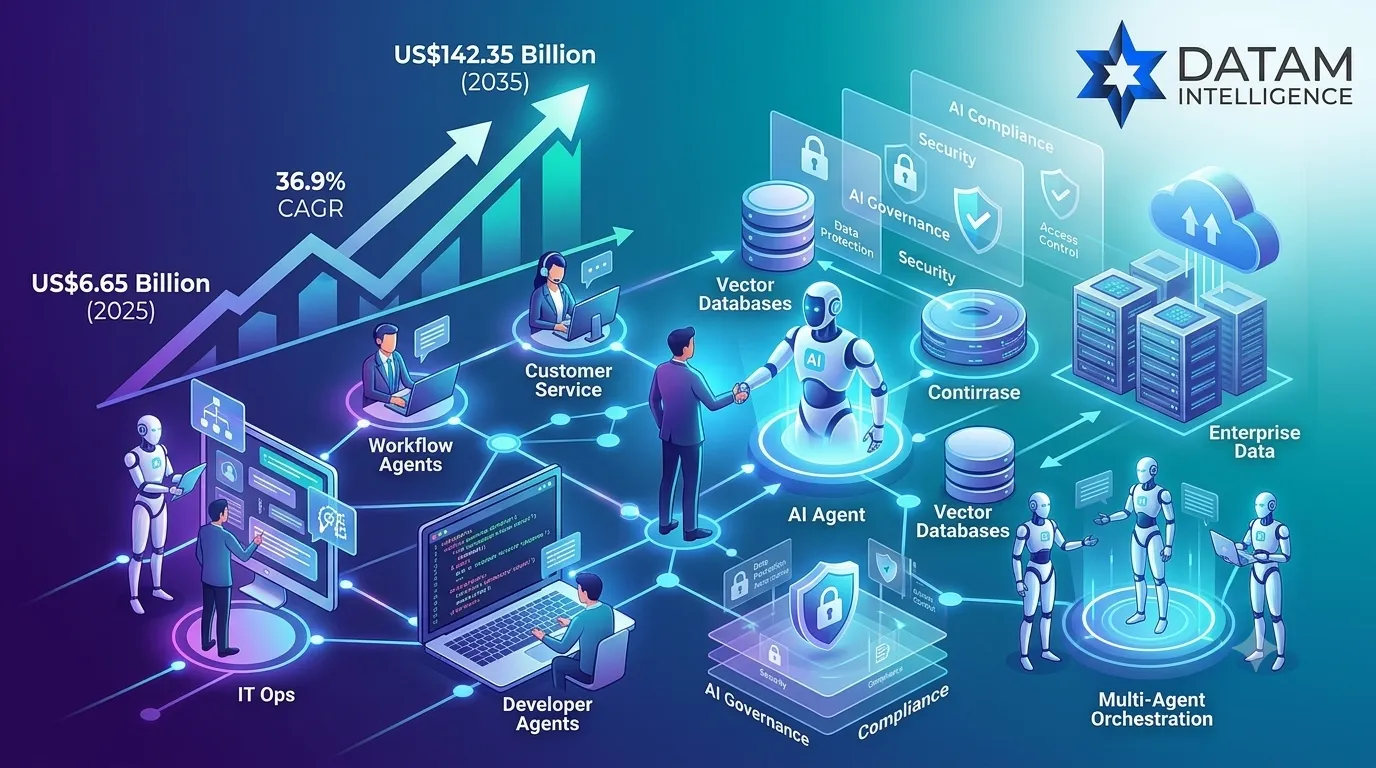
The enterprise AI agent market is entering a high-growth investment phase as organizations move from AI experimentation toward operational deployment. According to DataM Intelligence analysis, the global Enterprise AI Agent Adoption Market reached approximately US$6.65 billion in 2025 and is projected to reach US$142.35 reach billion by 2035, expanding at a CAGR of 36.9% during 2026 - 2035.
Explore the Enterprise AI Agent Adoption Market
Gain access to comprehensive Enterprise AI Agent Adoption Market forecasts, investment trends, adoption patterns, competitive intelligence, and growth opportunities shaping the future of enterprise AI agents.
Download the Sample Report and uncover where the next wave of enterprise AI investments is heading.
Enterprise investments are increasingly focused on AI agent platforms that enable autonomous workflows, decision support, customer engagement, and business process automation. Companies are prioritizing spending across workflow agents, customer-facing agents, developer agents, and decision-support systems to improve productivity, reduce operational complexity, and accelerate digital transformation.
Investment priorities are also expanding beyond AI models toward the supporting ecosystem required for enterprise-scale adoption, including enterprise data platforms, AI orchestration frameworks, cloud infrastructure, governance solutions, and secure deployment environments. DataM Intelligence highlights that fragmented data systems, legacy architectures, and governance challenges remain key factors influencing enterprise AI agent implementation strategies.
Organizations are particularly directing AI agent investments toward high-impact functions such as IT operations, customer service, finance, sales, human resources, and procurement, where autonomous workflows can deliver measurable efficiency improvements and faster decision-making.
AI Agents Move from Experimentation to Enterprise Scale
The enterprise AI landscape has evolved rapidly over the past two years. Organizations are increasingly deploying AI agents capable of autonomous reasoning, workflow execution, task orchestration, and decision support.
Recent industry research indicates that nearly three-quarters of enterprise leaders are adopting or testing AI agents, while a growing number of organizations have begun integrating them into core business functions.
This shift is creating significant investment opportunities across:
- Agentic AI platforms
- Enterprise AI software
- AI infrastructure
- AI governance solutions
- Workflow automation technologies
- Multi-agent orchestration systems
Where Are Companies Spending on Enterprise AI Agents in 2026?
As enterprises transition from AI experimentation to large-scale implementation, investment priorities are shifting toward technologies that enable autonomous decision-making, workflow automation, and intelligent business operations. Organizations are allocating budgets across AI infrastructure, agent platforms, governance frameworks, customer experience automation, software development, and enterprise knowledge management.
The focus is no longer limited to deploying standalone AI tools. Businesses are investing in complete AI agent ecosystems that combine advanced models, enterprise data, cloud infrastructure, security controls, and operational frameworks to achieve measurable business outcomes.
1. AI Infrastructure and Computing Resources: Building the Foundation for Enterprise AI Agents
AI infrastructure has become one of the most critical investment areas as enterprises scale AI agent deployments across business functions. Unlike traditional software applications, AI agents require significant computational capabilities to process large datasets, execute complex workflows, and provide real-time decision support.
Organizations are increasing investments in:
- High-performance computing (HPC) environments to support complex AI workloads and model execution.
- GPU-powered infrastructure to accelerate AI model training, inference, and enterprise-scale deployments.
- AI-optimized cloud platforms that provide flexible computing resources, scalability, and faster deployment capabilities.
- Vector databases and data processing systems that allow AI agents to retrieve and analyze enterprise information efficiently.
- Edge AI infrastructure to enable real-time AI decision-making closer to where data is generated.
As enterprises deploy more autonomous AI agents, infrastructure investments are becoming essential to ensure reliability, scalability, and performance. Companies are also prioritizing hybrid and multi-cloud AI environments to maintain flexibility while managing operational costs.
The growing demand for agentic AI workflows is accelerating investments in computing capacity, data infrastructure, and AI-ready enterprise environments, creating opportunities across the broader AI technology ecosystem.
2. Enterprise AI Agent Platforms: Enabling Autonomous Business Workflows
Enterprise AI agent platforms are becoming a central investment priority as organizations seek scalable solutions for developing, deploying, and managing AI agents.
Businesses are moving beyond individual AI applications and adopting platforms that support:
- AI agent development and customization
- Workflow automation and task execution
- Multi-agent collaboration
- Integration with enterprise applications
- Real-time monitoring and performance analytics
These platforms allow organizations to build AI agents capable of handling complex processes such as customer interactions, financial analysis, employee support, IT operations, and business decision-making.
Enterprises are increasingly evaluating AI agent platforms based on capabilities such as:
- Enterprise-grade security features
- AI governance and compliance controls
- Low-code/no-code development options
- API connectivity with existing systems
- Workflow orchestration capabilities
- Agent performance monitoring
As adoption expands, companies are looking for flexible platforms that can integrate with existing enterprise software environments while supporting customized AI workflows across departments.
3. AI Governance, Security, and Compliance: Managing Enterprise AI Risks
As AI agents gain greater access to business systems, internal data, and operational workflows, organizations are increasing investments in governance and security solutions.
Enterprise AI adoption requires strong controls to ensure AI agents operate safely, transparently, and within regulatory requirements.
Key investment areas include:
- AI governance platforms for monitoring and managing AI agent activities
- Identity and access management solutions to control agent permissions
- AI monitoring and observability tools to track performance and behavior
- Compliance automation solutions to support regulatory requirements
- Risk management frameworks for responsible AI deployment
- Data protection technologies to secure sensitive enterprise information
Security has become a strategic priority as enterprises address risks associated with autonomous AI systems, including:
- Unauthorized access
- Data leakage
- Incorrect decision-making
- Model vulnerabilities
- Compliance challenges
Organizations are increasingly adopting governance-first AI strategies to ensure AI agents can scale securely across business operations.
4. Customer Service and Contact Center Automation: A Leading AI Agent Investment Area
Customer service is one of the fastest-growing application areas for enterprise AI agents due to its measurable business impact and immediate return on investment potential.
Companies are deploying AI-powered customer service agents to improve response times, reduce operational costs, and enhance customer experiences.
Major investment areas include:
- Automated customer support agents
- Virtual assistants and conversational AI systems
- Intelligent ticket classification and routing
- AI-powered knowledge retrieval systems
- Service desk automation
AI agents are helping organizations manage high-volume customer interactions while providing personalized responses based on customer history, preferences, and real-time data.
Businesses are increasingly integrating AI agents with CRM platforms, enterprise databases, and communication systems to create seamless customer engagement experiences.
The ability to improve efficiency while maintaining personalized customer interactions is making customer service one of the highest-priority AI agent deployment areas.
5. Software Development and Engineering Operations: Accelerating Digital Innovation
Software engineering is emerging as a major area of enterprise AI agent investment as organizations seek to improve developer productivity and accelerate application development.
AI agents are transforming traditional software workflows by assisting with:
- AI-powered coding assistance
- Automated software testing
- DevOps workflow optimization
- Code review automation
- Technical documentation generation
Development teams are using AI agents to automate repetitive engineering tasks, identify errors faster, improve code quality, and shorten software delivery cycles.
Beyond coding assistance, enterprises are exploring autonomous development workflows where AI agents can support planning, testing, debugging, and deployment processes.
As businesses prioritize digital transformation, AI-driven software engineering solutions are expected to become a key component of enterprise technology strategies.
6. Knowledge Management and Enterprise Search: Unlocking Business Data Value
Enterprise knowledge management has become another important investment area as organizations struggle with fragmented information across multiple systems.
AI agents are being deployed to transform how employees access, analyze, and utilize enterprise knowledge.
Key applications include:
- Intelligent enterprise search
- Knowledge base automation
- Document analysis and summarization
- Data-driven decision support
- Employee productivity assistants
Many organizations have large volumes of unstructured data stored across documents, emails, databases, and internal systems. AI agents help businesses retrieve relevant information quickly and generate actionable insights.
This investment area provides strong ROI potential because organizations can leverage existing data assets without completely redesigning business processes.
By connecting employees with accurate information faster, AI agents are improving productivity, collaboration, and organizational decision-making.
Future Outlook: Enterprise AI Agent Investments Will Expand Across Business Functions
Enterprise AI agent investments in 2026 are moving toward comprehensive AI ecosystems rather than isolated applications. Organizations are prioritizing solutions that combine automation, intelligence, security, and scalability.
Future investment growth is expected across:
- Autonomous workflow automation
- Industry-specific AI agents
- Multi-agent systems
- AI governance platforms
- Enterprise AI infrastructure
- Human-AI collaboration solutions
Companies that successfully integrate AI agents into core business processes will gain advantages through improved efficiency, faster decision-making, and enhanced customer experiences.
The Enterprise AI Agent Adoption Market is expected to witness significant growth as organizations continue investing in AI-powered automation and intelligent enterprise transformation. Companies, technology providers, and investors are increasingly focusing on scalable AI agent strategies to capture opportunities in the next phase of enterprise digital transformation.
Why Enterprise AI Adoption Is Accelerating in 2026
Enterprise AI adoption is entering a new phase as organizations move beyond initial experimentation and focus on deploying AI agents at scale. Businesses across industries are increasingly recognizing AI agents as strategic technologies capable of improving operational efficiency, automating complex workflows, enhancing decision-making, and creating new growth opportunities.
The acceleration of enterprise AI investment is being driven by several key factors, including measurable business value, rapid advancements in AI technology, increasing competitive pressure, and stronger executive-level commitment.
1. Proven Business Value: Moving from AI Experimentation to Measurable Outcomes
One of the primary drivers accelerating enterprise AI adoption is the growing evidence of tangible business benefits from successful AI deployments.
Organizations are shifting their focus from testing AI capabilities to implementing solutions that deliver measurable improvements across business operations. AI agents are increasingly being deployed to automate repetitive tasks, optimize workflows, reduce operational costs, and improve employee productivity.
Key areas where enterprises are achieving value include:
- Process automation: AI agents are automating time-consuming manual processes across departments such as finance, HR, customer service, and IT operations.
- Improved productivity: Employees are leveraging AI assistants and autonomous agents to complete tasks faster, access information efficiently, and enhance decision-making.
- Operational efficiency: AI-driven workflows help organizations reduce errors, improve response times, and optimize resource utilization.
- Enhanced customer experiences: Businesses are using AI agents to provide faster, personalized, and always-available customer support.
As organizations continue to measure positive returns from AI implementations, investment is shifting toward broader enterprise-wide deployment rather than isolated pilot projects.
2. Technology Maturity: Enterprise AI Platforms Become More Scalable and Reliable
Advancements in artificial intelligence technologies are making AI agents more capable, secure, and suitable for enterprise environments.
Early AI solutions were primarily focused on basic automation and content generation. However, the emergence of agentic AI has introduced more advanced capabilities, enabling systems to understand objectives, execute multi-step workflows, interact with enterprise applications, and make data-driven recommendations.
Technology maturity is being driven by improvements in:
- Large language models (LLMs): More powerful models are enabling advanced reasoning, contextual understanding, and complex task execution.
- AI orchestration frameworks: Enterprises can now manage multiple AI agents working together across different workflows.
- Enterprise integration capabilities: AI agents are becoming easier to connect with CRM, ERP, cloud platforms, and internal databases.
- AI monitoring and governance tools: Improved visibility and control are helping organizations deploy AI responsibly.
These advancements are reducing implementation barriers and encouraging more enterprises to adopt AI agents for mission-critical operations.
3. Competitive Pressure: AI Adoption Becomes a Strategic Differentiator
Increasing competition across industries is pushing organizations to accelerate AI adoption to maintain market relevance.
Companies are recognizing that AI-powered automation can provide significant advantages in areas such as operational efficiency, customer engagement, innovation speed, and cost optimization.
Businesses are investing in AI agents to:
- Reduce operational expenses through automation
- Improve customer response and personalization
- Accelerate product and service innovation
- Enhance employee productivity
- Improve decision-making through real-time insights
Industries such as healthcare, financial services, retail, manufacturing, technology, and professional services are increasingly exploring AI agents to transform traditional business models.
Organizations that successfully integrate AI into their operations are expected to gain competitive advantages by operating more efficiently and responding faster to market changes.
4. Executive Support: AI Becomes a Board-Level Investment Priority
Enterprise AI adoption is increasingly receiving strong support from senior leadership teams as executives recognize AI as a long-term strategic investment rather than a short-term technology initiative.
Chief Information Officers (CIOs), Chief Technology Officers (CTOs), and business leaders are allocating larger budgets toward AI transformation programs focused on automation, innovation, and business growth.
Executive priorities are shifting toward:
- Developing enterprise AI strategies
- Building AI-ready infrastructure
- Establishing governance frameworks
- Scaling successful AI use cases
- Creating AI-driven operating models
Leadership involvement is accelerating AI adoption by ensuring alignment between technology investments and business objectives.
As AI becomes a core component of digital transformation strategies, organizations are making long-term commitments to AI platforms, infrastructure, talent development, and ecosystem partnerships.
Key Challenges Impacting Enterprise AI Agent Adoption
Despite increasing investments and growing interest in agentic AI technologies, enterprises continue to face several challenges while scaling AI agent adoption across business functions. Moving from pilot projects to enterprise-wide deployment requires organizations to address technical, operational, security, governance, and financial complexities.
While AI agents offer significant opportunities for automation and productivity improvement, successful adoption depends on building the right infrastructure, establishing strong governance frameworks, managing risks, and ensuring sustainable investment strategies.
1. Legacy System Integration: Overcoming Complex Enterprise Technology Environments
One of the biggest challenges affecting enterprise AI agent adoption is the integration of AI technologies with existing IT infrastructure.
Many organizations continue to operate on legacy systems, traditional databases, and outdated enterprise applications that were not originally designed to support AI-driven workflows. These fragmented technology environments can create difficulties when connecting AI agents with critical business processes and data sources.
Key integration challenges include:
- Compatibility issues: Older systems may lack modern APIs or integration capabilities required for AI agent connectivity.
- Data fragmentation: Enterprise data is often distributed across multiple platforms, making it difficult for AI agents to access accurate and real-time information.
- Infrastructure limitations: Existing technology environments may require significant upgrades to support advanced AI workloads.
- Workflow disruption risks: Organizations must integrate AI agents without interrupting existing business operations.
To overcome these challenges, enterprises are investing in modern data architectures, cloud migration strategies, API-based integrations, and AI-ready infrastructure that enables seamless interaction between AI agents and existing systems.
2. Governance Complexity: Managing the Growth of AI Agent Ecosystems
As enterprises deploy AI agents across multiple departments, managing and controlling these systems is becoming increasingly complex.
Unlike traditional software applications, AI agents can independently perform tasks, access information, interact with systems, and make recommendations. Without proper governance, organizations may face challenges related to monitoring, accountability, and operational control.
A growing concern is AI agent sprawl, where multiple departments independently deploy AI agents without centralized management.
Major governance challenges include:
- Lack of visibility: Organizations may struggle to track where AI agents are deployed and how they are being used.
- Performance monitoring: Enterprises need mechanisms to evaluate AI agent accuracy, reliability, and effectiveness.
- Access management: AI agents require clearly defined permissions to prevent unauthorized actions.
- Standardization issues: Different departments may adopt different AI tools, creating inconsistent processes.
To address these concerns, enterprises are developing AI governance frameworks that include centralized monitoring, usage policies, compliance guidelines, and lifecycle management strategies.
Effective governance will become a critical factor in enabling responsible and scalable AI agent adoption.
3. Security and Compliance Risks: Ensuring Safe Enterprise AI Operations
Security and regulatory compliance remain major barriers to enterprise AI agent implementation, particularly as AI systems gain access to sensitive business information and operational workflows.
AI agents often interact with enterprise databases, customer information, financial systems, and internal applications, increasing the importance of strong security controls.
Key security and compliance concerns include:
- Data privacy risks: AI agents must handle sensitive information while complying with data protection regulations.
- Unauthorized access: Poorly managed permissions can allow AI agents to access restricted systems or information.
- Model vulnerabilities: AI systems may face risks such as prompt manipulation, data leakage, or incorrect outputs.
- Regulatory requirements: Enterprises must ensure AI deployments align with industry-specific compliance standards.
Organizations are increasingly investing in:
- AI security platforms
- Data protection solutions
- Identity and access management systems
- AI monitoring tools
- Compliance automation frameworks
Building secure and transparent AI agent environments will be essential for enterprise adoption, particularly in highly regulated industries such as healthcare, banking, insurance, and government services.
4. Cost Management: Balancing AI Investment With Long-Term ROI
Although AI agents can deliver significant productivity improvements, managing costs remains a major consideration for enterprises.
The financial requirements of deploying AI agents extend beyond software licensing and include infrastructure, integration, maintenance, security, and ongoing optimization expenses.
Major cost factors include:
- Computing infrastructure: Advanced AI workloads require significant processing power, cloud resources, and storage capacity.
- Model usage costs: Organizations must manage expenses associated with AI model inference and API consumption.
- Integration investments: Connecting AI agents with enterprise systems often requires specialized development and customization.
- Monitoring and maintenance: Continuous performance evaluation and improvement require ongoing investment.
As AI agents handle increasingly complex workflows, enterprises must develop effective cost management strategies to maximize returns.
Organizations are focusing on:
- Selecting appropriate AI models based on business requirements
- Optimizing AI workflows to reduce unnecessary computation
- Using hybrid AI architectures
- Measuring AI performance through business impact metrics
A clear focus on ROI will help enterprises determine which AI agent deployments deliver the highest strategic value.
Future Perspective: Addressing Challenges Will Define Enterprise AI Success
Enterprise AI agent adoption is accelerating, but long-term success will depend on how effectively organizations address integration, governance, security, and cost challenges.
Companies that establish strong AI foundations including modern infrastructure, effective governance frameworks, robust security practices, and sustainable investment models will be better positioned to scale AI agents across business operations.
As enterprises continue moving toward autonomous workflows and intelligent automation, overcoming these adoption barriers will play a critical role in shaping the future growth of the Enterprise AI Agent Adoption Market.
Enterprise AI Agent Market Outlook Through 2032
The next phase of enterprise AI adoption will focus on:
- Multi-agent systems
- Autonomous business workflows
- Industry-specific AI agents
- Agent governance platforms
- AI workforce augmentation
- Human-agent collaboration models
Analysts expect enterprise spending to continue shifting from standalone AI tools toward integrated agent ecosystems capable of delivering end-to-end business outcomes. Gartner forecasts substantial growth in AI models, AI platforms, and AI infrastructure spending as enterprises expand adoption.
Organizations that establish scalable AI agent strategies today will be better positioned to capture productivity gains, operational efficiencies, and competitive advantages over the coming decade.
Analyst Perspective
Enterprise AI agents are no longer a future concept they are becoming a foundational layer of digital transformation. The most successful organizations in 2026 are not simply investing in AI tools; they are building enterprise-wide agent ecosystems supported by governance, security, and measurable business outcomes.
As adoption accelerates, decision-makers should focus on scalable deployment models, strong governance frameworks, and use cases that deliver clear ROI. Companies that balance innovation with operational control will lead the next wave of enterprise AI transformation.
Where are companies investing in enterprise AI agents in 2026?
Companies are investing in enterprise AI agents across AI workflow automation platforms, enterprise data infrastructure, AI governance solutions, cloud deployment environments, and industry-specific AI applications. The highest adoption opportunities are emerging in IT operations, customer service, finance, knowledge management, and business process automation as enterprises scale AI from pilot projects to production environments.