


Introduction
The future of autonomous mobility depends entirely on a vehicle's ability to make intelligent decisions within milliseconds. As the automotive industry transitions from driver-assist technologies toward true Level 4 autonomous driving capabilities where the vehicle handles all driving tasks under specific conditions one challenge stands out above all others: the real-time data processing bottleneck.
Modern autonomous vehicles (AVs) are rolling data centers. They generate enormous volumes of data from a massive sensor array: high-resolution cameras, LiDAR point clouds, radar systems, ultrasonic sensors, GPS modules, and vehicle-to-everything (V2X) communication networks. Processing this continuous tidal wave of information quickly enough to execute safe navigation, split-second obstacle avoidance, and emergency braking requires a radical departure from traditional computing models.
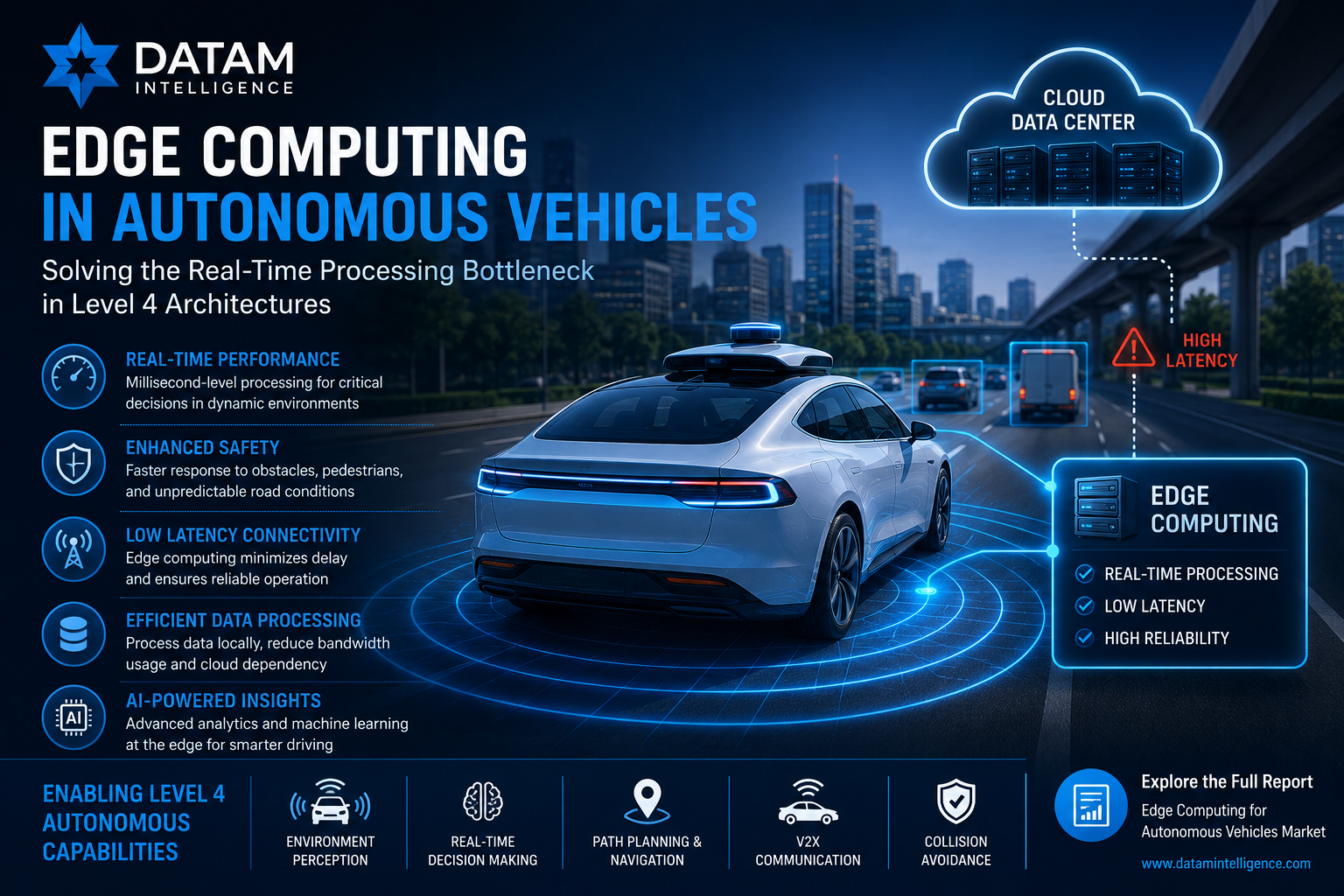
This is where edge computing has emerged as a non-negotiable technology enabler. By shifting data processing from distant, centralized cloud servers directly to the "edge" of the network onboard the vehicle itself and within localized roadside infrastructure automakers are unlocking the ultra-low latency required for safe, driverless mobility.
What Is Edge Computing in Autonomous Vehicles?
Edge computing in autonomous vehicles refers to the architectural practice of processing and analyzing vehicle-generated data locally either via onboard AI computers or through nearby roadside units (RSUs) rather than transmitting raw data to remote cloud data centers.
By keeping computation local, edge computing minimizes network transmission delays and ensures that the vehicle retains full situational awareness and operational capacity, even when driving through cellular dead zones. For Level 4 autonomous systems, edge computing is no longer a design preference; it is the foundational infrastructure required for functional safety.
Why Real-Time Processing Is Critical for Level 4 Mobility
At 60 mph, a vehicle travels approximately 88 feet per second. In a safety-critical scenario, a processing delay of even 100 milliseconds means the vehicle moves nearly 9 feet before initiating a safety response.
To safely pilot a vehicle without human oversight, a Level 4 system must ingest, fuse, and interpret a massive stream of simultaneous data inputs every single second:
- High-resolution video feeds tracking lane markings and traffic signals.
- LiDAR point clouds mapping out a highly accurate 3D representation of the immediate environment.
- Radar inputs measuring the relative velocity of surrounding objects in poor weather.
- V2X telemetry alerting the vehicle to hidden hazards around a blind corner.
Edge computing eliminates the dangerous transit time of this data, enabling local perception-action loops to execute in under 10 milliseconds well within the window required for human-surpassing safety.
Deepen Your Automotive Edge Strategy
Designing next-generation Level 4 vehicle architectures requires balancing computing power, hardware TCO, and electrical efficiency.
Download a Free Sample PDF of the Global Edge Computing for Autonomous Vehicles Market Report to explore our 2026 - 2033 forecast on in-vehicle processing hardware, AI accelerator adoption rates, and vendor market shares.
The Cloud Computing Limitation in Autonomous Driving
Centralized cloud computing remains vital to the autonomous ecosystem, powering fleet management, long-term data storage, over-the-air (OTA) software updates, and global deep learning model training. However, relying exclusively on the cloud for real-time driving decisions introduces three fatal flaws:
- Network Latency: Even with advanced cellular connectivity, routing data to a remote server, waiting for processing, and transmitting the command back introduces a latency floor that cannot support split-second collision avoidance.
- Connectivity Gaps: Vehicles must operate reliably across underground parking structures, rural corridors, tunnels, and areas suffering from network congestion or dropped signals. A loss of cellular connection cannot mean a loss of vehicle control.
- Bandwidth and Cost Constraints: A single autonomous test vehicle can generate several terabytes of data per day. Attempting to continuously stream raw sensor data from millions of production vehicles to the cloud would crash existing cellular networks and create unsustainable operational costs.
How Edge Computing Solves the Processing Bottleneck
1. Ultra-Low Latency Decision Making
Instead of sending raw sensor data upstream, onboard edge platforms perform localized machine learning inference. This allows the vehicle's actuation systems to instantly adapt to a pedestrian stepping off a curb or a leading vehicle slamming on its brakes.
2. Deterministic Fail-Safe Reliability
Edge architecture provides the system redundancy required for functional safety standards (such as ISO 26262). If a vehicle loses its 5G connection entirely, the local edge computer continues to navigate, track objects, and execute safe harbor maneuvers completely unassisted.
3. Intelligent Data Triage
Edge computing acts as an intelligent filter. It processes high-frequency data locally and compresses or filters out non-critical information. Only critical edge-cases, anomalous data points, and system health metrics are flagged for cloud upload, drastically lowering cellular bandwidth costs.
Key Technologies Powering the Automotive Edge
The deployment of edge computing in Level 4 architectures relies on a highly integrated stack of hardware and communication protocols:
| Technology Component | Primary Role in Edge Architecture | Key Players / Standards |
|---|---|---|
| AI Accelerators | High-speed neural network inference for object and lane detection. | NVIDIA DRIVE Thor, Mobileye Ultra, Qualcomm Snapdragon Ride |
| Sensor Fusion Engines | Combining LiDAR, radar, and camera inputs into a single, real-time 3D world model. | Local System-on-Chip (SoC) hardware blocks |
| 5G & C-V2X | High-speed, low-latency communication with local Roadside Units (RSUs) and nearby vehicles. | 3GPP Release 16/17, Multi-access Edge Computing (MEC) |
Industry Applications Beyond Passenger Vehicles
While passenger cars command significant media attention, the commercial deployment of edge computing is scaling rapidly across several distinct mobility verticals:
- Robotaxis: Urban ride-hailing fleets operating in dense, chaotic city centers depend heavily on localized edge nodes to safely navigate high-pedestrian environments.
- Autonomous Trucking: Long-haul hub-to-hub freight relies on edge processing to manage the massive braking distances and high-speed aerodynamics of class-8 commercial vehicles.
- Industrial & Off-Highway Mobility: In mining, agriculture, and closed-loop logistics centers, local edge platforms allow autonomous machinery to operate productively in remote environments completely devoid of stable internet connectivity.
Regional Spotlight: Asia-Pacific as a Growth Hub
The Asia-Pacific region is rapidly solidifying its position as a primary engine for autonomous edge computing infrastructure. Driven by aggressive government frameworks, massive smart city initiatives, and rapid 5G infrastructure rollouts, countries like China, Japan, and South Korea are accelerating commercial edge deployments. The concentration of leading semiconductor foundries and automotive Tier-1 suppliers in the region continues to fast-track the commercialization of cost-effective, high-compute automotive edge silicon.
Frequently Asked Questions
Why is edge computing important for autonomous vehicles?
Edge computing allows autonomous vehicles to process vast amounts of sensor data locally, cutting down latency to single-digit milliseconds. This rapid processing is vital for split-second, safety-critical driving decisions.
Can autonomous vehicles operate using only cloud computing?
No. While the cloud is excellent for fleet analytics, mapping updates, and long-term AI training, it cannot guarantee the ultra-low latency or continuous connectivity required for real-time steering, braking, and hazard avoidance.
How does edge computing lower operational costs for AV fleets?
By processing and filtering data locally on the vehicle, edge systems only transmit necessary metadata and high-value edge-cases to the cloud. This drastically reduces cellular data bandwidth consumption and cloud storage costs.
Access the Complete Market Insights
The global edge computing for autonomous vehicles market is moving at a breakneck pace. Fuelled by hardware consolidation, software-defined vehicle architectures, and shifting regional dynamics, staying ahead requires verified data.
Request a Comprehensive Market Report Presentation or connect with our lead automotive analysts to review the complete market segmentation, competitive intelligence, and growth forecasts through 2033.