


The global data-center industry is entering a more demanding phase of growth. Artificial intelligence is still driving unprecedented requirements for compute capacity, high-density racks and accelerated infrastructure deployment. Yet the industry’s central challenge is no longer simply securing land, raising construction capital or attracting cloud tenants. The most decisive issues are increasingly access to reliable power, speed of grid connection, water availability, planning approvals and the ability to build facilities that can support AI workloads without creating unsustainable operating costs.
This week’s developments show new campuses advancing at hundred-megawatt and gigawatt scale while regulators increase scrutiny of energy demand, community impact and grid costs.
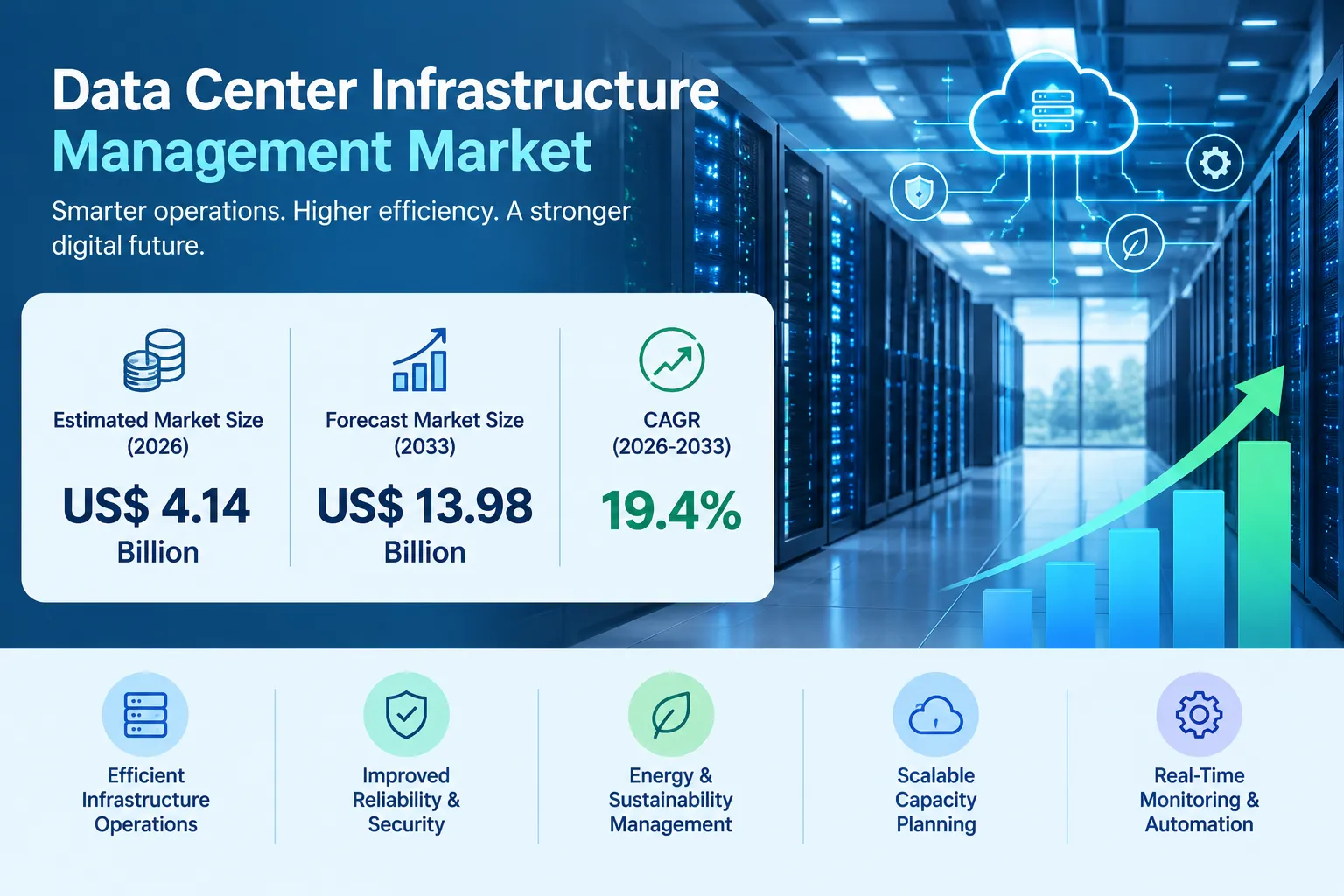
Request Sample: https://www.datamintelligence.com/download-sample/data-center-infrastructure-management-market
Nscale’s IPO Filing Signals Continued Capital-Market Confidence in AI Infrastructure
Nscale’s planned U.S. IPO is one of the week’s clearest signs that investors still see AI infrastructure as a long-term growth category. The company is positioning itself as an integrated AI-cloud and data-center platform, with operating capacity today and a much larger potential development pipeline across the United States and Europe.
Capital is moving toward operators that combine secured sites, power pathways, GPU-ready design and customer commitments. Prospective customers should test whether an announced pipeline is supported by signed power arrangements, financing, equipment access and a realistic construction timetable.
Australia’s Proposed Rules Put Renewable Power and Water at the Center of Site Selection
Australia is considering requirements that would make large AI data centers match their electricity usage with renewable generation while reducing their water intensity. These proposals acknowledge a reality the industry can no longer ignore: a data center’s impact on regional power and water systems is becoming a formal factor in market access.
Energy procurement and water strategy must be embedded in site selection from the beginning. Renewable-energy contracts, behind-the-meter generation, energy storage, closed-loop cooling and recycled-water access are becoming commercial differentiators.
U.S. Lawmakers Debate Who Should Pay for Data Center Grid Expansion
The debate in Washington over grid-cost allocation highlights a growing tension between AI growth and consumer electricity affordability. Large data centers often require new substations, transmission upgrades and generation capacity. The unresolved question is how much of that incremental cost should be funded by operators and how much could fall on wider ratepayer bases.
Even where land and customer demand are available, uncertain interconnection costs can change the investment case. Developers should model higher contributions to network upgrades, staged energisation and longer connection timelines.
Loudoun County’s Pause Shows That Mature Hubs Face New Permitting Risk
Loudoun County, Virginia, remains one of the world’s most important data-center markets, but its decision to pause final action on certain new applications shows that even established hubs are reassessing growth. The county is reviewing rules related to data-center locations, standards and electrical substations, reflecting broader concerns about land use, power infrastructure and local acceptance.
Mature hubs have not stopped growing, but their development model is becoming more selective. Companies need strong local stakeholder plans, transparent community-benefit narratives and diversified land pipelines.
Project Phoenix Redefines the Power-Ready Campus Model
Aligned Data Centers’ Project Phoenix in Pennsylvania illustrates how the next generation of large campuses may be designed. The planned 2 GW development combines a former industrial energy site with dedicated onsite power and a low-water operating model. This is significant because it brings energy supply, land redevelopment and data-center capacity into a single project proposition.
Sites connected to existing energy assets can offer a faster route to scale than greenfield projects dependent on long grid-upgrade cycles. The project also shows how water-efficient cooling is becoming essential for large AI campuses.
Microsoft’s Atlanta Plans Reinforce Georgia’s Hyperscale Momentum
Microsoft’s proposed two-building campus outside Atlanta is another indication that hyperscalers are expanding beyond their earliest concentration points. Georgia offers a combination of land, connectivity, enterprise demand and proximity to a growing technology ecosystem. The move also highlights the importance of secondary markets that can support large-scale development while avoiding some of the land and permitting pressure found in more mature data-center clusters.
Regional expansion does not remove infrastructure risk: multiple hyperscalers can rapidly tighten local power availability and construction capacity. Developers need detailed insight into utility planning, substation capacity, fibre routes, labour availability and local approvals.
Madrid’s 100 MW Addition Strengthens Southern Europe’s AI Position
Nabiax’s new 100 MW project in Madrid demonstrates that Southern Europe is becoming more relevant to cloud and AI infrastructure strategies. The facility is intended to support hyperscale, cloud and AI demand and will use closed-loop cooling, reflecting the importance of environmental design in newer European projects.
Madrid’s appeal rests on connectivity, regional demand, talent and its role as a gateway between Europe and international markets. Operators should assess long-term clean-power availability and regulatory expectations around heat, water and emissions.
Oman’s Capacity Target Highlights Middle East Ambition
Oman’s O-Green is targeting substantial data-center capacity by 2028, adding to wider Middle East ambitions in cloud, AI and digital infrastructure. The region’s potential is supported by renewable-energy resources, strategic connectivity routes and government interest in diversifying national economies through technology investment.
The Middle East now requires a dedicated strategy rather than a small regional extension. The opportunity depends on reliable power, strong connectivity, data-sovereignty requirements and credible local partnerships.
Scotland’s Planning Restrictions Raise the Environmental Bar
Scotland’s decision to tighten scrutiny of new AI data-center proposals underlines how environmental assessment and community acceptance are evolving from secondary issues into core market constraints. Data-center projects can bring construction investment, tax revenue and digital capacity, but local stakeholders increasingly demand clear evidence on power consumption, water use, emissions, noise and employment benefits.
This trend is likely to influence planning outcomes across regions with constrained grids or concerned communities. Renewable procurement, heat reuse, liquid cooling, grid support and workforce development can strengthen a project’s social licence to operate.
India’s AI Infrastructure Investment Momentum Opens a Larger Value Chain
India continues to attract attention as investment in AI-enabling infrastructure grows across power systems, data centers and semiconductors. The opportunity is larger than the facilities themselves. It extends to transmission equipment, backup power, cooling systems, network connectivity, engineering services, cloud platforms and specialised operations talent.
India’s scale and growing digital economy create a compelling long-term case, but buyers must evaluate local power availability, state-level policy, land acquisition, water management and equipment supply chains.
The investment case also depends on how facilities are commercialised. Demand is likely to be split between hyperscale cloud regions, enterprise colocation, sovereign-cloud workloads and AI inference deployed closer to users. This creates room for multiple operating models, but it also raises the importance of matching facility design to the customer profile. A campus designed primarily for large AI training clusters requires different power density, cooling, network architecture and commercial contracts from a facility serving conventional enterprise workloads.
India’s opportunity will therefore be strongest where developers can connect infrastructure capability with a clear route to market. Long-term power planning, local implementation partners, flexible deployment phases and credible commitments from anchor customers can reduce execution risk. These factors will determine which announced projects become durable capacity rather than simply additions to a development pipeline.
The New Data Center Competitive Advantage: Power, Permits and High-Density Readiness
The developments of the past week point to one conclusion: demand for AI data-center capacity remains strong, but not every announced project will convert into operational infrastructure on time. Winning operators will secure grid access or dedicated energy solutions early, select sites with realistic permitting paths, design for high-density computing and demonstrate responsible water and environmental performance.
For investors, the most valuable platforms will be those with credible power contracts, qualified supply chains, financially executable projects and customer demand that can support long-term returns. For suppliers, the strongest opportunity lies in enabling this transition: advanced cooling, electrical distribution, backup power, grid integration, modular construction, connectivity and operational software.
This changes the buying criteria across the ecosystem. Customers will assess not only the price of capacity but also the certainty of energisation, the ability to accommodate future rack densities and the transparency of power and water performance. Investors will look more closely at whether capital expenditure is linked to real customer commitments. Local governments will increasingly seek evidence that facilities deliver jobs, infrastructure improvements and responsible resource use. The commercial winners will be those that can align these interests without slowing the pace of AI deployment.
Read Complete Research Report: https://www.datamintelligence.com/research-report/data-center-infrastructure-management-market