


The rapid expansion of artificial intelligence is forcing data center infrastructure to confront a physical reality: every additional unit of computing power produces heat that must be removed continuously, reliably and economically.
For decades, cooling was treated as supporting infrastructure selected after decisions about servers, racks and floor space had already been made. That sequence no longer works for AI clusters, high-performance computing environments and increasingly dense cloud infrastructure. Cooling capacity now influences how much computing equipment can be installed, how quickly new workloads can be activated and whether existing facilities can support the next generation of processors.
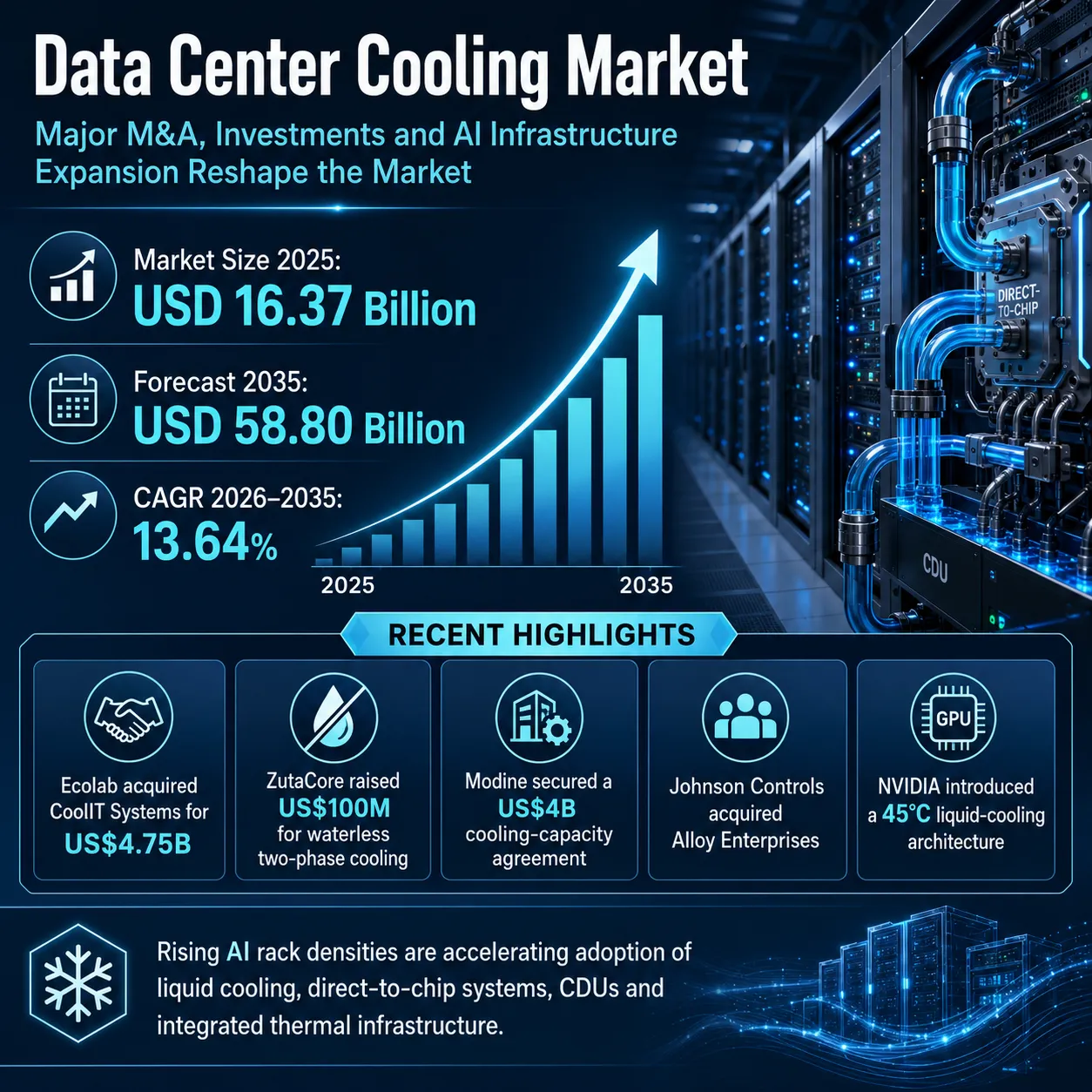
The commercial impact of this transition is already visible. According to DataM Intelligence, the global data center cooling market reached USD 16.37 billion in 2025 and is projected to reach USD 58.80 billion by 2035, expanding at a CAGR of 13.64% during 2026–2035. Growth is being supported by hyperscale construction, colocation expansion, AI workloads, cloud adoption and demand for more efficient thermal infrastructure.
Request for Exclusive Sample: https://www.datamintelligence.com/download-sample/data-center-cooling-market
The United States and Japan illustrate two different dimensions of the cooling challenge. The United States is experiencing an unprecedented expansion of AI computing capacity, placing pressure on electricity grids, water resources and existing data center campuses. Japan is combining digital infrastructure growth with tighter energy-efficiency requirements, limited space and a growing focus on advanced cooling controls.
In both markets, the central question is no longer whether cooling technology needs to evolve. It is how quickly operators can select, finance and implement the right combination of air cooling, liquid cooling, automation and water-conscious design.
Key Takeaways
- Cooling is becoming a primary constraint on deployable AI computing capacity.
- Air cooling will remain relevant, but high-density environments increasingly require direct-to-chip, rear-door or immersion-based systems.
- Most existing facilities will transition through hybrid cooling rather than replace air systems completely.
- Cooling investment should be evaluated against compute capacity, energy consumption, water exposure, reliability and future expansion.
- The United States must align data center cooling plans with grid availability, local water conditions and community expectations.
- Japan’s PUE requirements are making measurable efficiency a more important consideration in new construction and facility modernization.
- AI-based control systems could reduce overcooling by coordinating server demand, chillers, HVAC equipment and liquid cooling loops.
Cooling Is Becoming the Capacity Gatekeeper for AI Infrastructure
Traditional data center expansion was largely driven by the availability of floor space and electrical capacity. AI infrastructure adds a third non-negotiable requirement: the ability to remove concentrated heat from high-density racks.
AI servers combine power-intensive accelerators, high-bandwidth memory, advanced networking and tightly packed components. As a result, the heat generated within a single rack can rise far beyond the comfortable operating range of legacy room-based air-cooling designs.
When cooling capacity is exhausted, available floor space can become commercially unusable. A facility may have room for additional racks and even access to sufficient electricity, yet still be unable to deploy more computing equipment safely.
The practical equation is straightforward:
Available power + available cooling + usable floor capacity = deployable compute capacity
This changes the financial role of cooling. A better thermal architecture can support additional computing capacity within an existing building, delay the need for physical expansion and improve the revenue potential of each data hall.
DataM Intelligence identifies this shift as one of the defining forces in the market. Cooling now affects the ability to deploy AI racks, improve power utilization and increase computing density without rebuilding the entire facility.
Why Legacy Cooling Designs Are Under Pressure
Air cooling remains effective for a large share of conventional enterprise, cloud and colocation workloads. The problem is not that air cooling has suddenly become obsolete. The problem is that its economic and engineering limits are being tested by concentrated AI workloads.
A conventional system removes heat by moving conditioned air through servers and then returning warmer air to cooling equipment. Its effectiveness depends on airflow volume, containment, temperature differentials, fan performance and the ability to prevent hot and cold air from mixing.
As rack density increases, several problems can appear:
- Thermal hotspots become more difficult to control.
- Server fans consume more electricity.
- More floor space is required for air movement.
- Cooling equipment may need to operate at higher intensity.
- Temperature variations can increase across the data hall.
- Additional computing equipment cannot be installed without substantial mechanical upgrades.
- Overcooling may be used as a precaution against localized heat.
These challenges explain why many facilities are moving toward architectures that remove heat closer to the processor.
Comparing the Main Data Center Cooling Technologies
No single cooling method is appropriate for every facility. Workload density, building design, climate, water availability, hardware compatibility and capital budgets all influence the final choice.
| Cooling architecture | Best suited for | Strategic advantages | Important considerations |
| Air cooling | Conventional and moderate-density workloads | Established operating practices, broad hardware compatibility and easier maintenance | Becomes more difficult and energy-intensive as rack density rises |
| Direct-to-chip liquid cooling | AI, GPU and HPC clusters | Removes heat directly from processors and accelerators; can be introduced selectively | Requires cold plates, piping, manifolds, CDUs and leak-management procedures |
| Rear-door heat exchangers | Targeted high-density rack upgrades | Captures heat at the rack and can reduce room-level thermal pressure | Requires rack integration and sufficient facility water-loop capacity |
| Immersion cooling | Specialized and extremely dense environments | Strong heat-transfer performance and reduced dependence on server fans | Changes hardware handling, maintenance, fluid management and warranty processes |
| Hybrid cooling | Brownfield upgrades and mixed workloads | Allows air and liquid systems to coexist during a phased transition | Requires coordinated controls and more complex operational management |
Request for an Exclusive Sample on Data Center Cooling Market
DataM Intelligence expects a broad market involving CRAC units, CRAH units, in-row systems and cooling towers alongside direct-to-chip cooling, immersion cooling, rear-door heat exchangers and hybrid systems. This indicates that the market is not moving toward one universal technology. It is moving toward a more diversified cooling architecture.
Direct-to-Chip Cooling: A Practical Route to Higher Density
Direct-to-chip cooling uses cold plates placed on heat-generating components such as CPUs, GPUs or accelerators. A coolant absorbs heat from the components and transfers it through a closed loop to a coolant distribution unit or another heat-rejection system.
Its strongest advantage is targeted heat removal. Instead of cooling an entire room to protect a few high-density racks, the system captures a significant portion of the heat where it is generated.
This can offer several benefits:
- Higher rack-density support
- Lower dependence on server fans
- More stable component temperatures
- Reduced room-level cooling demand
- Better use of existing data hall space
- A phased migration path for facilities that still operate air-cooled equipment
However, adoption requires more than adding pipes to a rack. Operators must evaluate coolant chemistry, filtration, materials compatibility, pressure control, leak detection, redundancy, service procedures and the relationship between the technology cooling loop and the facility water system.
Responsibility must also be clearly defined. Server suppliers, cooling vendors, system integrators and facility operators may all control different parts of the cooling chain. Unclear ownership can create maintenance and warranty risks.
Immersion Cooling: High Performance with a Different Operating Model
Immersion cooling places servers or computing components in a dielectric liquid designed to transfer heat without conducting electricity.
It can provide strong thermal performance because the cooling fluid comes into direct contact with heat-producing hardware. It may also reduce the energy consumed by server fans and enable highly compact computing configurations.
The technology is particularly relevant for specialized HPC, AI or edge environments where density is more important than compatibility with conventional server rooms.
Its challenge is operational change. Immersion systems can require:
- Modified or immersion-ready hardware
- New maintenance procedures
- Fluid-testing and replacement policies
- Specialized lifting or handling equipment
- Different fire, safety and environmental reviews
- Updated spare-parts and service arrangements
- Careful warranty evaluation
Immersion cooling should therefore be assessed as an infrastructure operating model, not simply as a cooling product.
Hybrid Cooling Will Define the Transition Period
A complete replacement of air cooling is neither financially realistic nor technically necessary for most existing facilities.
Enterprise and colocation data centers typically host a mixture of workloads. Conventional servers may continue to operate efficiently with optimized air cooling, while dense AI clusters require direct liquid cooling or rear-door heat exchangers.
A hybrid design allows both environments to coexist. This is likely to become the dominant modernization route because it lets organizations:
- Upgrade high-density zones first
- Preserve existing air-cooled infrastructure
- Reduce implementation risk
- Test liquid-cooling performance before wider deployment
- Align investment with actual workload growth
- Avoid premature replacement of functional equipment
Hybrid systems are more complex to manage, however. Airflow, water temperatures, pump operations, chillers, CDUs and workload changes must be monitored together. This creates a strong case for integrated controls and AI-assisted thermal management.
The United States: Cooling Decisions Are Becoming Energy Decisions
The scale of U.S. data center electricity demand makes cooling efficiency strategically important.
Lawrence Berkeley National Laboratory estimates that U.S. data centers consumed approximately 176 TWh of electricity in 2023, equal to about 4.4% of total national electricity consumption. Depending on future equipment shipments, AI-server operations and cooling practices, consumption could reach approximately 325–580 TWh by 2028, representing 6.7%–12% of U.S. electricity use.
These figures do not mean every planned facility will be built or operate at its proposed capacity. They do show why power and cooling can no longer be planned independently.
Power availability
Cooling equipment consumes part of a data center’s total electrical capacity. Every megawatt used by pumps, fans, chillers and heat-rejection systems is a megawatt that cannot be used by computing equipment.
Improving cooling efficiency can therefore release capacity for revenue-generating IT loads, especially in facilities where additional grid supply is difficult to secure.
Water exposure
Evaporative cooling can lower electricity consumption under appropriate climate conditions, but it can also increase on-site water demand. This creates potential challenges in drought-prone or water-constrained regions.
Site-specific evaluation is essential. A design that performs well in one U.S. region may be unsuitable in another because of differences in temperature, humidity, electricity prices, water availability and local regulation.
Closed-loop liquid cooling, dry coolers, hybrid heat rejection, reclaimed water and higher-temperature coolant loops are becoming more relevant where water availability could affect permitting or community acceptance.
Brownfield modernization
The United States has a large base of existing colocation, enterprise and hyperscale facilities. Many were designed before current AI rack densities were anticipated.
The immediate commercial opportunity therefore extends beyond new construction. Existing data halls need:
- Higher-capacity heat rejection
- Improved airflow containment
- Selective liquid-cooling zones
- Additional CDUs
- More advanced monitoring
- Updated redundancy plans
- Stronger water and leak-management controls
The most valuable upgrade may not be the most technically advanced design. It may be the system that adds the greatest amount of usable compute capacity with the least operational disruption.
Japan: Efficiency Requirements Are Reshaping Cooling Strategy
Japan faces a different combination of constraints. Space is expensive in major metropolitan areas, energy efficiency is a national priority and digital infrastructure growth must be balanced with electricity-system requirements.
Japan’s Agency for Natural Resources and Energy has established a benchmark objective for applicable data center businesses to work toward a PUE of 1.4 or lower by fiscal 2030. New data centers established from fiscal 2029 onward are expected to meet an energy-efficiency standard of PUE 1.3 or lower, subject to the framework’s specified operating timeline. The country also expanded PUE reporting and related measures to tenant-type data center operators beginning with fiscal 2026 submissions.
These measures increase the importance of verifiable efficiency. Cooling systems will need to be evaluated not only for design performance but also for actual operation under changing workloads.
Why PUE matters
Power Usage Effectiveness compares the total energy consumed by a data center with the energy used by its IT equipment.
A lower PUE generally indicates that less energy is being consumed by supporting systems such as cooling, lighting and power conversion. However, PUE should not be interpreted in isolation. A facility can improve PUE while still facing concerns involving water consumption, carbon intensity or reliability.
Japan’s framework nevertheless provides a clear efficiency signal. Cooling investments that reduce fan energy, improve chiller performance, prevent overcooling and support higher coolant temperatures could become increasingly valuable.
Space-efficient cooling
Where land and facility space are constrained, increasing computing output from an existing footprint can be commercially attractive.
Direct-to-chip cooling can help support dense AI infrastructure without relying entirely on large volumes of room-level airflow. Rear-door heat exchangers and modular CDUs can also provide targeted upgrade options.
Climate and resilience
Cooling designs in Japan must account for seasonal humidity, high summer temperatures and the need for resilient infrastructure. Seismic considerations, redundancy, equipment accessibility and rapid recovery procedures must be incorporated into system design rather than addressed after installation.
Request for Sample on Japan Cooling-as-a-Service Market
2026 Development: AI-Controlled Cooling Moves Toward Real-World Validation
One of the most important 2026 developments is the movement from equipment-level optimization toward coordinated, data-driven control of the complete cooling chain.
Daikin and NTT DATA announced a joint proof of concept in Japan for a next-generation cooling optimization system. The initiative uses AI to predict internal server thermal conditions through indirect information such as server power consumption and temperature data. The planned system coordinates HVAC, chiller and liquid-cooling operations rather than optimizing each system separately. Validation is scheduled at an NTT DATA facility during fiscal 2026, with commercialization targeted for fiscal 2027.
The significance of this project extends beyond one installation.
Conventional cooling controls often respond to room or rack inlet temperatures. These readings may not accurately represent the thermal condition of processors operating under rapidly changing AI workloads. As a result, cooling can be excessive during lower-load periods or insufficient during sudden demand peaks.
Predictive control could improve performance by estimating future thermal requirements and adjusting cooling before conditions move outside the desired range.
Potential benefits include:
- Reduced overcooling
- Lower electricity consumption
- Faster response to workload changes
- Better coordination between air and liquid systems
- Fewer manual adjustments
- Improved temperature stability
- More reliable operation of dense AI hardware
The long-term opportunity is a shift from static cooling infrastructure to an adaptive thermal platform that responds continuously to computing demand.
PUE, WUE and the Metrics That Matter
Cooling performance cannot be measured with a single number.
Power Usage Effectiveness
PUE measures the relationship between total facility energy and IT-equipment energy. It is useful for tracking infrastructure overhead, but comparisons should consider climate, utilization, redundancy and facility design.
Water Usage Effectiveness
WUE measures water use in relation to IT energy consumption. It is increasingly important in regions where water availability affects permitting, operating cost or local acceptance.
Cooling energy per unit of IT load
This metric isolates cooling-system performance and can help identify whether pumps, fans, chillers or controls are consuming more energy than expected.
Thermal stability
Average temperature alone can hide short-duration peaks. Operators should monitor temperature variation, hotspot frequency and thermal excursions.
Cooling availability
A highly efficient system has limited value if it introduces a single point of failure. Pump, CDU, piping, control and heat-rejection redundancy should be assessed against the criticality of the supported workload.
Deployable compute capacity
The most commercially relevant metric may be the additional computing capacity enabled by a cooling investment. This connects thermal performance directly to infrastructure value.
The Economics of Data Center Cooling
Cooling projects should not be judged only by equipment price.
A complete investment case must include capital expenditure, operating cost, risk reduction and the commercial value of additional capacity.
Capital expenditure
- Cooling equipment
- CDUs, cold plates and manifolds
- Piping and heat exchangers
- Chiller or water-loop modifications
- Controls and monitoring
- Electrical upgrades
- Installation and commissioning
- Redundancy
- Facility downtime during implementation
Operating expenditure
- Electricity
- Water
- Coolant inspection or replacement
- Pump and fan energy
- Maintenance
- Spare parts
- Staff training
- Monitoring and software
- Service contracts
Strategic value
- More compute within the existing footprint
- Higher rack-density support
- Reduced risk of thermal shutdowns
- Improved PUE
- Lower water exposure
- Faster deployment of customer workloads
- Longer useful life for an existing facility
- Delayed construction of additional space
Cooling ROI is strongest when an upgrade unlocks stranded power or floor capacity. In that situation, the investment does more than reduce utility costs; it enables additional computing operations.
A Practical Cooling Modernization Roadmap
1. Establish the thermal baseline
Measure rack density, inlet temperatures, return temperatures, airflow, cooling energy, water use, hotspots and current redundancy.
2. Model future workloads
Estimate how processor types, rack density and utilization could change over the next three to five years. Avoid designing only for current hardware.
3. Identify the binding constraint
Determine whether expansion is limited by power, cooling, floor space, water, heat rejection or electrical distribution.
4. Compare architecture options
Evaluate optimized air cooling, rear-door systems, direct-to-chip cooling, immersion and hybrid designs against the same workload scenario.
5. Calculate total cost
Include installation, operational disruption, maintenance, training, energy, water, service and capacity value.
6. Run a controlled pilot
A pilot should test more than thermal performance. It should also validate procedures, hardware compatibility, leak detection, monitoring and service responsibilities.
7. Test failure scenarios
Simulate pump loss, control-system failure, power interruption, coolant leakage and loss of facility heat rejection.
8. Commission under realistic demand
Cooling systems should be tested against actual or simulated workload fluctuations rather than steady design loads alone.
9. Integrate controls
Connect server power information, temperature sensors, CDUs, HVAC equipment and facility energy-management platforms.
10. Track performance continuously
Monitor PUE, WUE, thermal stability, cooling availability, energy cost and deployable compute capacity.
How to Evaluate a Data Center Cooling Partner
A cooling provider should be assessed across the full lifecycle of the infrastructure.
Important evaluation areas include:
- Experience with the required rack density
- Compatibility with current and planned server hardware
- CDU capacity and redundancy
- Coolant and materials compatibility
- Leak detection and containment
- Integration with chillers and facility water loops
- Controls and monitoring
- Installation methodology
- Commissioning capability
- Service coverage in the United States and Japan
- Spare-parts availability
- Cybersecurity for connected controls
- Warranty responsibilities
- Training and documentation
- Heat-reuse capability
- Coolant disposal or recovery
- Long-term expansion support
The strongest proposal is not necessarily the one with the lowest initial price. It is the one that provides a credible path to reliable capacity expansion.
Frequently Asked Questions
What is data center cooling?
Data center cooling is the combination of equipment, controls and operating practices used to remove heat generated by servers, storage and networking systems. It includes air-based systems, chillers, CRAC and CRAH units, liquid cooling, CDUs, cold plates, rear-door heat exchangers and immersion cooling.
Why do AI data centers need liquid cooling?
AI servers concentrate large amounts of electrical power and heat within individual racks. Liquid can capture heat closer to processors and transfer it more efficiently than room-level air alone, making it useful for dense GPU and high-performance computing environments.
Is air cooling becoming obsolete?
No. Air cooling will continue to support many conventional and moderate-density workloads. The likely transition is toward hybrid facilities where air cooling remains in established data halls while liquid systems support selected high-density AI zones.
What is the difference between direct-to-chip and immersion cooling?
Direct-to-chip cooling circulates coolant through cold plates attached to processors or accelerators. Immersion cooling places hardware in a dielectric fluid. Direct-to-chip systems can be easier to introduce selectively, while immersion cooling requires a more significant change in hardware handling and maintenance.
How does cooling affect data center ROI?
Efficient cooling can reduce energy consumption, avoid downtime, support higher rack densities and unlock additional computing capacity within an existing building. The value of added compute capacity can be greater than the direct utility savings.
What is a coolant distribution unit?
A coolant distribution unit manages the flow, pressure, temperature and heat exchange of liquid supplied to racks or servers. It often separates the technology cooling loop from the facility water loop and provides monitoring, filtration and control functions.
Why is water usage important?
Some cooling and heat-rejection systems use substantial amounts of water. In water-constrained locations, this can affect cost, permitting and community acceptance. Closed-loop liquid cooling, dry cooling and recycled water can help reduce exposure.
What PUE requirements are affecting data centers in Japan?
Applicable operators are working toward a PUE benchmark of 1.4 or lower by fiscal 2030. Japan has also introduced a PUE 1.3-or-lower efficiency standard for qualifying new facilities established from fiscal 2029 onward.
The Strategic Outlook Through 2035
Data center cooling is entering a period of structural change.
Air-based infrastructure will remain important, particularly across conventional enterprise and colocation environments. At the same time, direct-to-chip cooling, immersion systems, rear-door heat exchangers, advanced CDUs and hybrid designs will become more prominent as AI workloads increase.
The United States will remain a major demand center because of hyperscale development, AI infrastructure investment and the need to modernize existing facilities. Cooling strategies will increasingly be evaluated alongside grid access, water availability and community impact.
Japan is likely to become an important market for high-efficiency systems, liquid-cooling integration and advanced controls. Its efficiency framework and space constraints create strong incentives for measurable thermal performance.
Across both markets, the winning approach will not be the indiscriminate deployment of the newest technology. It will be the disciplined selection of cooling architecture based on workload density, facility constraints, operational risk, regional conditions and long-term capacity requirements.
Cooling is no longer simply the system that prevents equipment from overheating. It is part of the computing platform itself. It determines how much infrastructure can be deployed, how efficiently it can operate and how confidently future AI capacity can be expanded.
For a detailed assessment of market size, solution segments, regional opportunities, competitive positioning and supplier developments, explore the DataM Intelligence Data Center Cooling Market analysis through 2035.