


The AI Revolution Is Creating an Unprecedented Power Challenge
The rapid rise of artificial intelligence is fundamentally transforming data center infrastructure worldwide. While AI accelerators, GPUs, and high-performance computing clusters receive significant attention, a critical challenge is emerging behind the scenes: power availability and energy resilience.
Modern AI data centers consume substantially more electricity than traditional facilities, creating unprecedented pressure on electrical grids, power distribution networks, and backup power systems. As a result, Battery Energy Storage Systems (BESS) are becoming an integral part of next-generation data center architecture.
According to DataM Intelligence analysis, the Data Center Battery Energy Storage Market is experiencing strong growth driven by expanding AI workloads, increasing investments in hyperscale data centers, growing renewable energy integration, and rising demand for uninterrupted power supply solutions. The market is also benefiting from modernization efforts that are replacing legacy battery technologies with advanced lithium-ion energy storage systems.
Explore the Data Center Battery Energy Storage Market Full Market IntelligenceGain access to detailed Data Center Battery Energy Storage Market size, growth forecasts, competitive benchmarking, technology trends, regional analysis, and investment opportunities within the global Data Center Battery Energy Storage Market.
Download the Sample Report to uncover the technologies, companies, and growth strategies shaping the future of AI-powered data center energy infrastructure.
For operators, investors, technology providers, and infrastructure developers, battery energy storage is rapidly evolving from a cost center into a strategic asset capable of improving reliability, sustainability, operational efficiency, and long-term scalability.
Why Battery Energy Storage Has Become Critical for Data Centers
For decades, batteries served a relatively simple purpose within data centers: providing short-duration backup power until diesel generators could activate during grid outages.
That role is changing rapidly.
Today's AI-driven facilities require energy infrastructure that can respond instantly to fluctuating workloads, maintain uptime requirements approaching 99.999%, support renewable energy integration, and manage increasing electricity costs.
Battery energy storage systems now play a broader role by:
- Ensuring uninterrupted power availability
- Managing peak electricity demand
- Supporting grid-interactive operations
- Improving energy efficiency
- Enabling renewable energy integration
- Enhancing sustainability performance
- Supporting microgrid deployments
- Reducing dependence on diesel generators
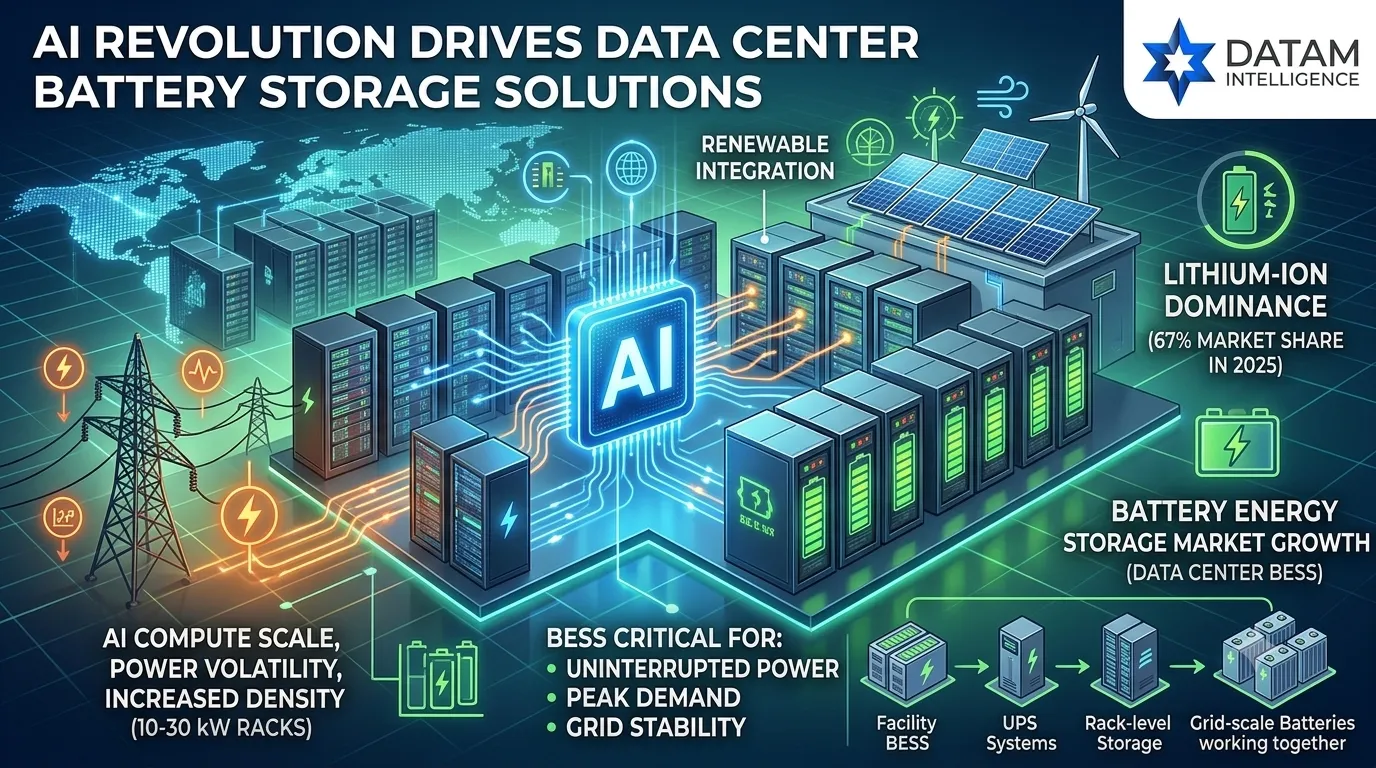
As AI computing scales globally, battery storage is becoming a foundational infrastructure layer rather than a supplementary power component. Research on AI data center energy systems increasingly highlights multi-layer storage architectures, including facility-level BESS, UPS systems, rack-level storage, and grid-scale batteries working together to improve reliability and grid stability.
AI Workloads Are Reshaping Data Center Power Requirements
Artificial intelligence is creating a structural shift in data center energy consumption.
Traditional enterprise workloads generated relatively predictable power demand patterns. AI workloads are different.
Training large language models, running AI inference engines, and operating GPU-intensive clusters create sudden spikes in power consumption that require highly responsive energy systems.
According to the ZincFive 2026 Data Center Energy Storage Report cited by DataM Intelligence, 57% of industry respondents reported increasing power density requirements driven by AI deployments. At the same time, rack power density continues to rise, with average rack densities reaching approximately 9 kW and increasingly moving toward high-density deployments in the 10–30 kW range.
These higher-density environments create several challenges:
Greater Power Volatility
AI servers can generate rapid changes in electricity demand, requiring immediate response from supporting infrastructure.
Increased Uptime Requirements
As AI workloads support mission-critical applications across industries, tolerance for downtime continues to decline.
Growing Grid Dependency
Utilities in many regions are struggling to provide sufficient capacity for expanding hyperscale developments.
Higher Operational Costs
Electricity is becoming one of the largest operating expenses for large-scale data centers.
Battery energy storage helps address these challenges by providing immediate power support and improving energy management flexibility.
Key Market Drivers Accelerating BESS Adoption
1. Expansion of Hyperscale Data Centers
Hyperscale facilities continue to dominate global infrastructure investments.
Major cloud providers, AI companies, and colocation operators are building increasingly larger campuses designed to support next-generation computing workloads.
According to DataM Intelligence, North America accounted for approximately 40.2% of the global market share in 2025, supported by a 36% year-over-year increase in operational capacity across major U.S. data center markets.
As these facilities expand, battery storage becomes essential for maintaining reliability and supporting power-intensive operations.
2. Rising Demand for Reliable Backup Power
Downtime remains one of the most expensive risks facing data center operators.
A single outage can impact cloud services, enterprise operations, AI model training, financial transactions, and digital applications.
Battery energy storage systems provide:
- Instantaneous power delivery
- Improved fault tolerance
- Enhanced disaster recovery capabilities
- Increased operational resilience
Consequently, operators are investing heavily in advanced energy storage solutions to strengthen business continuity strategies.
3. Renewable Energy Integration
Sustainability commitments are becoming increasingly important for hyperscale operators.
Organizations are under pressure from investors, regulators, and customers to reduce carbon emissions while maintaining reliable operations.
Battery storage allows operators to maximize renewable energy utilization by:
- Storing excess solar energy
- Managing intermittent renewable generation
- Balancing supply and demand
- Supporting net-zero initiatives
As renewable energy adoption accelerates, BESS is becoming a critical enabler of sustainable data center operations.
4. Grid Capacity Constraints
One of the biggest barriers to new data center construction is the availability of electrical infrastructure.
Recent industry reports indicate that data center construction timelines are often significantly shorter than utility interconnection timelines. In some regions, obtaining sufficient grid capacity can take several years.
Battery energy storage provides operators with greater flexibility by:
- Managing peak demand
- Reducing grid stress
- Supporting microgrid operations
- Improving energy independence
This capability is becoming increasingly valuable as AI-related power demand continues to surge.
Lithium-Ion Batteries Continue to Dominate the Market
Among all battery technologies, lithium-ion remains the clear market leader.
DataM Intelligence estimates that lithium-ion batteries captured approximately 67% of the market in 2025, largely driven by the industry's transition away from traditional valve-regulated lead-acid (VRLA) systems.
Several factors explain this dominance:
Higher Energy Density
Lithium-ion batteries deliver more power within a smaller footprint, a critical advantage for space-constrained facilities.
Faster Response Times
AI workloads require rapid power stabilization, making fast-response battery technologies highly desirable.
Lower Maintenance Requirements
Compared to traditional battery systems, lithium-ion solutions typically require less maintenance while delivering longer operational lifecycles.
Better Total Cost of Ownership
According to the industry survey referenced by DataM Intelligence, 84% of respondents identified total cost of ownership as the most important factor influencing energy storage purchasing decisions.
As battery costs continue to decline and technology performance improves, lithium-ion adoption is expected to remain strong throughout the forecast period.
Emerging Trends Shaping the Future Market
Battery Safety Is Becoming a Competitive Differentiator
As battery deployments grow larger, safety considerations are becoming increasingly important.
DataM Intelligence reports that 76% of surveyed organizations consider battery chemistry safety a major purchasing criterion.
This trend is driving:
- Advanced battery monitoring systems
- Improved thermal management technologies
- Enhanced fire suppression solutions
- Stricter safety standards
Manufacturers that prioritize safety innovation are expected to gain a competitive advantage.
Sustainability Is Influencing Procurement Decisions
Environmental performance is increasingly influencing infrastructure investments.
According to DataM Intelligence, 70% of buyers consider sustainability a significant factor when selecting energy storage technologies.
Organizations are evaluating battery systems based on:
- Lifecycle emissions
- Recyclability
- Energy efficiency
- Environmental impact
This trend is expected to drive further innovation across battery technologies and energy management platforms.
Large-Scale Storage Deployments Are Expanding
As AI facilities become larger and more power-intensive, storage requirements are increasing correspondingly.
DataM Intelligence identifies growing momentum for battery energy storage systems exceeding 20 MWh capacity, particularly in hyperscale and AI-focused facilities.
These deployments support:
- Peak demand management
- Renewable integration
- Grid support services
- Extended backup capabilities
The trend reflects the growing strategic importance of energy storage in digital infrastructure planning.
Regional Outlook: North America Leads While Global Investments Accelerate
North America remains the largest market for data center battery energy storage due to:
- High concentration of hyperscale facilities
- Rapid AI infrastructure expansion
- Significant cloud computing investments
- Growing renewable energy deployment
However, opportunities are expanding globally.
Asia-Pacific is emerging as a major growth region as countries increase investments in cloud infrastructure, AI computing capacity, and digital transformation initiatives.
Europe continues to prioritize sustainable energy infrastructure, creating favorable conditions for advanced energy storage deployment.
Collectively, these regional investments are expected to drive substantial market expansion over the coming decade.
Investment Opportunities Across the Value Chain
The convergence of AI infrastructure and energy storage is creating significant opportunities for multiple stakeholders.
For Data Center Operators
- Improve uptime and resilience
- Reduce energy costs
- Meet sustainability targets
For Battery Manufacturers
- Capitalize on growing hyperscale demand
- Expand lithium-ion and next-generation battery deployments
For Energy Technology Providers
- Develop advanced battery management software
- Support grid-interactive energy systems
For Investors
- Gain exposure to the intersection of AI, digital infrastructure, and clean energy
As AI adoption accelerates globally, battery energy storage is positioned as one of the most attractive investment segments within the broader digital infrastructure ecosystem.
Conclusion: Batteries Are Becoming Core Infrastructure for the AI Era
The future of data centers will be determined not only by compute performance but also by energy resilience.
AI is driving unprecedented electricity demand, increasing power density, and creating new infrastructure challenges that traditional power architectures cannot address alone.
Battery Energy Storage Systems are emerging as a critical solution, enabling operators to improve reliability, support renewable integration, manage energy costs, and scale AI infrastructure efficiently.
DataM Intelligence research highlights a market increasingly shaped by hyperscale expansion, lithium-ion adoption, sustainability priorities, and growing investment in large-scale energy storage infrastructure. With North America leading adoption and global demand accelerating, battery storage is transitioning from backup power technology to strategic digital infrastructure.