


The U.S. Food and Drug Administration’s approval of Cosentyx (secukinumab) for polymyalgia rheumatica (PMR) adds a new treatment option for a defined group of adults: those whose response to corticosteroids is inadequate or who cannot tolerate a corticosteroid taper. Announced by Novartis on November 17, 2026, the decision makes Cosentyx the first anti-IL-17 biologic approved for PMR. It is not the first biologic approved for the disease: Kevzara (sarilumab), which targets the IL-6 receptor, has held a U.S. PMR indication since 2023.
PMR treatment now includes two FDA-approved biologics with different inflammatory targets, alongside glucocorticoids, conventional steroid-sparing approaches and investigational programs. The news does not establish which biologic will work better for an individual or how quickly prescribing will change. It does make treatment mechanism, evidence, safety, patient eligibility and access more central to the polymyalgia rheumatica treatment market.
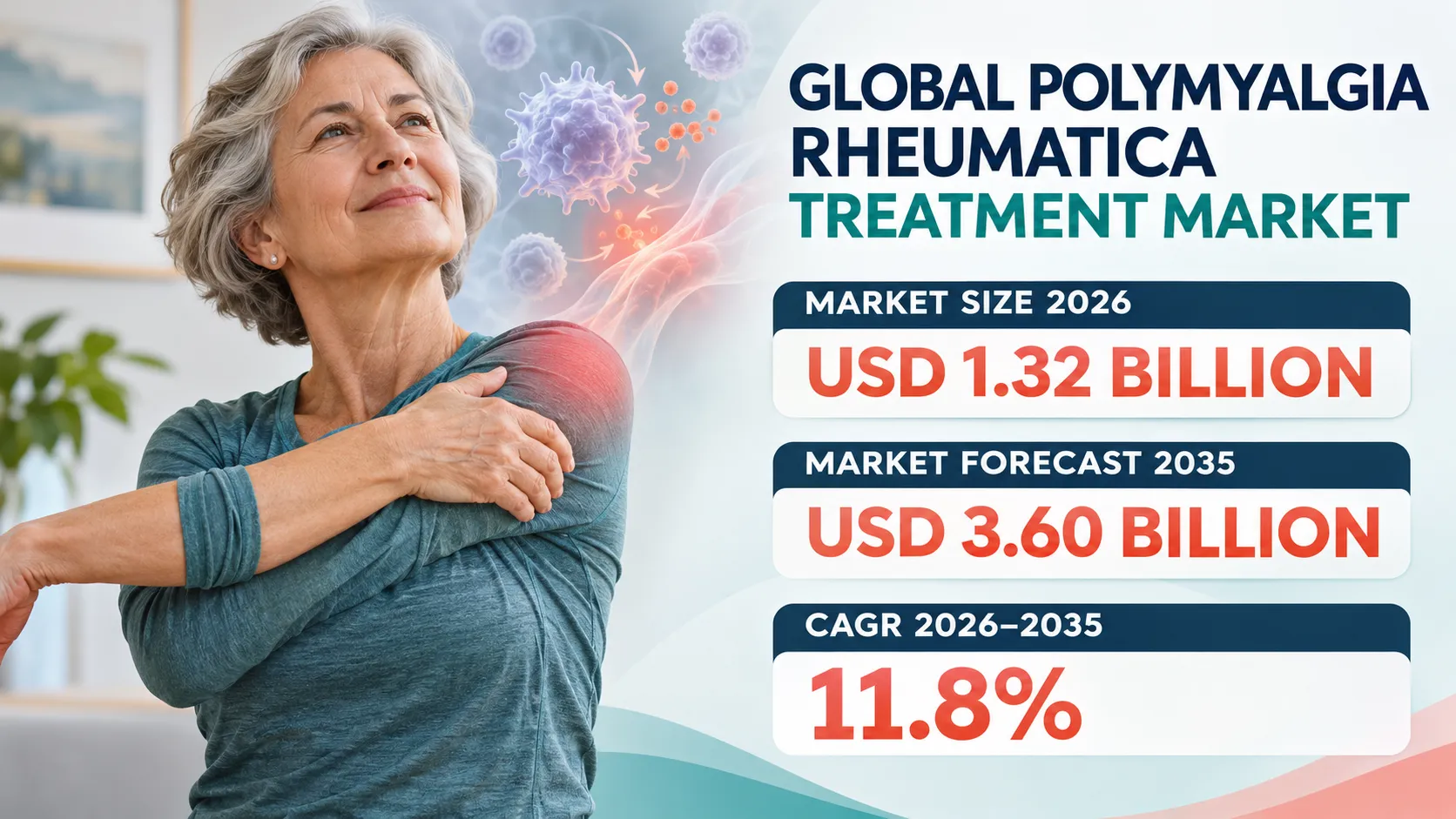
Request Exclusive Sample: https://www.datamintelligence.com/download-sample/polymyalgia-rheumatica-treatment-market
What the FDA approved
The FDA approved Cosentyx 150 mg for adults with PMR who have had an inadequate response to corticosteroids or cannot tolerate corticosteroid tapering. Cosentyx (secukinumab) is a fully human monoclonal antibody that inhibits interleukin-17A (IL-17A), a cytokine involved in inflammatory signaling. Novartis described this as the first and only anti-IL-17 biologic indication for PMR. The drug had already received a PMR approval in the European Union; Novartis said regulatory review was continuing in Japan.
The approved population matters. This is not a new first-line option for every person diagnosed with PMR, nor does the approval mean that corticosteroids will disappear from care. It expands the choices for adults with inadequate response or taper intolerance. For clinicians and market-access teams, the practical questions are how patients are identified, how treatment is positioned within existing pathways, and what evidence payers will require.
What the REPLENISH trial showed-and what it did not
The FDA decision was based on REPLENISH, a global Phase III trial conducted in 27 countries. Participants were assigned to secukinumab 300 mg, secukinumab 150 mg, or placebo, with each group following a 24-week corticosteroid taper. At Week 52, sustained remission was reported in 40.5% of patients receiving secukinumab 150 mg and 20.5% receiving placebo. The 150 mg group also had a lower adjusted annual cumulative glucocorticoid dose: 1,683 mg compared with 2,093 mg for placebo.
These findings support a steroid-sparing treatment discussion, but the comparison was with placebo under the trial’s taper regimen. REPLENISH was not a head-to-head comparison against Kevzara, tocilizumab or another PMR therapy. The figures should not be used to claim that Cosentyx is superior to those treatments. Differences in trial design, patient selection, taper schedules and outcome definitions make cross-trial percentage comparisons unreliable.
Safety also belongs in any balanced account. Novartis reported that the PMR trial safety profile was consistent with the established Cosentyx profile, while serious adverse events occurred in 15.9% of the 150 mg group and 14.2% of the placebo group. The company also reported more hypersensitivity reactions and urinary tract infections in the secukinumab group, and one fatal case of cryptococcal meningitis. Prescribing decisions must be based on the FDA-approved label and a clinician’s assessment of risks and benefits.
How the competitive landscape is changing
Before this approval, the treatment foundation for PMR was glucocorticoids, with Kevzara as the only FDA-approved biologic specifically indicated for adults who respond inadequately to corticosteroids or cannot tolerate tapering. Cosentyx adds an IL-17A mechanism beside Kevzara’s IL-6 receptor inhibition. This creates a more differentiated biologic landscape, but not a simple class-versus-class contest. There are no head-to-head data showing which pathway or product is preferable across PMR patients.
The wider landscape includes other drugs and development programs, each with a different evidence and regulatory status. The following is a map of ten relevant players or treatment tracks-not a ranking by market share. Only Cosentyx and Kevzara are FDA-approved biologics for PMR.
| Player or treatment track | PMR status | Why it matters |
Novartis - Cosentyx (secukinumab) | FDA-approved for the specified adult population | Adds the first approved IL-17A biologic and new mechanism-based competition. |
Sanofi / Regeneron - Kevzara (sarilumab) | FDA-approved IL-6 receptor inhibitor | The most direct existing branded comparator, with an established PMR indication. |
Roche / Chugai - Actemra (tocilizumab) | PMR evidence; not FDA-approved for PMR | A relevant off-label IL-6 receptor therapy discussed in clinical evidence and guidance. |
Pfizer - Xeljanz (tofacitinib) | Investigational/off-label PMR research | A JAK inhibitor program to monitor; it is not an FDA-approved PMR therapy. |
Eli Lilly - Olumiant (baricitinib) | Studied in PMR; not approved for PMR | Early research raises a possible JAK-pathway question but does not establish routine use. |
Rituximab developers and biosimilar manufacturers | Phase III investigator-led PMR studies | REDUCE-PMR studies examine steroid exposure in newly diagnosed and relapsing disease. |
Generic glucocorticoid manufacturers | Conventional treatment foundation | Remain central to care and the comparator for steroid-sparing value. |
Methotrexate and leflunomide suppliers | Conventional/off-label steroid-sparing approaches | Lower-cost options with evidence and use that vary by patient and setting. |
Zura Bio - tibulizumab | Planned Phase II PMR study | Company updates say NEXUS-PMR was planned to start by year-end 2026; the candidate remains investigational. |
Sparrow Pharmaceuticals - SPI-62 | Completed Phase II PMR study; no results posted in the registry record reviewed | A program to track, while avoiding claims of proven benefit without public results. |
Request a Customized Report According to Your Business Strategy: https://www.datamintelligence.com/customize/polymyalgia-rheumatica-treatment-market
This map illustrates why “competitor” needs careful definition in PMR. Kevzara is a direct, approved biologic competitor. Tocilizumab has a clinical evidence and guideline role but no PMR-specific FDA indication. JAK inhibitors and rituximab represent clinical research or off-label use. Generic corticosteroids remain the incumbent treatment, and conventional disease-modifying drugs may be considered in selected care settings. These categories should never be presented as equivalent levels of approval or evidence.
What could change next
In the near term, the approval may raise awareness of steroid-sparing treatment and prompt clinicians, payers and health systems to revisit pathways for patients who relapse or struggle to taper. Actual adoption will depend on clinical judgment, label criteria, coverage, patient preference and the practicalities of treatment. FDA approval alone does not reveal uptake, payer policy or market share.
Over the medium term, evidence on real-world use will matter. Decision-makers will want to understand durability, relapse patterns, cumulative steroid exposure, safety monitoring and outcomes across patient subgroups. Comparative effectiveness research may become especially valuable because trial-to-trial comparisons cannot resolve which treatment is best suited to which clinical profile.
Guidance will also be watched closely. The British Society for Rheumatology’s updated PMR guideline was published in October 2026, before the U.S. Cosentyx decision. It advises considering an IL-6 receptor antagonist with glucocorticoids for selected patients with inadequate response or taper intolerance, and recommends discussing methotrexate in specified groups. Because the guideline predates this approval, future updates and local recommendations will need to evaluate the new IL-17 evidence rather than treating the older guidance as a comparative verdict on secukinumab.
In the longer term, one plausible scenario is a more stratified PMR treatment market: glucocorticoids remain important for many patients, while steroid-sparing options are assessed for people with relapse, taper difficulties or higher risk from prolonged steroid exposure. This is a scenario, not a market forecast. Its scale will depend on further evidence, access, clinician experience and how treatment guidance evolves.
What the approval means for market intelligence
For pharmaceutical and biotechnology companies, the approval increases the value of tracking physician adoption, payer coverage, treatment sequencing and pipeline milestones. For investors and business development teams, the key distinction is between approved products, established off-label approaches and investigational assets. For market-access leaders, the question is how steroid-sparing evidence is assessed alongside safety, cost and local reimbursement rules.
The central competitive question is no longer simply whether PMR has a biologic option. It is how distinct mechanisms and evidence profiles fit into care for the eligible population-and what data are still needed to guide those decisions. The Cosentyx approval broadens the conversation; it does not settle it.
For deeper market sizing, segmentation and competitive analysis, explore DataM Intelligence’s Polymyalgia Rheumatica Treatment Market report.
Frequently Asked Questions
Is Cosentyx FDA-approved for polymyalgia rheumatica?
Yes. FDA approved secukinumab 150 mg for adults with PMR who have had an inadequate response to corticosteroids or cannot tolerate corticosteroid tapering. Novartis announced the decision on November 17, 2026.
Is Cosentyx the first biologic approved for PMR?
No. It is the first FDA-approved anti-IL-17 biologic for PMR. Kevzara (sarilumab), an IL-6 receptor inhibitor, received a U.S. PMR indication in 2023.
Did Cosentyx outperform Kevzara in clinical trials?
No head-to-head trial has established that. REPLENISH compared secukinumab with placebo, not Kevzara. Results from separate trials should not be treated as direct comparative evidence.
What did REPLENISH find?
At Week 52, sustained remission was reported in 40.5% of patients receiving secukinumab 150 mg and 20.5% receiving placebo after a 24-week corticosteroid taper. The trial also reported a lower adjusted annual cumulative glucocorticoid dose for the secukinumab group.
What other PMR treatments are being studied?
Investigational or off-label research includes JAK inhibitors, rituximab, methotrexate-based steroid-sparing approaches and tibulizumab. These programs have different evidence and approval status; none should be described as an FDA-approved PMR biologic unless a relevant indication is granted.