


Plastics are not disappearing. They are being redesigned.
For decades, the plastics industry grew around fossil-based feedstocks, low-cost mass production, and linear consumption: extract, manufacture, use, discard. That model is now under pressure from regulators, brand owners, consumers, packaging buyers, and material scientists. The next phase of plastics will not be defined only by lighter bottles or thinner films. It will be shaped by circular materials that can reduce fossil dependence, improve recyclability, and fit into cleaner carbon cycles.
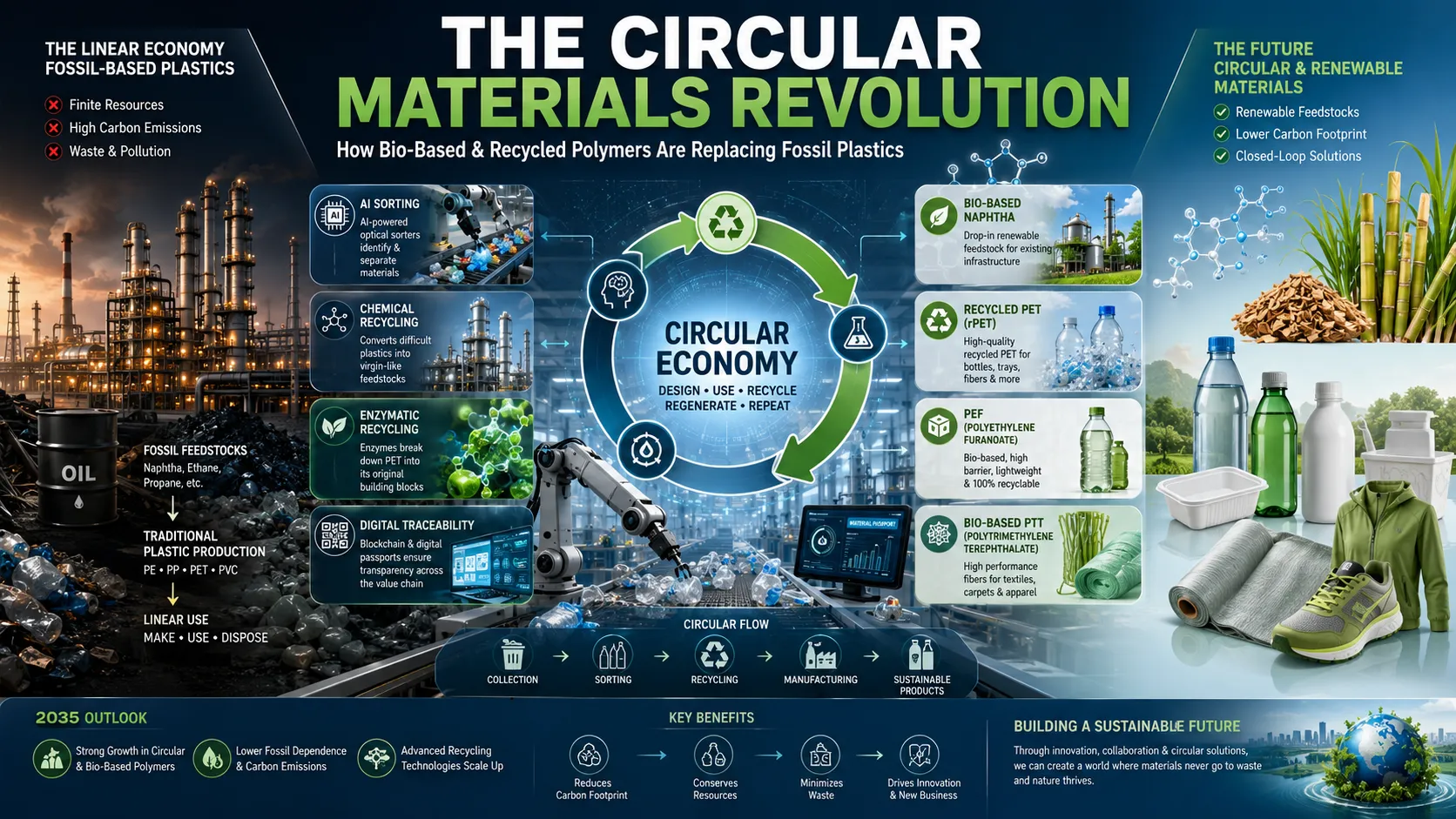
Circular materials include bio-based plastics, recycled PET, post-consumer recycled plastic, bio-based naphtha, PEF, bio-based PTT, PLA, and high-quality recycled polymers produced through mechanical, chemical, enzymatic, and digital sorting technologies. These materials are becoming important not because they sound sustainable, but because they solve practical problems in packaging, textiles, automotive components, consumer goods, and industrial applications.
Why Fossil-Based Plastics Face Growing Pressure
Fossil plastics face pressure from three sides: carbon, waste, and regulation.
The carbon issue is straightforward. Most conventional plastics are made from oil and gas-derived feedstocks such as naphtha, ethane, and propane. When companies use fossil carbon to make plastic packaging, textiles, or consumer goods, that carbon enters the economy and eventually becomes a waste-management challenge. Even when a plastic item is lightweight and useful, its lifecycle is still tied to fossil extraction, petrochemical processing, and end-of-life emissions.
Waste is the second concern. Packaging has a short use cycle, but many polymers remain in the environment for decades or longer if not collected and processed properly. Flexible films, multilayer pouches, colored plastics, contaminated food packaging, and mixed-polymer waste are especially difficult to recycle. This is why the industry is shifting from “make packaging recyclable in theory” to “make packaging recyclable in real systems.”
Regulation is the third driver. Packaging laws, recycled-content targets, extended producer responsibility systems, plastic taxes, and landfill restrictions are changing how brands select materials. In the future, a polymer will not be judged only on cost and performance. It will also be judged on traceability, recycled content, carbon footprint, recyclability, food-contact compliance, and compatibility with collection systems.
Rise of Bio-Based Feedstocks
Bio-based feedstocks are one of the most important routes away from fossil plastics. Instead of using fossil naphtha, producers can use renewable carbon from sugarcane, corn, plant oils, used cooking oil, forestry residues, agricultural residues, or bio-based intermediates.
Bio-based naphtha is especially important because it can act as a drop-in feedstock. This means it can enter existing petrochemical infrastructure and produce familiar polymers such as polyethylene, polypropylene, and other plastics without forcing converters to completely redesign their processing equipment. For packaging manufacturers, this is attractive because they can lower fossil feedstock dependence while keeping performance similar to conventional materials.
Bio-based plastics are not one single material. They include PLA, bio-based PE, bio-based PTT, PEF, PBS, PHA, and other emerging polymers. Some are biodegradable under specific conditions. Some are not biodegradable but are recyclable. Some are designed for compostable applications such as food-service packaging, while others target durable textiles, bottles, films, automotive parts, or electronics.
The key point is that “bio-based” refers to the origin of carbon, not automatically to biodegradability. A bio-based plastic can still behave like a conventional plastic if its chemical structure is similar. This distinction matters because buyers often confuse bio-based, biodegradable, compostable, and recyclable materials. The future will reward companies that communicate these differences clearly.
How Recycled Plastics Are Improving Quality
Recycled plastic technology is moving beyond low-value reuse. Historically, recycled polymers were often associated with inconsistent color, odor, contamination, weak mechanical properties, and limited food-contact use. That is changing quickly.
Mechanical recycling remains the backbone of the circular plastics economy. Better washing, flake purification, deodorization, melt filtration, and solid-state polycondensation are improving recycled PET quality. High-quality rPET can now move back into bottles, trays, fibers, films, and branded packaging when collection and processing are well managed.
Chemical recycling adds another route. Technologies such as depolymerization, methanolysis, glycolysis, pyrolysis, and solvent-based purification can handle certain streams that mechanical recycling struggles with. The goal is to break waste plastics into monomers, oils, or purified intermediates that can be rebuilt into virgin-like materials. This is particularly important for polyester textiles, colored PET, multilayer structures, and hard-to-recycle mixed plastic waste.
Enzymatic recycling is also gaining attention. Instead of relying only on heat and chemical reactions, enzyme-based systems can selectively break PET into its building blocks. If scaled successfully, this could help recycle lower-quality PET waste into high-quality material while supporting circularity in bottles and textiles.
Digital sorting is another underrated breakthrough. AI-assisted optical sorters, near-infrared sensors, robotics, object recognition, watermarking, and tracer technologies can separate food-grade from non-food-grade plastic, distinguish polymers, identify colors, and remove contaminants. Better sorting means better feedstock. Better feedstock means better recycled polymer quality.
PEF vs PET Comparison
PET is one of the world’s most successful packaging polymers. It is clear, strong, lightweight, and widely recycled in bottle systems. Recycled PET already has a strong role in circular packaging. However, PEF is emerging as a serious next-generation alternative for selected applications.
PEF, or polyethylene furanoate, is a bio-based polymer made using FDCA as a key building block. Its main advantage is performance. Compared with PET, PEF can offer stronger gas barrier properties, especially for oxygen and carbon dioxide. That makes it attractive for carbonated drinks, juices, beer, sauces, personal care packaging, and other products where shelf life matters.
PEF may also allow thinner packaging because of its mechanical strength. If a bottle or film can use less material while maintaining performance, the sustainability benefit comes not only from renewable feedstock but also from material efficiency.
PET will not disappear. It already has massive recycling infrastructure, established processing systems, and broad acceptance in packaging. The more realistic future is not “PEF replaces all PET.” Instead, PEF will likely grow first in premium packaging, high-barrier bottles, films, specialty applications, and brand-led circular material programs. PET will remain important where cost, infrastructure, and recyclability are already strong.
Future Demand Outlook to 2035
By 2035, demand for sustainable polymers will be shaped by a mix of regulation, brand commitments, consumer pressure, feedstock availability, and technology maturity. The strongest growth is likely to come from packaging, textiles, consumer goods, automotive interiors, electronics, and industrial applications that need both performance and lower environmental impact.
Packaging will remain the fastest-moving application because it faces the most visible waste challenge. Recycled PET, post-consumer recycled plastic, bio-based PE, PLA, PEF, and compostable polymers will all compete depending on application needs. Beverage bottles, food trays, flexible packaging, cosmetics packaging, hygiene packaging, and e-commerce packaging will see more material redesign.
Textiles are also becoming a major opportunity. Polyester dominates global synthetic fibers, but textile-to-textile recycling remains difficult. Advanced PET recycling, enzymatic recycling, bio-based PTT, and partially bio-based performance polymers could help reduce fossil dependence in apparel, carpets, home textiles, and automotive fabrics.
By 2035, circular materials will not be judged by sustainability claims alone. Buyers will ask sharper questions: Can it be recycled at scale? Is the feedstock traceable? Is the carbon benefit verified? Does it perform on existing equipment? Can it meet food-contact rules? Is it cost-stable? Can it be supplied globally?
The winners will be materials that combine environmental value with industrial practicality.
Challenges in Collection and Recycling
The circular materials revolution still faces serious obstacles.
Collection is the first challenge. Many regions lack effective waste sorting, deposit return systems, curbside collection, or recycling infrastructure. Without clean and consistent input material, even the best recycling technology cannot deliver high-quality output.
Contamination is another problem. Food residues, labels, adhesives, inks, multilayer structures, additives, and mixed polymers reduce recycling efficiency. A recyclable package can still fail in practice if it is poorly designed for real sorting and processing systems.
Economics also matter. Virgin plastic can be cheaper than recycled or bio-based alternatives, especially when fossil feedstock prices are low. Recycled polymers need reliable demand, regulatory support, and brand commitments to justify investment in collection, sorting, and processing.
There is also a communication challenge. Consumers often assume that bio-based means biodegradable or that recyclable means actually recycled. Clear labeling, better education, and standardized claims will be essential.
Top 10 Companies Transforming Sustainable Materials
| Rank | Company | Strategic Importance |
|---|---|---|
| 1 | Neste | A major player in renewable and recycled feedstocks, including bio-based naphtha routes that can help polymer producers reduce fossil carbon without replacing existing infrastructure. |
| 2 | Braskem | Known for bio-based polyethylene made from sugarcane, Braskem is strategically important because it offers a drop-in polymer that behaves like conventional PE while using renewable carbon. |
| 3 | Avantium | A key innovator in FDCA and PEF, Avantium is central to the future of high-barrier bio-based packaging materials that could complement or replace PET in selected applications. |
| 4 | Eastman | Its molecular recycling strategy targets hard-to-recycle polyester waste and supports production of virgin-quality recycled materials for packaging, textiles, and consumer goods. |
| 5 | Indorama Ventures | One of the most important global PET and rPET players, with strong relevance in bottle-to-bottle recycling, recycled polyester, and circular PET supply chains. |
| 6 | ALPLA | A packaging and recycling leader with long experience in PET, HDPE, and PP recycling, helping brands convert post-consumer plastics into high-quality packaging formats. |
| 7 | TOMRA | Strategic because it improves the front end of recycling through sensor-based sorting systems that separate polymers, colors, and contaminants more accurately. |
| 8 | CARBIOS | A leading enzymatic PET recycling innovator, important for the future of bottle and textile circularity where conventional recycling struggles with lower-quality feedstock. |
| 9 | NatureWorks | A major producer of Ingeo PLA, making it central to bio-based plastics used in packaging, fibers, food-service items, 3D printing, and specialty applications. |
| 10 | CovationBio | Important in bio-based PTT and performance biomaterials through Sorona and related building blocks, especially for textiles, carpets, apparel, and durable applications. |
Final Thoughts
The circular materials revolution is not about replacing every fossil plastic with one perfect alternative. It is about building a smarter materials system.
Bio-based naphtha can reduce fossil carbon in existing polymer chains. Bioplastics such as PLA, PEF, and bio-based PTT can create new performance possibilities. Recycled PET and post-consumer recycled plastics can keep carbon already in the economy in productive use. Advanced sorting, chemical recycling, enzymatic recycling, and digital traceability can make recycled materials cleaner and more reliable.
By 2035, the most successful sustainable polymers will be those that solve both environmental and technical problems. They will need to be scalable, traceable, processable, affordable, and compatible with circular systems. Fossil plastics built the modern packaging economy. Circular materials will shape its next chapter.
Related Reports Covered:
Bio-Based Naphtha Market: https://www.datamintelligence.com/research-report/bio-based-naphtha-market
Bioplastics Market: https://www.datamintelligence.com/research-report/bioplastics-market
Circular Economy Market: https://www.datamintelligence.com/research-report/circular-economy-market
Post-Consumer Recycled Plastic Market: https://www.datamintelligence.com/research-report/post-consumer-recycled-plastic-market
Bio-based Polyethylene Furanoate Market: https://www.datamintelligence.com/research-report/bio-based-polyethylene-furanoate-market
Bio-based Polytrimethylene Terephthalate Market: https://www.datamintelligence.com/research-report/bio-based-polytrimethylene-terephthalate-market