


Global Cenospheres Market Intelligence | 2026
| THE FEEDSTOCK PROBLEM | Cenospheres are not independently mined. They are recovered from coal fly ash, and typically represent only a very small fraction of that ash stream. As coal-fired generation contracts, the future feedstock base contracts with it. |
| THE 2026 WARNING | U.S. coal consumption is forecast to fall from 451 million short tons in 2025 to 398 million in 2027. EIA also expects 13 GW of coal-fired capacity to retire by the end of 2027. |
| THE SUPPLY-DEMAND MISMATCH | End-use demand remains diversified across oilfield, coatings, composites, refractories and construction, while the Western fresh-ash feedstock base is structurally shrinking. |
This Is Not a Normal Commodity Shortage
Cenospheres sit in an unusual position in the industrial-materials chain. Demand is driven by what they do - reduce density, improve thermal performance, control slurry weight and add functional volume without adding the same mass as conventional mineral fillers. Supply, however, is controlled by something buyers do not control: how much suitable coal fly ash is created, captured and processed.
That mismatch is becoming more important. The U.S. and other Western power markets are retiring coal assets, tightening environmental rules and shifting generation toward gas, renewables and storage. The result is not simply less coal. It is fewer future opportunities to create fresh fly ash containing recoverable cenospheres.
The key procurement question is therefore changing. Buyers can no longer ask only, “What is the cenosphere price this quarter?” They increasingly need to ask, “Which plants will still generate suitable ash, which processors have recovery access, which grades are actually available and what happens to delivered cost when supply migrates toward Asia?”
The Supply Risk Starts With a Simple Fact: Cenospheres Are Rare
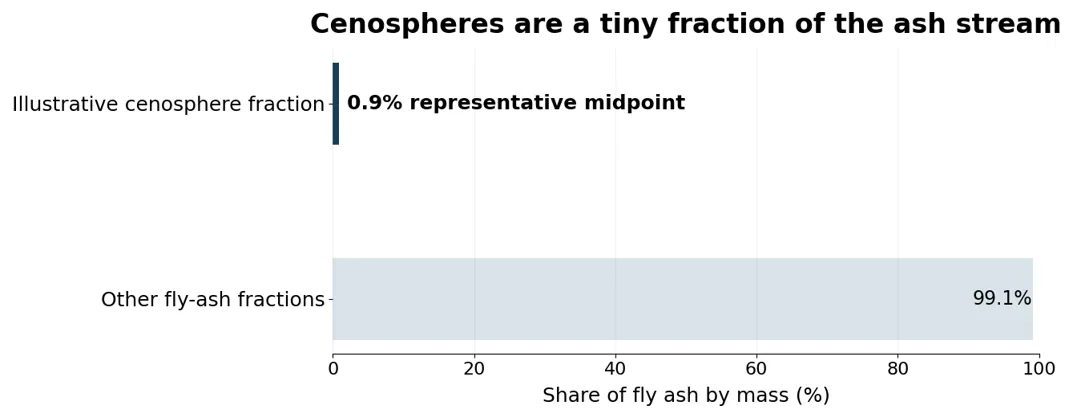
Cenospheres are hollow aluminosilicate spheres formed during pulverized-coal combustion. They are valuable because they combine low density, thermal resistance, chemical stability and spherical morphology. But they are not the dominant component of fly ash. Technical literature commonly places cenospheres at roughly 0.3%-1.5% of fly ash by mass, although wider values have been reported depending on coal chemistry and combustion conditions.
Request Sample: https://www.datamintelligence.com/download-sample/cenospheres-market
| 24.7M short tons of U.S. coal fly ash generated in 2024 | 0 cenosphere production reported by ACAA for 2023 and 2024 | 78% of U.S. coal fly ash was reused in 2024 |
The ACAA data point does not prove that no cenospheres were sold in the U.S. in those years. It means its production survey reported none from coal ash. Commercial supply can still come from imports, inventories, legacy ash processing or channels outside the survey. The signal is still important: fresh domestic production is not a dependable assumption for procurement planning.
Coal Retirements Turn a Byproduct Into a Depleting Feedstock
EIA’s November 2026 outlook forecasts U.S. coal consumption at 419 million short tons in 2026, down 7% from 2025, followed by another 5% decline to 398 million short tons in 2027. The coal share of U.S. generation is expected to fall from 17% in 2025 to 15% in 2027, with 13 GW of coal capacity scheduled to retire by the end of 2027.
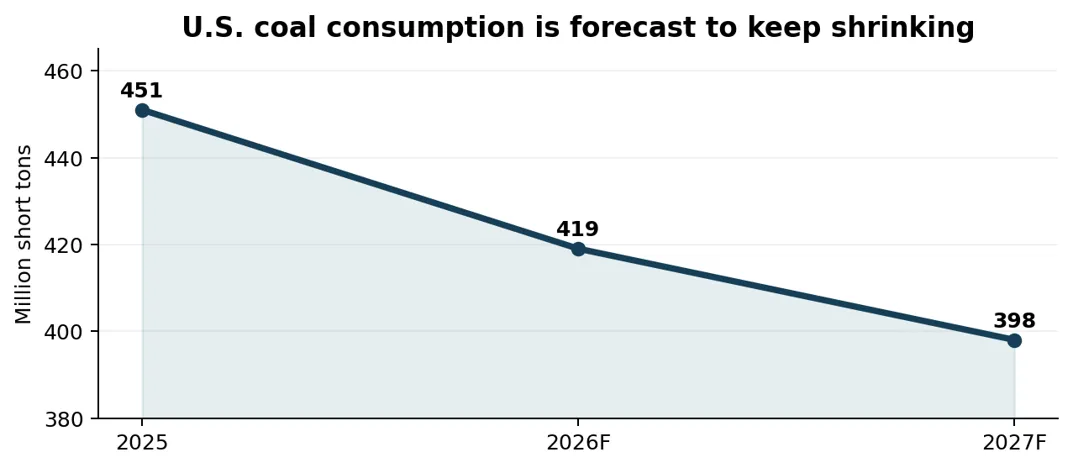
Source: U.S. Energy Information Administration, Short-Term Energy Outlook, November 2026.
Why “Harvest More Legacy Ash” Is Only a Partial Answer
The U.S. coal-ash industry is already adapting. ACAA says more than 4 million tons of previously disposed coal ash were harvested and beneficially used in 2023. This is strategically important because legacy ash can extend the usable life of the resource after a generating unit shuts down.
But legacy ash does not automatically translate into high-quality cenosphere supply. Cenosphere recovery depends on whether hollow spheres are present at useful concentrations, whether they survived storage and handling, the chemistry of the original coal and ash, contamination, particle-size distribution and the economics of separation and cleaning. A large ash pond can therefore be a large mineral resource without being a large source of premium cenospheres.
THE CENOSPHERE SUPPLY CHAIN
| COAL PLANT Suitable coal + combustion | FLY ASH Cenospheres formed | RECOVERY Float/separate + clean | GRADE Density + size + chemistry | BUYER Oilfield, coatings, composites |
Every step can constrain supply. Plant closure removes future ash creation. Poor recovery economics can strand material. Grade inconsistency can make an apparently available ton unusable for a high-specification application. This is why “tons of fly ash” and “tons of saleable cenospheres” are very different numbers.
The Geography of Supply Is Moving
The long-term answer is likely to be a more international supply chain. India reported more than 340 million tonnes of fly ash generation in 2024-25, while U.S. coal fly ash generation in 2024 was about 24.7 million short tons, equivalent to roughly 22.4 million metric tonnes. The categories and power systems are not identical, but the scale difference illustrates where future recovery opportunities are increasingly concentrated.
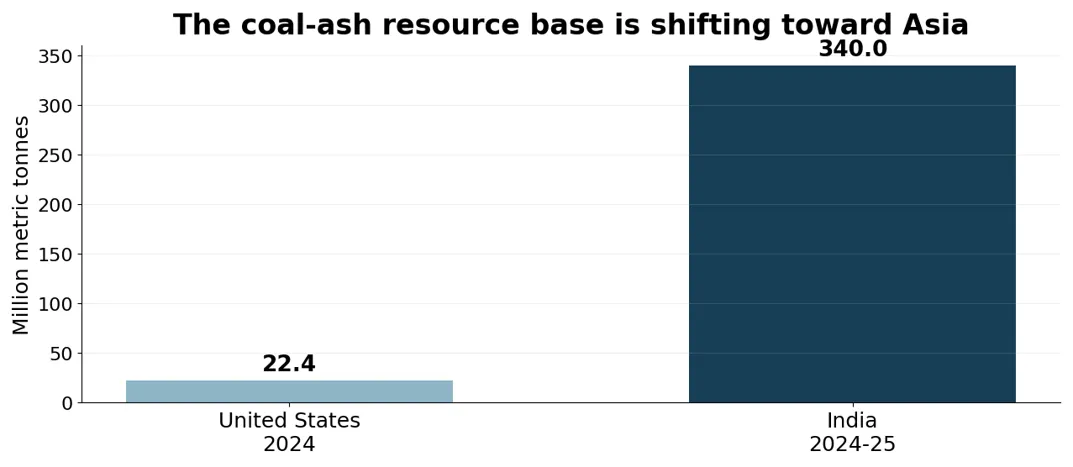
Sources: American Coal Ash Association; Government of India / Central Electricity Authority.
For Western buyers, that creates a second risk on top of material scarcity: longer logistics chains, more dependence on importers and processors, greater exposure to freight and working-capital cycles and more variation in delivered grade consistency. The market may remain globally supplied, but it becomes less locally controllable.
Demand Is Expanding Into Applications That Cannot Always Substitute Easily
Cenospheres are often treated as “just a filler,” but that understates why some buyers are sensitive to shortages. Their value comes from a specific combination of low density, hollow structure, heat resistance and spherical morphology. In several applications, a substitute may exist, but substitution can change formulation cost, rheology, density, thermal behavior or qualification requirements.
| Oil & gas cementing | Low-density cement systems use hollow particles to reduce hydrostatic pressure while retaining compressive performance. Reformulation can require qualification and field validation. |
| Paints & thermal coatings | Low density and low thermal conductivity support lightweight, insulating and heat-resistant coatings. Recent research continues to expand high-temperature applications. |
| Construction | Cenospheres reduce density and can improve thermal performance in lightweight cementitious systems. |
| Automotive & composites | Hollow ceramic spheres reduce component density and can add dimensional and thermal benefits to polymer and metal-matrix systems. |
| Refractories & specialty materials | High-temperature stability makes specific grades attractive where conventional low-cost fillers cannot perform equivalently. |
The Shortage Will Not Arrive Everywhere at the Same Time
That is the most important commercial point. A global market can still grow while individual grades become difficult to source. Higher-specification white or low-iron material, tightly controlled particle-size bands, low-density fractions and grades qualified for oilfield or high-temperature systems can tighten earlier than bulk construction-grade material. The real shortage is therefore likely to appear first as a specification problem, then as a lead-time problem and finally as a price problem.
FIVE SIGNALS BUYERS AND SUPPLIERS SHOULD TRACK
| Signal | Why it matters | What it can trigger | Decision |
| Coal unit retirement | Fresh local ash disappears | Import dependence / longer lead time | Dual-source before closure |
| Supplier inquiry spike | Buyers are testing availability | Inventory drawdown / price reset | Lock grade + volume |
| Grade rejection rises | Usable yield is tightening | More processing and qualification | Audit alternate grades |
| Freight share rises | Supply origin is moving farther away | Higher delivered cost | Model landed-cost scenarios |
| Legacy ash project starts | New secondary feedstock enters market | Temporary/local supply relief | Verify recovery quality |
The Strategic Question Is No Longer “Will There Be Enough?”
For a buyer, the more useful question is: enough of which grade, from which origin, at what delivered cost and with what qualification risk? For a supplier, the question is where the next supply gap will create pricing power and where substitute materials will cap that upside.
This is why a market-size forecast alone is not enough. The next phase of the cenospheres market will be shaped by the interaction of coal retirements, ash availability, recovery economics, legacy-ash projects, regional processing capacity, import dependence and end-use qualification requirements.
| WHAT THE CENOSPHERES MARKET REPORT HELPS ANSWER • How fast is demand growing by region, type and end-use? • Which countries retain the strongest long-term fly-ash feedstock base? • Where are coal retirements most likely to tighten cenosphere availability? • Which companies control processing, distribution and high-specification grades? • How could the balance shift between domestic supply, imports and legacy-ash recovery? • Which end-use segments are most exposed to price and availability shocks? |
The report covers type and end-use segmentation, regional supply exposure, competitive landscape, company profiles, demand drivers, supply constraints, sourcing risks and strategic market opportunities through 2033 View the DataM Intelligence Cenospheres Market Report