


Executive view
AI infrastructure is changing submarine cable economics. Hyperscalers increasingly want direct control over international bandwidth, while new AI campuses in India and Southeast Asia are changing which landing points matter. The strongest opportunity extends beyond subsea cable manufacturing into landing stations, terrestrial backhaul, optical interconnects and route security. Asia Pacific is becoming the main growth corridor because new cable projects increasingly connect data center clusters rather than only population centers.
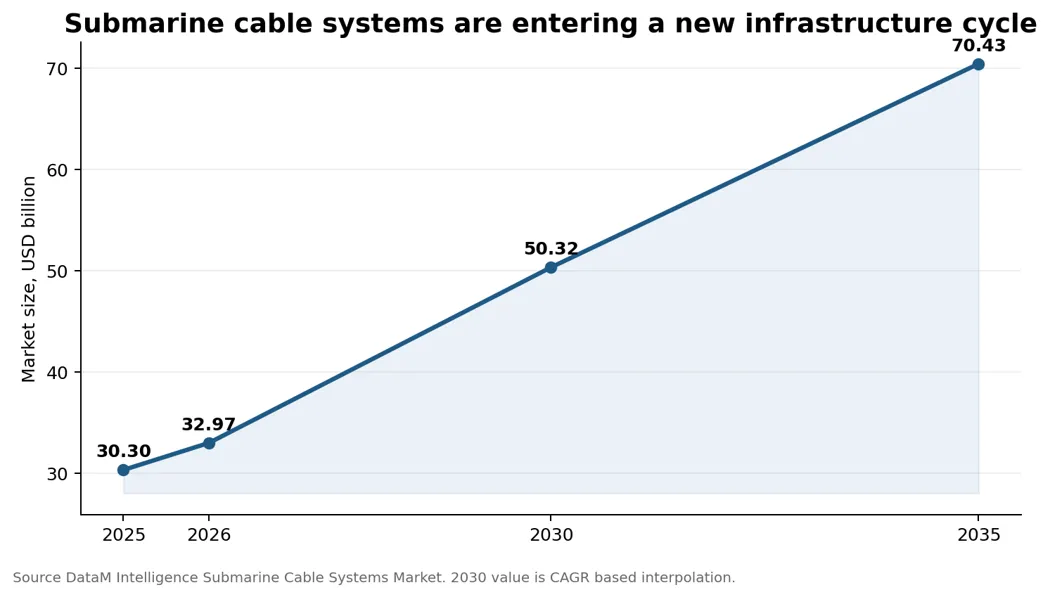
Figure 1. The submarine cable systems market is entering a new investment cycle as cloud connectivity and AI traffic increase demand for international capacity.
AI Infrastructure Is Turning International Connectivity Into a Site Selection Issue
The AI data center boom is usually discussed through accelerators, power availability, liquid cooling, and land. International connectivity is becoming another strategic constraint. Training clusters are concentrated in large campuses, while inference capacity must connect users and cloud regions across borders. The result is a larger requirement for resilient fiber paths between computing hubs.
DataM Intelligence estimates that the global Submarine Cable Systems Market reached USD 30.30 billion in 2025 and is expected to reach USD 70.43 billion by 2035 at an 8.8 percent CAGR. The 2026 market is estimated at USD 32.97 billion. The market page identifies data center connectivity, AI traffic, cloud region expansion, and hyperscale cable investment as core demand drivers.
This changes the site selection equation. A coastal AI campus near several landing stations can gain route diversity and shorter terrestrial backhaul. A large inland campus can still scale, although it may depend on more fiber construction and additional network redundancy. Connectivity therefore moves closer to the same strategic level as power access when operators evaluate multi-hundred-megawatt infrastructure.
Hyperscalers Are Moving From Capacity Buyers to Infrastructure Owners
Google, Meta, Microsoft and Amazon are increasingly involved in submarine cable ownership because internal traffic volumes can justify long-term infrastructure control. The commercial logic becomes stronger when the same company operates cloud regions across North America, Europe, and Asia Pacific. Owning fiber capacity can improve cost visibility while supporting route diversity and latency control.
Meta provides a clear example of how AI infrastructure and submarine networks are starting to merge. In June 2026, Meta announced that it would lease the first 168 MW phase of an AI-enabled data center being developed by Reliance in Jamnagar, India. Meta linked the facility to its wider network investments including Project Waterworth. Waterworth is planned to extend more than 50,000 kilometers across five continents and connect markets including the United States, India, Brazil and South Africa.
This model is important because the compute campus and the international network can be planned together. Large AI operators can identify where power is available, build compute close to that power, and then strengthen the cable routes that connect the campus with other cloud regions. The submarine cable map therefore starts to follow AI infrastructure geography.
Related DataM Intelligence report Explore the DataM AI Data Centers Market report. Use this report to assess hyperscale capacity, regional AI infrastructure buildout, and supplier demand.
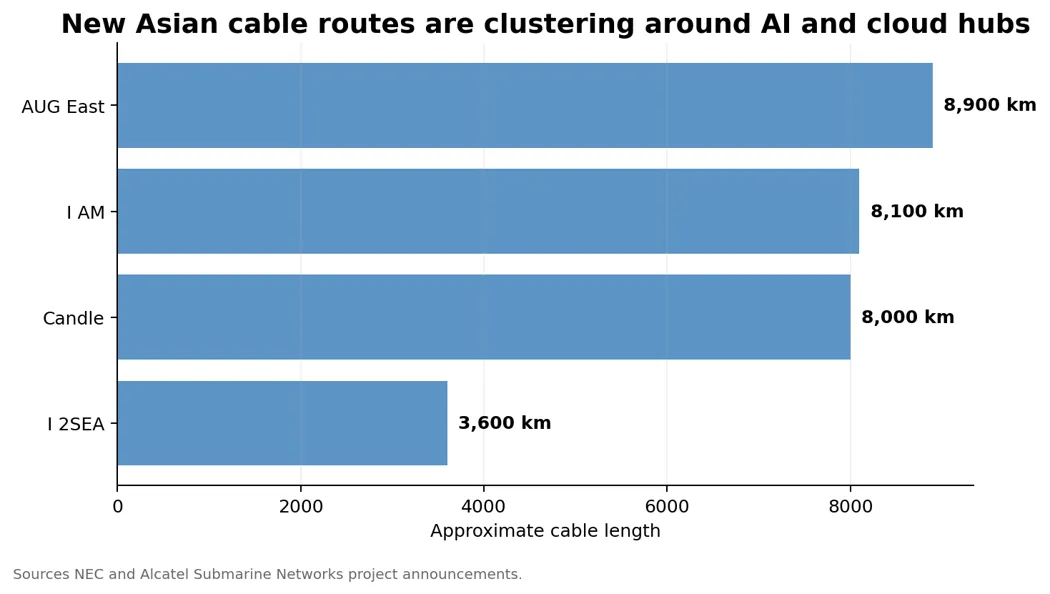
Figure 2. Major Asian cable projects increasingly connect the same markets that are attracting cloud regions and AI data center investment.
India, Malaysia and Singapore Are Becoming a New AI Connectivity Corridor
Asia Pacific is the clearest example of the cable map being redrawn around data center growth. Singapore remains a major cloud interconnection hub. Malaysia is scaling rapidly as Johor and Kuala Lumpur attract large data center investments. India is expanding hyperscale capacity across multiple metros while also offering western and eastern coast landing options.
Several cable projects show this shift. NEC signed a supply contract in July 2026 for I 2SEA, an approximately 3,600-kilometer system connecting India, Malaysia and Singapore. NEC specifically described the route as linking areas with fast-growing AI and hyperscaler data center concentration, including Hyderabad, Chennai, Kuala Lumpur, and Singapore. Operations are planned for 2029.
The same regional pattern appears in Candle and AUG East. Candle is an approximately 8,000-kilometer system with 24 fiber pairs connecting Japan, Taiwan, the Philippines and Indonesia with Malaysia and Singapore. AUG East will span about 8,900 kilometers between Japan and Singapore through several East Asian markets, with a consortium that includes AWS and Microsoft. Alcatel Submarine Networks is also building the 8,100-kilometer I AM system linking Japan, Malaysia and Singapore with additional connectivity to South Korea. I AM is designed for approximately 320 Tbps of initial capacity and supports up to 16 fiber pairs.
The investment message is increasingly clear. New cable routes are clustering around markets where cloud operators expect computing demand to grow. This strengthens the value of coastal land, carrier-neutral landing stations, and dense terrestrial fiber networks around new AI hubs.
Related DataM Intelligence report Explore the DataM Data Center Site Selection and Advisory Services Market report . Assess how power, fiber, land, and permitting are changing site selection economics.
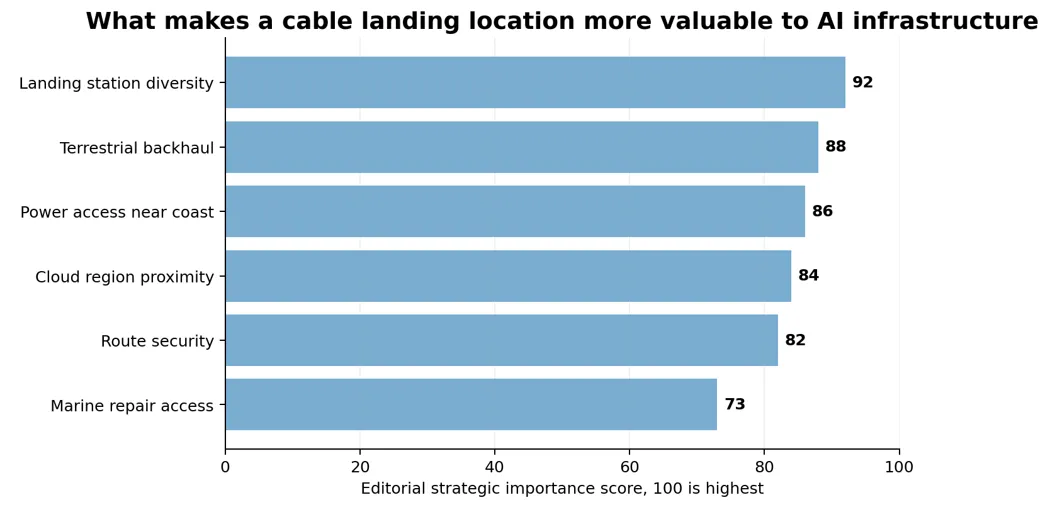
Figure 3. AI data center growth increases the value of landing station diversity, terrestrial backhaul, and power access around coastal connectivity hubs. Scores are an editorial synthesis.
Cable Landing Stations Are Becoming Digital Infrastructure Development Assets
Cable landing stations have traditionally been treated as telecom infrastructure. AI can make them much more important to data center development. A landing station is where subsea capacity enters the terrestrial network, which means its commercial value depends on backhaul routes and proximity to large computing demand.
The most attractive locations combine several characteristics. Multiple cables reduce route concentration. Strong terrestrial fiber creates competing backhaul paths. Nearby power capacity makes it easier for data center developers to build close to international bandwidth. Security and maintenance access also matter because cable faults can interrupt traffic even when data center hardware is fully operational.
This could change regional infrastructure planning. Coastal markets that previously competed mainly for cable landings may increasingly compete for cable landing stations and AI campuses together. Developers may also seek sites where cable capacity can be paired with renewable energy, gas generation, or grid expansion. The value shifts from the cable endpoint itself toward the broader digital infrastructure cluster around it.
The Investment Opportunity Extends Beyond the Wet Plant
Submarine cable manufacturing is only one layer of the opportunity. AI-driven bandwidth demand creates a wider investment chain across repeaters, branching units, landing station equipment, and terrestrial backhaul. Optical interconnects, silicon photonics, and higher-capacity network components also benefit because traffic must move efficiently from the subsea system into data centers.
DataM Intelligence estimates the Optical Interconnect Market will grow from USD 18.58 billion in 2024 to USD 50.09 billion by 2032 at a 13.2 percent CAGR. The Data Center Site Selection and Advisory Services Market is forecast to grow at 15.5 percent through 2035, while the Co Packaged Optics Market is projected to expand at 34.7 percent. These markets show how AI infrastructure spending spreads across the connectivity stack.
For cable suppliers, higher fiber pair counts create new manufacturing requirements. For landing station operators, the opportunity is in resilient facilities and backhaul. For optical component suppliers, the opportunity is in higher data rates and lower energy per bit. The cable itself is therefore the first layer in a broader AI connectivity capital cycle.
Related DataM Intelligence report Explore the DataM Optical Interconnect Market report . Track optical connectivity demand across data centers, telecom networks, and high-speed transport systems.
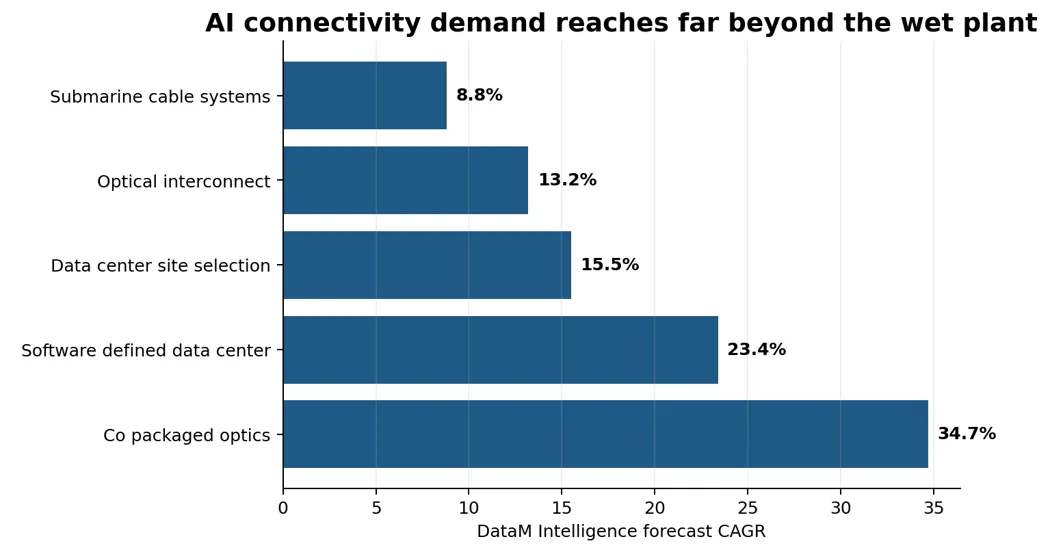
Figure 4. DataM linked markets show that AI connectivity investment reaches submarine systems, optical interconnects, site selection, software-defined infrastructure, and co-packaged optics.
Route Resilience and Security Are Becoming Procurement Criteria
AI makes cable resilience more economically important because concentrated compute creates high-value traffic flows. A single route failure can push traffic onto alternate systems, increase latency, and create congestion. Hyperscalers therefore have a strong reason to build route diversity rather than relying on a small number of traditional corridors.
Geopolitics adds another layer. Governments increasingly treat submarine cables as critical infrastructure. Ownership, manufacturing origin, landing station security, and repair capacity can influence project approvals. This is likely to favor suppliers with trusted manufacturing footprints and operators that can demonstrate route redundancy with strong security controls.
The result is a more strategic procurement model. Cable buyers increasingly need to evaluate total route resilience, landing concentration, and repair access alongside nominal capacity. This can support investment in secondary landing locations and regional cable systems that would have looked less attractive when bandwidth was the main decision variable.
What Data Center Developers and Infrastructure Investors Should Do Now
Data center developers should map submarine cable exposure earlier in the site selection process. Power remains the first constraint in many AI markets, although international connectivity can become the next constraint once campuses scale. Developers should assess cable landings, terrestrial routes, carrier diversity and planned systems before committing to very large capacity.
Infrastructure investors should evaluate cable landing stations as part of broader digital infrastructure clusters. The strongest opportunities may combine subsea capacity with terrestrial fiber, data center development and power infrastructure. This can create multiple revenue pools around the same location while improving the strategic value of the asset.
Cable system owners should secure manufacturing and marine capacity early. New systems take years to permit, manufacture, and install. Higher demand can therefore create bottlenecks in cable production, repeaters, and specialized vessels. Long project lead times make early procurement increasingly valuable when a cloud region or AI campus is expected to scale rapidly.
Optical component suppliers should align product roadmaps with the same corridors. More international traffic creates demand for higher capacity transmission from the landing station into metro and data center networks. Silicon photonics, co-packaged optics and high-speed transceivers are positioned to benefit as the physical cable network expands.
Market Outlook for 2026 and Beyond
AI data centers are changing the economic geography of submarine cables. The market is moving from a telecom-led model toward a mixed infrastructure model where cloud providers, content platforms, and governments play larger roles. Asia Pacific is likely to see the most visible shift because data center capacity is expanding across India and Southeast Asia while new high fiber count systems are already moving toward 2028 and 2029 service dates.
The strongest winners will be companies that control difficult infrastructure. Submarine cable system suppliers can benefit from manufacturing scarcity. Landing station operators can benefit from route concentration around AI hubs. Fiber and optical suppliers can benefit from higher traffic volumes. Data center developers can benefit when they secure both power and connectivity before competition tightens.
The next submarine cable map will increasingly follow the locations where AI can be powered at scale. That makes subsea connectivity a direct part of the AI capital expenditure cycle rather than a separate telecom investment category.