


For most investors, the AI semiconductor story still starts with the GPU.
That view is becoming incomplete.
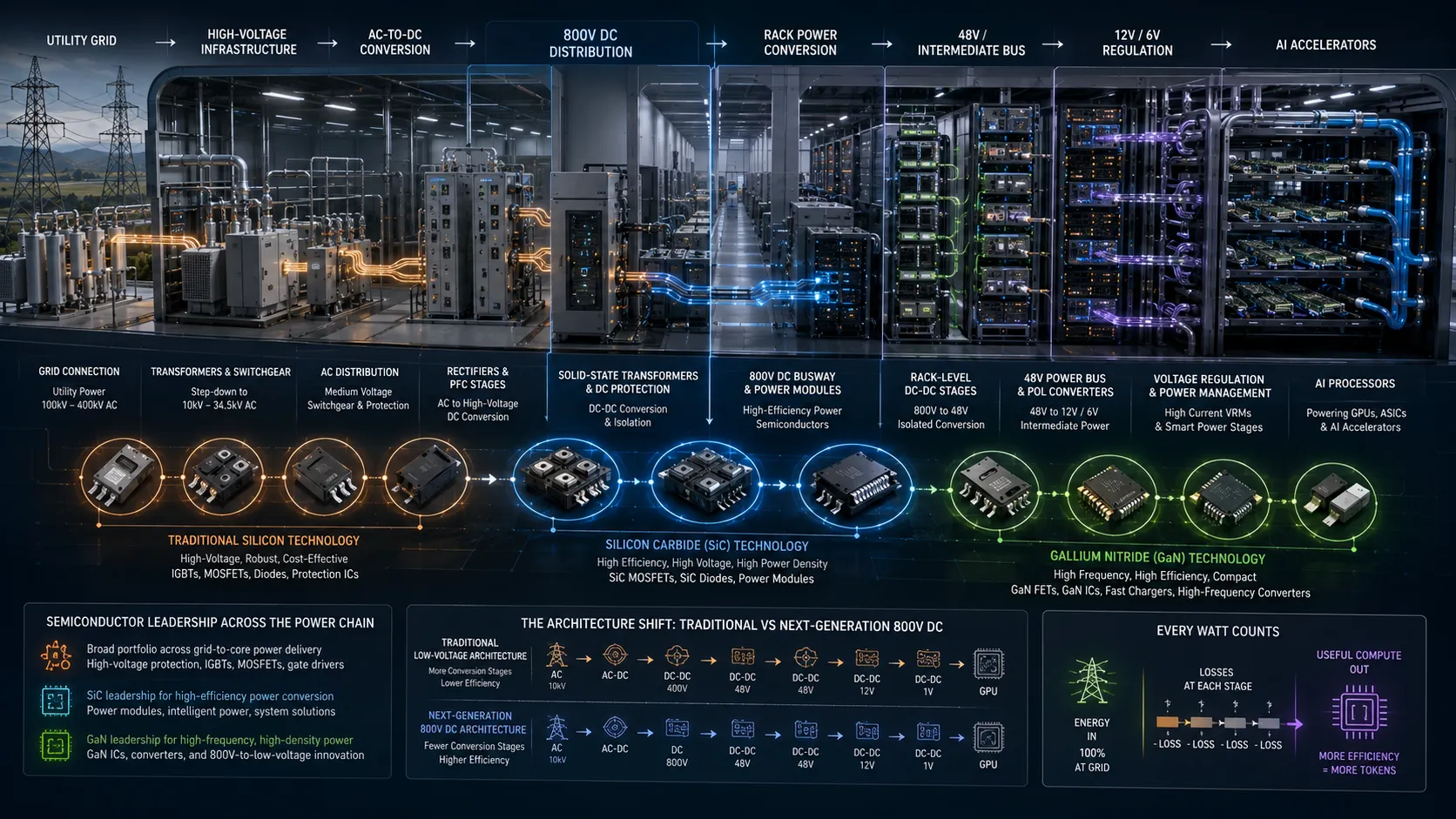
An AI accelerator cannot perform useful work until electricity travels from the grid, through transformers and protection equipment, into the data hall, through the rack, and finally down to the low voltages required by GPUs, CPUs, and memory.
Every conversion creates losses. Every additional watt creates heat. And as AI racks become more powerful, the old power-delivery architecture starts consuming too much copper, too much physical space and too much electricity.
That is turning companies such as Infineon, onsemi and STMicroelectronics into less obvious beneficiaries of AI infrastructure spending.
NVIDIA is already preparing an 800-volt direct-current architecture for next-generation AI data centers. The company says today's 54V rack architecture begins running into physical limits as racks move beyond 200 kilowatts and is targeting 800V infrastructure for 1-megawatt IT racks and above beginning in 2027.
The next AI semiconductor opportunity may therefore be less about adding another processor and more about answering a basic question:
How do you feed a megawatt-scale computer without wasting the electricity before it reaches the chips?
According to a research report published by DataM Intelligence, “The global semiconductors market size is projected to reach US$ 2,141.46 billion by 2035, growing at a CAGR of 10.70% during the forecast period from 2026 to 2035.”
Request for Exclusive Sample: https://www.datamintelligence.com/download-sample/semiconductors-market
AI Is Turning Electricity Into a Semiconductor Problem
The power problem is already much larger than an individual server.
A U.S. Department of Energy-backed study found that data centers consumed about 4.4% of U.S. electricity in 2023 and projected that share could reach roughly 6.7% to 12% by 2028. Total data-center electricity consumption was estimated to rise from 176 TWh in 2023 to between 325 TWh and 580 TWh in 2028.
That does not mean every additional unit of electricity demand comes from generative AI. Data centers support cloud computing, storage and many other workloads.
But AI changes the equipment density.
Traditional server racks were designed around kilowatt-scale power loads. NVIDIA says future AI systems are moving toward megawatt-scale racks, where continuing to distribute power at 54V would require enormous amounts of current and copper. A theoretical 1MW rack using that architecture could require as much as 200 kilograms of copper busbar, according to NVIDIA.
Raising distribution voltage solves part of the problem because higher voltage allows the same amount of power to travel with lower current.
That is why 800V DC has suddenly become one of the most important engineering changes in AI infrastructure.
The 800V Shift Creates a New Semiconductor Content Layer
Today's data centers typically convert electricity several times before it reaches the processor.
NVIDIA's proposed architecture moves toward centralized conversion from AC power to 800V DC, which can then be distributed through the facility before being converted closer to the computing hardware.
The goal is not simply to change a voltage number.
NVIDIA says the architecture reduces conversion stages, copper requirements, cable bulk and distribution losses while allowing more computing hardware to fit into the rack.
That creates opportunities at several points in what power-semiconductor companies call the power tree.
High-voltage conversion needs efficient switches.
Power distribution needs protection.
Intermediate conversion needs another set of power devices.
The final step feeding GPUs requires very high-current voltage regulation.
No single semiconductor material is likely to dominate all of these stages.
Silicon remains important. Silicon carbide, or SiC, is increasingly useful where higher voltages, temperature and efficiency matter. Gallium nitride, or GaN, can allow faster switching and denser power systems.
The result is important for investors: AI can increase semiconductor content even when the additional chip is not doing any AI computation itself.
Infineon Is Already Seeing AI Power Move the Income Statement
Infineon provides one of the clearest examples.
On August 5, the company reported €4.172 billion in fiscal Q3 2026 revenue, the highest quarterly revenue in its history at that point. Its Power & Sensor Systems business reached €1.442 billion, up 14% sequentially, with Infineon saying rising demand for AI data-center power solutions was a major contributor.
The more interesting number sits inside its AI forecast.
Infineon now expects more than €1.6 billion of AI-related revenue in fiscal 2026, up from its previous €1.5 billion forecast.
This is not merely an AI-themed product announcement.
Infineon's CEO described AI data-center power supplies as the company's most important growth driver in the latest quarter.
The sales model is changing as well.
Infineon disclosed that several leading AI data-center customers had either entered or were negotiating multi-year capacity-reservation agreements covering a cumulative high-single-digit-billion-euro revenue volume. Some agreements include prepayments.
That is unusual enough to deserve attention.
Capacity reservations are associated with industries where customers are worried that strategically important supply will not be available when they need it.
If hyperscalers and AI infrastructure suppliers are reserving future power-semiconductor capacity, power management is moving closer to the strategic procurement status already seen around GPUs, advanced packaging and high-bandwidth memory.
Infineon Is Pulling Manufacturing Investment Forward
AI demand is also changing where Infineon spends money.
Earlier in 2026, the company increased its planned fiscal-year investment to around €2.7 billion, in part to accelerate manufacturing capacity for AI data-center power products. Its Dresden Smart Power Fab is being brought online as that demand increases.
Infineon's 800V strategy combines silicon, SiC and GaN devices rather than betting on one material.
The company is also working with NVIDIA on hot-swap and protection technology for 800V systems. This matters because operators cannot simply shut down an expensive rack every time a board needs servicing. New high-voltage architectures require ways to disconnect and replace equipment safely while maintaining availability elsewhere in the system.
This turns reliability and protection chips into part of the AI economics story.
A semiconductor that prevents downtime can create value without performing a single matrix multiplication.
onsemi Is Turning an Automotive Power Portfolio Toward AI
onsemi presents a different case.
The company built much of its recent investor identity around automotive electrification and industrial power. Now AI data centers are becoming a meaningful additional demand source.
In its August 3 second-quarter results, onsemi reported $1.604 billion in quarterly revenue, up 9% year over year. Management described AI data centers as its fastest-growing business and said it now expected that business's revenue to more than double during 2026.
The company also disclosed AI infrastructure platform wins involving Great Wall, a Chinese cloud-infrastructure power supplier, and an expanded role in NVIDIA's MGX ecosystem.
The technological story is broader than conventional silicon power devices.
In June 2026, onsemi launched GaNEXUS, a GaN portfolio spanning 40V to 650V, aimed partly at AI data-center power delivery and 48V systems.
It is also developing vertical GaN.
Unlike conventional lateral GaN structures, onsemi's approach sends current vertically through a GaN-on-GaN device. The company is sampling 700V and 1,200V versions and is positioning the technology for high-voltage applications including 800V AI power conversion.
These are company performance claims rather than independent benchmarks, but they show where onsemi believes the architecture is heading.
The interesting investor point is that AI gives a power-semiconductor supplier another large customer base for technologies originally strengthened by electrification.
The same basic capabilities-switching large amounts of power efficiently, controlling heat and reducing conversion losses-matter in electric vehicles, industrial systems and AI data centers.
Request for Exclusive Sample: https://www.datamintelligence.com/download-sample/semiconductors-market
STMicroelectronics Has Quietly Doubled Its Data-Center Ambition
STMicroelectronics may be the clearest example of how quickly expectations are changing.
In June, ST raised its expected 2026 data-center revenue to about $1 billion, from a previous expectation of nicely above $500 million.
It also said that, assuming current demand and customer engagements continue, the figure could double in 2027.
That is a major forecast revision in a short period.
ST is attacking the power problem from several voltage levels.
At NVIDIA GTC 2026, it expanded its 800V power-conversion portfolio with architectures that convert 800V directly to 12V or 6V, complementing an existing 800V-to-50V solution.
That direct-conversion approach is important because every unnecessary conversion stage can add losses, components, heat and complexity.
The company combines silicon, SiC, GaN, analog and mixed-signal technologies rather than treating 800V as a single-device opportunity.
For ST, the AI data-center story also extends beyond power into silicon photonics and other infrastructure components. But power conversion is becoming one of the most immediate ways that rising accelerator density translates into additional semiconductor content.
The Next AI Bottleneck May Be Between the Grid and the GPU
GPU availability dominated the first stage of the generative-AI infrastructure cycle.
The constraint is widening.
A data center now needs enough grid capacity, transformers, switchgear, cooling, backup energy, power conversion and distribution before the GPUs can operate.
This is why NVIDIA's list of 800V partners extends far beyond semiconductor companies to Eaton, Schneider Electric, Vertiv, Delta, Flex and other electrical-infrastructure suppliers.
The AI supply chain is effectively stretching outward from the processor.
That creates a new way to think about semiconductor exposure.
Instead of asking only “Who makes the AI chip?”, investors increasingly need to ask:
Who gets paid every time more electrical power is delivered to an AI chip?
Infineon, onsemi and STMicroelectronics fit that second category.
Efficiency Is Becoming Revenue, Not Just Sustainability
Power efficiency used to be discussed mainly as an environmental target.
AI changes the economics.
When electrical capacity is the constraint, saving a watt can create room for additional computing.
A data center that loses less energy during conversion can potentially direct more of its available electrical capacity toward revenue-producing processors.
NVIDIA explicitly describes the objective of its 800V architecture in terms of tokens per watt, not simply electrical efficiency.
That phrasing matters.
It connects a power semiconductor directly to AI output economics.
The power device is no longer just supporting the server.
It can influence how many useful AI tokens the facility produces from a fixed electrical connection.
But This Is Not Yet a Simple Power-Semiconductor Supercycle
There are important risks.
The full 800V transition is still ahead. NVIDIA says data-center architecture will evolve gradually, and its megawatt-scale 800V roadmap starts from 2027. Existing facilities will continue operating with established power systems for years.
Different conversion stages will also favor different technologies.
GaN will not automatically replace silicon or SiC everywhere. Cost, voltage, reliability, switching frequency and thermal requirements determine which technology makes sense.
Infineon, onsemi and ST themselves are building mixed portfolios for that reason.
There is also customer concentration risk. A small number of hyperscalers, accelerator manufacturers and power-system suppliers can account for very large projects.
AI infrastructure spending remains capital intensive, making these forecasts sensitive to deployment schedules.
So the investment thesis is not that every power semiconductor becomes an AI chip.
It is that rising compute density raises the value of efficient power conversion throughout the data center.
DataM Intelligence View: Who Is Best Positioned?
Among the three companies, Infineon currently provides the clearest evidence that AI power has become a material earnings driver.
Its more-than-€1.6-billion fiscal 2026 AI revenue forecast, manufacturing acceleration and multi-year customer capacity reservations give the story unusual commercial visibility.
onsemi has an interesting technology-optionality story. Its existing silicon and EliteSiC portfolio, new GaNEXUS products and vertical-GaN development allow it to compete across several stages of the emerging power architecture. Its expectation that AI data-center revenue will more than double in 2026 shows that this is already moving beyond laboratory development.
STMicroelectronics may have the strongest evidence of rapid expectation changes. Doubling its 2026 data-center revenue ambition to about $1 billion and targeting multiple direct 800V conversion stages with NVIDIA shows how quickly AI infrastructure is becoming more important inside its broader portfolio.
None of this diminishes the role of GPUs.
It shows what comes next.
The first AI infrastructure trade was about acquiring enough compute.
The next one is increasingly about delivering enough electricity to that compute without wasting it on the way.
That could make power semiconductors one of the most important-and still less discussed-second-order beneficiaries of the AI data-center buildout.
For the broader semiconductor value chain, materials, component segmentation and industry outlook, this analysis connects directly with DataM Intelligence's current Semiconductors Market research, which covers discrete power devices alongside the wider global semiconductor ecosystem.
Frequently Asked Questions
Why do AI data centers need more power semiconductors?
AI accelerators require large amounts of electricity at very low operating voltages. Power semiconductors convert, regulate, protect and distribute electricity from the grid down to the processor. Higher rack density increases the amount and performance requirements of this power electronics.
What is an 800V AI data center?
An 800V data center distributes electricity at 800 volts direct current through part of the facility and rack architecture. NVIDIA is developing this approach for future megawatt-scale AI racks because higher voltage reduces current, copper requirements and the number of power-conversion stages.
Why are silicon carbide and GaN important for AI?
SiC and GaN are wide-bandgap semiconductor materials that can offer advantages in power efficiency, switching speed, voltage handling, temperature or system size depending on the application. Data-center designs increasingly combine them with conventional silicon rather than relying on one material for the complete power chain.
Is Infineon benefiting from AI data centers?
Yes. Infineon currently forecasts more than €1.6 billion of fiscal 2026 AI-related revenue and says AI data-center power is its most important current growth driver.
Is onsemi exposed to AI data centers?
Yes. onsemi said in August 2026 that AI data centers were its fastest-growing business and that it expected revenue from that business to more than double during 2026.
How large is STMicroelectronics' AI data-center opportunity?
ST currently expects about $1 billion of data-center revenue in 2026 and said that revenue could double in 2027 if current demand and customer engagements continue. These are company forecasts rather than guaranteed results.
Will 800V replace today's data-center power systems immediately?
No. NVIDIA describes the transition as gradual. Existing facilities and racks will continue using current architectures while new high-density AI infrastructure begins adopting 800V systems.
What should investors watch next?
The most useful indicators include AI-related power-semiconductor revenue, customer capacity reservations, qualification for 800V platforms, SiC and GaN manufacturing ramps, power-conversion efficiency, rack-density roadmaps, and whether power infrastructure becomes a limiting factor for new AI deployments.
Read Complete Research Report: https://www.datamintelligence.com/research-report/semiconductors-market